Bushcraft Through the Seasons: What to Practise, Pack and Watch All Year
Bushcraft through the seasons means treating spring, summer, autumn and winter as four different trips in the same forest. Daylight, night temperature, water, insects, fire danger and wildlife all change, and so do the skills worth practising: green-wood carving in spring, heat and water management in summer, long nights and rain in autumn, and cold and snow in winter. The best time of year for camping is therefore the one that matches your experience, not one calendar month.
This is the hub for seasonal planning. It covers each season for temperate regions, with Central Europe as the reference, and links to the detailed guides: reading the weather, clothing, sleeping gear, trip planning and more. If you are new, begin with bushcraft for beginners and your first night in a first overnight. All numbers are typical values for lowlands at about 50–52° N; check your own place and date.
Step by step
-
1

Check daylight for your date
Look up sunrise, sunset and twilight with the daylight calculator. Plan to arrive at camp at least 1–2 hours before dark.
-
2

Size the sleep system to the cold
Choose bag, pad and clothing for the coldest likely night, not the average, and run the numbers in the sleep calculator.
-
3

Pick one skill for the season
Spring: green-wood carving. Summer: water and insects. Autumn: night and rain. Winter: warmth and snow. One focus per trip.
-
4

Check the wildlife calendar
Breeding season, rut and hunting season change where you go and how visible you should be. Dogs stay on the lead.
-
5

Check fire danger and weather
Look at the forest fire danger level, bans and the forecast the day before. No fire is a perfectly good plan.
-
6

Start with one easy night
Begin close to home with a short, forgiving trip in the mildest part of the season, then move towards the colder months.
Why the season changes everything
A trip in the same wood can be a relaxed afternoon in June and a serious test in January. The forest has not changed; the margins have. In midsummer you have roughly 16–17 hours of daylight and night lows around 10–17 °C. In midwinter daylight shrinks to about 8 hours, nights last 15–16 hours and lows fall to around −6 to 2 °C on typical nights and lower in cold spells. Every skill still works, but the time and heat budget behind it moves.
That is why seasonal bushcraft skills are not a luxury. Fire lighting is easy in a dry August and demanding in a wet November. Collecting water is trivial in spring and a fuel-and-time project in a frozen January. A tarp that is perfect in July may leave you cold in October. Learning the pattern lets you pick the right challenge at the right time instead of meeting it by accident.

Use the daylight calculator for the exact date and place, and see lighting and headlamps for how many hours of light to plan. The same night lengths are used in that guide, so the numbers match.
The four seasons at a glance
The sequence below shows the focus of each season. Detailed sections follow, one per season.
One forest, four seasons
 1Spring: cold nights, green wood
Days lengthen quickly, but nights can still frost until May. Sap is rising, so green wood carves easily. Birds are nesting: stay on paths near reeds and hedges.
 2Summer: heat, water, insects
Long days, short nights and dry fuel. Drink more, start early, rest at midday and treat fire bans as non-negotiable.
 3Autumn: long nights, rain, rut
Days shorten by roughly 3–4 minutes each day around the equinox. Plan for darkness, wet ground and falling temperatures. Be visible in hunting season.
 4Winter: cold, snow, short days
Eight hours of light, long nights, frost and wind chill. Everything takes longer; insulation, dry layers and a turnaround time keep it safe.
Spring: bushcraft in March, April and May
Weather and daylight. Spring in temperate Europe is changeable: warm sun at midday, frost on the grass at dawn, hail showers in April. Day length rises from about 12 hours at the equinox to 16 hours in May, so you gain roughly 3–4 minutes of light every day around the equinox – more time for camp chores. Nights, however, are still cold: typical lows range from about −2 °C in March to around 11 °C in late May, and clear, calm nights bring frost in hollows. Read the weather closely, especially fast-growing cumulus and cold fronts with gusts, and put the camp slightly up the slope, not on the valley floor (see choosing a camp site).
What to practise. Spring is the season for green-wood work. Sap is rising, wood is soft and wet, and a knife slices through it. It is the ideal time for carving a spoon from green wood, whittling and practising basic carving cuts. Take only windfall, prunings or wood the owner has agreed to – never cut live trees on your own.
Spring is also when fibre work comes alive, but treat it carefully. Natural cordage from bark or bast must come from fallen, felled or pruned material and only with the owner's permission; never peel or ring a living tree, because it can kill it. Nettle stems later in the season are an easier first project. Dry tinder is scarce in spring – everything is wet or green – so carry a good backup and read natural tinder for what survives the winter: last year's dead grass, birch bark from fallen trees and fatwood.
| Topic | What to expect | What to do |
|---|---|---|
| Daylight | About 12 h in late March, 14 h in mid-April, 16 h in mid-May | Arrive at camp 1–2 h before dark; the daylight calculator gives the exact times |
| Night temperature | Typically −2 to 11 °C; frost possible until May | Pack for frost, even when the afternoon is warm |
| Water | Streams full, ground soaked, meltwater from the hills | Camp ≥ 60 m from water; check for rising levels after rain |
| Ticks | Active from the first mild days | Long trousers, check your body each evening: ticks and insects |
| Fire | Wet fuel, but grass fires are possible on dry, windy days | Check the local danger level; build small, sheltered fires |
| Wildlife | Breeding and rearing season, young animals everywhere | Stay on paths, dogs on the lead, leave young animals alone |
Kit changes. Spring kit is autumn kit with a bit less insulation: rain gear on top, a warm layer for evenings, a sleeping bag rated for near-freezing temperatures and a pad with a decent R-value. In the Kit Builder choose Spring: it packs like autumn for cold nights and adds spring tips; switch to Summer only for settled, warm weeks in late May. Wet feet are the usual spring problem, so carry spare socks (see footwear).
Wildlife and rules. In many parts of Germany the Brut- und Setzzeit (breeding and rearing season) runs roughly from April to mid-July, with exact dates varying by Land and by region. Many places then require dogs on the lead and sometimes staying on marked paths. Fawns, leverets and fledglings lying alone are usually not abandoned – leave them. The details are in wild animals and your camp and camping with dogs.
Good first spring trip. A single night in April on a flat site close to home, with a tarp or tent, a sleep system rated clearly below the forecast low, a green-wood carving project for the afternoon and a stove as the main cooking method.
Summer: heat, water, insects and fire danger
Weather and daylight. Summer is the easiest season for bushcraft beginners and has its own traps. Daylight lasts up to 16–17 hours in June, so the dark window is only 7–8 hours, but the heat of the day and thunderstorms in the afternoon are the real risks. Typical night lows are about 9–17 °C; in hot spells the tent stays warm and sleep is poor. Learn the build-up of storms from thunderstorm signs and leave exposed ridges early, as the 30/30 rule on that page explains.
Water and heat. Water is the main summer skill. Needs rise steeply with heat and effort, so use the water calculator and read hydration for signs of dehydration. Start walking early, rest in shade at midday, and plan refills around finding water. In dry summers streams shrink or disappear, so ask locally. Treat all drinking water: a rolling boil for 1 minute is the baseline (3 minutes from 2,000 m), see water purification and boiling. Keep camp, washing and latrine at least 60 m from any water.
A hot day: when to move, when to rest
 1Early start
Walk and do heavy work in the cool of the morning. Fill all bottles at the last reliable source and drink before you feel thirsty.
 2Midday rest in shade
From roughly 12:00 to 16:00 rest under trees or a tarp, eat, drink and do quiet jobs. Heat and storms peak in the afternoon.
 3Evening camp
Pitch with plenty of light, away from still water. Check the sky for storms, and finish fire and cooking before dark.
Mosquitoes and ticks. Summer evenings near still water mean mosquitoes, and tall grass means ticks. Camp on a breezy, dry spot away from ponds, wear long, light-coloured clothing at dusk and check yourself for ticks daily. Everything is in ticks and insects; it explains clothing, repellents and a safe tick check. A bite is not an emergency, but a fever or spreading redness afterwards needs a doctor.
Fire bans and forest fire danger. Long dry spells turn the forest floor into fuel. In Germany the Deutscher Wetterdienst publishes a daily forest fire danger index, and authorities in many Länder and municipalities ban open fires in woodland and nearby at high levels. Rules differ by Land, forest owner and day, and this is not legal advice – check the current situation before every trip. Read fire bans and danger levels and have a stove ready as plan B. If a fire is allowed, build it at least 5 m from tents and hammocks and at least 3 m from synthetic tarps. See how to build a fire pit and, when open fires are off, camp stoves. DIY firestarters help for the fires that are allowed.
Kit changes. Summer kit is the lightest of the year: a light bag or quilt, a thin pad, sun hat, water capacity and insect protection. In the Kit Builder choose Summer; the pack weight calculator shows how much lighter the pack gets. Do not save on rain gear – a summer storm drops the temperature fast, and thunderstorms are the time to be in a real building or car, not under a tarp.
Wildlife. Roe deer rut in July and August, adders sun themselves in spring and summer, and cattle graze on open pastures. Dogs overheat quickly; see dogs. Good first summer trip: one night near a stream or lake with a bag clearly warmer than the forecast, a tarp for shade, and the day built around water, early walking and an unhurried evening.
Autumn camping tips: long nights, rain and rut
Weather and daylight. Autumn is often the best time of year for camping in Central Europe: the heat is gone, the colours are good and the forest is quiet. It is also the season where days shorten fastest. From the September equinox (about 12 hours of light) you lose roughly 3–4 minutes of light per day, so by mid-November you are down to about 9 hours and have 15 hours of darkness. Typical night lows fall from about 12 °C in early September to −1 °C in late November. October and November bring storms, long rainy spells, fog and the first frosts. Learn to read the signs in reading the weather.
What to practise. The skill of autumn is working in the dark and in the wet. Learn walking and working at night in a safe, familiar place, practise a dark-adapted routine and master headlamps and camp lighting. Practise camping in the rain: a steep tarp pitch, a dry kitchen area and a dry sleeping area. Autumn is also the season to collect dry tinder for the year: dead grass heads, birch bark from fallen trees and fatwood, stored in a dry container (see tinder by season). A fire in wet weather is the matching skill.
| Month | Daylight (about) | Typical night low | Main task |
|---|---|---|---|
| September | 12–13 h | 6–12 °C | Last warm nights; practise the rain pitch |
| October | 10–11 h | 2–8 °C | Warmer sleep system, dry spare layers, headlamp |
| November | About 9 h | −1 to 5 °C | Cook before dark, keep wool and insulation dry |
Daylight for about 50–52° N around the middle of each month; nights are up to 15 h long by late November.
Kit changes. Autumn is where kit matters most: a mid-season bag or one with a liner, a pad with an R-value of 4 or more for the first frosts, a wool or synthetic mid-layer, an insulated jacket and a full rain system. The Kit Builder default setting is Autumn, and the clothing table in clothing by season and the sleep numbers in sleeping gear by season match it. Pack spare batteries and a second light, because evenings last 3–4 hours.
Wildlife and hunting. Red deer rut from mid-September into October and fallow deer a little later, so stags can be noisy and bold; keep your distance. From October driven hunts (Drückjagden, Gesellschaftsjagden) take place in many forests, mainly until January. Be visible: wear something bright, tell people locally, check for signs at the forest entrance and avoid the area on announced hunt days. Details are in hunting seasons and deer and the rut. Dogs stay on the lead.
Good first autumn trip. One night in early October, arriving with at least 2 hours of light, a tarp pitched before the evening and tinder gathered on the way. Cook before dark, keep a dry set of clothes for the sleeping bag and note the forecast. If the weather turns, a base camp close to the car makes retreat easy.
Bushcraft in winter: cold, snow and short days
Weather and daylight. Bushcraft in winter is the most rewarding and the most demanding season. Around the winter solstice daylight lasts only about 7.5–8.5 hours in Germany, which leaves 15–16 hours of darkness. Typical night lows are about −6 to 2 °C and much colder on clear nights in snow or in cold air pools in valleys. Wind chill matters as much as the air temperature; the wind chill calculator shows the felt temperature. The full planning guide is winter camping, and the daylight planning is covered in planning around short days.
What to practise. Winter work is about three things: keeping warm, keeping dry and managing time. Practise the layering and moisture rules in clothing, make a well-insulated sleep system with sleeping gear and check the numbers with the sleeping bag calculator. Learn to melt snow safely: see snow water for the method and the fuel budget. Practise fire on snow with a log platform, and know the early signs of hypothermia so you can act long before it is serious.
A winter evening, step by step
 1Arrive with light left
Reach the site 1–2 hours before dark. A low sun sets quickly in the trees; the pitch and the stove are the first jobs.
 2Shelter and insulation first
Pitch, lay the pad on a ground layer of branches or a second pad and put the bag out to loft. Change into dry clothes before you cool down.
 3Melt snow and cook
Start with a little water in the pot so it does not scorch, then add snow. Treat the water as in snow water and eat a hot meal early.
 4Go to bed warm
Do a little light exercise, drink something warm, empty the bladder and keep tomorrow's socks and the water bottle in the bag.
Kit changes. Winter kit is heavier by nature. Use the Kit Builder season Winter, which adds warmer layers, insulation and more food, and the pack weight calculator for the total. Do not cut insulation to save weight. A stove (with fuel for melting snow) is the main kitchen; see camp stoves. Sleeping bag, pad and clothing must handle the coldest likely night: a winter bag, an insulated pad with R 5 or more and a bivvy or tent. A thermos with a hot drink is cheap insurance.
Hazards. Wet cold around 0–10 °C with wind is more dangerous than dry frost, because clothes soak and insulation fails. Sweat is the enemy: open the jacket before you heat up and stop before you are drenched. Ice on lakes and rivers is a real danger; never rely on it. In snow, daylight and navigation are limited; carry map, compass and a spare light and set a strict turnaround time.
Wildlife. Animals save energy in winter; do not flush them. Foxes call during the mating season in winter, game is stressed by dogs and walkers, and driven hunts continue until about January. Keep dogs on the lead and give wintering animals space.
Good first winter trip. A single night with a mild forecast (about −2 to +3 °C), a site 20 minutes from the car, a bag rated clearly below the forecast, a stove and plenty of hot drinks. Bail-out is simple, and the experience is the same.
Season by season: daylight, temperatures, risks and skills
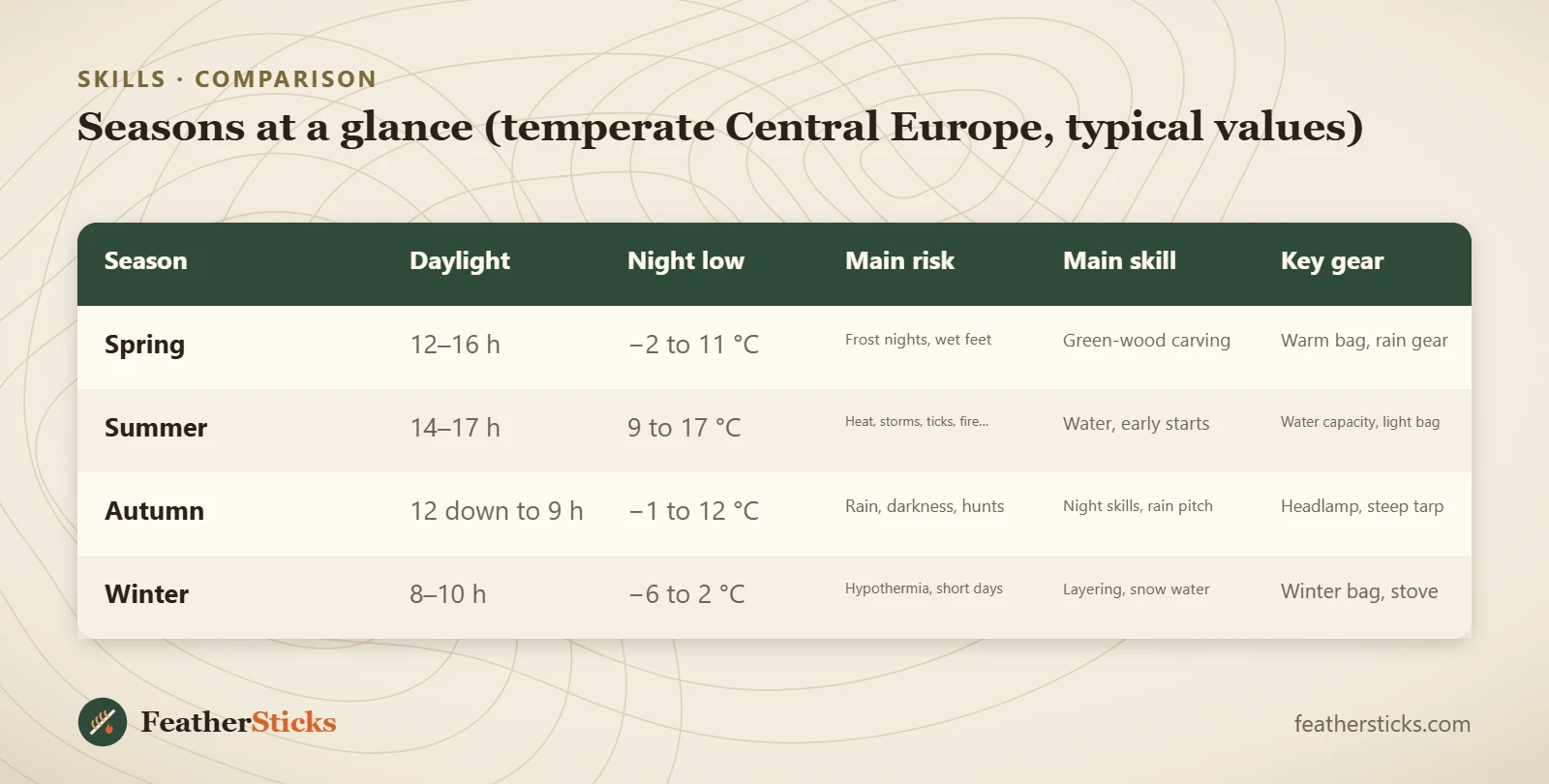
The table sums up the main numbers. Daylight is for about 50–52° N, night lows are typical values for Central European lowlands and vary with altitude, cloud cover and snow cover; use them only as a rule of thumb and check the real forecast.
| Season | Daylight | Typical night low | Main risk | Main skill | Key gear |
|---|---|---|---|---|---|
| Spring (Mar–May) | 12–16 h | −2 to 11 °C | Frost nights, wet feet, changeable weather | Green-wood carving, weather reading | Warm bag, rain gear, spare socks |
| Summer (Jun–Aug) | 14–17 h | 9 to 17 °C | Heat, thunderstorms, ticks, fire danger | Water, early starts, fire-ban discipline | Water capacity, light bag, insect cover |
| Autumn (Sep–Nov) | 12 down to 9 h | −1 to 12 °C | Rain, storms, darkness, hunts | Night skills, rain pitch, tinder stock | Headlamp, steep tarp, dry layers |
| Winter (Dec–Feb) | 8–10 h | −6 to 2 °C | Hypothermia, wet cold, short days | Layering, snow water, sleep system | Winter bag, insulated pad, stove |
Month-by-month bushcraft calendar
A calendar helps you plan the practice year. Use it as a rough guide; weather in a given year can be weeks ahead or behind, and your region may differ.
| Month | Daylight | Night low | Focus for the month |
|---|---|---|---|
| January | 8–9 h | −6 to 1 °C | Winter kit, snow water, strict turnaround time |
| February | About 10 h | −5 to 2 °C | Winter skills, day trips, planning the year |
| March | About 12 h | −2 to 5 °C | Green-wood carving, frost nights, gear check |
| April | About 14 h | 0 to 7 °C | Breeding season starts: paths, dogs on the lead |
| May | About 16 h | 4 to 11 °C | First lightweight overnight, tick routine |
| June | 16–17 h | 9 to 15 °C | Longest days, thunderstorms, fire danger |
| July | About 16 h | 11 to 17 °C | Water planning, heat management, roe rut |
| August | 14–15 h | 10 to 16 °C | Dry spells and fire bans, insects at dusk |
| September | 12–13 h | 6 to 12 °C | Last warm nights; red deer rut begins |
| October | 10–11 h | 2 to 8 °C | Rain pitch, night skills, hunting season starts |
| November | About 9 h | −1 to 5 °C | Cook before dark, wet cold, storms |
| December | About 8 h | −4 to 2 °C | Longest nights, hot drinks, cold-weather sleep system |
How your kit changes through the year
You do not need four kits. Most people need one core kit and a handful of swaps: sleep system, clothing layers, light and water capacity. The core list is in the bushcraft kit list (see its section on seasonal differences), and the Kit Builder changes the list when you switch between Spring, Summer, Autumn and Winter; Spring and Autumn share the shoulder-season kit.
| Item | Spring | Summer | Autumn | Winter |
|---|---|---|---|---|
| Sleep system | 3-season bag, pad R 3–4 | Light bag or quilt, thin pad (about R 2) | 3-season+ bag, pad R 4+ | Winter bag, pad R 5+ |
| Clothing | Layers, rain gear, spare socks | Light long sleeves, sun hat | Wool or fleece, insulated jacket | Full layering, insulated boots, mittens |
| Shelter | Tarp or tent with good drainage | Tarp for shade, mosquito net | Steep tarp or tent, groundsheet | Tent or tarp with wind protection |
| Light | Headlamp, 2 spare cells | Small headlamp | Headlamp plus spare, 3–4 h per evening | Headlamp plus power bank, 4–5 h |
| Water | Streams full | 2–3 L capacity, filter or boil | Rain collection possible | Insulated bottle, stove for snow |
| Fire | Wet fuel, grass danger | Often banned; carry a stove | Wet but allowed; stock tinder | Platform on snow, plenty of dry wood |

The sleeping bag and pad calculator turns your expected low into a bag rating. For clothes, clothing explains layering; and for bags and pads, sleeping gear explains ratings. A repair kit belongs in every season, but cold makes small failures bigger.
The wildlife and hunting calendar
Wildlife is seasonal too, and it shapes where you go and how you behave. The ranges below are general: the exact dates vary by species, region and year, and local rules differ. The detailed guide is wild animals and your camp.

| Period | What happens | What you do |
|---|---|---|
| Roughly April – mid-July | Breeding and rearing season (Brut- und Setzzeit); fawns, leverets, nesting birds, piglets | Dogs on the lead, stay on paths, never touch young animals; varies by Land |
| July – August | Roe deer rut; adders active; cattle on pastures | Keep distance, watch where you sit, avoid cattle with calves |
| Mid-September – October | Red deer rut, fallow deer later | Listen for roaring, give stags space, do not follow them at night |
| October – January | Driven hunts and other hunts in many forests | Wear bright colours, check signs and notices, avoid hunt days |
| December – February | Game conserves energy; foxes call | Keep dogs close, avoid wintering areas, do not feed |
In Germany, disturbing wild animals and damaging habitats is regulated by federal and Land law, and rules differ by Land and by municipality. This is general information and not legal advice; local signs and forest rangers have the last word. Wild camping in Germany explains what is and is not allowed.
What is the best time of year for camping?
It depends on the goal. For a first night, the best time of year for camping in Central Europe is late May to mid-September: long days, mild nights and simple kit. For learning bushcraft skills, spring and autumn are ideal because conditions are demanding but forgiving, and winter is for those who already master the basics. For quiet forests and few insects, September and October are hard to beat.
Which season for your next trip?
Is this your first night out?
Yes → Pick a warm, settled period from late May to September, start close to home and stay one night.No → Go to the next question.Do you want to practise fire, tinder and wet-weather skills?
Yes → Choose early autumn, when fuel and weather are varied but nights are not yet freezing.No → Go to the next question.Do you have a bag and kit rated for below freezing and a bail-out option?
Yes → A mild winter night is a fine next step.No → Stay with spring or autumn and build up the kit first.
The common pairs are worth knowing: spring or autumn for skill practice, summer for relaxed family trips (see bushcraft with kids), winter for experienced groups. Follow the first overnight guide for the first one.
A first trip for each season
A first trip should be short, close to home and easy to cancel. Build it around one new skill per season and keep everything else familiar.
| Season | Trip | New skill | Safety net |
|---|---|---|---|
| Spring | One night, flat site near home | Green-wood spoon carving | Bag rated below forecast, stove, car nearby |
| Summer | One night near water | Water planning and boiling | Extra water, shade, storm plan, fire-ban check |
| Autumn | One night with rain in the forecast | Steep tarp, dry kitchen, headlamp routine | Spare dry layer, warm sleep system, early arrival |
| Winter | Short walk-in, mild forecast | Snow melting, layering, sleeping warm | Hot drinks, bail-out option, strict turnaround |
For a longer plan, a base camp from which you make day trips teaches seasons slowly and safely, and a tarp shelter works in most seasons. Always tell someone your plan and the time you expect to be back.
How to plan a seasonal trip
Use the same plan every time and let the season change the numbers. Trip planning gives the full method; the steps below add seasonal checks.
Seasonal planning in five checks
- DaylightSunrise, sunset and twilight with the daylight calculator.
- Distance and timeRealistic pace with the hiking time calculator: slower with snow, mud and heavy kit.
- Weather and windForecast, warnings and the wind chill calculator in cold weather.
- Rules and risksFire danger, hunting, breeding season, access rules and navigation: see navigation gear.
- Plan BTurnaround time, a bail-out route and a contact who knows when you are back.
If the forecast changes, change the plan, not the margin. A short, safe night beats a long, miserable one. In an emergency call 112 (EU); see distress signals and first aid. For an overview of all skills, see the skills hub.
| Season | Daylight | Night low | Main risk | Main skill | Key gear |
|---|---|---|---|---|---|
| Spring | 12–16 h | −2 to 11 °C | Frost nights, wet feet | Green-wood carving | Warm bag, rain gear |
| Summer | 14–17 h | 9 to 17 °C | Heat, storms, ticks, fire danger | Water, early starts | Water capacity, light bag |
| Autumn | 12 down to 9 h | −1 to 12 °C | Rain, darkness, hunts | Night skills, rain pitch | Headlamp, steep tarp |
| Winter | 8–10 h | −6 to 2 °C | Hypothermia, short days | Layering, snow water | Winter bag, stove |
Common mistakes
- Packing for the average temperature instead of the coldest likely night.
- Treating spring like summer: warm afternoons followed by frost and wet feet at night.
- Ignoring fire bans and the forest fire danger level in a dry summer.
- Underestimating how early it gets dark in October and November.
- Heading into the forest on driven-hunt days without bright clothing or any local check.
- Letting the dog run in breeding season or near wintering game.
- Sweating through layers in winter and then stopping in the wind.
What you need
- Season-rated sleeping bag and pad (check the sleep calculator)
- Rain gear and a spare dry layer in every season
- Headlamp with spare batteries, especially in autumn and winter
- Water capacity for summer and an insulated bottle for winter
- Stove as fire backup when fire bans apply
- Bright clothing or pack cover for hunting season
- Map, compass and a printed plan
FAQ
What is the best time of year for camping?
How do I get started with bushcraft in winter?
What are the most important autumn camping tips?
Which bushcraft skills are best in spring?
How cold does it get at night in each season?
When is the breeding season and what does it change?
Do I need a fire in every season?
How do I plan around the shorter days in autumn and winter?
Check yourself
Completed6 quick questions from this guide. Nothing is sent anywhere.
Related step-by-step guides
-
 1
-
 1
-
 1