Ticks & Mosquitoes: How to Avoid Ticks When Camping and Remove Them Safely
If you want to know how to avoid ticks when camping, the short answer is: cover your legs, tuck trousers into socks, use a repellent as its label says, stay out of long grass where you can – and check your whole body every evening. Ticks wait on grass and low undergrowth, not in tree crowns, so most of them get on at boot and knee height. Found one anyway? Remove it promptly with fine tweezers or a tick card, gripping right at the skin and pulling slowly.
This guide covers prevention, the daily tick check, how to remove a tick correctly, and mosquito protection for camping – plus wasps, horseflies and midges. It is general information, not medical advice; the medical side belongs to your doctor and to official sources. It builds on the bushcraft first aid kit and is part of our bushcraft skills series.
Step by step
-
1

Dress to keep ticks out
Wear long, light-coloured clothing and closed shoes. Tuck trousers into socks and the shirt into the trousers so ticks stay on the outside.
-
2

Use repellent as labelled
Apply a repellent that lists ticks and mosquitoes to exposed skin, thinly and evenly. Follow the label, especially for children.
-
3

Pick a breezy camp, close the mesh
Camp on dry, open ground with a breeze, away from standing water and long grass. Sleep behind a mesh inner or bug net.
-
4

Check everyone every evening
Look and feel over the whole body: behind the knees, groin, waistband, armpits, navel, hairline and behind the ears. Check children and dogs too.
-
5

Remove ticks promptly
Grip the tick right at the skin with fine tweezers or a tick card and pull slowly and steadily. No oil, no glue, no heat, no squeezing.
-
6

Note the date, watch the spot
Disinfect, write down date and place, and watch the bite for several weeks. An expanding rash, fever or flu-like symptoms mean: see a doctor.
Before you read on: prevention is a skill, diagnosis is a doctor's job
Ticks and biting insects are the most common wildlife encounter of any trip – far more common than anything with teeth. Most bites are harmless and merely annoying. A few are not: ticks can transmit infections such as Lyme disease (borreliosis) and, in some regions, tick-borne encephalitis (TBE); mosquitoes carry diseases in many parts of the world; and wasp stings are dangerous for people with an allergy.
Nearly everything that matters happens before a bite: where you walk and camp, what you wear, what you put on your skin and whether you look yourself over at night. That is ordinary camp craft, like checking the branches above your camp site or your fire site.
Where do ticks live – and do they fall from trees?
No, ticks do not fall or jump from trees. That is the most persistent tick myth, and it sends people looking in the wrong direction. Hard ticks – the kind that matter to hikers in Europe and North America – climb grass stems, bracken, herbs and low shrubs and wait there with their front legs stretched out. Biologists call this questing. When a warm body brushes past, the tick simply holds on. Then it walks, usually upwards, looking for thin, warm, slightly moist skin.
That has two practical consequences. First, the contact zone is low: mostly between your ankles and your hips, higher only when you sit down, crawl through brush or carry armfuls of bracken for shelter bedding. Second, there is a delay between the tick getting on and the tick biting – time in which light-coloured clothing, tucked-in trousers and an evening check can stop it.

| Terrain | Tick pressure | Why | What to do |
|---|---|---|---|
| Forest edges, hedgerows, overgrown path sides | High | Humid, shaded, lots of deer, mice and birds passing | Walk in the middle of the path, do not brush the verge |
| Long grass, meadows next to woodland, bracken | High | Stems at perfect waiting height | Long trousers in socks; choose a mown or trodden line |
| Deciduous and mixed forest with undergrowth and leaf litter | Medium to high | Leaf litter keeps the ground moist | Sit on a pad, not on the litter; check after gathering wood |
| Stream banks, damp hollows, reed margins | Medium to high | Moisture and dense plants – also mosquito country | Collect water, then move on; do not camp there |
| Dry, open pine forest on sand, short dry heath | Lower | Dries out quickly | Still check – game trails and bilberry carpets hold ticks |
| Bare rock, gravel, mown lawn, wide forest roads | Low | No stems to wait on, too dry and sunny | Good places for breaks and for camp |
| Gardens, parks, campsites with hedges | Present | Hedgehogs, mice and birds carry ticks into towns | The evening check is worth it at home too |
Rough guide only. Local conditions, weather and wildlife make a big difference – after any day in vegetation, check.
Tick season and weather
Ticks need moisture and mild temperatures. In most of temperate Europe and North America the main season runs from spring to autumn, typically with a peak in late spring and early summer and often a second one in autumn. A figure of roughly 7 °C is often quoted as the temperature at which ticks become active; in mild winters they can be out in any month. Hot, dry spells push them down into the leaf litter, and a warm day after rain brings them back up.
For trip planning that means: do not switch off in October or on a mild February day, and expect the most ticks on warm, humid days in lush vegetation. If you learn to read the weather, you can also read tick weather.
Which stage bites?
Ticks go through larva, nymph and adult stages. The nymphs are the ones people overlook – they are about the size of a poppy seed and look like a speck of dirt or a new freckle. This is why the evening check is done with fingertips as well as eyes, and with a headlamp rather than by firelight.
How to avoid ticks when camping: clothing first
Clothing is the most reliable tick protection because it is a physical barrier and does not wear off. The principle is simple: make every opening face downwards into the next layer, like roof tiles, so a tick that climbs upwards stays on the outside where you can see it and brush it off.
- Long trousers in a tightly woven fabric, tucked into the socks or closed with gaiters. It looks odd and works.
- Light colours – beige, light grey, sand. A dark tick on light fabric is obvious; on black or olive trousers it is invisible.
- Long sleeves, shirt tucked into the trousers, cuffs closed when you work in brush.
- Closed shoes or boots, never sandals in long grass. See bushcraft footwear.
- A hat or cap, especially for children, whose heads are at grass and shrub height.
Dressing against ticks – four details that matter
 1Choose light colours
On light trousers a crawling tick stands out within seconds; on dark fabric you will not see it until the evening. Light colours are also cooler in the sun and, by common experience, attract fewer biting insects than dark ones.
 2Trousers into socks
Ticks crawl upwards. With the trouser leg inside the sock the only way up is on the outside, in plain view. Typical error: tucking in only when you "reach the forest" – the path verge on the way there is the worst part.
 3Shirt in, sleeves down, hat on
Tuck the shirt into the waistband so a tick cannot slip under it at the hip. Roll sleeves down for wood gathering and bushwhacking. Our clothing guide shows fabrics that stay bearable in summer.
 4Repellent last
If you use a repellent, apply it after dressing: to exposed skin and – where the product label allows it – to shoes, socks and trouser legs, where most ticks get on.
During the day: small habits
Brush your trouser legs off with a few strokes of the hand after every stretch of long grass and whenever you stop. Sit on a sit pad, a log or a rock instead of in leaf litter. Keep to the middle of paths. When you have been collecting bracken, grass or leaf litter, check your forearms and the front of your shirt straight away. And hang or stand your pack rather than laying it in the grass – ticks ride into the shelter on gear, too.
Repellents: DEET, icaridin, PMD and permethrin-treated clothing
Repellents do not kill insects; they make you harder to find or less attractive to land on. They are a useful second layer on top of clothing, not a replacement for it or for the evening check. Rather than brands, look at the active ingredient and at what the label promises: which animals (mosquitoes only, or ticks as well), for how long, and from what age.
| Active ingredient | Used on | Good to know | Watch out |
|---|---|---|---|
| DEET | Skin; some products also on clothing | The longest-established repellent, widely recommended by health authorities for mosquitoes and ticks | Can damage some plastics, synthetic fabrics, watch straps and varnish; age limits and concentrations differ by product and country |
| Icaridin (picaridin) | Skin; often clothing | Widely recommended alternative; nearly odourless and generally kind to gear and fabrics | Check that the label names ticks if you need tick protection; follow age limits |
| PMD (from oil of lemon eucalyptus, "Citriodiol") | Skin | Plant-derived active ingredient with recognised repellent effect | Not the same as "essential lemon eucalyptus oil"; age restrictions on the label; can irritate eyes |
| IR3535 and similar | Skin | Used in many family products | Protection time against ticks may be shorter – read the label |
| Permethrin (clothing treatment) | Clothing and gear only – never on skin | An insecticide bonded to fabric: factory-treated garments or approved treatment products where available | Availability and rules differ by country; toxic to cats while wet and harmful to aquatic life – never treat or rinse near water |
| Essential oils, wristbands, ultrasonic gadgets, vitamin B | Various | Popular | Short-lived or not shown to protect reliably; do not rely on them in tick or mosquito country |
Authorisation, approved concentrations and age limits vary by country. The label of the product in your hand is the rule; ask a pharmacist if unsure.
How to apply repellent properly
- Apply thinly and evenly to all exposed skin – gaps are found. Do not apply under clothing.
- Keep it away from eyes, mouth, cuts and irritated skin. For the face: spray into your hands first, then spread.
- If you also use sunscreen, health authorities generally advise sunscreen first, repellent on top once it has soaked in.
- Reapply only as the label allows. Sweat, rain, swimming and rubbing shorten the protection time; protection against ticks is often shorter than against mosquitoes.
- Wash it off when you are back in the shelter for the night, and wash your hands before handling food.
- Keep repellents away from flames and stoves – many sprays are flammable – and away from water sources.
Permethrin-treated clothing
Permethrin is different from skin repellents: it is an insecticide for fabric, and ticks that walk across a treated trouser leg are affected by contact. Factory-treated trousers, socks and gaiters are sold in many countries, and some forestry and military clothing is treated as standard. In some places you can also buy treatment sprays for your own clothing; in others they are restricted. Follow the instructions exactly, treat outdoors, let garments dry completely before wearing, and keep wet-treated items away from cats and from any stream or pond. Treated clothing still needs the trousers-in-socks habit – and still needs the evening check.
Mosquito protection for camping: choose the site, close the mesh
With mosquitoes and midges, the camp site decides most of your evening. Mosquitoes breed in still water – ponds, bog pools, flooded ruts, water-filled stumps – and they are weak fliers that avoid wind and bright, dry heat. Midges, the tiny biting flies of Scotland, Scandinavia and many northern and mountain regions, are even more sensitive to a breeze. So the best mosquito protection when camping costs nothing: sleep where the air moves.

Camp site: fewer bites vs more bites
Fewer mosquitoes and midges
- Slightly raised, open ground with a steady breeze
- Dry forest floor – pine needles, sand, short grass
- Well away from ponds, bog and slow backwaters
- Short or trodden vegetation around the shelter
- Shelter opening turned so the breeze passes through the mesh
More mosquitoes and midges
- Sheltered hollows and dense thickets with no air movement
- Lake shores, reed beds, marsh, flooded meadows
- Long grass and bracken right up to the sleeping place (ticks as well)
- Standing water in buckets, tarps and pots around camp
- A bright light inside an open shelter at dusk
A breezy, raised site fits well with the other rules of choosing a camp site – off the valley floor where cold air pools, away from the water's edge – but it has to be balanced against wind chill and storm exposure in bad weather. Where you may camp at all is a legal question that varies by country and region: see wild camping rules.
Timing: dusk is rush hour
Most mosquito species bite hardest around dusk and again at dawn, midges in calm, damp, overcast conditions and at the ends of the day. Plan the evening around it: cook and wash up early, have water collected and firewood cut, and be in long sleeves – or behind mesh – before the light goes. The daylight calculator tells you when that is. A sensible camp layout with the kitchen a few steps from the sleeping place also keeps food smells and wasps away from your bed.
Mesh: the only complete protection
- Tent: keep the mesh door zipped at all times, not only at night. Get in quickly, then deal with the few that followed you.
- Tarp: add a mesh inner or a hanging bug net with a floor or a skirt that tucks under your mat. A net that hangs open at the ground lets in mosquitoes – and ticks. Setups: tarp shelter pitches, choosing one: tarp guide.
- Hammock: use an integrated or wrap-around bug net, and remember that mosquitoes bite through thin fabric from below – an underquilt or pad stops that. More in hammock camping.
- Bivvy bag: choose a model with a mesh panel over the face, or combine it with a head net and a hat brim to hold the mesh off your skin (bivouac guide).
- Midge country: ordinary mosquito netting is too coarse for midges – look for mesh sold as midge-proof or "no-see-um".
Head net and smoke
A head net weighs next to nothing and turns an unbearable evening into a tolerable one; worn over a brimmed hat it stays off the face. Add thin gloves and long sleeves and you can cook in peace.
Smoke is a weak aid. Sitting slightly downwind of a small fire does thin out mosquitoes a little, but it does not protect you a few metres away, it does nothing against ticks, and nobody should breathe thick smoke for hours. Never light fires, coils or candles inside a tent or closed shelter – fire and carbon monoxide are a far bigger risk than bites – and respect fire bans (campfire safety). Empty standing water around camp, and keep stored rainwater covered (collecting rainwater).
The daily tick check: where and how to look
The evening check is the single most valuable habit in tick country. Ticks often wander for a while before they attach, and an attached tick that is found the same evening has had far less time than one discovered three days later at home. Make it a fixed part of the camp routine, like hanging the food or banking the fire: before you get into the sleeping bag, every day you have been in vegetation, in every season with mild weather.
The evening tick check in four parts
 1Clothes and pack first
Take off the outer layer outside the sleeping area and look it over, inside and out – seams, cuffs, waistband, sock tops. Shake it out and leave the day clothes and the pack outside the inner tent or at the foot end, not in your sleeping bag.
 2The body map
Work from the feet upwards with a headlamp and your fingertips: between the toes, ankles, behind the knees, groin and genital area, waistband, navel, armpits, under the bra line, inner elbows, neck. Ticks like thin, warm skin and places where clothing sits tight.
 3Children: head and neck too
On children, ticks are found on the head and neck much more often than on adults, because that is where the grass reaches. Part the hair along the hairline, look behind and inside the ears and along the nape. Make it a calm routine, not an alarm.
 4Do not forget the dog
Run your fingers against the lie of the coat: ears, around the eyes and muzzle, neck under the collar, armpits, belly, groin, between the toes and under the tail. Ask your vet about tick protection for your dog.
Tick check – body areas not to skip
- Between the toes, ankles, sock line
- Behind the knees
- Groin, genital area, buttock crease
- Waistband and belt line, navel
- Armpits, under the bra line, inner elbows
- Neck, hairline, scalp, behind and in the ears
- A partner, a small mirror or the phone camera for your back
- Children from head to toe; dogs after every walk
- Again the next morning and after a shower at home
What it should look and feel like
An unfed tick is flat, dark and firmly anchored: when you brush over it with a fingertip it feels like a tiny scab that does not rub off. Nymphs look like a new dark freckle with legs when you get the light close. A mole does not have legs and was there yesterday; when in doubt, use the magnifier on a tick card or the phone camera on zoom.
Back home
Check again under the shower – ticks that have not attached may wash or rub off, and you see everything. Day clothes can carry ticks into the house; health authorities such as the CDC advise a hot tumble-dryer cycle, where the fabric allows it, because dry heat is what ticks tolerate least. Look over the pack, the tarp and the dog's blanket as well.
How to remove a tick step by step
Found one attached? No panic, but no delay either: remove it now, with a tool, rather than waiting until you are home. Health authorities agree on the core of the method – grip as close to the skin as possible, pull slowly and evenly, do not squeeze the body, do not put anything on the tick first.
How to remove a tick – five steps
 1Get the tool, get light
Fetch fine pointed tweezers, a tick card or a tick hook from the first aid kit, plus a disinfectant wipe and a headlamp. Sit down. Do not put oil, glue, nail varnish, alcohol or heat on the tick.
 2Grip right at the skin
Slide the tips of the tweezers flat along the skin and close them on the tick's mouthparts, as close to the skin as you can get – not on the round body. With a card or hook, push the notch under the tick from the side.
 3Pull slowly and steadily
Pull straight away from the skin with even, patient pressure until the tick lets go – this can take several seconds. Do not jerk or wrench. Lever-type hooks are used as their instructions describe.
 4Disinfect and wash
Clean the bite site with a disinfectant wipe or soap and clean water, and wash your hands. Dispose of the tick so it cannot bite again – for example folded into a strip of tape – and never crush it between bare fingers.
 5Note it, then watch
Write down the date, the body site and where you were, or take a photo with the phone – it is easy to forget after a trip. Keep an eye on the spot for several weeks.

| Tool | How it works | Strengths | Limits |
|---|---|---|---|
| Fine pointed tweezers | Tips grip the mouthparts at skin level, then a straight pull | Precise; works on tiny nymphs; also pulls splinters | Blunt, slanted cosmetic tweezers tend to squeeze the body – buy pointed ones |
| Tick card | V-notch is pushed under the tick along the skin and lifts it out | Flat, light, lives in a wallet or hip-belt pocket; often has a magnifier | Awkward in skin folds, hair and on dogs with thick coats |
| Tick hook / tick lever | Forked tip slides under the tick; removed as the instructions say | Good in fur and hair; popular for dogs; two sizes in most sets | Small parts are easy to lose; follow the specific instructions |
| Tick tweezers / loop ("lasso") pens | Spring jaws or a loop close around the mouthparts | One-handed use, good for places you can barely see | Bulky models struggle with nymphs |
| Fingernails, improvised thread loop | Emergency only | Always with you | High risk of squeezing or tearing; use a proper tool whenever you can |
Whatever the tool: grip at the skin, do not squeeze the body, pull patiently. Clean the tool afterwards.

Troubleshooting
- A small dark piece stays in the skin: these are usually parts of the mouthparts. Do not dig around with a needle or knife. Clean the spot, leave it alone and keep watching it; if it becomes inflamed or you are unsure, ask a doctor or pharmacist.
- You cannot reach it (back, scalp): ask your partner, or use the phone camera and a loop or card tool. If you cannot remove it properly, get help at a pharmacy or surgery rather than leaving it in.
- The tick is very small: use pointed tweezers and a magnifier; cards are often too coarse for larvae.
- No tool at all: this is why a tick card belongs in the wallet. Improvising with fingernails is a last resort and usually ends with a squeezed tick.
- Many ticks or a hard-to-reach place on a child: stay calm, remove what you can properly and have the rest done by a doctor.
Bitten – what now? When to see a doctor
Tick bite: what now?
Is the tick still attached?
Yes → Remove it now with tweezers, card or hook – grip at the skin, pull slowly. Then disinfect.No → Clean the bite site and note date, body site and place.Could you remove it properly, or reach it at all?
Yes → Good. Note the date and watch the spot for several weeks.No → Have it removed at a pharmacy, surgery or minor-injuries service – do not leave it in.In the following weeks: an expanding red patch or ring at the bite or elsewhere on the body?
Yes → See a doctor promptly and mention the tick bite and its date.No → Keep watching until several weeks have passed.Fever, flu-like symptoms, unusual tiredness, headache or aching joints in the weeks after a bite?
Yes → See a doctor and mention the bite – even if you never saw a rash.No → No action needed beyond your normal checks.Are you travelling to or living in a region with TBE, or unsure about your vaccinations?
Yes → Ask your doctor about TBE vaccination well before the trip and check official risk maps.No → Prevention and the evening check stay the same everywhere.
What is normal, what is not
A small red, sometimes itchy bump right at the bite that appears straight away and fades within a few days is a common local reaction, much like a mosquito bite. What you are watching for is different: a red patch or ring that appears later and grows larger over days. Doctors call this erythema migrans; it is the typical early sign of Lyme disease, although not everyone who is infected develops it. Draw round a suspicious patch with a pen or photograph it next to a coin every day, so you and the doctor can see whether it is spreading.
The second warning sign is feeling ill in the weeks after a bite: fever, flu-like aches, headache, marked tiredness. In summer, without a cold going round, that is a reason to see a doctor and to say clearly: "I had a tick bite on this date, in this region." Anything further – whether tests or treatment are needed – is a medical decision and not something to work out from an article or a forum.
Lyme disease and TBE in general terms
Lyme disease (borreliosis) is caused by bacteria and occurs across the temperate northern hemisphere – in Europe, North America and parts of Asia. It is treated by doctors; there is nothing to self-treat. Tick-borne encephalitis (TBE) is caused by a virus and occurs in defined risk areas in parts of central, eastern and northern Europe and Asia. A vaccination against TBE exists and is recommended by national health authorities for people who are exposed to ticks in risk areas; it protects against TBE only, not against Lyme disease. North America has a number of other regional tick-borne illnesses.
Because risk areas shift from year to year, do not rely on old maps or on this page. Check before the season: the CDC for the USA, the NHS and UKHSA for the UK, the ECDC for European overviews, and for Germany the Robert Koch Institute (RKI), which publishes the current TBE risk areas, together with the vaccination recommendations of the national immunisation committee (STIKO). Then ask your doctor what applies to you.
Wasps, hornets, horseflies, midges and hairy caterpillars
Ticks and mosquitoes get the attention, but a camp has other regulars. None of them needs special gear – only a few habits.
| Insect | When and where | What helps | Take seriously when |
|---|---|---|---|
| Wasps | Late summer; drawn to sweet drinks, fruit, meat, fish | Cover food and drinks, drink from a cup you can see into, move calmly, no swatting | Sting in the mouth or throat; signs of an allergic reaction – emergency call |
| Hornets | Nests in hollow trees and sheds; fly at dusk and towards light | Keep your distance from the nest, do not block the flight path, turn lights down | As for wasps. In many countries hornets and their nests are protected |
| Bees | Flowering meadows, clover, hives | Shoes in the grass; if stung, remove the stinger quickly | As for wasps |
| Horseflies (clegs) | Warm, humid, sunny days; near water, pasture and livestock | Long, loose, light clothing; keep moving; shade and breeze | Bites that become hot, swollen or infected |
| Midges / black flies | Calm, damp air; dawn and dusk; moors, lakes, northern forests | Wind, head net, fine "midge-proof" mesh, long sleeves | Mass bites on children; strong swelling |
| Oak processionary caterpillars | On and around oaks, late spring and summer; old nests stay hazardous | Keep well away, heed warning signs, do not camp under affected oaks | Rash, eye irritation, breathing trouble after contact |
Wasps and hornets at camp
Wasps come for the food, not for you. Keep the kitchen tidy, put lids on pots, seal rubbish and store food closed (food storage at camp). Sweet drinks are the classic accident: a wasp crawls into a can or bottle and is swallowed with the next sip. Pour into a mug, look before you drink, and give children cups with lids. If a wasp lands on you, stay still or brush it away slowly; flapping and blowing make it defensive. Check the ground and nearby logs for a nest entrance before you pitch – a steady stream of wasps to one hole means: camp elsewhere.
Oak processionary and other hairy caterpillars
In parts of Europe, including Germany, the Netherlands, Belgium, France and southern England, the caterpillars of the oak processionary moth carry fine irritating hairs that can cause itchy rashes, eye irritation and breathing problems. The hairs break off, drift on the wind and stay active in old nests and on the ground beneath for a long time. The rules are simple: keep away from marked trees, do not touch caterpillars or the web-like nests on oak trunks and branches, do not collect firewood or pitch a tarp beneath them, and keep children and dogs out. After suspected contact, change and wash your clothes, shower and wash your hair; see a doctor if symptoms appear, and treat breathing difficulty as an emergency. The pine processionary of southern Europe calls for the same caution.
Bite and sting care basics
- Do not scratch. Scratched bites are how small problems become infected ones. Keep nails short on long trips.
- Cool it: a cloth soaked in cold water takes the heat out of bites and stings.
- Bee sting: the stinger stays in – remove it quickly, by scraping or lifting it out, then cool.
- Keep it clean: wash with clean water and soap; cover scratched-open bites with a plaster.
- Remedies: if you want a soothing gel or tablets in the kit, ask a pharmacist and follow the leaflet.
- See a doctor if redness and swelling keep spreading after a day or two, if red streaks, pus or fever appear, or after a sting near the eye.
What goes in the kit against ticks and insects?
Very little, and none of it heavy. Most of it already belongs in the first aid kit; the rest is clothing you would wear anyway. Add the items to your kit list or let the Kit Builder do the weighing.
Tick and insect kit
- Fine pointed tweezers and a tick card or tick hook – in the hip-belt pocket, not buried in the pack
- Disinfectant wipes, a few plasters, a strip of tape
- Repellent with a label that names ticks and mosquitoes, suitable for everyone in the group
- Long, light-coloured trousers and shirt; socks long enough to tuck into
- Head net and a brimmed hat; thin gloves in midge country
- Mesh inner, bug net or bivvy with mesh panel
- Headlamp and a small mirror (or the phone camera) for the evening check
- Pencil and paper or phone notes for date and place of a bite
- Personal medication and, if prescribed, the allergy emergency kit
- For the dog: tick hook and whatever the vet recommends
The daily routine in tick and mosquito country
- MorningDress long and light, trousers in socks, repellent as labelled.
- On the moveMiddle of the path, brush off trouser legs at every stop.
- AfternoonPick a dry, breezy site; pitch the mesh before dusk.
- EveningFull-body check with headlamp; day clothes stay outside the bed.
- If neededRemove, disinfect, note the date, watch for weeks.
Ticks on dogs
Dogs run exactly where the ticks wait and bring them into the tent. Check your dog after every walk and before it comes into the sleeping area, remove ticks with a hook made for the purpose, and talk to your vet about suitable tick protection and about tick-borne diseases of dogs in the region you are visiting. Two cautions: never use human repellents on animals or animal products on people, and remember that permethrin products for dogs or clothing are dangerous to cats.
With children or a group, make the check a fixed, unembarrassing routine – "teeth, tick check, sleeping bag". The wider habits of a safe trip are in the bushcraft basics guide.
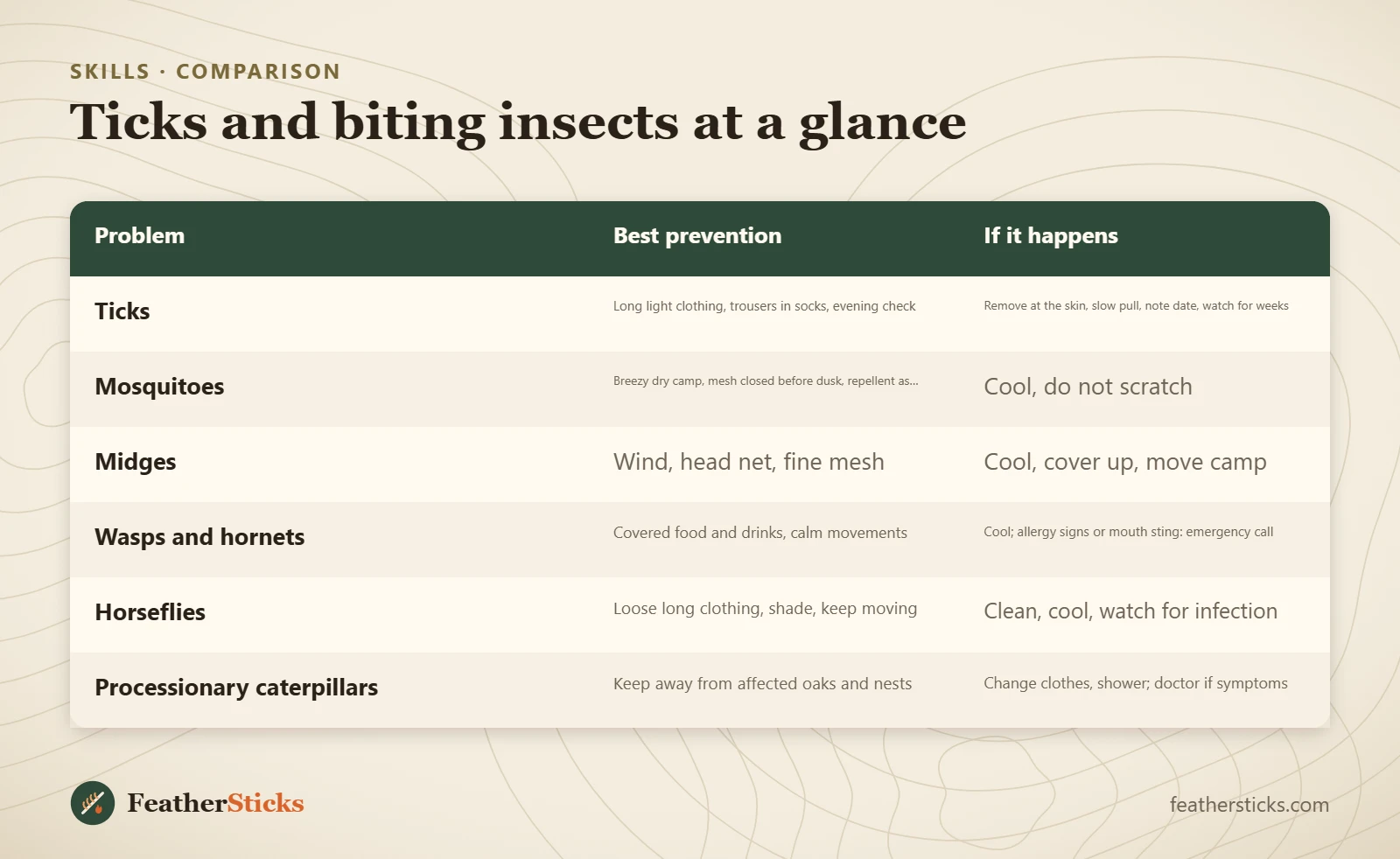
| Problem | Best prevention | If it happens |
|---|---|---|
| Ticks | Long light clothing, trousers in socks, evening check | Remove at the skin, slow pull, note date, watch for weeks |
| Mosquitoes | Breezy dry camp, mesh closed before dusk, repellent as labelled | Cool, do not scratch |
| Midges | Wind, head net, fine mesh | Cool, cover up, move camp |
| Wasps and hornets | Covered food and drinks, calm movements | Cool; allergy signs or mouth sting: emergency call |
| Horseflies | Loose long clothing, shade, keep moving | Clean, cool, watch for infection |
| Processionary caterpillars | Keep away from affected oaks and nests | Change clothes, shower; doctor if symptoms |
Common mistakes
- Looking up at the trees – ticks wait in grass and undergrowth and get on at leg height.
- Putting oil, glue, nail varnish or alcohol on an attached tick, or burning it with a match.
- Squeezing the tick body or tearing at it instead of gripping at the skin and pulling slowly.
- Skipping the evening check because you "used spray" or "only walked on paths".
- Dark trousers and sandals in long grass – nothing to see and nothing in the way.
- Camping in a sheltered hollow beside still water and leaving the mesh open at dusk.
- Forgetting the date of a bite and not connecting a rash or fever weeks later with it.
What you need
- Fine pointed tweezers
- Tick card or tick hook
- Disinfectant wipes and plasters
- Repellent labelled for ticks and mosquitoes
- Long light-coloured trousers and long socks
- Head net and brimmed hat
- Mesh inner or bug net for tarp, tent or hammock
- Headlamp for the evening check
FAQ
How do I avoid ticks when camping?
How do you remove a tick correctly?
Do ticks fall from trees?
What should I do if the head of the tick stays in?
When should I see a doctor after a tick bite?
Which insect repellent works best against ticks and mosquitoes?
How do I keep mosquitoes away from my campsite?
Is there a vaccine against tick bites?
Check yourself
Completed6 quick questions from this guide. Nothing is sent anywhere.
Related step-by-step guides
-
 1
-
 1
-
 1