How to Poop in the Woods: Cathole, Toilet Paper & Outdoor Hygiene for Camping
Knowing how to poop in the woods properly comes down to four things: walk about 60–70 m (200 feet) away from water, trails and camp, dig a cathole 15–20 cm deep in dark, living soil, fill it in and disguise it, and carry your used toilet paper out in a sealed bag. Then wash your hands – that last step prevents more stomach bugs on trips than any water filter.
This guide covers the whole of outdoor hygiene for camping: choosing the spot, digging the hole, toilet paper, when you have to pack everything out, peeing, periods, hand washing, washing yourself, dishes and clothes, winter, children and the rules. It belongs to our bushcraft skills series and builds on a sensible camp layout and the beginner basics.
Step by step
-
1

Pick the spot
Walk about 60–70 metres, roughly 70 big steps, away from water, trails and camp. Look for dark, crumbly soil in a place nobody is likely to walk or camp.
-
2

Dig a cathole
Scrape the leaf litter aside and dig a hole 15–20 centimetres deep and 10–15 centimetres wide. Keep the soil next to the hole.
-
3

Fill it in and disguise it
Put all the soil back, press it down gently and spread the leaf litter and a few twigs over the top until the spot looks untouched.
-
4

Pack out the paper
Seal used toilet paper and wipes in a zip bag inside an opaque bag and carry them out. Never burn paper when the ground is dry.
-
5

Wash your hands
Wash with a drop of soap and a little water for 20 seconds, well away from the water source. Sanitiser is a backup, not a replacement.
-
6

Wash away from the water
Wash yourself, dishes and clothes 60–70 metres from streams and lakes with very little biodegradable soap. Strain the grey water and scatter it widely.
Why outdoor toilet hygiene matters
Human waste is the least glamorous topic in bushcraft and one of the most important. Done badly, it harms three things at once: the water, the next visitor and the wildlife.
- Water. Faeces carry bacteria, viruses and parasites – health authorities such as the CDC and WHO name germs like Giardia, Cryptosporidium, E. coli and norovirus among the classic causes of diarrhoea from untreated water. Rain washes badly placed waste downhill into the same stream somebody else is about to drink from. That is the reason you treat water even in clean-looking country – and the reason distance from water is the single most important rule in this article.
- Other people. Nothing spoils a camp site faster than toilet paper "flowers" behind every bush. Popular wild camping spots get closed for exactly this reason.
- Wildlife and dogs. Animals dig up shallow holes, and paper travels a long way on the wind. In some mountain areas animals are drawn to the salt in urine and chew up plants and soil to get it. Dog waste is packed out too; see camping with dogs.
Your own health is the other half. Most upset stomachs on group trips come from dirty hands passing germs to food and shared snack bags, not from the stream. Outdoor hygiene is therefore two skills – disposing of waste so it stays put, and keeping your hands clean.
Where to go: choosing the spot
The common Leave No Trace guidance is to go at least 200 feet – about 60–70 m, or roughly 70 adult steps – from water, trails and camp. Treat that number as a guideline, not a law of nature: on a steep slope above a stream, in thin soil or in a busy area, more distance is better. The idea behind it is simple. Soil filters and soil organisms break waste down, but only if rain cannot carry it into the water first.
A good spot has three properties:
- Far from water – streams, lakes, springs, bogs, and also dry stream beds and gullies that carry water after rain. If you are still learning to read the terrain, the signs that point to water are the same signs that tell you where not to dig.
- Away from trails and camp – including places where the next party is likely to pitch. The flat, sheltered patch that looks perfect to you looks perfect to them as a tent site.
- Dark, organic soil – crumbly forest topsoil full of roots and insects is where decomposition happens. Avoid bare sand, gravel and waterlogged ground if you have a choice.
Go early, take the trowel and the paper kit, and note a landmark – at dusk 70 steps into thick forest is enough to get disoriented, so a headlamp belongs in the kit. When you choose a camp site, decide the toilet direction at the same time: away from the water and not on the path everyone uses to fetch it.

| Place | Verdict | Why |
|---|---|---|
| Forest floor with dark, crumbly soil, 60–70 m from water | Good | Active soil life, easy to dig, easy to disguise |
| Stream bank, lake shore, spring area | Never | Direct route into drinking water |
| Dry gully or stream bed | Never | Carries water after the next rain |
| Bare rock, scree, thin alpine soil | Pack it out | Nothing to dig in, hardly any decomposition |
| Frozen ground or deep snow | Pack it out | You cannot reach soil; snow only hides it until the thaw |
How to dig a cathole, step by step
A cathole is a small, single-use hole: about 15–20 cm (6–8 inches) deep and 10–15 cm (4–6 inches) wide. The depth is not arbitrary. The top layer of forest soil – the dark, humus-rich topsoil under the leaf litter – contains most of the soil organisms that break organic matter down. Too shallow and animals or rain uncover it; much deeper and you are in pale mineral subsoil where little happens.

Digging a cathole in four moves
 1Scrape the litter aside
Push leaves, needles and twigs to one side with the trowel and keep them in a small heap. They are your camouflage later. In turf, cut a plug of sod and lift it out in one piece instead.
 2Dig to depth
Dig 15–20 cm down and 10–15 cm wide – about the length of a trowel blade and a little more. Pile the soil right next to the hole. If roots stop you at 5 cm, move half a metre and start again.
 3Put all the soil back
Afterwards fill the hole with the soil you dug out and press it down gently with your boot or the trowel. Nothing that touched the waste goes back in your pack.
 4Disguise it
Spread the litter heap back over the spot and add a couple of twigs. The aim is that an animal has no reason to dig and the next person has no idea. Then clean your hands.
What to dig with
A small trowel makes a proper hole in under a minute; metal ones cope with roots and stones, plastic ones only with soft forest soil. A boot heel or a tent peg almost always produces a hole that is too shallow. Do not dig with your knife – it ruins the edge. If you forgot the trowel, carve a flat digging stick with a chisel tip from dead hardwood.
Position and comfort
Most people squat with heels down, feet a little wider than the hole. If your knees or balance do not allow that, hold on to a small tree trunk in front of you, or sit on the edge of a fallen log with the hole behind it. Loosen clothing well clear, check what is behind you on a slope, and keep paper and the sealed bag within reach before you start.
Catholes are single-use and scattered: several separate holes spread over a wide area break down better than one concentrated spot. Do not mark them with stones.
Toilet paper outdoors: pack it out, bury it or do without?
Toilet paper is the part of the problem everybody sees. Paper breaks down far more slowly than people assume, animals dig it up, and one rainy night spreads it across a whole clearing. The cleanest answer is therefore the same everywhere: pack it out.
Packing paper out
The system is two bags. Used paper goes into a small zip bag; that bag lives inside a second, opaque bag or a small dry bag that nobody mistakes for a snack pouch. Press the air out, seal it and stow it in an outside pocket; at the next bin it goes into the general waste. A sealed bag does not smell, and after the first trip it is routine.
Burying paper – where it is acceptable
Where land managers accept it and the soil is deep and moist, a small amount of plain, white, unscented paper can be buried in the cathole, pushed right to the bottom. That is a compromise, not the ideal, and it does not apply in dry, rocky, alpine or heavily used places. Wet wipes, tissues with lotion, kitchen roll, tampons and pads never go in the hole – most wipes contain synthetic fibres, and even those labelled "biodegradable" break down far too slowly in cold soil.
Never burn it in dry conditions
Burning toilet paper at the hole can start a wildfire. A lit wad of paper is light, the wind takes it, and you are squatting in dry leaf litter with your trousers down. In dry weather, in conifer forest, in grass and whenever a fire ban is in force, do not burn paper – see fire safety.
Natural alternatives – with caution
People managed without paper for a very long time, and some natural materials work well. They also leave nothing to pack out, because they go into the hole. The caution matters, though: only use what you can identify as harmless, and never strip living plants.
| Material | How well it works | Watch out for |
|---|---|---|
| Smooth, rounded stones | Good, surprisingly clean | Take them from dry ground, not out of the stream; bury or leave them in the hole |
| Snow (firm, formed into a wedge) | Very good, cleans and rinses | Cold; only in winter conditions |
| Large dead leaves, dry and intact | Fair | Brittle leaves crumble; check both sides for insects |
| Moss | Good, soft and absorbent | Grows very slowly – take only loose, fallen pieces, never in protected areas |
| Green leaves you cannot name | Avoid | Irritant and poisonous plants exist in every region – if in doubt, leave it |

When you must pack everything out
A cathole only works where there is soil with life in it. In a growing number of places the correct answer to "leave no trace toilet" is to carry solid waste out as well – and in many parks, canyons and glaciated areas this is a regulation, not a suggestion. Check the rules for your area before the trip.
| Terrain | What to do | Reason |
|---|---|---|
| Forest and meadow with deep soil | Cathole | Soil organisms break waste down |
| Frozen ground, deep snow | Pack out | You cannot reach soil; everything reappears at the thaw |
| Rock, scree, high alpine zones | Pack out | No soil, cold, almost no decomposition |
| Narrow river canyons and gorges | Pack out | Nowhere 60–70 m from water; floods wash everything into the river |
| Heavily used camp sites and climbing areas | Pack out | Too many holes in too little ground |
How pack-out systems work
You do not need a brand name, just the principle: a container that is leak-proof, smell-proof and clearly not for anything else.
- Double-bag kits. An inner bag you go into directly (or pick up with, like a dog bag), usually with a gelling or absorbing powder, and a tough resealable outer bag. Commercial waste bag kits are built this way and are approved for normal rubbish disposal in many areas – read the pack.
- Home-made version. A sturdy inner bag with a spoonful of absorbent material (cat litter or sawdust), knotted, inside a second zip bag, inside an opaque stuff sack.
Carry the kit outside the main compartment, away from food. Sealed bag kits usually go in general waste; never leave bags at a trailhead or put them in a composting toilet.
Peeing and menstrual hygiene outdoors
Peeing
Urine is a much smaller health issue than faeces, but it smells, and its salt attracts animals. A few habits are enough:
- Go well away from camp, the trail and the water – the 60–70 m guideline is ideal, and at night even 30 m in the right direction is far better than the tree next to the tarp.
- Prefer bare mineral ground, gravel or thick leaf litter over delicate plants. In mountain areas, pee on rock or gravel rather than on vegetation, so animals after the salt do not tear up the plants.
- Not always the same spot. On a longer camp, spread it around or it will smell by day two.
- Paper used after peeing goes in the bag too. A washable "pee cloth" dried on the outside of the pack, or a splash of water, saves paper.
Periods on the trail
Menstruation is no reason to stay home; it only needs a slightly bigger kit and the same rule as for paper: everything manufactured comes back out with you.
- Tampons and pads are packed out, always. They do not break down in a cathole and animals dig them up. Use the double-bag system with an opaque outer bag.
- Menstrual cups save a lot of waste on longer trips. Empty the cup into a cathole, as you would other waste. Rinse it with clean (treated) water 60–70 m away from any water source, pouring the rinse water into the hole, or wipe it with paper that you pack out. Wash your hands before and after – with soap, not just sanitiser.
- Period underwear and washable pads are rinsed away from water like any other laundry (see below) and dried on the pack.
In bear country, used hygiene products are stored like food – sealed and away from the sleeping area. See storing food in camp and wildlife encounters.
Hand hygiene: the real illness-preventer
If you remember only one section, make it this one. Germs from faeces reach your mouth mainly by hand: toilet, then trowel, then zip, then the shared bag of nuts. Health authorities describe hand washing with soap as one of the most effective ways to prevent diarrhoeal illness, and it works outdoors exactly as it does at home. Treating your water carefully and then eating with unwashed hands is half a job.
When to wash
- After every toilet visit – including after handling the waste bag or the trowel.
- Before cooking, before eating and before handing food to others.
- Before treating a wound or touching a blister (see the first aid kit).
Soap and water, away from the source
Carry water away from the stream or lake – the same 60–70 m – and wash there, over soil. A bottle with a small hole in the lid, or a companion pouring, gives you a thin stream that wastes almost nothing; a quarter of a litre is enough for a proper wash.
Washing hands in camp with a quarter litre of water
 1Wet your hands
Away from the water source, pour a small splash over both hands. You do not need running water – a pierced bottle cap or a friend with a bottle does the job. Plan hygiene water on top of what the water calculator gives for drinking and cooking.
 2One drop of soap
A single drop of concentrated, unscented biodegradable soap is plenty. More soap only means more rinsing water and more soap in the soil.
 3Scrub for 20 seconds
Palms, backs of the hands, between the fingers, thumbs and under the nails – the CDC and WHO recommend at least 20 seconds.
 4Rinse over soil, air-dry
Rinse with another small splash and let the water fall onto soil, not rock leading to the stream. Shake your hands dry or use your own small towel – not the shared dish cloth.
Soap and water vs hand sanitiser
Soap and water
- Removes dirt, grease and germs mechanically
- Works on visibly dirty hands
- The better choice after the toilet and before cooking
- Needs a little water and a spot away from the source
Alcohol hand sanitiser
- Fast, no water needed, good on the move
- Works poorly on dirty or greasy hands
- According to the CDC less effective against some germs, for example norovirus and Cryptosporidium
- Flammable – let it dry fully before going near a flame
The practical routine: sanitiser straight after the toilet, because it is in your pocket, and a real wash with soap before the next meal. If you use sanitiser, choose an alcohol-based one (the CDC advises at least 60 % alcohol), use enough to wet both hands completely and rub until dry.
Small habits that stop a group getting ill
- Pour, do not reach. Tip nuts and sweets from the bag into people's hands instead of letting ten hands dig into it.
- Keep the cook healthy. Anyone with diarrhoea does not prepare food for others.
Washing yourself, dishes and clothes: 60–70 m from water
The rule for all washing is the same as for the toilet: carry the water to the washing, not the soap to the water. Fill a pot or a folding bucket, walk about 60–70 m away from the stream or lake, wash there and scatter the used water over soil. Soil and its organisms deal with small amounts of soap and food residue; a stream cannot.
"Biodegradable" on the bottle does not change that. Biodegradable soap needs soil bacteria and time to break down – in open water it is simply a pollutant, harmful to aquatic insects and amphibians.
Washing your body
A pot of water, a small cloth and at most a few drops of soap are enough. Wash from clean to dirty – face, armpits, then groin, backside and feet – and rinse the cloth in the pot, not in the stream. A swim without soap is fine where bathing is permitted.
Washing dishes
Dirty pots are a hygiene problem and a wildlife problem. Eat everything you cooked, wipe the pot out, and wash up straight after the meal while residue is still soft.
Washing up without leaving a trace
 1Scrape first
Scrape or wipe every scrap of food into your rubbish bag before any water touches the pot. Planning portions well helps – see meal planning.
 2Warm water, one drop of soap
Heat a little water in the dirty pot itself, 60–70 m from the source. A drop of soap and a small cloth or a handful of clean sand does the rest. Greasy pans from campfire cooking need hot water more than they need soap.
 3Strain the grey water
Pour the dishwater through a bandana or a fine mesh into a second pot. The food bits that stay in the cloth go into the rubbish bag – they are what attracts animals.
 4Scatter it widely
Fling the strained grey water in a wide arc over soil and vegetation, away from camp and never into the stream. A single puddle smells and draws wildlife; a fine spray disappears.
Rinse with a little clean water and let everything air-dry. Our cookware guide shows which pots clean easily.
Washing clothes
On trips of a few days, rinsing is enough: socks, underwear and the base layer in a pot or a dry bag with water, kneaded, wrung out and hung on the pack or a line. If you use soap, the same 60–70 m rule applies. Keep one dry set strictly for sleeping – see outdoor clothing for fabrics that dry fast.
Brushing teeth
Use a pea-sized amount of toothpaste, brush away from camp and water, and either spit into a small hole or spray it out in a fine mist over a wide area so no white blob remains. Rinse the brush with drinking-quality water. Where animals are attracted to smells, toothpaste is stored with the food, not in the tent.
Staying clean on multi-day trips
Nobody stays fresh for a week in the woods, and nobody has to. The aim of personal hygiene on a trip is narrower: prevent skin problems, infections and chafing, and sleep in a reasonably clean bag. A short evening routine achieves that with half a litre of water.
The five-minute evening wipe-down
- Hands and face Wash hands with soap, then face and neck with clean water. Sunscreen, repellent and smoke come off; the skin can recover overnight.
- Armpits, groin, backside Damp cloth, a little soap if needed, then dry thoroughly. This is where rashes and chafing start.
- Feet last Wash or wipe the feet, dry carefully between the toes and let them air while you cook. Check for hot spots and treat them now, not tomorrow at noon.
- Into dry sleep clothes Change into the dry set that never leaves the sleeping bag liner. Hang the day clothes to air.
- Cloth and teeth Rinse the cloth, hang it to dry, brush your teeth. In tick season, this is also the moment for the evening tick check.
Feet
Feet carry the trip, and wet, dirty skin blisters fastest. Air them at every long break, change into dry socks at midday on wet days, rinse the worn pair and dry it on the pack. Keep nails short and cut straight. Our footwear guide covers socks, fit and blister prevention in detail.
Chafing
Chafing between the thighs, in the backside crease and under pack straps comes from salt, moisture and friction. Wash the salt off in the evening, dry the skin completely and wear clean, close-fitting underwear – alternate two pairs and rinse one each day. A little plain skin balm on known problem zones before walking prevents most of it.
Winter and snow: what changes
Cold changes the toilet question completely. Frozen ground cannot be dug with a trowel, and snow is not soil: a hole in the snowpack simply hides waste until the thaw, when it reappears on the surface or runs into the meltwater – the water everyone downstream drinks in spring.

- Pack out is the standard in snow and on frozen ground. In the cold a sealed bag freezes and does not smell. Snow, incidentally, makes good toilet paper.
- If you can reach unfrozen soil – for example under thick litter beneath conifers, or on a sunny south-facing slope – a normal cathole there is acceptable. Stay far from watercourses and from anything that looks like a summer path or camp site.
- Hand hygiene suffers first in the cold: water is precious and fingers are numb. Keep the sanitiser in an inside pocket and still do one real wash with warm water and soap a day. Dry your hands completely.
- Do not hold it in to avoid the cold. Go before you get into the sleeping bag. Some winter campers use a clearly marked wide-mouth pee bottle at night and empty it well away from where they collect snow for melting.
Put on jacket and boots for night trips – getting chilled repeatedly is a small step towards hypothermia. More in winter camping and snow shelters, where everything is packed out.
Groups and children
Groups
Groups concentrate waste and share food, so they need rules that are spoken aloud on the first evening:
- A toilet direction, agreed and well away from water and camp, and wide enough that catholes are scattered rather than clustered.
- One trowel per two or three people, each with paper and bags, so nobody improvises.
- A fixed hand-wash station between the toilet direction and the kitchen.
- A latrine only where it makes sense. For large groups staying several days in one place – and where the land manager allows it – a shared, narrow trench latrine with a pile of soil to cover after each use can be better than dozens of badly dug holes. It needs the same 60–70 m from water and is filled in completely on departure. For small parties, catholes remain the better method.
Children
Explain the method at home, let children carry their own small kit, and go with them the first few times.
- Ask early and often – "anyone need to go before we cook?" – because children wait until it is urgent.
- Dig the hole for small children and help with balance: holding both hands from the front, or letting the child hold a small tree, works better than explanations.
- Nappies, pull-ups and wipes are always packed out – double-bagged. Solid waste from a nappy can be tipped into a cathole first.
- Make hand washing a fixed ritual before every meal, with a song or a count to twenty.
More ideas for trips with young ones are in bushcraft with kids; if this is your own first night out, the first-overnight guide helps you keep the plan simple.
Rules and local context: check before you dig
Whether a cathole is allowed at all depends on where you are. The method in this article is the general Leave No Trace approach for backcountry without facilities; the law and the land manager come first.
- USA and Canada. Catholes are the default on much public land, but many national parks, desert canyons, river corridors and high-use alpine areas require you to pack out solid waste, sometimes with a specific container. Permit conditions say so.
- UK and Ireland. Access guidance such as the Scottish Outdoor Access Code asks you to use public toilets where possible, otherwise to bury waste well away from buildings, paths and watercourses.
- Scandinavia. The right of public access comes with the duty not to disturb or destroy: bury waste far from water, houses and paths, take paper with you and use the toilets at shelters and huts.
- Central Europe, including Germany. Wild camping is restricted in most places, and there is no general right to dig holes in a forest. Plan with official trekking sites, huts and campsites, which have toilets, and treat a cathole as an emergency solution – see wild camping rules.
Wherever you are: protected areas, drinking water protection zones and private land have stricter rules, and leaving paper or bags behind is littering everywhere. This is general information, not legal advice – check the current rules for your destination.
What do I do here?
Is there a toilet within reasonable reach?
Yes → Use it.No → Next question.Do local rules require packing out waste?
Yes → Use a waste bag kit and carry it out.No → Next question.Can you get 60–70 m from water, trails and camp, into deep, unfrozen soil?
Yes → Dig a cathole 15–20 cm deep; pack out the paper.No → Pack everything out.
The outdoor toilet and hygiene kit
The complete kit fits in a one-litre bag and weighs very little. Pack it where you can reach it without emptying the rucksack, and separately from food. If you build your packing list with the Kit Builder or from our bushcraft kit list, add the items below as one "hygiene" module.

Toilet and hygiene checklist
- Small trowel (metal for stony ground)
- Toilet paper, plain and unscented, in its own zip bag
- Two or three spare zip bags plus one opaque outer bag or small dry bag
- Waste bag kit where packing out is required (terrain, season or rules)
- Hand sanitiser, small bottle, alcohol-based
- Biodegradable soap, concentrated and unscented, in a dropper bottle
- Small quick-drying cloth and a separate hand towel
- Toothbrush, small tube of toothpaste
- Period supplies and extra bags, if needed
- Bandana or mesh for straining dishwater
- Headlamp for night trips to the toilet spot
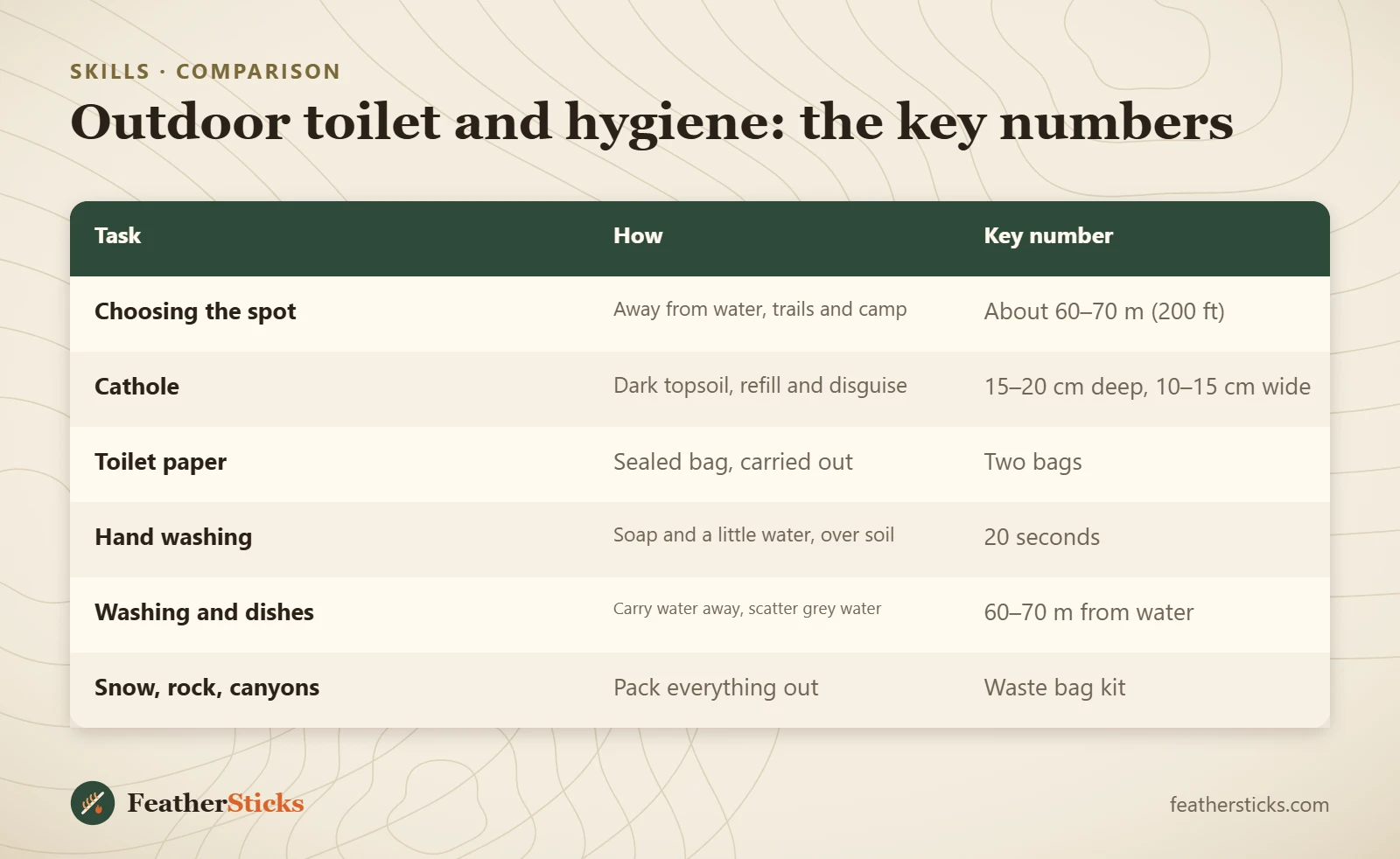
| Task | How | Key number |
|---|---|---|
| Choosing the spot | Away from water, trails and camp | About 60–70 m (200 ft) |
| Cathole | Dark topsoil, refill and disguise | 15–20 cm deep, 10–15 cm wide |
| Toilet paper | Sealed bag, carried out | Two bags |
| Hand washing | Soap and a little water, over soil | 20 seconds |
| Washing and dishes | Carry water away, scatter grey water | 60–70 m from water |
| Snow, rock, canyons | Pack everything out | Waste bag kit |
Common mistakes
- Going too close to water – behind the nearest bush on the stream bank instead of 60–70 m away.
- A hole that is only a scrape: less than 15 cm deep, uncovered by the first animal or rainstorm.
- Leaving toilet paper or wet wipes under a stone or in the hole, where they resurface.
- Burning toilet paper in dry forest or grass.
- Skipping hand washing, or relying on sanitiser alone with visibly dirty hands.
- Washing dishes, clothes or yourself with soap directly in a stream or lake – "biodegradable" does not make it harmless in water.
- Digging a hole in the snow and assuming the problem is gone.
What you need
- Small trowel
- Toilet paper in a zip bag
- Opaque outer bag or waste bag kit
- Alcohol-based hand sanitiser
- Unscented biodegradable soap in a dropper bottle
- Small cloth and hand towel
- Bandana or mesh strainer for dishwater
- Headlamp
FAQ
How deep should a cathole be?
How far from water should you poop in the woods?
Can you bury toilet paper?
Is hand sanitiser enough when camping?
What do you do with poop when the ground is frozen or covered in snow?
How do you deal with your period when camping?
Check yourself
Completed6 quick questions from this guide. Nothing is sent anywhere.
Related step-by-step guides
-
 1
-
 1
-
 1