Leave No Trace in Practice: The 7 Principles for Bushcraft
The Leave No Trace principles are seven simple rules for enjoying the outdoors without damaging it: plan ahead and prepare, travel and camp on durable surfaces, dispose of waste properly, leave what you find, minimise campfire impacts, respect wildlife and be considerate of others. In practice that means a small, well-chosen camp at least 60 m from water, everything packed out, a small fire only where it is allowed, and a site that looks untouched when you leave.
This guide explains each principle with concrete bushcraft practice and points you to the detailed guides instead of repeating them. It also tackles the real tension in bushcraft ethics – fires, shelters, carving and cutting wood – and how to practise those skills responsibly. It belongs to the bushcraft skills section and builds on bushcraft for beginners.
Step by step
-
1

Plan and check the rules
Check access and fire rules, weather and route before you go. Pack bags for rubbish, a trowel and a stove.
-
2

Camp on durable ground
Use established sites or bare, durable ground, at least 60 m from water. Avoid moss, flowering meadows and banks.
-
3

Pack out all waste
Everything you carried in goes home, including food scraps and used toilet paper. Bury human waste only in a proper cathole.
-
4

Small fire, dead wood only
Light a fire only where it is allowed, in an existing ring or fire pan, with dead and fallen wood. Put it out until cold.
-
5

Give wildlife space
Watch animals quietly from a distance, never feed them and store food out of reach. Keep dogs under control.
-
6

Restore the site
Dismantle what you built, scatter wood and shavings, fluff up the ground and pick up any litter, even if it is not yours.
What are the Leave No Trace principles?
Leave No Trace is a set of guidelines for low impact camping and travel that outdoor organisations and land managers in many countries teach in similar form. It is not a law and not a brand of outdoor purity: it is a practical checklist that helps you make good decisions when nobody is watching. Our glossary entry sums it up in one line; this guide shows what each principle means when you carry a knife, a saw and a fire steel.
The seven principles commonly taught are:

| Principle | In bushcraft practice | Detailed guide |
|---|---|---|
| 1. Plan ahead and prepare | Know access, camping and fire rules; plan route, weather and group size | Trip planning |
| 2. Travel and camp on durable surfaces | Established sites or bare ground, at least 60 m from water, one night per spot | Choosing a camp site |
| 3. Dispose of waste properly | Pack it in, pack it out; cathole 15–20 cm deep; wash 60–70 m from water | Outdoor hygiene |
| 4. Leave what you find | No cutting of living trees, no digging, no collecting plants, stones or antlers | Section below |
| 5. Minimise campfire impacts | Stove first; fire only where allowed, small, dead wood, cold before you leave | Campfire safety |
| 6. Respect wildlife | Distance, no feeding, food stored out of reach, dogs under control | Wildlife encounters |
| 7. Be considerate of others | Quiet, small groups, discreet light, camp out of sight of paths | Section below |
None of these principles is new. What makes them useful is that they turn a vague feeling of "being careful" into concrete habits: a rubbish bag in the lid pocket, a trowel in the kit, a fire pan on the packing list, a glance at the clock so you are not setting up camp in the dark. The rest of this guide goes through the principles one by one, then looks at bushcraft skills specifically.
Principle 1: Plan ahead and prepare
Most damage outdoors is not malicious; it happens because people arrive late, tired, unprepared or in the wrong place. Good planning prevents almost every problem the other six principles deal with. The full method is in planning a bushcraft trip; for low impact camping, the key questions are:
- Is camping allowed here, and where? Access and camping rules differ widely between countries, regions and landowners. Some places allow a discreet night, others only designated sites. Our guide to wild camping rules explains the background for Germany and other European countries.
- Is a fire allowed, and what is the fire danger today? If the answer is unclear, plan with a stove and no fire.
- When does it get dark? Arriving with an hour of daylight left gives you time to choose a good spot instead of pitching on the first flat patch. The daylight calculator and the hiking time calculator help you time the day.
- How many people? Small groups leave smaller footprints. Split larger groups into several small parties that camp apart, or book a group site.
- What waste will you create? Repack food at home into reusable bags or tubs, leave packaging behind and you have less to carry out.
Leave No Trace kit (adds very little weight)
- Two or three strong rubbish bags, one opaque for used toilet paper
- Small trowel for catholes
- Stove as an alternative to a fire, and a fire pan where ground fires are not allowed
- Collapsible bowl or bucket for washing and extinguishing water
- Small piece of cloth or a mesh strainer for dishwater
- Headlamp with a red or dimmed mode
- Light groundsheet for carving and crafting, so shavings can be collected
- Map with protected-area boundaries marked
Planning also means honest self-assessment. If you do not yet know how to put out a fire completely or how to dig a cathole, practise in the garden or on a campsite first. A first night outdoors on a site with facilities is the best place to build these habits before you need them in the forest.
Principle 2: Travel and camp on durable surfaces
Vegetation recovers slowly from being trampled. A single tent on a flowering meadow can leave a pale rectangle for weeks; a camp used every weekend on the same moss cushion can destroy it for years. Durable surfaces are those that can take a footstep or a tent without lasting harm: rock, gravel, sand, bare soil, dry grass, thick needle litter and snow.
There are two strategies, depending on where you are. In popular areas, concentrate the impact: use established sites, existing fire rings and paths, and keep your camp within the area that is already worn. In remote, untouched places, disperse it: camp on durable ground where nobody has camped before, stay only one night and leave no sign so that no new "site" forms. The camp site selection guide covers the safety side of choosing a pitch: widowmakers, wind, drainage and water.

| Surface | Rating | Why |
|---|---|---|
| Rock, gravel, sand, bare soil | Durable | Nothing to trample; no visible trace after a night |
| Thick needle or leaf litter | Durable | Spreads the load, easy to fluff up again |
| Dry grass, already short | Fairly durable | Recovers within days if you stay one night |
| Snow cover | Durable | Protects the ground below, as long as it is deep enough |
| Moss, lichen, bilberry, heather | Fragile | Crushes easily, grows back very slowly |
| Flowering meadows, wet meadows, bog | Fragile | Rare plants, ground-nesting birds, soft soil |
| Stream banks and lake shores | Fragile and off-limits | Erosion, wildlife corridors, too close to water |
How far from water should you camp?
The site-wide rule on FeatherSticks is at least 60 m (about 200 ft, roughly 70 adult steps) from lakes, streams and springs for your camp, your washing and your toilet. Shores are where animals drink and where plants are most sensitive, and the further away you are, the less chance that soap, food and waste reach the water.
Other habits on durable ground
- Do not dig trenches around a tent or tarp. Choose a pitch that drains naturally instead.
- Do not clear the ground of stones and branches more than necessary, and put back what you moved.
- Walk on paths, in single file, even when they are muddy. Stepping around puddles widens paths over time.
- Vary your route to water and toilet in untouched places, so no new path forms.
- Stay one night in a wild spot. A base camp of several days belongs on a site where that is allowed – see setting up a base camp.
Principle 3: Dispose of waste properly
"Pack it in, pack it out" is the core of low impact camping. Everything you carried in leaves with you: packaging, food scraps, tea bags, wet wipes, tape, cord ends and anything that did not burn. Organic scraps are not harmless either. Orange peel, nutshells and bread take a surprisingly long time to break down in a cool forest, they look like litter to the next visitor, and they teach animals to look for food at camp.
The waste routine in camp
 1Scrape every scrap
After eating, scrape pots and plates into the rubbish bag with a spoon. What is in the bag cannot end up in the dishwater or attract animals.
 2Strain the grey water
Wash at least 60 m from water, pour the dishwater through a cloth or strainer, pack out the solids and scatter the water widely. The method is in washing dishes without a trace.
 3Bag the paper, dig a cathole
Dig a cathole 15–20 cm deep, 60–70 m from water, trails and camp, and carry used toilet paper out in an opaque, sealed bag.
 4Sweep for micro-litter
Before you leave, walk the site slowly and look at the ground. Bottle caps, foil scraps, cord ends and tape are the litter that is missed most often.
Human waste
Where there are no toilets, the standard method is a cathole: walk about 60–70 m away from water, trails and camp, dig a hole 15–20 cm deep and 10–15 cm wide in dark topsoil, use it, fill it in and disguise it. Used toilet paper, wipes and hygiene products go into a sealed bag and are packed out, not buried or burnt. In narrow gorges, on rock, on frozen ground or in busy areas, pack everything out. The details, including washing hands with very little water, are in how to poop in the woods and stay clean.
Washing and dishes
Carry the water to the washing, not the soap to the water. Fill a pot or a folding bowl, carry it at least 60 m from the source, use hot water and at most a drop of biodegradable soap, strain the water and scatter it over soil. Even biodegradable soap does not belong in a stream. For the kitchen side – how to set up cooking, washing and storage so that nothing is spilled – see setting up a camp kitchen.
Principle 4: Leave what you find
The forest is not a supply store. Stones, antlers, feathers, flowers, fungi, old fence posts and historical remains all belong where they are, for the next visitor and for the animals and plants that depend on them. A stone lifted for a fire ring leaves a bare patch where insects and seedlings lived; a stack of picked flowers is one season's seed lost.
- Never cut or damage living trees. No carving initials, no stripping bark, no hacking branches for poles or bedding. Bark damage opens the tree to fungi and pests.
- Do not build structures you will leave. No benches, tables, walls or "permanent" shelters. What you build for practice, you take apart.
- Do not dig except a cathole, and a fire pit only where fire and digging are allowed and the sod goes back afterwards.
- Leave plants and fungi alone in protected areas, and elsewhere collect only where it is permitted and in small amounts. This site gives no advice on eating wild plants or fungi.
- Do not move things between places. Clean mud from boots and tent pegs between regions, and do not transport firewood where that is restricted, so that seeds and tree pests do not travel with you.

The simplest test is the one the principle is named after: would the next person to walk past notice that someone had been here? If the answer is yes, put it back.
Principle 5: Minimise campfire impacts
A fire is one of the core skills of bushcraft and one of its biggest impacts: scorched soil, blackened stones, half-burnt logs, collected deadwood and the risk of a wildfire. Minimising campfire impacts starts with an honest question: do I need a fire here, today? For cooking, a stove is often faster and leaves nothing behind; the options are compared in camp stoves and hobo stoves. When a fire is allowed and sensible, keep it small and leave no mark.
A low impact campfire
- Check that it is allowed No fire ban, an acceptable fire danger level and the landowner's permission. In many countries fire in the forest is forbidden outside designated sites.
- Use what exists Use an existing fire ring rather than building a new one. Otherwise use a fire pan or a mound fire, or a leave-no-trace fire pit where digging is allowed.
- Keep the distances About 3 m cleared to bare soil around the fire, tents and hammocks at least 5 m away and synthetic tarps at least 3 m away, never directly downwind of sparks.
- Dead and fallen wood only Collect dead wood lying on the ground, thin enough to break by hand, where collecting is allowed. Never cut living trees or standing dead trees, which are habitat. The firewood calculator tells you how much to gather.
- Burn it to ash Keep the fire small and stop adding wood early, so everything burns to fine ash. Half-burnt logs are the most visible trace a fire leaves.
- Out cold, then scatter Drown, stir and feel until the ash is cold to the touch, then scatter the cold ash widely, return any soil and scatter unused wood.
The details of each step are in the dedicated guides: fire bans, clearances and putting the fire out in how to put out a campfire, pit types and restoring the sod in how to build a fire pit, and gathering, sorting and splitting fuel in how to collect and prepare firewood.
Old fire rings and other people's mess
If you find several rings close together, use one and leave the others; dismantling them with good intent can make the scar larger. Where you know rings are not allowed, and the land manager wants them removed, scatter cold stones and ash and cover the patch with litter. Clean foil and rubbish out of an existing ring before you light a fire – burning it only makes it worse.
Principle 6: Respect wildlife
You are a guest in the animals' home, often during their most active hours at dusk, at night and at dawn. Respecting wildlife means that animals do not change their behaviour because of you: they do not flee, they do not learn to associate people with food and they are not disturbed while raising young.
- Watch from a distance. If an animal stops feeding, stares at you or moves away, you are already too close. Use binoculars or a zoom lens, not your feet. How to behave in an actual encounter with boar, deer or wolves is in wildlife encounters.
- Never feed animals, not even birds at the picnic spot. Fed animals lose their shyness, which is bad for them and can make them dangerous.
- Store food and rubbish out of reach. In most of Europe, a dry bag hung 1.5–2 m high on a thin branch, away from the trunk, keeps mice and foxes out. In bear country, follow the local rules for canisters or hangs, as explained in storing food at camp.
- Be especially careful in spring and early summer, the breeding and rearing season. Stay on paths, keep away from nests and dens, and never pick up a young animal that seems alone; its mother is usually nearby.
- Keep dogs under control. A dog that chases deer or rummages through a nest undoes everything else you do right. Rules for leads, waste and camp routines are in camping with a dog.
Principle 7: Be considerate of others
Other people come to the forest for the same reasons you do: quiet, nature and a break from noise and screens. Being considerate is the principle that keeps wild camping tolerated where it is tolerated at all.
- Keep it quiet. No music from speakers, no shouting across camp, and a quiet camp after dark. Voices carry far over water and in still forests.
- Keep groups small. A group of ten in the forest is a camp, not a discreet overnight stay, and is treated as such by owners and rangers. Many land managers set maximum group sizes.
- Camp out of sight of paths, viewpoints and houses. Arrive late and leave early where discretion is expected.
- Mind your light. Use a dimmed or red light in camp, point the headlamp at the ground rather than into the trees or at people, and switch off when you do not need it. Light at night disturbs animals and neighbours; see headlamps and camp lighting.
- Be friendly when a forester, hunter or landowner speaks to you, and leave if you are asked to.
- Share paths fairly: step aside for others, let faster walkers pass and keep dogs close to you.

Bushcraft ethics: practising skills without leaving a trace
Here is the honest tension. Classic bushcraft is about using the forest: cutting poles for a lean-to, gathering spruce boughs for a bed, carving spoons, splitting wood, lighting fires with friction and natural tinder. Done on a large scale in a crowded, managed forest, those skills leave exactly the scars Leave No Trace tries to avoid – and in most places they are not legal without permission.
The answer is not to give up the skills but to practise them in the right place, with the right material and with a plan to leave no trace.
Practising bushcraft responsibly
 1Dead and fallen wood
Use material that is already on the ground: deadfall, storm damage left for collection, or prunings. Living trees and standing dead trees stay untouched.
 2Work over a sheet
Carve, whittle and make feather sticks over a groundsheet, so shavings and chips can be burnt in the fire or scattered thinly afterwards instead of lying in a bright pile.
 3Ask the owner
For cutting green wood, building shelters or harvesting bark for cordage, ask the landowner or forestry office. Many will agree to a small, specific request.
 4Take it apart
Dismantle every practice shelter, frame or tripod before you leave and scatter the material naturally, so that no new "camp" invites others.
Where to practise
- Private land with permission – a farmer's woodlot or your own garden is the best training ground for shelters and fire.
- Bushcraft courses and dedicated sites that have the owner's agreement to cut, build and burn.
- Campsites and trekking sites with fire rings for fire skills, using firewood you bought or brought where that is allowed.
- Your workshop or balcony for carving: carving with green wood from a legitimate source – garden prunings, a tree surgeon's offcuts – leaves no trace in the forest at all.
Shelters and beds
A tarp shelter is the low impact standard: it needs no material from the forest and leaves no mark. If you want to practise natural shelters, do it on land where you have permission, use dead material and take everything apart afterwards. The same goes for raised beds and bough beds – our guide to bushcraft beds shows how to dismantle one cleanly.
Traditional vs. modern bushcraft habits
Old-school habit
- Lean-to of freshly cut saplings
- Bed of cut spruce boughs
- New stone fire ring at every camp
- Shavings and chips left in a pile
- Trench dug around the tent
Low impact alternative
- Tarp, or a deadfall shelter with permission, dismantled after
- Sleeping pad, or a bed taken apart and scattered
- Existing ring, fire pan or mound fire
- Work over a sheet, burn or scatter thinly
- Pitch on ground that drains naturally
Leave No Trace in Germany and elsewhere: rules and protected areas
Leave No Trace is an ethic, not a legal framework, but in many countries the law already covers much of it. Rules differ by country, region and landowner, and this section is general orientation, not legal advice.
Germany is a good example of how strict it can be. Everyone may enter the forest and open countryside for recreation, but the forest laws of the federal states (Landeswaldgesetze) generally require the owner's consent for camping in the forest, and open fire in and near forests is usually forbidden outside approved sites – in most states also within a set distance of the forest edge, often around 100 m. In nature reserves (Naturschutzgebiete) and national parks, the area's own regulations nearly always forbid camping, fire and leaving the paths. Cutting branches, damaging trees and disturbing wildlife during the breeding season can lead to considerably higher fines. The full overview, including bivouacs and trekking sites, is in wild camping in Germany.
Elsewhere, rights of access vary a lot. The Nordic countries and Scotland have broad access traditions that still come with clear expectations of responsible behaviour and seasonal fire bans. In North America, many parks and forests set specific rules for permits, campsites, food storage and group size. Whatever the local framework, check the official information before you go and respect signs on the ground.
May I practise this skill here?
Is the area a nature reserve, national park or other protected area?
Yes → Follow its rules strictly: usually no camping, no fire, stay on paths, take nothing.No → Go to the next question.Does the skill need living material, digging or fire?
Yes → Only with the owner's permission and where fire is allowed today.No → Go to the next question.Can you leave the site exactly as you found it?
Yes → Go ahead, and take everything apart before you leave.No → Choose a different skill or a different place.
Before you leave: the final site check
The last fifteen minutes of a trip decide whether the site looks untouched or used. Make the final check a fixed routine, ideally with one person in the group responsible for it.
Restoring the site in four steps
 1Fire cold
Drown, stir and feel until the ash is cold to the touch with the back of your hand. Only then scatter the cold ash widely, unless you used an established ring.
 2Scatter wood
Spread unused firewood and the material of any practice structure naturally over a wide area, not in one tidy pile that looks like a campsite.
 3Restore the ground
Fluff up flattened grass with your fingers, return leaves and needles where the tent stood and put back stones you moved.
 4Leave it better
Walk the site one last time, pick up every bit of litter, including what others left, and look back from the path: nothing should catch the eye.
Final check before you go
- Fire site cold to the touch; cold ash scattered or left in the established ring
- All rubbish, food scraps and used toilet paper packed
- Catholes filled in and disguised
- Shelters, frames and seats taken apart, material scattered
- Shavings and chips burnt or scattered thinly
- Pegs, cord ends and tape collected
- Flattened ground fluffed up, leaves and stones put back
- One last look from the path
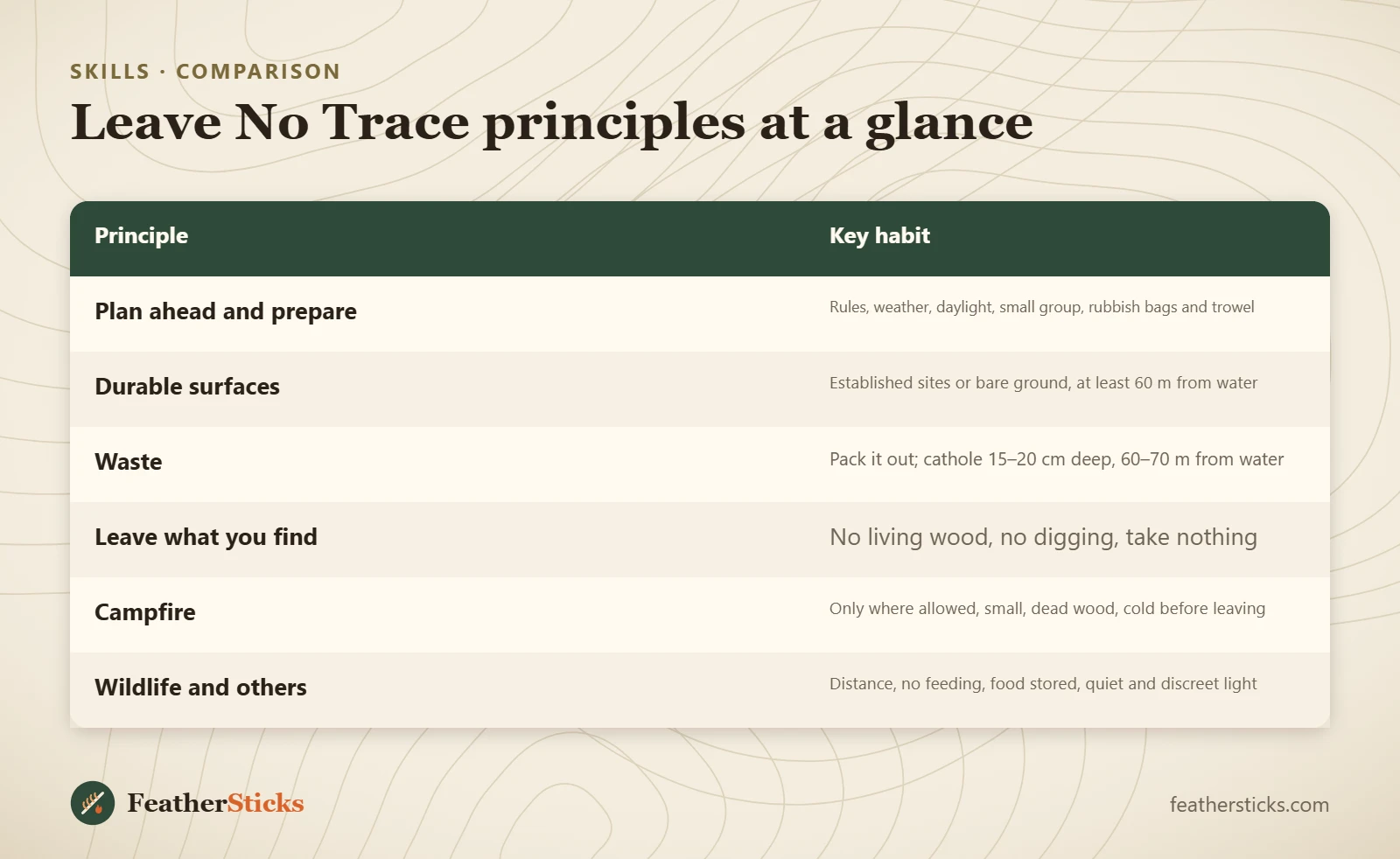
| Principle | Key habit |
|---|---|
| Plan ahead and prepare | Rules, weather, daylight, small group, rubbish bags and trowel |
| Durable surfaces | Established sites or bare ground, at least 60 m from water |
| Waste | Pack it out; cathole 15–20 cm deep, 60–70 m from water |
| Leave what you find | No living wood, no digging, take nothing |
| Campfire | Only where allowed, small, dead wood, cold before leaving |
| Wildlife and others | Distance, no feeding, food stored, quiet and discreet light |
Common mistakes
- Camping right on the shore of a lake or stream instead of at least 60 m away.
- Leaving food scraps such as orange peel or nutshells because they are "natural".
- Burning rubbish and foil in the campfire.
- Cutting living branches for poles, beds or firewood.
- Building a new fire ring next to an existing one.
- Leaving a pile of feather-stick shavings or a practice shelter standing.
- Burying toilet paper instead of packing it out.
What you need
- Strong rubbish bags, one opaque for used toilet paper
- Small trowel
- Camping stove and, where needed, a fire pan
- Collapsible bowl or bucket
- Cloth or mesh strainer for dishwater
- Headlamp with red or dimmed mode
- Lightweight groundsheet for carving
FAQ
What are the 7 Leave No Trace principles?
Is bushcraft compatible with Leave No Trace?
How far from water should I camp?
Can I bury food scraps or toilet paper?
Is it OK to use dead wood for a campfire?
What should I do with the ash from my campfire?
Is Leave No Trace a law?
Check yourself
Completed6 quick questions from this guide. Nothing is sent anywhere.
Related step-by-step guides
-
 1
-
 1
-
 1