Shelter
Wild Camping in Germany: Rules, Bivouac Grey Areas & Legal Alternatives
Wild camping in Germany is, in short, not generally allowed. Everyone may walk in the forest and open countryside, but pitching a tent in the woods usually requires the landowner's permission under the forest laws of the 16 federal states, and in nature reserves and national parks overnight stays are almost always forbidden. Sleeping out without a tent – a bivouac – is a legal grey area that some states tolerate and others do not. Open fires in the forest are prohibited.
The good news: Germany has a growing network of legal trekking sites (Trekkingplätze) in regions like the Palatinate Forest, the Black Forest, the Eifel and the Sauerland, plus riverside rest areas for canoeists and plenty of campsites. This guide explains the rules for international visitors, compares Germany with Scotland, Scandinavia, Austria and Switzerland, and shows how to sleep outside legally and without a trace – a core part of responsible bushcraft. It is general information as of 2026, not legal advice – always check local rules.
Step by step
-
1
Know which state you are in
Camping rules are set by each of Germany's 16 states. Check the forest and nature conservation rules for your region.
-
2
Stay out of protected areas
National parks, nature reserves and core zones forbid overnight stays. Watch for green triangle signs with an eagle.
-
3
Book a trekking site
Use legal Trekkingplätze in regions like the Palatinate, Black Forest, Eifel or Sauerland – basic pitches in the woods.
-
4
Ask the landowner
With the owner's or forester's permission, a night on private land is usually fine. Ask politely and in advance.
-
5
No open fire in the forest
Cook on a stove away from the forest where allowed, and respect fire danger warnings. Better still: cold food.
-
6
Leave no trace
Arrive late, leave early, pack out all waste and leave the spot as if you had never been there.
Is wild camping legal in Germany? The short answer
No – at least not in the Scandinavian sense. Germany has no general "right to roam and camp". What it does have is a right of access for recreation: you may walk, and on suitable paths cycle and ride, through forests and open countryside, including privately owned land. That right covers being there, not setting up camp. Pitching a tent, building a shelter, making a fire or parking a camper for the night are all outside that right and generally need permission.
The details are regulated at state level, which is why you will find contradictory information online. There are 16 forest laws (Landeswaldgesetze) and 16 nature conservation laws, and they differ on questions like "Is sleeping in a bivy bag without a tent the same as camping?" or "Can I pitch a tent for one night outside the forest?". For visitors, the safe summary is:
- Tent in the forest: generally only with the forest owner's permission.
- Tent in open countryside (fields, meadows): needs the landowner's permission; a few states have narrow exceptions for hikers or paddlers.
- Bivouac without tent: grey area – tolerated in some places, prohibited in others.
- National parks, nature reserves: forbidden, often with high fines.
- Open fire in and near the forest: forbidden without explicit permission.
The legal framework: access rights vs. camping
Federal law: the right of access
Two federal laws set the framework. The Federal Nature Conservation Act (Bundesnaturschutzgesetz, BNatSchG) allows everyone to enter the open countryside on roads, paths and unused land for recreation. The Federal Forest Act (Bundeswaldgesetz) allows everyone to enter the forest for recreation. Both explicitly leave the details to the states – and both are about access, not overnight stays.
State law: forest and nature conservation acts
The state forest laws define what goes beyond simple access. Typically they list activities that need the owner's consent – and camping in the forest (German: Zelten) is almost always among them, often alongside driving motor vehicles, setting up structures and lighting fires. Some state laws also mention "lagern" (setting up camp, lounging for a longer time) or overnight stays in general; others mention only tents. That difference is the root of the bivouac debate below.
State nature conservation laws cover the open countryside outside the forest. Here a few states have exceptions that allow hikers, cyclists or canoeists without motor vehicles to pitch a tent for a single night under strict conditions, typically away from forests, farmland in use and protected areas. These exceptions are narrow, and the wording differs, so read the current law of the state in question before relying on one.
Private property
Almost half of Germany's forest is privately owned, the rest belongs to the states, municipalities and other public bodies. Access rights apply regardless of ownership, but permission to camp comes from the owner – for state forests, that means the local forestry office. Many owners are open to a polite request from a small, quiet group, especially if you promise no fire and no trace.
Which rules apply? From strictest to most general
- National park, nature reserve, biosphere core zone: specific ordinances, usually strict bans.
- Municipal bylaws, temporary forest closures, fire danger bans.
- Define camping, fire, vehicles – differ between the 16 states.
- Everyone may enter forest and countryside for recreation.
Tent vs. bivouac: the legal grey area of sleeping out
This is the question German outdoor forums argue about most. If a state forest law only forbids tents without permission, is it allowed to sleep under the stars in a sleeping bag, or in a bivy bag, or under a tarp? Unfortunately, there is no uniform answer:
- Some legal commentators and outdoor associations argue that a single night without a tent, without leaving traces, is covered by the right of access for recreation or at least tolerated in practice.
- Other states' laws are worded more broadly (forbidding "camping", "lagern" or setting up any shelter), which can include tarps and hammocks.
- A tarp or hammock is often treated like a tent in practice, because it is a structure that is set up. A bivy bag on the ground is the most discreet option but not automatically legal.
- In protected areas, the distinction usually does not matter – overnight stays of any kind are forbidden.
In practice, many people who bivouac discreetly for one night – arriving at dusk, leaving at dawn, no fire, no trace – are never bothered. But "rarely enforced" is not the same as "legal", and a ranger, hunter or landowner can ask you to leave or report you. If you want to be on the safe side, use a legal trekking site or ask for permission. For the technical side of discreet sleeping out, see our guides to the tarp shelter and hammock camping.
Tent, tarp, bivy bag: how the rules tend to see them
 1Tent
1TentA tent is "camping" in almost every state law: in the forest you need the owner’s permission. It is the most visible option and the one most often reported.
 2Tarp or hammock
Anything you set up — a tarp between trees, a hammock with straps — is often treated like a tent, because it is a structure. Do not assume a tarp is automatically "just a bivouac".
 3Bivy bag on the ground
The most discreet way to sleep out and the core of the grey area. Some states tolerate a single night without fire or trace; others word their laws more broadly. It is never allowed in protected areas.
Tent vs. bivouac in Germany
Tent
- Clearly regulated: in the forest generally needs owner permission
- Very visible, often treated as "camping" by authorities
- Some states allow one night in open country for hikers (narrow exceptions)
- Legal at trekking sites and campsites
Bivouac (no tent)
- Grey area: depends on the state law's wording
- Discreet, low impact, often tolerated for one night
- Tarp or hammock may count as a structure
- Still forbidden in national parks and nature reserves
National parks and nature reserves: strictly off-limits
Germany has 16 national parks – from the Wadden Sea and Jasmund on the coast to the Harz, Saxon Switzerland, the Eifel, the Black Forest, the Bavarian Forest and Berchtesgaden – plus thousands of nature reserves (Naturschutzgebiete), biosphere reserves and Natura 2000 sites. Their ordinances almost always prohibit camping, overnight stays, leaving marked paths and fire. Fines here tend to be at the upper end of the scale, because disturbing wildlife and damaging habitats is taken seriously.
How to recognise them: nature reserves are marked with a sign showing a sea eagle on a green-bordered, white or yellow triangle (varies slightly by state); national parks have their own entrance signs and information boards. Topographic maps and most hiking apps show protected area boundaries. Nature parks (Naturparks) are different: they are large recreational landscapes where ordinary rules apply, and many of the legal trekking sites are in nature parks.
One notable exception inside a national park: in Saxon Switzerland, climbers may traditionally sleep in designated rock shelters called Boofen, but only at the marked sites, only in connection with climbing and never with a fire. Check the national park's current rules before planning this.
Campfires, stoves and fire danger
Open fire in the forest is prohibited in every German state unless you are at a designated fire site or have explicit permission. Most states also forbid fire within a certain distance of the forest edge – often around 100 m, but the exact distance and exceptions vary. Many states additionally ban smoking in the forest during the main fire season. Fires in fields and meadows need the landowner's consent and are often restricted further by municipal rules.
Camping stoves are a grey area of their own. Some states treat any open flame as "fire", others tolerate stoves on bare ground away from vegetation. Given the dry summers of recent years, the responsible choice in the forest is: no fire, and a stove only at legal sites or outside the forest where permitted. The German Weather Service (DWD) publishes a daily forest fire danger index with five levels – at the higher levels forest access itself can be restricted.

What happens if you get caught? Fines and enforcement
Illegal camping is usually an administrative offence (Ordnungswidrigkeit), not a crime. What happens depends on the situation and the person who finds you: often a forester, hunter or ranger will simply ask you to pack up and leave. If it is reported, fines can range widely by state and circumstance – from a modest warning fine to considerably higher amounts in protected areas, for repeat offences or where damage occurred. There is no single national fine table, and the upper limits in state laws are high.
Several factors make things much worse: camping in a national park or nature reserve, lighting a fire, leaving litter, cutting trees or branches, disturbing wildlife during the breeding season, or driving a vehicle into the forest. Causing a forest fire can lead to criminal prosecution and liability for firefighting costs. The best strategy is to not give anyone a reason to complain: be polite, cooperative and leave immediately if asked.
Relative risk of trouble (not fine amounts)
Wild camping rules by German state (general overview)
The table below gives a deliberately general overview. In every state, pitching a tent in the forest without permission is not allowed, and protected areas are off-limits. The differences lie in the details: whether bivouacking is addressed, whether there are exceptions for a single night in open country, and which legal alternatives exist. Legal offers change quickly – new trekking sites open every year – so treat the examples as starting points.
| State | Tent in the forest | Notes & legal options (examples) |
|---|---|---|
| Baden-Württemberg | Only with permission | Trekking camps in the Black Forest (bookable); campsites |
| Bavaria | Only with permission | Strong access right to nature, but camping needs consent; national parks strict; trekking sites in some regions such as the Franconian Forest |
| Berlin, Hamburg, Bremen | Practically not possible | City states: use campsites |
| Brandenburg | Only with permission | Often cited as more liberal: narrow exception for one night outside the forest for non-motorised travellers; water-hiker rest areas |
| Hesse | Only with permission | Campsites, huts; check regional trekking offers |
| Mecklenburg-Western Pomerania | Only with permission | Water-hiker rest areas for canoeists; reported exceptions for one night – check current law |
| Lower Saxony | Only with permission | Harz National Park strict; campsites |
| North Rhine-Westphalia | Only with permission | Trekking sites in the Eifel and Sauerland (bookable) |
| Rhineland-Palatinate | Only with permission | Trekking sites in the Palatinate Forest – one of the oldest networks |
| Saarland | Only with permission | Check regional offers; campsites |
| Saxony | Only with permission | Boofen in Saxon Switzerland (climbers, designated sites only) |
| Saxony-Anhalt, Thuringia | Only with permission | Harz and Thuringian Forest: check trekking and hut offers |
| Schleswig-Holstein | Only with permission | Beaches and dunes usually forbidden; campsites |
As of 2026, no legal advice. Simplified; rules and offers change and vary locally. Always check the current state law, local signs and the landowner's rules.
Legal alternatives: trekking sites, huts and private land
Trekking sites (Trekkingplätze)
Trekking sites are the closest thing to legal wild camping in Germany: small, simple pitches in the forest, usually for a few tents, often with a compost toilet and sometimes a fire pit, but no showers, electricity or car access. You book online in advance, pay a small fee per tent and night, and reach the site on foot. The concept started in the Palatinate Forest and has spread to the Black Forest, the Eifel, the Sauerland and other regions. Stays are typically limited to one night per site, and places fill up quickly on summer weekends.
Water-hiker rest areas and bivouac sites
Along rivers and lakes, especially in Brandenburg and Mecklenburg-Western Pomerania, there are rest areas for canoeists and kayakers (Wasserwanderrastplätze), where paddlers may pitch a tent for a night. In the Alps, there are occasional bivouac shelters, but true high-alpine bivouac culture is more an Austrian, Swiss and Italian thing than a German one.
Huts and shelters
Mountain huts of the German Alpine Club (DAV) and other clubs offer dormitories. Many forests also have small open shelters (Schutzhütten) along hiking trails. These are generally meant as weather protection during the day; whether you may sleep in them depends on the owner (often a municipality or hiking club), and it is frequently not allowed. Ask first.
Private land with permission
The simplest legal option: ask. Farmers, forest owners and forestry offices often agree to a single night for a small group that promises no fire and no trace. There are also online platforms where private people offer simple tent pitches in gardens and meadows. Always get permission in advance, not after the fact.
Three legal ways to sleep outside
 1Trekking site
Book online, pay a small fee, walk in. Look for the wooden platform or marked pitch and the sign; stay one night and use only the fire pit if the site rules allow it.
 2Water-hiker rest area
For canoeists and kayakers on many rivers and lakes, especially in the north-east. Usually one night, often without booking — check the rules on the board.
 3Private land with consent
Ask the farmer, forest owner or forestry office before you arrive. Say how many you are, for how long, and promise no fire and no trace.
| Option | Where | Booking | Wild feeling |
|---|---|---|---|
| Trekking site | Palatinate, Black Forest, Eifel, Sauerland and more | Online, small fee | High |
| Water-hiker rest area | Rivers and lakes, esp. in the north-east | Often none or on site | Medium |
| Private land | Anywhere with owner consent | Ask directly | High |
| Nature campsite | Nationwide | Usually online or on arrival | Medium |
| Mountain hut | Alps, low mountain ranges | Reservation | Low–medium |
How Germany compares: Scotland, Scandinavia, Austria, Switzerland
If you come from Scandinavia or Scotland, German rules will feel strict. If you come from the Netherlands or Belgium, they may feel familiar. Here is how the main destinations differ – again, simplified and without guarantee.
Scotland: access rights with a code
Under the Land Reform (Scotland) Act 2003, everyone has a right of responsible access to most land, which includes wild camping in small numbers for two or three nights in one place. The Scottish Outdoor Access Code sets out what "responsible" means: stay away from buildings, roads and enclosed fields, leave no trace and use a stove rather than an open fire where possible. Some areas, such as camping management zones in Loch Lomond & The Trossachs National Park, require a permit in season.
England and Wales
Wild camping generally needs the landowner's permission. The main exception is Dartmoor, where designated areas allow backpack camping; elsewhere, discreet one-night camping on high ground is sometimes tolerated but not a right.
Norway, Sweden, Finland: the right of public access
The Nordic right of public access – allemannsretten in Norway, allemansrätten in Sweden, jokamiehenoikeus in Finland, known in German as Jedermannsrecht – allows you to camp for a short time on uncultivated land, away from houses and without causing damage. In Norway, the usual guidance is at least 150 m from inhabited houses or cabins and generally one or two nights in one place; a general fire ban applies in and near forests from mid-April to mid-September. Sweden and Finland have similar principles, with national parks and nature reserves having their own rules. Denmark is stricter than its neighbours and uses designated primitive camp sites and shelters.
Austria: often stricter than Germany
The Austrian Forest Act allows access to the forest for recreation, but camping in the forest needs the owner's consent. Outside the forest, rules are set by the nine federal states and often by municipalities, and several prohibit camping outside campsites. Above the treeline, a single emergency bivouac is often tolerated, but not everywhere. National parks are strict.
Switzerland: cantonal rules
There is no national ban, so rules vary by canton and municipality. Above the treeline, a single-night bivouac is often tolerated, according to the Swiss Alpine Club, as long as it is away from wildlife and hunting reserves and the national park. In forests and below the treeline, restrictions are more common.
| Country | General rule | Typical conditions | Fire |
|---|---|---|---|
| Germany | Permission needed; bivouac grey area | Protected areas forbidden | Forbidden in forest |
| Scotland | Access right incl. camping | Outdoor Access Code; permit zones | Stove preferred |
| England & Wales | Permission needed | Dartmoor designated areas | Usually forbidden |
| Norway / Sweden / Finland | Right of public access | Short stay, away from houses | Seasonal bans |
| Austria | Often forbidden or permission | Varies by state and municipality | Forbidden in forest |
| Switzerland | Cantonal | Above treeline often tolerated | Depends on canton |
Simplified overview as of 2026, no legal advice.
How to sleep outside responsibly in Germany
Whether you use a trekking site, a friendly farmer's meadow or a tolerated bivouac spot, the same principles apply. They protect nature, keep landowners open to outdoor people, and keep you out of trouble. The seven Leave No Trace principles, developed by the US Center for Outdoor Ethics and adopted by outdoor organisations worldwide, are a good framework.
Leave No Trace – adapted for Germany
- Plan ahead: Check state rules, protected area maps, fire danger and sunset time with the daylight calculator; book trekking sites early.
- Choose durable ground: Camp on existing pitches, leaf litter or bare ground, never in young plantations, meadows before mowing or sensitive moss. See choosing a camp site.
- Dispose of waste properly: Pack out everything, including food scraps and toilet paper. Dig a cat hole at least 60 m from water.
- Leave what you find: Do not cut branches, build benches or dig trenches.
- Minimise fire impact: No fire in or near the forest. Use a stove only where permitted.
- Respect wildlife: Stay off game trails and away from feeding areas, keep dogs leashed, especially in breeding season (roughly spring to mid-summer).
- Be considerate: Small groups, quiet, arrive late and leave early. Be friendly if someone asks you to leave.
Practical tip: a small, dark-coloured tarp or bivy bag, a stove for use at legal sites, a trowel, and a waste bag are the core of a low-impact overnight kit. Our bushcraft kit list and the Kit Builder help you pack light. Water is often the limiting factor at trekking sites – plan with the water calculator and know where to find water along your route.
Leave No Trace in four pictures
 1Arrive late, leave early
Set up in the last light and pack up at first light — but always choose your spot in daylight, so you can still check the trees overhead.
 2Durable ground
Sleep on leaf litter, needles or existing pitches. Avoid moss carpets, young plantations and meadows before mowing, which take months to recover.
 3Pack out everything
Carry one bag for rubbish, including food scraps and used tissues. What you bring in goes home with you.
 4Leave it as you found it
No fire ring, no cut branches, no trenches. Before you go, turn round and look: the spot should show nothing but some flattened leaves.

Can I sleep here tonight?
Is this a national park, nature reserve or core zone?
Yes → No overnight stay. Move on.No → Continue.Is it a designated trekking site, campsite or rest area?
Yes → Follow its rules and enjoy.No → Continue.Do you have the landowner's or forester's permission?
Yes → Fine – no fire unless explicitly allowed.No → Continue.Do you plan to pitch a tent in the forest?
Yes → Not allowed without permission. Find a legal option.No → A discreet one-night bivouac is a grey area – check the state law and accept the risk, or choose a legal site.
On the night: checklist and what to do if someone asks you to leave
Before you settle down
- You know which state you are in and whether you are inside a protected area (check the map, look for signs)
- You are at a trekking site, a rest area or on land where the owner has agreed — or you have consciously accepted a grey area
- No fire; stove only where it is explicitly allowed
- Spot chosen in daylight: no dead trees overhead, no game trail, level ground
- Rubbish bag, trowel and head torch with red light at hand
- Someone at home knows where you are
If a ranger, forester, hunter or landowner approaches you
Stay calm and friendly, switch on a light so they can see you, and listen. Explain briefly what you are doing and that you will leave no trace. If you are asked to leave, pack up and go — arguing rarely helps and can turn a friendly request into a report. Answer questions honestly; do not invent permissions you do not have. At night, ask whether you may stay until first light if moving would be unsafe, and accept the answer. Many good contacts with landowners start exactly like this, and a polite exit makes it easier for the next outdoor person.
Planning a legal overnight trip in Germany
A legal night out in Germany takes a little more planning than in Sweden, but it is very doable. Start with the map: pick a region with trekking sites or campsites, and plan your walking day so that you arrive with at least two hours of daylight left. The hiking time calculator estimates your arrival from distance, ascent and pack weight, and our guide to map and compass navigation helps you find a trekking site that is often only marked by a small sign and GPS coordinates.
Next, think about comfort. Trekking sites are simple wooden platforms or flat forest ground, so your sleep system has to do the work: the sleeping bag and pad calculator tells you which comfort rating and R-value you need for the expected low, and sleeping gear explains the options. Since fire is rarely allowed, plan meals that work on a stove or cold, and store food so that foxes, mice and wild boar don't get it – see storing food at camp. If you collect water from streams, treat it: water purification methods compares filters, tablets and boiling.
Finally, set up camp efficiently and quietly. Our camp setup guide shows how to arrange sleeping, cooking and toilet zones on a small pitch, and the broader shelter section covers tarps, hammocks and bivvies. Note that building natural shelters such as a debris shelter means cutting or moving material and is only appropriate with the landowner's explicit consent – on a bushcraft course, for example.
Five common myths about wild camping in Germany
"One night is allowed everywhere." This rule of thumb is widespread but wrong. The one-night exceptions in a few states apply – if at all – only outside the forest, only to non-motorised travellers and only under further conditions. They do not help you in the forest or in protected areas.
"A bivy bag is always legal." Too simple. Whether a bivouac without a tent is permitted depends on the wording of the state law, and in national parks and nature reserves it is forbidden anyway.
"Pitch after sunset, leave before sunrise and you are fine." Being discreet lowers the chance of being noticed; it does not change the legal situation. And pitching in the dark is the worst time to spot dead branches overhead.
"I may not sleep outside even in an emergency." Of course you may protect yourself if you are injured, lost or caught out by the weather. A genuine emergency bivouac is generally accepted – but a planned overnight stay does not become an emergency. Our lean-to guide shows how to improvise shelter quickly.
"The access right means the landowner cannot say no." The access right covers passing through and resting for recreation, not staying overnight with gear. Permission to camp comes from the owner alone, who may refuse it.
A simple rule keeps you safe: legal is what is designated or explicitly permitted. Everything else is at best a grey area.
Camper vans and sleeping in the car
Many visitors arrive by van. Driving and parking in the forest is prohibited on almost all forest roads. On public parking spaces, a single night's sleep to restore your fitness to drive is widely considered acceptable under traffic law, as long as you do not "camp" – no chairs, awnings or tables outside. Many municipalities have designated motorhome parking areas (Wohnmobilstellplätze). Local signs and bylaws can prohibit overnight parking, so look for them.
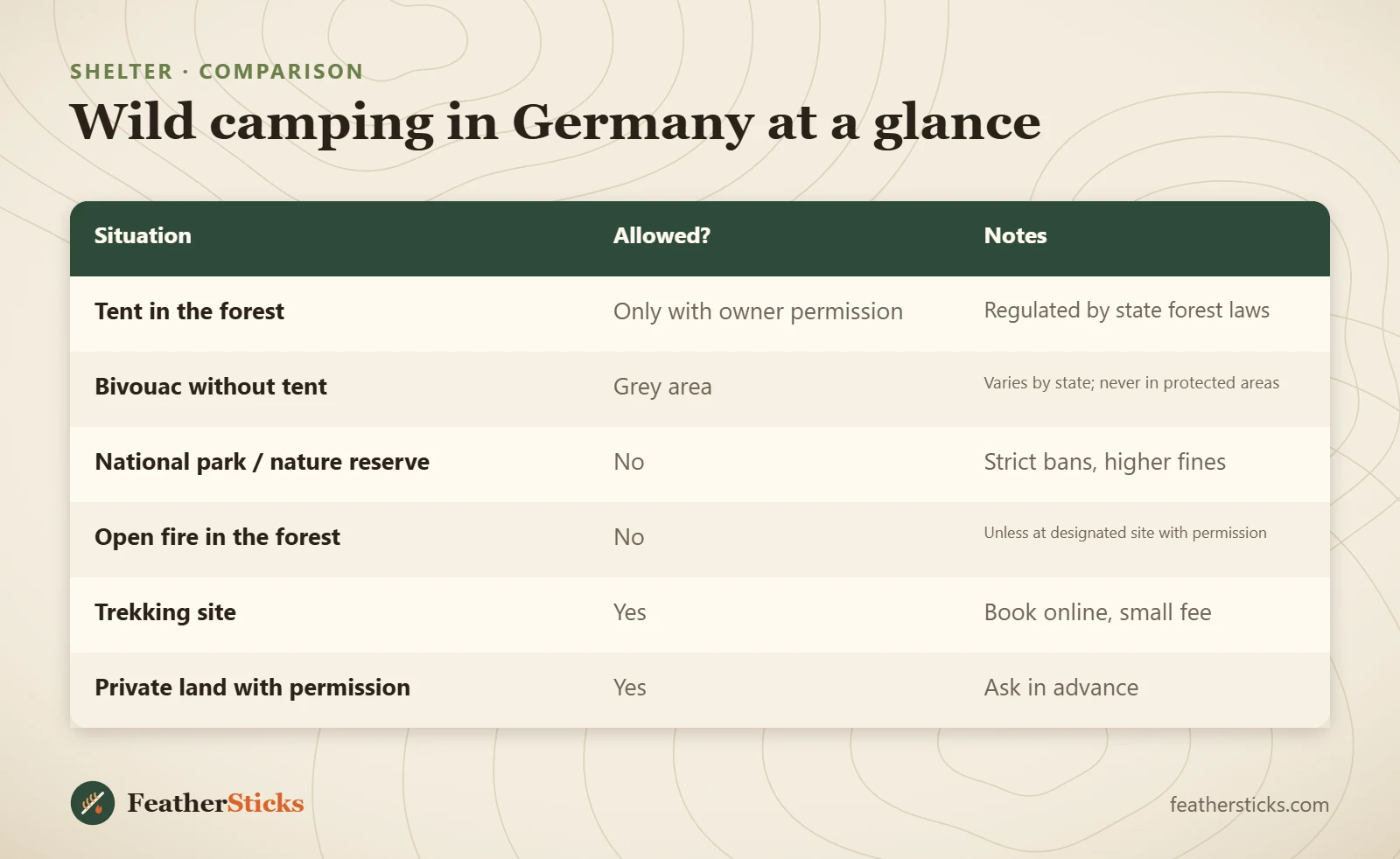
| Situation | Allowed? | Notes |
|---|---|---|
| Tent in the forest | Only with owner permission | Regulated by state forest laws |
| Bivouac without tent | Grey area | Varies by state; never in protected areas |
| National park / nature reserve | No | Strict bans, higher fines |
| Open fire in the forest | No | Unless at designated site with permission |
| Trekking site | Yes | Book online, small fee |
| Private land with permission | Yes | Ask in advance |
Common mistakes
- Assuming Germany has a Scandinavian-style right to camp anywhere.
- Relying on a single forum post – rules differ between the 16 states.
- Camping inside a nature reserve because the sign was overlooked.
- Lighting a campfire or even a stove in a dry forest.
- Leaving toilet paper, food scraps or a fire ring behind.
- Arguing with a ranger or landowner instead of leaving politely.
What you need
- Topographic map showing protected areas
- Bivy bag or small dark tarp
- Stove for legal sites (check rules)
- Trowel and waste bags
- Headlamp with red light
- Enough water for dinner and breakfast