Water
Water Purification Methods Compared: Boil, Filter, Tablets, UV
The main water purification methods for outdoor use are boiling, filtering, chemical disinfection (chlorine dioxide, chlorine, iodine) and ultraviolet light, plus solar disinfection (SODIS) as an emergency option. Only boiling reliably kills bacteria, viruses and all protozoa in any water. Filters miss viruses, chlorine and iodine barely touch Cryptosporidium, and UV fails in cloudy water — so the smartest approach is often a combination.
This guide compares every method against bacteria, viruses, Giardia and Cryptosporidium, lists realistic contact times and temperature effects, explains why turbidity matters and why no field method fixes chemical pollution, and ends with a decision tree. It builds on finding water and links to the detailed guides on boiling and filtering in our water section.
Step by step
-
1
Choose the cleanest source
Collect clear, flowing water upstream of trails, camps and farmland. Avoid any source with signs of chemical pollution or algae.
-
2
Remove cloudiness first
Let muddy water settle, then prefilter through cloth. Clear water makes every method — chemicals, UV, filters — work better.
-
3
Pick a method for the risk
Remote wild water: filter or tablets. Near people or abroad: boil, or filter plus chlorine dioxide. Cloudy water: boil.
-
4
Respect contact time
Boil 1 minute (3 above 2,000 m). Tablets need 30 minutes to 4 hours, longer in cold water. Follow the label exactly.
-
5
Store it clean
Keep treated water in clean, marked containers. Never let raw water touch threads, lids or your cup.
Water purification methods at a glance
No method is perfect. Each has a pathogen group it handles poorly, a condition under which it fails, and a cost in weight, time or fuel. The table summarises how well each method works against the four main groups of waterborne pathogens, based on the categories used by the CDC for backcountry and travel water treatment. "Good" assumes clear water and the correct dose and contact time.
| Method | Bacteria | Viruses | Giardia | Cryptosporidium |
|---|---|---|---|---|
| Boiling 1 min (3 min > 2,000 m) | Very good | Very good | Very good | Very good |
| Microfilter 0.1–0.2 µm | Very good | Poor | Very good | Very good |
| Purifier / ultrafilter (virus-rated) | Very good | Very good | Very good | Very good |
| Chlorine dioxide | Very good | Very good | Good (≈ 30 min) | Moderate (up to 4 h) |
| Chlorine (NaDCC, bleach) | Very good | Very good | Low–moderate | Not effective |
| Iodine | Very good | Very good | Low–moderate | Not effective |
| Silver ions alone | Slow | Poor | Poor | Not effective |
| UV light (pen / bottle) | Very good | Very good | Very good | Very good |
| SODIS (6 h sun, PET bottle) | Good | Moderate–good | Moderate | Uncertain |
Simplified. Real results depend on product, dose, temperature and turbidity. Always follow the manufacturer’s instructions.
Two conclusions stand out. First, boiling and a combination of filter plus chlorine dioxide are the only practical ways to cover all four groups in almost any water. Second, the weak spots of the other methods do not overlap much — which is exactly why combining two methods is so effective.

What are you protecting yourself from?
Waterborne illness in the outdoors is mostly caused by faecal contamination — from wildlife, livestock and people. The organisms fall into three groups that differ in size and in how resistant they are to treatment. Understanding them makes the strengths and weaknesses of each method obvious.
The three pathogen groups
- Bacteria (≈ 0.2–5 µm)
- E. coli, Campylobacter, Salmonella, Shigella. Easy to kill with heat and chemicals; removed by microfilters.
- Viruses (≈ 0.02–0.1 µm)
- Norovirus, hepatitis A, rotavirus. Mostly from human faeces. Too small for microfilters; killed by heat, chlorine, UV.
- Protozoa: Giardia (≈ 8–12 µm)
- Common in wildlife and livestock areas. Removed by filters; moderately resistant to chlorine and iodine.
- Protozoa: Cryptosporidium (≈ 4–6 µm)
- Very resistant to chlorine and iodine. Removed by filters, killed by boiling and UV, slowly by chlorine dioxide.
In the mountains and forests of Europe and North America, protozoa and bacteria from animals are the typical concern, which is why a microfilter alone is often considered adequate for remote water. Viruses become a significant risk near human activity: huts with septic systems, villages, popular lakes, campsites and in countries with limited sanitation. Snow and ice are not automatically clean either — see water from snow.
Symptoms of waterborne illness range from a day of diarrhoea to weeks of cramps and fatigue; some infections start only one to two weeks after drinking. This article is not medical advice. If you develop persistent diarrhoea, fever, blood in the stool or signs of dehydration — especially in children, older people or anyone with a weakened immune system — seek medical care and mention that you drank untreated or wild water. Oral rehydration salts belong in every first aid kit.
Boiling: the gold standard
Bring water to a rolling boil for 1 minute, or 3 minutes above about 2,000 m, as recommended by CDC and WHO guidance. Boiling kills every group of pathogens, works in cold and cloudy water and needs no chemicals. Its costs are fuel, time and waiting for the water to cool. At altitude water boils at a lower temperature — about 93 °C at 2,000 m — which is why the time is extended. The boiling point and fuel calculator shows the boiling point at your altitude and how much gas or wood you need.
Boiling is ideal in camp, where you run a stove or fire anyway for cooking. It is less practical for frequent refills on the move. All details — rolling boil, containers, fuel, cooling — are in our guide to boiling water.
Filters and purifiers
Hollow-fibre and ceramic microfilters (pore size roughly 0.1–0.5 µm) physically remove protozoa and bacteria and clear cloudy water, with no waiting time and no taste. They do not stop viruses. Purifiers — ultrafilters around 0.02 µm, electroadsorptive elements or filter-plus-chemical systems — also remove or inactivate viruses and should be tested to recognised standards such as the US EPA guide standard for microbiological purifiers.
Filters have two big weaknesses in the field: they clog in silty water, and hollow fibres can be destroyed by a single night of frost without any visible sign. Read our guide to filtering water for types, pore sizes, maintenance and frost protection.
Chlorine dioxide: the best chemical option
Chlorine dioxide (ClO₂) is sold as tablets or as two-part liquid drops that are mixed before use. Despite its name, it behaves differently from ordinary chlorine: it is effective against bacteria and viruses, good against Giardia, and — unlike chlorine and iodine — it also inactivates Cryptosporidium, though only slowly. It leaves less taste than chlorine and is relatively tolerant of pH.
Typical manufacturer instructions for clear water at moderate temperature are around 15–30 minutes for bacteria and viruses, about 30 minutes for Giardia and up to 4 hours for Cryptosporidium. In very cold or cloudy water, contact times increase, often doubling. Doses and times differ between products, so always follow the label. Tablets are light, keep for years if sealed, and cannot freeze or break — which makes them the ideal backup to any filter or stove.
How to use purification tablets correctly
 1Prefilter cloudy water
Turbidity binds disinfectant and shields germs. Let muddy water settle and pour it through cloth into the bottle first.
 2Measure the volume
Tablets are dosed for a specific volume — typically 1 litre. Fill exactly to the mark, not "about full"; an overfilled bottle is underdosed.
 3Add the tablet, close, shake
Drop in the tablet, screw the cap on and shake until it has fully dissolved. Undissolved fragments mean the clock has not really started.
 4Rinse the threads
Loosen the cap a little and tip the bottle so some treated water runs over the threads and the inside of the lid — raw water from filling sits exactly there.
 5Wait the full contact time
30 minutes for most germs, up to 4 hours if Cryptosporidium is a concern; longer in cold water. Start counting only after the tablet has dissolved.
 6Drink or store clean
Keep the treated bottle separate from raw-water containers and drink from it or a clean cup — never dip a cup into the source afterwards.
Chlorine tablets and household bleach
Chlorine-based tablets (usually sodium dichloroisocyanurate, NaDCC) and plain household bleach (sodium hypochlorite) are cheap and widely available. They kill bacteria and viruses well, but they are only moderately effective against Giardia and do not reliably inactivate Cryptosporidium. A typical contact time is 30 minutes; in cold or cloudy water, many guidelines recommend doubling the contact time or the dose.
In an emergency, unscented plain household bleach can disinfect clear water. The CDC gives dosing figures based on the concentration printed on the label — for common 6 % bleach this works out to roughly 2 drops per litre, with a 30-minute wait. Use only bleach without scents, thickeners or other additives, and follow current official guidance for the concentration you have. The water should have a faint chlorine smell after the contact time; if not, repeat the dose and wait again.
Chlorine leaves a residual that protects stored water from recontamination for a while, which is one reason it is used in drinking water systems. The taste can be reduced by letting treated water stand open for a while, by pouring it between containers, or — after the full contact time — with a pinch of vitamin C powder.
Emergency disinfection with household bleach
 1Check the bottle
Only plain, unscented household bleach without thickeners or other additives. Read the concentration on the label — the dose depends on it.
 2Dose per litre
For common 6 % bleach, roughly 2 drops per litre of clear water, following current official guidance. Double the dose if the water is cloudy or cold.
 3Wait, then smell
Close, shake and wait 30 minutes. The water should smell faintly of chlorine; if it does not, add the dose again and wait another 30 minutes.
Iodine: effective but with health limits
Iodine tablets and tincture have a long history in expedition use. They kill bacteria and viruses reliably and are moderately effective against Giardia, but, like chlorine, they are not effective against Cryptosporidium. Typical contact time is 30 minutes at room temperature and considerably longer in cold water. Iodine gives water a distinct taste and a brownish colour.
Silver: preservation, not disinfection
Silver-ion tablets and drops are widely sold in Europe, often side by side with disinfection products. Silver slowly inhibits bacteria and keeps already treated water fresh in tanks and bottles for weeks or months, but it acts slowly, is poor against viruses and protozoa, and is not a substitute for disinfecting wild water. Use it for storage of water that is already safe — not for treating water from a stream.
UV purifiers: fast, but only in clear water
Ultraviolet (UV-C) light damages the genetic material of microorganisms so they can no longer multiply. Battery-powered UV pens and UV bottle caps treat half a litre to a litre in roughly 60–90 seconds of stirring or shaking, depending on the model. UV works against bacteria, viruses, Giardia and Cryptosporidium alike, leaves no taste, and does not depend on water temperature.
The catch: UV only works on organisms the light actually reaches. Cloudy water, particles and dark tannin-stained water shield microbes, and the device has no way of telling you. UV also leaves no residual protection, needs batteries that weaken quickly in the cold, and can break when dropped. Treat clear, prefiltered water only, and carry tablets as backup.
Using a UV pen step by step
 1Check the clarity
Hold the filled bottle in front of printed text. If you cannot read it easily through the water, prefilter first — particles shield germs from the light.
 2Lamp fully in the water
Use a wide-mouth bottle, switch the pen on and immerse the lamp completely. The bottle rim must not touch raw water on the pen body.
 3Stir for the full cycle
Stir or swirl for the time the device shows — about 60–90 seconds for half a litre to a litre, depending on the model. Stop early and the dose is incomplete.
 4Close, keep clean, keep batteries warm
UV leaves no residual protection, so cap the bottle and keep it clean. In the cold, carry the pen and spare batteries inside your jacket.
UV pen vs chemical tablets
UV pen
- About 1 minute per litre
- Effective against all four groups incl. Crypto
- No taste, no chemicals
- Needs clear water, batteries, careful handling
- No residual protection
Chlorine dioxide tablets
- 30 min to 4 h waiting
- Crypto only with long contact time
- Slight taste
- Very light, cannot break or freeze
- Some residual effect in stored water
SODIS: solar disinfection as an emergency method
Solar water disinfection (SODIS), promoted by the WHO for households without other options, uses the combined effect of UV-A radiation and warmth. Fill a clear, unscratched PET bottle of up to 2 litres with clear water, shake it to add oxygen, and lay it flat in full sun for at least 6 hours — or two consecutive days if the sky is more than half cloudy. A dark or reflective surface underneath helps.
SODIS needs clear water: a common field test is whether you can read large print through the filled bottle from above. It does not work in rain, in thick cloud cover, with coloured or glass bottles, or with large containers. Effectiveness against viruses and Cryptosporidium is less certain than for bacteria. On a bushcraft trip in Central Europe it is a last resort when you have no fuel, filter or tablets — useful to know, not something to plan on.
SODIS in four steps
 1The right bottle
A clear, unscratched PET bottle of up to 2 litres. Coloured, painted, metal or insulated bottles do not let enough light through.
 2Fill and shake
Fill with clear water, shake it to add oxygen, then top it up and close it.
 3Flat in full sun
Lay the bottle flat on a dark or reflective surface in full sun for at least 6 hours, from morning to afternoon.
 4Clouds mean two days
If more than half the sky is cloudy, leave it for two consecutive days. In rain SODIS does not work — use another method.
Contact times, temperature and turbidity
Chemical disinfection is a race between the disinfectant and the microbes, and temperature sets the pace. Cold slows the reaction: in water near 0–5 °C, contact times typically need to be doubled compared with room temperature. Turbidity makes it worse, because particles consume disinfectant and give microbes places to hide. That is why every serious guideline says the same: clear first, then disinfect.
| Method | Clear water, ≈ 20 °C | Cold (≤ 5 °C) or cloudy | Notes |
|---|---|---|---|
| Boiling | 1 min rolling boil | Same (3 min > 2,000 m) | Temperature-independent — the reference method |
| Chlorine dioxide | 15–30 min (bacteria, viruses), 30 min (Giardia), up to 4 h (Crypto) | Often double | Best chemical option |
| Chlorine (NaDCC, bleach) | 30 min | 60 min or double dose | Not effective against Crypto |
| Iodine | 30 min | 60 min or longer | Not effective against Crypto; health limits |
| UV pen | ≈ 60–90 s per 0.5–1 L | Same, but batteries weaken | Cloudy water: not reliable |
| SODIS | 6 h full sun | 2 days if > 50 % cloud | Clear PET bottles ≤ 2 L only |
| Microfilter | No wait | Risk of frost damage | Viruses not removed |

Before you drink: quick checkpoints
- Clarity: you could read print through the bottle before treating.
- Dose: the right number of tablets or drops for the actual volume, fully dissolved.
- Time: the full contact time on the label has passed since dissolving — extended for cold or cloudy water, 4 hours where Cryptosporidium matters.
- Threads and lid: rinsed with treated water.
- Smell (chlorine): a faint chlorine smell remains after the contact time.
How to deal with cloudy water
- Settle: let the water stand for 30 minutes to several hours, then pour off the clear upper part.
- Prefilter: bandana, coffee filter or an improvised sand-and-charcoal sediment filter.
- Choose boiling if the water stays cloudy — it is the only method unaffected by turbidity.
- With chemicals, use the longer contact time or double dose as the label instructs for cloudy water.
Combining methods for complete protection
Because the weak spots of the methods differ, two methods together often cover everything — with less fuel than boiling everything and less waiting than tablets alone. The order matters: remove particles first (settling, prefilter, filter), then disinfect.
| Combination | Covers | When to use |
|---|---|---|
| Microfilter + chlorine dioxide | All four groups | Travel, water near settlements, groups |
| Microfilter + UV | All four groups | Fast, no taste; filter clears the water for UV |
| Microfilter + boiling | All four groups | Filter on the move, boil in camp |
| Prefilter + chlorine | Bacteria, viruses (not Crypto) | Budget option where Crypto risk is low |
| Settling + boiling | All four groups | Very muddy water, winter, no filter |

| Problem | Likely cause | What to do |
|---|---|---|
| Strong chlorine taste | Dose for cloudy water used in clear water, or overdosed | Let it stand open, pour between containers, or add vitamin C after the contact time |
| No chlorine smell after 30 min | Water very dirty or too cold, dose used up | Dose again and wait again; prefilter next time |
| UV pen shows an error or stops | Weak or cold batteries, lamp not submerged | Warm the batteries, restart the full cycle; tablets as backup |
| Tablet will not dissolve | Very cold water, old or damp tablets | Crush it in the cap, shake longer, keep tablets sealed and dry |
| Filter flow suddenly faster | Possible frost or impact damage | Stop using it; boil or disinfect instead |
The complete treatment chain
- SourceClearest, cleanest water you can find — the only defence against chemicals.
- ClearSettle and prefilter; remove sediment.
- RemoveFilter out protozoa and bacteria.
- KillBoil, UV or chlorine dioxide for viruses and the rest.
- StoreClean, marked containers; no raw-water contact.
The limit of every method: chemical pollution
Everything above deals with germs. None of the standard outdoor methods reliably removes dissolved chemicals: pesticides, nitrate from fertiliser, fuel and oil, heavy metals from old mines, industrial pollutants, salt, or the toxins produced by blue-green algae. Boiling can even concentrate them. Activated carbon, found in some filters, can reduce certain organic chemicals and improve taste, but its capacity is limited and unknown in the field. Distillation and reverse osmosis are the only processes that remove most dissolved substances, and neither is practical on a normal trip.
Which water purification method should you use?
Use this decision tree as a starting point. It assumes you have already chosen the best available source and ruled out chemical pollution.
Choosing your purification method
Is the water cloudy even after settling?
Yes → Prefilter and boil — the only method unaffected by turbidity.No → Continue.Is there a significant virus risk (near huts, villages, pasture, popular lakes, abroad)?
Yes → Boil, or filter plus chlorine dioxide or UV.No → Continue.Is Cryptosporidium a concern (livestock, wildlife areas)?
Yes → Use a filter, UV or boiling — not chlorine or iodine alone.No → Continue.Is frost likely tonight?
Yes → Keep the filter in your sleeping bag or rely on boiling and tablets.No → A microfilter is a fast, taste-free choice.Do you have a backup method?
Yes → Good — you are covered if the main method fails.No → Pack chlorine dioxide tablets: 20 g of insurance.
Common water purification myths
- "Fast-flowing water purifies itself." Movement adds oxygen and reduces algae, but it does not remove Giardia, Cryptosporidium or viruses. A stream a few hundred metres below a pasture can carry plenty of them.
- "High mountain water is always safe." Wildlife, grazing animals and hikers reach remarkable heights. Clear, cold water is a good sign, not a guarantee.
- "Clear water does not need treatment." The pathogens that matter are microscopic. Clarity tells you about sediment, not about germs.
- "A few drops of iodine or a squirt of bleach and you can drink immediately." Chemicals need their full contact time, and cold water slows them down considerably.
- "A filter with activated carbon removes everything." Carbon improves taste and adsorbs some chemicals, but it does not make a microfilter virus-proof and its chemical capacity is limited.
- "Alcohol, tea or instant coffee disinfect water." None of these reliably kills pathogens at the concentrations you would drink. Only tea made with properly boiled water is safe — because of the boil, not the tea.
- "Snow is distilled water, so it is clean." Snow collects dust, droppings and anything blown onto it; old snow near huts and trails can be heavily contaminated. Treat melted snow like any other wild water.
The underlying rule is simple: treat every wild source as contaminated, choose a method that matches the risk, give it the full time it needs, and keep treated water clean afterwards.
Hygiene: the weak link after treatment
Many cases of "water sickness" on trips are actually hand-to-mouth infections. Treated water is only as clean as the container it goes into and the hands that touch it. Use separate, clearly marked containers for raw and treated water, never dip a treated bottle into the source, and let treated water run over bottle threads when using tablets. Wash or sanitise your hands after toilet stops and before handling food and water — our guide to storing food at camp covers kitchen hygiene, and choosing a camp site explains how to keep toilet areas well away from water.
Choose containers that are easy to clean and suit your method — wide-mouthed bottles for UV pens and tablets, a metal bottle for boiling. See our guide to water containers.
Planning water treatment for your trip
Start with the volume. The water needs calculator estimates drinking and cooking water per day and for the whole trip — and translates that into roughly how many tablets and how much filter capacity you need (about one tablet per litre for most products). A typical adult on a mild day with six active hours needs around 4 litres to drink plus cooking water.
Then choose a primary method and a backup that fails in different ways:
- Summer, remote forest or mountains: squeeze filter + chlorine dioxide tablets as backup.
- Group base camp: gravity filter + boiling for cooking water.
- Winter: stove and pot for melting and boiling + tablets; keep any filter warm.
- Travel with poor sanitation: purifier or filter + chlorine dioxide; boil when possible.
- No stove, fire allowed: boil over a fire — solid fire-starting skills make this realistic even in the rain.
Add your chosen method to your kit list or build a weighted list with the Kit Builder. Water treatment is one of the core skills in bushcraft for beginners — practise it at home before you depend on it outdoors.
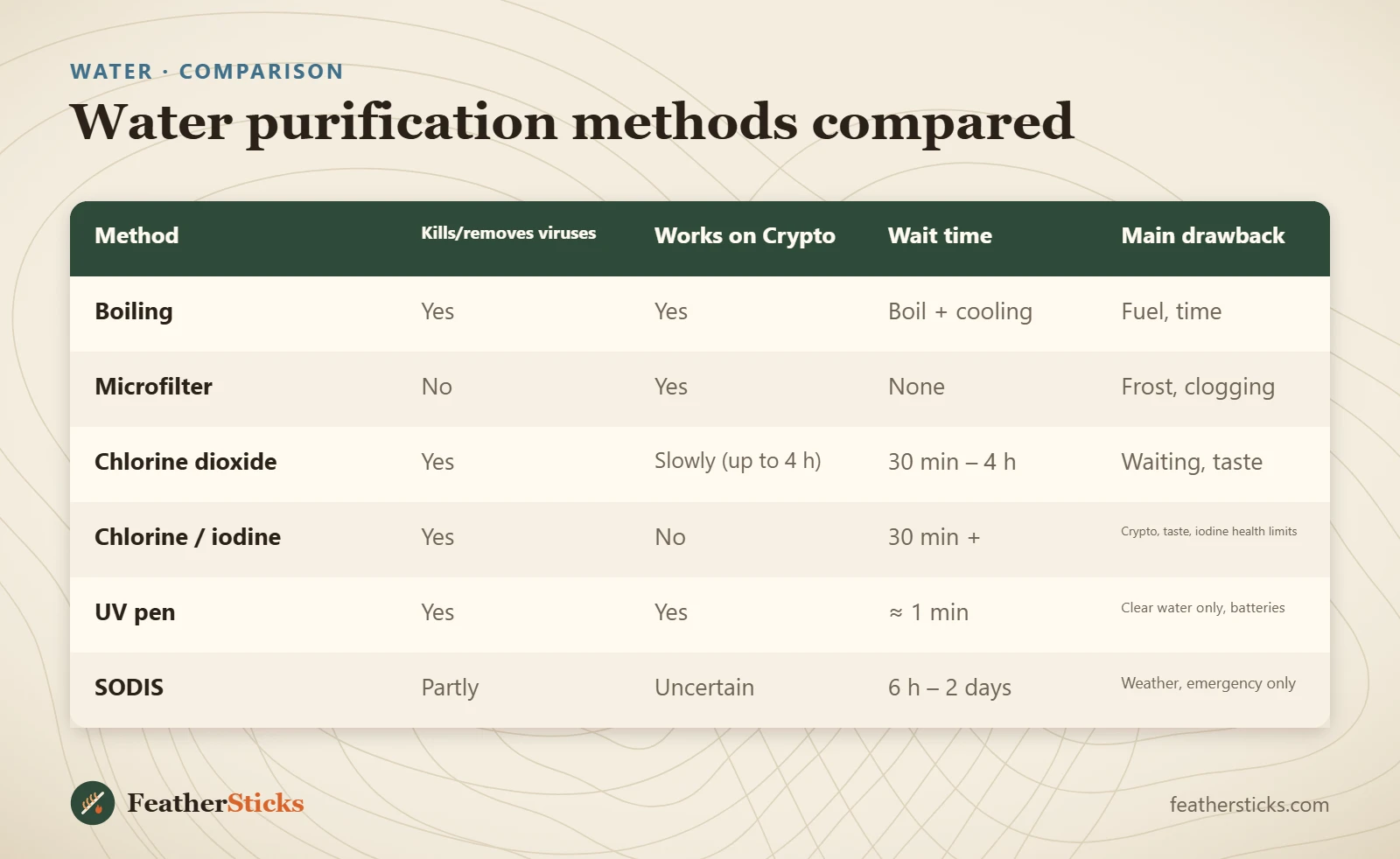
| Method | Kills/removes viruses | Works on Crypto | Wait time | Main drawback |
|---|---|---|---|---|
| Boiling | Yes | Yes | Boil + cooling | Fuel, time |
| Microfilter | No | Yes | None | Frost, clogging |
| Chlorine dioxide | Yes | Slowly (up to 4 h) | 30 min – 4 h | Waiting, taste |
| Chlorine / iodine | Yes | No | 30 min + | Crypto, taste, iodine health limits |
| UV pen | Yes | Yes | ≈ 1 min | Clear water only, batteries |
| SODIS | Partly | Uncertain | 6 h – 2 days | Weather, emergency only |
Common mistakes
- Relying on a microfilter alone near huts, villages or abroad, where viruses are likely.
- Using chlorine or iodine alone where Cryptosporidium is a risk.
- Using UV or tablets on cloudy water without prefiltering.
- Cutting contact times short, especially in cold water.
- Believing any field method removes chemical pollution.
- Recontaminating treated water via bottle threads, lids, cups or hands.
- Carrying no backup when the filter freezes or the UV battery dies.
What you need
- Chlorine dioxide tablets or drops
- Hollow-fibre filter or virus-rated purifier
- Metal pot and stove for boiling
- UV pen with spare batteries (optional)
- Bandana or coffee filters for prefiltering
- Marked raw and treated water containers
- Hand sanitiser and oral rehydration salts