
Feather Sticks
How to make a feather stick that lights first time: best wood, knife grips, push and pull curls, fatwood, fixing problems and carving in the rain.
Light, build and manage a fire in any weather.
Fire is the bushcraft skill that makes every other one easier: it warms you, dries your kit, turns doubtful water into safe drinking water and cooks your food. This hub collects every fire guide on the site in a logical order, so you can go from your first match to a friction fire in the rain.
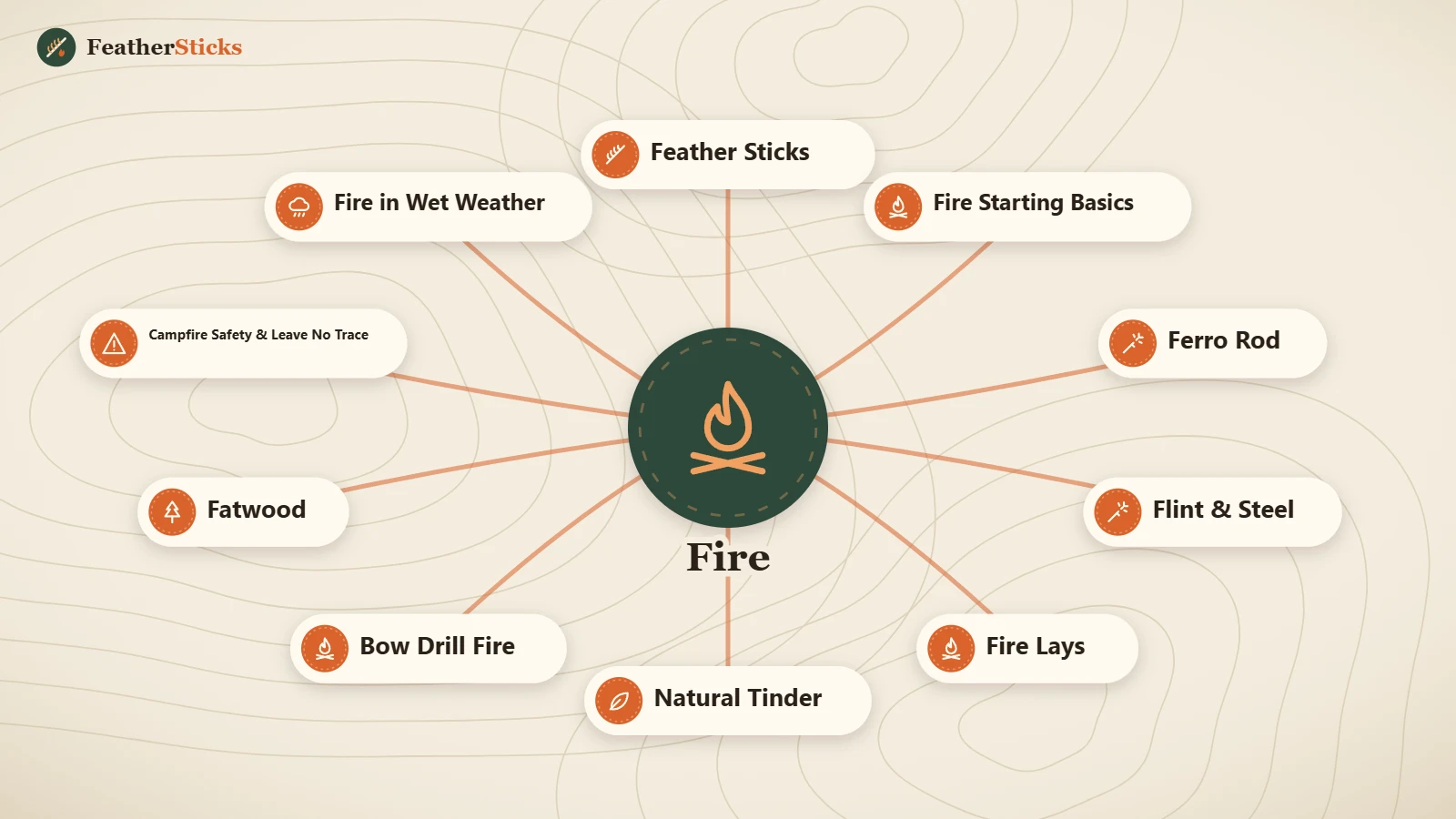
Start with fire starting basics – the fire triangle and the tinder-kindling-fuel ladder. Learn to find and process natural tinder, carve feather sticks and harvest resin-rich fatwood. Then pick your ignition: the all-weather ferro rod, traditional flint and steel with char cloth, or the classic friction method, the bow drill.
With the right fire lay you build exactly the fire you need – a quick boil, a cooking bed of embers or a long reflector fire for the night. Put it all together in fire in wet weather, and read campfire safety and Leave No Trace before you strike anything. Fire rules vary by country and season: always check local bans first.
How to make a feather stick that lights first time: best wood, knife grips, push and pull curls, fatwood, fixing problems and carving in the rain.
How to start a fire step by step: fire triangle, site prep, tinder to fuel, every ignition method compared, troubleshooting and putting it out safely.
How to use a ferro rod: remove the coating, master the pull-back strike, choose the best striker and tinder, and fix a rod that will not spark.
Learn flint and steel fire lighting: the right striker and stone, how to make char cloth, the striking technique and how to blow an ember into flame.
Types of fire lays compared: teepee, log cabin, lean-to, star, long fire, Dakota hole, platform, upside-down, keyhole and Swedish torch, with build steps.
Natural tinder explained: birch bark, dry grass, cattail fluff, fatwood and fungi – how to find tinder in every season, process it and keep it dry.
Bow drill fire made simple: best wood, exact sizes, notch geometry, bowing technique and a troubleshooting guide that turns smoke into an ember.
What fatwood is, where to find it in pine stumps and knots, how to identify it by smell, colour and weight, and how to harvest and use it for fire.
Campfire safety made simple: fire bans and danger levels, site selection, clearance, wind, fire pans, how to put out a campfire and Leave No Trace.
How to start a fire in the rain: find dry fuel, split wood to the dry core, build a platform, shelter the fire, use fire extenders and keep it burning.
Most failed fires are not ignition problems – they are preparation problems. That is why the learning path below starts with materials, not with sparks. Each stage builds on the one before, and each has its own in-depth guide. Work through them in order and practise every stage at home or at a legal fire site before you rely on it in the field.
A sensible rule of thumb: only move to a harder ignition method once you can reliably light a fire with an easier one using natural materials. If a lighter and a bundle of birch bark still give you trouble, a bow drill will not.
The fire skills ladder
Around this core sit supporting skills from other sections. A sharp knife and good technique are the basis for feather sticks and bow drill parts, so read up on choosing a bushcraft knife, safe carving grips and batoning wood to reach the dry core of wet logs. If you are completely new, the bushcraft for beginners guide puts fire in context with shelter, water and navigation.
There is no single "best" way to start a fire – there is the right method for your skill level, weather and kit. Modern tools trade tradition for reliability; traditional methods trade reliability for self-sufficiency and deep understanding. The table compares every ignition method covered on this site and a few you will meet elsewhere.
| Method | Difficulty | Works when wet | Tinder needed | Best use |
|---|---|---|---|---|
| Lighter (disposable) | Very easy | After drying the wheel; weak in deep cold | Any dry tinder, small kindling | Everyday backup in every kit |
| Storm / stormproof matches | Very easy | Yes, burn in wind and rain | Any dry tinder | Emergency kit, first-aid pouch |
| Ferro rod | Easy | Yes – wipe and strike | Fine, fluffy tinder or feather stick curls | Primary all-weather igniter |
| Flint and steel | Medium | Only with dry char material | Char cloth, amadou or charred punkwood | Traditional kit, historical interest |
| Bow drill | Hard | Poorly – needs dry wood and dry air | Ember into a fine tinder nest | Skill-building, self-reliance |
| Hand drill | Very hard | Poorly | Ember into a fine tinder nest | Advanced friction practice |
| Lens / solar ignition | Medium | Needs strong direct sun | Dark, charred tinder | Sunny days, backup only |
| Battery + fine steel wool | Easy | Steel wool burns even damp | Any dry tinder | Improvised emergency method |
Always carry at least two independent ignition sources. More detail on each method: all ignition methods explained.
Skill needed (1 = none, 10 = expert)
Whatever you strike, the result depends on what the spark or ember lands in. A ferro rod throws hot sparks that catch fine, dry fibres; flint and steel and friction methods produce a tiny ember that needs a well-built tinder nest. That is why finding and preparing tinder matters as much as the igniter itself.
Once the flame is going, the shape of the fire decides what it is good for. A tall teepee boils a pot quickly but eats wood; a log cabin collapses into an even bed of embers for cooking; a long log or reflector fire throws heat into a shelter all night. The Fire Lay Picker suggests a lay from your purpose, weather and ground, and the fire lays guide shows how to build each one.
| Goal | Recommended lay | Wood | Tip |
|---|---|---|---|
| Boil water fast | Teepee or small top-down fire | Thin, dry softwood | Use the boiling point calculator to plan fuel |
| Cook a meal | Log cabin → ember bed | Hardwood (beech, oak, ash, maple) | Cook over embers, not flames – see campfire cooking |
| Warmth at camp | Long log or reflector fire | Thick, seasoned hardwood | Build the reflector wall facing your shelter |
| Wet or snowy ground | Platform fire | Split wood, dry core | Follow the wet-weather method |
| Low profile, windy site | Dakota fire hole (where digging is allowed) | Small, dry sticks | Restore the turf completely afterwards |
The best fuel is dead wood that is still off the ground. Dead lower branches on conifers such as pine and spruce often stay dry inside even after rain and make excellent kindling. Birch bark from fallen trees lights readily thanks to its natural oils. Dense hardwoods like oak, beech, ash and maple give long-lasting cooking embers, but only go on once the fire is well established.
Wood lying on the ground soaks up moisture and rots quickly – if it does not snap cleanly, leave it. Never cut living trees or branches: it is usually not permitted without the landowner's consent, and green wood burns poorly and smokes heavily.
A campfire is only a bushcraft skill if it is under control from the first spark to the last cold ash. Most wildfires in temperate regions are started by people. Every guide on this hub assumes you are in a place where fire is permitted and conditions are safe.
Site check in 60 seconds
A good fire kit is small, redundant and waterproof. Carry at least two ways to make fire (for example a ferro rod and a lighter), prepared tinder that stays dry, and a knife that can process wood. The bushcraft kit list shows where the fire kit fits into your full pack, and the Kit Builder creates a weighted list for your trip.
The layered fire kit (top = used first)
Practise with the kit you carry. Strike your ferro rod on a dry evening at home, prepare a tin of char cloth for your flint and steel, and carve a bow drill set from local wood before you ever need one. Skill weighs nothing – and it is what turns a pocketful of gear into a warm, controlled fire.
How much wood to gather for cooking, warmth or a full night — split into tinder, kindling and fuel.
Pick purpose, weather and ground — get the best fire lay and how to build it.