Fire
Natural Tinder: How to Find, Prepare and Store It
Natural tinder is the finest, driest material in your fire: the part that catches a spark or ember and burns long enough to light your kindling. The best natural tinder is dead, fibrous and bone dry – outer birch bark, dry grass, cattail fluff, shredded inner bark and fatwood shavings top the list almost everywhere in temperate forests.
Knowing how to find tinder is only half the skill. You also need to process it finely enough for your ignition method, build it into a proper bundle and keep it dry until the moment you need it. This guide covers all of that, season by season and habitat by habitat, and fits into the bigger picture of fire starting basics and our complete fire skills hub. New to the woods? Start with bushcraft for beginners.
Step by step
-
1
Look up, not down
Collect dead grass, bark and plant fluff still hanging off the ground. Standing dead material is far drier than anything lying in the leaf litter.
-
2
Gather two kinds of tinder
Take a fine spark-catcher (fluff, scraped bark) and a longer-burning flame-extender (grass, bark strips, fatwood shavings).
-
3
Process it finely
Scrape, shred and buff the material between your palms until it is hair-fine and airy. Finer fibres catch sparks far more easily.
-
4
Build a bird's nest
Form a fist-sized nest of coarse fibres with a pocket in the middle, then pack your finest spark-catching material into that pocket.
-
5
Keep it dry
Carry collected tinder in a pocket or waterproof bag close to your body. Body heat keeps drying it while you walk.
What does tinder actually have to do?
Tinder has exactly two jobs. First, it must catch the small amount of heat your ignition source delivers – a shower of sparks from a ferro rod, a tiny spark from flint and steel, a glowing ember from a bow drill or the flame of a match. Second, it must burn long and hot enough to set pencil-lead-thin kindling alight. Material that does only one of these jobs is half a tinder.
That is why the physical form matters more than the species. Fire needs heat, fuel and oxygen. Fine fibres have a huge surface area relative to their mass, so a spark heats them to ignition temperature in an instant, and the loose structure lets oxygen in from every side. A solid lump of the same material would just absorb the heat and go nowhere.
Tinder vs kindling
Tinder turns a spark or ember into a flame. Kindling turns that small flame into a fire. Kindling means dry dead twigs from matchstick to thumb thickness, split sticks or feather sticks. If your tinder flares up and dies without lighting anything, the problem is often not the tinder at all but kindling that is too thick or damp. Work out how much of each you need with the firewood calculator, which splits a fire into tinder, kindling and fuel.
Where tinder sits in a fire
- Wrist-thick and larger dead wood, added once the kindling burns strongly.
- Matchstick to thumb-thick dry twigs and split sticks – catches from the tinder flame.
- Coarser tinder: grass, bark strips, fatwood shavings – burns for 20 seconds to a minute or more.
- The finest tinder at the core: fluff, scraped bark dust, charred material.

Spark-catching vs flame-extending tinder
Most failed fires come from using one type of tinder for both jobs. Think of your bundle as a team of two.
Spark-catchers
These are the finest, airiest materials: cattail fluff, thistle and fireweed down, the seed fluff of old man's beard, finely scraped birch bark, buffed inner bark and fatwood dust. They ignite from a single spark, but many of them burn out in one or two seconds. On their own they are rarely enough to light kindling.
Flame-extenders
These are slightly coarser: dry grass, strips of birch bark, shredded cedar or lime bark, pine needles and thin fatwood shavings. They are harder to light directly with a spark but hold a flame long enough – often half a minute or more – to get kindling going.
Ember-catchers
For flint and steel or friction fire you need a third category: materials that take a spark or ember and smoulder rather than flame. Char cloth, charred punkwood, charred cattail fluff, prepared amadou and chaga fall into this group. You blow the glowing ember into flame inside a nest of flame-extenders.


What good tinder looks and feels like
Before you strike, hold the tinder up to the light and squeeze it. Good tinder passes four quick checks:
- See-through: you can see light through the fluffed bundle. If it looks solid, it is packed too tight.
- Crackles, does not bend: dry grass stems snap and rustle. Soft, silent stems are damp.
- Warm and light: dry material feels warm and weighs almost nothing. Cool, heavy tinder is holding water.
- Hair-fine edges: the finest part is as thin as hair, not as thick as a matchstick.
Best natural tinder: the key materials
Which is the best natural tinder? It depends on where you are and what the weather has done, but the materials below are reliable across most temperate and boreal forests in Europe and North America.
Birch bark
The papery outer bark of birch contains betulin and natural oils that burn hot and sooty, and it resists moisture well enough to light even when the surface is damp. Scrape it with the spine of your knife into a pile of fine dust and curls to catch a ferro rod spark, and add thin strips as flame-extender. Collect only from dead, fallen birches or pieces that have already fallen off.
Dry grass
Standing dead grass from late summer to winter is one of the most widespread tinders. Pick it at waist height rather than from the ground, strip the stems and roll the finer blades into a nest. Grass burns fast, so use a generous amount.
Cattail (reedmace) fluff
The brown seed heads of cattail burst into huge amounts of fluff. It catches a spark almost instantly but burns in a flash, so pack it into the heart of a grass nest. Charred, it also makes a good ember-catcher.
Clematis, thistle and fireweed
Old man's beard (wild clematis) gives you two tinders: the shaggy bark of old dead vines, which shreds into excellent fibres, and the feathery seed heads. Thistle and fireweed down work like cattail fluff – great spark-catchers, very short burn.
Inner bark fibres
The fibrous inner bark of cedar, juniper, lime (basswood) and willow can be buffed into soft, hair-like tinder that burns well. Take it only from dead wood – dead branches, fallen limbs or long-dead standing trunks. The same fibres are used for natural cordage, so you practise two skills at once.
Fatwood shavings
Resin-saturated pine heartwood, usually found in old stumps and at the base of dead branches, is the king of wet-weather tinder. Scrape it into fine dust for spark-catching and shave thin curls as a long-burning extender. See our full guide to finding and using fatwood.
Pine needles and dry leaves
Dry, brown pine needles burn quickly with a hot flame and make a decent flame-extender in bulk. Dry leaves are usually a poor tinder on their own: they curl, smoulder and smoke. Crushed very fine and mixed with grass they help, but do not rely on them.
Punkwood
Punkwood is dry, soft, crumbly rotten wood, often found inside dead standing trees. It rarely flames from a spark, but once charred it catches sparks and holds an ember for a long time.
Tinder fungus, amadou and chaga
The hoof-shaped tinder fungus (Fomes fomentarius) grows on dead and dying birch and beech. Its inner layer can be processed into amadou, a leathery felt that takes sparks from flint and steel and smoulders slowly. Chaga, a black, cracked growth on birch, has an orange-brown inner layer that catches sparks, especially once charred. Both are ember-catchers, not flame-makers. This article covers them only as fire materials – never as food or medicine.
Tip: scrape birch bark and fatwood with the sharp 90° spine of your knife, not the edge – finer dust, and your edge stays keen. See choosing a bushcraft knife.

How to find tinder in every season
Tinder availability changes a lot through the year. Spring can be surprisingly hard, while late summer and autumn are generous. Plan your fire strategy around the season, and always carry a backup.
| Season | Best finds | Watch out for |
|---|---|---|
| Spring | Last year's dead grass and cattail heads, birch bark from fallen trees, fatwood, dead clematis bark | Wet ground, fresh green growth hiding dry material, bird nesting season – avoid disturbing hedges |
| Summer | Dry grass, thistle and fireweed down, pine needles, inner bark fibres from dead wood | High wildfire risk and fire bans – check local rules before lighting anything |
| Autumn | Cattail and clematis seed heads, dry grass stands, dry leaves, tinder fungus on dead wood | Frequent rain – collect on dry days and dry it in your pocket |
| Winter | Birch bark, fatwood, dead grass above the snow, clematis vines, punkwood inside dead standing trees | Snow and frost melt on contact with warm hands – store tinder in an inner pocket |
Across all seasons the rule is the same: dead, off the ground, sheltered. Winter frost can actually help, because cold, dry air leaves standing grass crisp. Wet autumn weeks are the hardest; see lighting a fire in wet weather for strategies when everything is soaked.
Where to find tinder by habitat
Reading the landscape tells you what to look for before you even start searching. Choosing a camp near good tinder and dry dead wood is part of choosing a good camp site.
Conifer forest
Pine, spruce and fir forests offer fatwood in old pine stumps, resin blisters on dead spruce, dry needles under dense canopy and dead twigs on the lower trunk of spruce – often dry even after rain.
Deciduous forest
Birch is the star here: look for fallen trunks and loose bark pieces. Beech and birch deadwood may carry tinder fungus. Lime and willow deadwood give inner bark fibres, and clematis vines climb woodland edges and hedges.
Wetland and lakeshores
Cattail stands are the obvious resource, plus dead reed stems and dry sedge tops. Willow thickets add dead inner bark. The ground is wet, so collect from standing plants only and keep your haul in a bag.
Grassland and heath
Standing dead grass, thistle heads and fireweed down are everywhere from midsummer. These open habitats also dry out and catch fire fastest, so be extra careful with sparks and wind.
Coast
Dry beach grass above the high-tide line, sun-bleached driftwood that can be scraped into fine shavings, and dead shrub bark.
How to process natural tinder
Raw material rarely lights well straight from the plant. Processing means making it finer, drier and fluffier. The main techniques:
- Scraping: run the knife spine or a sharp edge held at 90° along birch bark or fatwood to produce fine dust and tiny curls.
- Buffing: roll bark fibres or grass vigorously between your palms until they separate into hair-like strands.
- Shredding: pull inner bark apart into thin strips, then buff those strips.
- Fluffing: tease cattail, thistle or clematis seed heads apart so air gets between the fibres.
- Drying: keep slightly damp material in a shirt or trouser pocket all day. Body heat and movement dry it gradually.
Knife control matters when scraping close to your hands; the grips from basic carving – especially working away from your body and bracing the material on a log – keep this safe.
Four ways to make tinder finer
 1Scrape
Lay birch bark or fatwood on a log and scrape it with the square knife spine, blade upright. Short strokes build a small pile of dust and tiny curls next to the bark.
 2Buff
2BuffRoll grass or bark fibres hard between your palms, as if warming your hands. Keep going until the strands separate and feel soft and hair-like.
 3Shred
Pull strips of dead inner bark apart lengthwise into ever thinner strands, then buff them. Work from the frayed end, where the fibres already open.
 4Fluff
Tease cattail, thistle or clematis heads apart so air gets between the fibres. Do it over your nest or a bag: the fluff blows away at the slightest breeze.
How to build a tinder bundle (bird's nest)
A good tinder bundle combines coarse, fine and finest materials in one structure. It is the standard shape for catching an ember from a bow drill or char cloth, and works just as well with a ferro rod if you open the centre.
Building a bird's nest step by step
 1Gather enough
Collect material for two fists' worth of loose nest – more in damp weather. Too little tinder is the most common beginner mistake.
 2Form the outer shell
Twist coarser grass, bark strips or needles into a ring about the size of your hand, like a bird's nest. Tuck the ends in so it holds its shape when you lift it.
 3Add the middle layer
Line the inside with finer grass and buffed inner bark fibres. This layer takes the flame from the core and passes it to the shell.
 4Fill the core
Press a thumb-deep pocket into the middle and fill it loosely with your finest spark-catcher: fluff, birch bark dust or fatwood scrapings.
 5Place the ember or spark
Drop an ember into the pocket, or strike sparks straight onto the core. Keep the pocket open towards the spark.
 6Close and blow
Fold the nest loosely around an ember and blow gently and steadily from below until it bursts into flame, then place it under your kindling. Turn your face away from the flare-up.
Checkpoints for a good nest
- Size: about two fists, and it still springs back when you squeeze it lightly.
- Light: you can see daylight through the shell. A dense ball smothers the ember.
- Order: coarse outside, fine inside, finest in the pocket, never the other way round.
- Dry: it rustles. Damp nests hiss, steam and turn brown instead of flaming.
Nest troubleshooting
- Ember glows but the nest will not flame: the pocket is too coarse, or you are blowing too hard. Add finer fibres around the ember and blow long and slow.
- Lots of white smoke, then nothing: the material is damp. Dry it in an inside pocket, or add birch bark or fatwood shavings.
- Flames up and burns out before the kindling catches: too little flame-extender. Make the shell thicker and put the nest under the kindling before it flames.
- The ember falls through: the core is too loose or the pocket too shallow. Press a proper hollow and line it with fluff.
Have your kindling and fire lay ready before you light the bundle – a burning nest gives you seconds, not minutes. The fire lay picker helps you choose the right structure for your conditions, and our guide to fire lays explains how to build each one.
Charred tinder for flint and steel and friction fire
Traditional flint and steel throws small, relatively cool sparks. Ordinary natural tinder rarely catches them. The solution is char: plant material heated with little or no oxygen so it becomes carbon-rich and catches a spark as a glowing ember.
Char cloth
Cut 100% cotton or linen into small squares, put them in a small tin with a tiny hole in the lid and place it on hot embers. Smoke and flammable gas jet out of the hole. When the smoke stops, remove the tin and let it cool closed. The squares should be black and flexible, not grey and crumbly.
Charred natural materials
The same tin method works with punkwood, cattail fluff, dry fungus pieces and cordage fibres. Charred punkwood and charred cattail are excellent natural alternatives to char cloth. Once you have a fire, char a new batch for next time.
For friction fire, the dust your spindle produces is itself charred and forms the ember; you need a well-built bird's nest to take it. See how to make a bow drill fire for the full method.
Making char cloth in a tin
 1Cut the squares
Cut small squares of 100% cotton or linen, for example from an old T-shirt or tea towel. Synthetic blends melt instead of charring.
 2Tin on the embers
Put the squares in a small tin with a tiny hole in the lid and set it on hot embers. Smoke and flammable gas jet out of the hole; that is normal.
 3Remove when the smoke stops
When no more smoke comes out, lift the tin off with a stick and let it cool with the lid closed. Opening it hot lets air in and the cloth burns to ash.
 4Check the result
Good char cloth is black, flexible and in one piece. Grey, crumbly squares were overcooked or got air; brown ones need more time.
Natural tinder compared: which works when?
The table below compares the most common natural tinders by ignition source and conditions. Ratings are practical rules of thumb, not lab measurements – moisture, processing and species all shift the results.
| Tinder | Catches ferro spark | Catches ember | Burn time | When damp | Where found |
|---|---|---|---|---|---|
| Birch bark (scraped) | Very good | Poor | Medium | Good | Fallen birches, deciduous and mixed forest |
| Fatwood shavings | Good | Poor | Long | Excellent | Old pine stumps, dead branch bases |
| Dry grass nest | Medium | Good (as nest) | Short | Poor | Meadows, clearings, field edges |
| Cattail fluff | Excellent | Good when charred | Very short | Poor | Wetlands, ditches, lakeshores |
| Clematis bark | Good | Good (as nest) | Short–medium | Medium | Hedges, woodland edges |
| Cedar / lime inner bark | Good | Very good | Medium | Medium | Dead branches and fallen limbs |
| Pine needles | Poor | Poor | Short | Poor | Conifer forest floor (dry spots) |
| Charred punkwood / char cloth | Good | Excellent (smoulders) | Long smoulder | Poor | Rotten deadwood / made at camp |
| Amadou / chaga (prepared) | Good | Excellent (smoulders) | Long smoulder | Medium | Birch and beech, dead or dying trees |
Relative flame time of a fist-sized handful (rough guide)
How to store and carry tinder
The best time to collect tinder is hours before you need it. Pick up good material whenever you see it – a strip of loose birch bark, a handful of standing dry grass, a cattail head – and stuff it in a pocket or a small bag. By evening you have a dry, varied supply without a frantic search in the dusk.
Tinder kit checklist
- Waterproof tin or zip bag for collected natural tinder
- Small tin of char cloth or charred punkwood (for flint and steel)
- 5–10 cotton balls with petroleum jelly in a sealed container
- A length of jute twine to fluff up as emergency tinder
- A few fatwood sticks for scraping
- Ferro rod and striker, plus a lighter as backup
- Knife with a sharp 90° spine for scraping
Keep your fire kit in one place and near the top of your pack, and build it into your bushcraft kit list so it is never forgotten.
Drill: the one-spark test
On your next walk, collect a pocketful of three different natural tinders. At home or at a legal fireplace, process each one into a small nest and see how many ferro rod strikes it takes to light. Anything that needs more than five strikes goes back into processing: finer, drier, fluffier. After a few rounds you will know by touch which material is ready, which is the skill that counts on a wet evening.
Man-made backup tinder: make your own
Even skilled practitioners carry backup tinder, because a cold, wet evening is a bad time to discover that everything is soaked. The classic options are cheap and easy to make at home:
- Cotton + petroleum jelly: work a small amount of jelly into cotton balls or pads. Pull one open to expose dry fibres before striking. Burns for several minutes.
- Jute twine: natural jute cord unravels into a fluffy, spark-catching nest. It doubles as cord.
- Wax-soaked tinder: cardboard strips, cotton wicks or sawdust dipped in candle wax burn long and resist damp.
Natural vs man-made tinder
Natural tinder
- Free and found almost anywhere with practice
- Teaches you to read the landscape
- Nothing to carry or run out of
- Quality varies with season and weather
- Needs time and skill to find and process
Man-made tinder
- Predictable and reliable in any weather
- Long burn time buys time with damp kindling
- Lightweight, but must be carried and restocked
- Petroleum-based options leave residue
- Can make you lazy about learning natural tinder
Safety, ethics and the law
Collecting tinder is low-impact when done well, but a few rules are non-negotiable. Rules about fires and plant collecting vary by country, region and land type, so always check what applies where you are.
When you are done, drown your fire, stir and drown again until everything is cold to the touch. The same care applies when you use the fire for campfire cooking: a small, well-fed fire needs less tinder, less wood and leaves less trace.
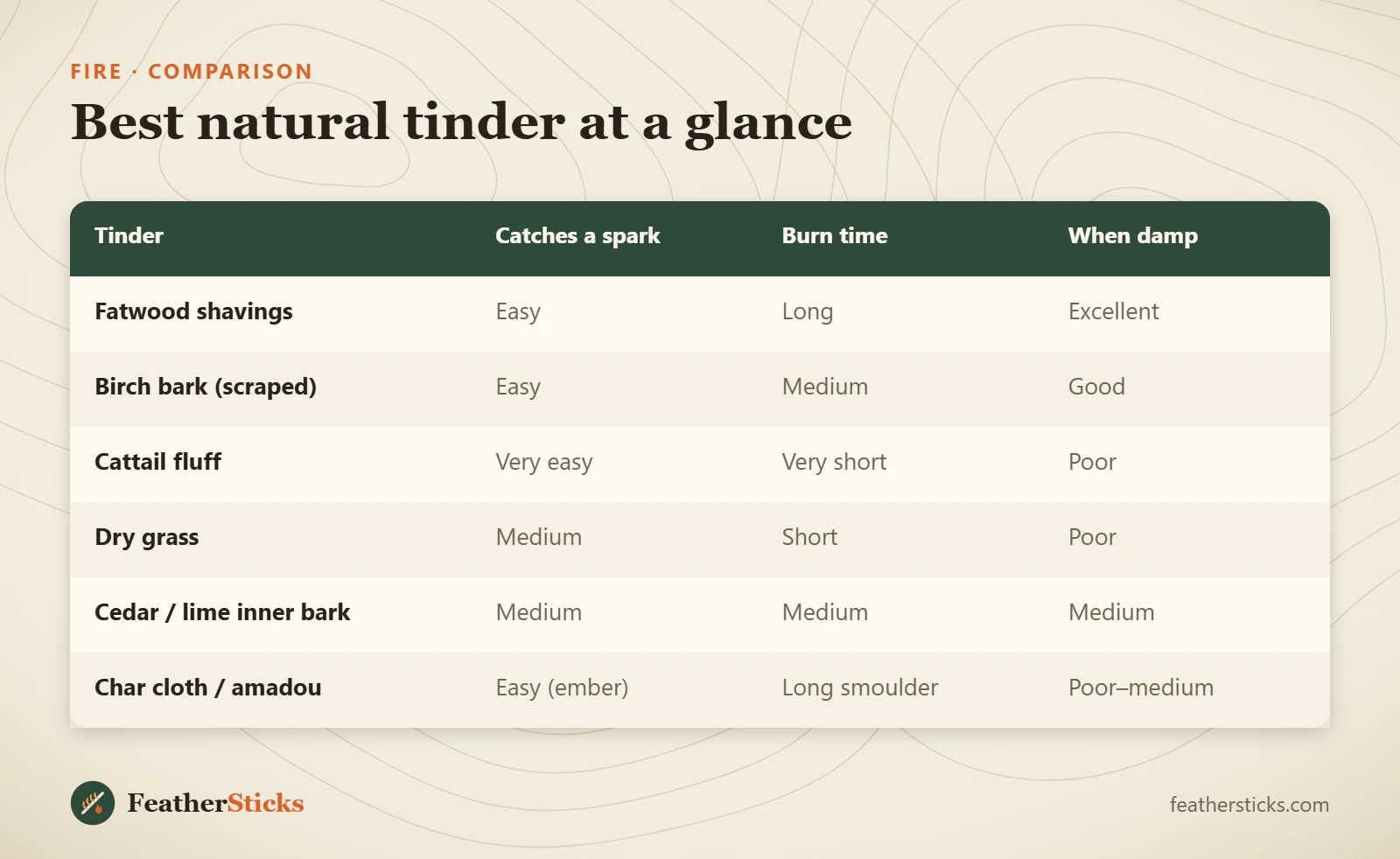
| Tinder | Catches a spark | Burn time | When damp |
|---|---|---|---|
| Fatwood shavings | Easy | Long | Excellent |
| Birch bark (scraped) | Easy | Medium | Good |
| Cattail fluff | Very easy | Very short | Poor |
| Dry grass | Medium | Short | Poor |
| Cedar / lime inner bark | Medium | Medium | Medium |
| Char cloth / amadou | Easy (ember) | Long smoulder | Poor–medium |
Common mistakes
- Collecting tinder from the damp ground instead of standing dead material.
- Using tinder that is too coarse – whole leaves or thick bark will not catch a spark.
- Too little tinder: a small pinch burns out before the kindling catches.
- Using only spark-catching fluff with nothing longer-burning around it.
- Lighting the tinder before kindling and fire lay are ready.
- Waiting until dusk or rain to start collecting.
- Stripping bark from living birch trees.
What you need
- Knife with a sharp 90° spine for scraping
- Waterproof tin or zip bag for tinder
- Ferro rod and striker
- Char cloth tin for flint and steel
- Cotton balls with petroleum jelly as backup
- Jute twine