Fire
Fatwood: What It Is, Where to Find It and How to Use It
Fatwood is pine wood saturated with natural resin, found mainly in old pine stumps, at the base of dead branches and in knots. The resin is flammable and water-repellent, so fatwood lights easily, burns hot for minutes and works even after days of rain. That makes it the best natural fire starter a bushcrafter can find.
This guide explains how fatwood forms, where to look for it, how to identify it by smell, colour and weight, how to harvest it ethically and legally, and how to process it into sticks, feather sticks and scrapings for fire starting. It is part of our fire skills and a staple of bushcraft for beginners.
Step by step
-
1
Look for old pine stumps
Search clear-cuts, storm damage and old pine forest for weathered stumps and dead pines with protruding knots.
-
2
Test with a small cut
Shave a little wood. Fatwood smells strongly of turpentine, looks amber to reddish and feels sticky.
-
3
Check permission first
Only harvest where you are allowed. Never cut living trees; take small amounts from dead wood.
-
4
Cut and split pieces
Saw or chop out a small resin-rich section and split it into finger-thick sticks.
-
5
Shave and scrape to light
Carve short curls and scrape fine dust with your knife spine. Light the dust with a ferro rod.
What is fatwood?
Fatwood goes by many names: lighter wood, lighter knot, fat lighter, rich pine, pitch wood or, in German, Kienholz. All describe the same thing: pine wood in which the natural resin has become concentrated to such a degree that the wood is soaked with it. Resin consists largely of terpenes (the source of turpentine) and rosin. Both burn readily, and both repel water.
Ordinary dry pine lights reasonably well, but it burns out quickly and soaks up moisture in rain. Fatwood behaves almost like a natural candle. A thumb-sized sliver burns for several minutes with a bright, hot, sooty flame, long enough to dry and ignite damp kindling. Because the resin seals the wood, fatwood can lie in wet forest for years and still light once you cut into it.
How fatwood forms
- Living pinePines produce resin to seal wounds and defend against insects and fungi.
- Injury or deathAfter the tree is cut, broken or dies, resin flows toward the stump, roots and branch bases.
- ConcentrationResin settles in the heartwood; volatile parts evaporate slowly, rosin remains.
- Decades of weatheringSapwood rots away; the resin-rich core resists decay and remains.
- FatwoodA heavy, amber, strongly scented core you can harvest and burn.
Where to find fatwood
Fatwood is found almost exclusively in pines. In North America, southern pines such as longleaf pine are famous for rich lighter wood; in Europe and northern Asia, Scots pine is the main source. Larch and some other conifers can also develop resin-rich wood, while spruce usually only forms resin pockets and blisters rather than true fatwood. Broadleaf trees never produce fatwood.
Old pine stumps
The classic source is the stump of a pine that was cut or broke off years ago. Over time the outer sapwood rots and falls away, while the resin-rich core and the upper roots remain hard. Look for stumps that are grey, weathered and partly decayed on the outside but still solid in the centre. Stumps in old clear-cuts, along forest tracks and in storm-damaged areas are good places to start.

What it should look like: a promising stump is grey and cracked on the outside, often with moss or crumbling wood around the rim, but the centre feels rock-hard when you press a knife tip into it. If the knife sinks into soft wood everywhere, the stump has no resin core left.
Knots and branch bases
Where a branch meets the trunk, pines concentrate resin to seal the joint. In a dead, fallen pine that has rotted for years, these knots often stick out like hard spikes from the crumbling log. Pull or cut them out: they are small but often pure fatwood. This is the most sustainable source, because the log is already decaying.

Wounds and root balls
Pines that were damaged by lightning, storms or old injuries may have resin-soaked wood around the wound. The roots of blown-down pines are also worth checking. Never harvest from a living tree: cutting into it creates new wounds and harms the tree.
| Location | Likelihood | How to harvest | Impact |
|---|---|---|---|
| Old, weathered pine stump (centre and upper roots) | High | Saw or axe a small section from the top edge | Low if small amounts are taken |
| Knots in rotten fallen pine logs | High | Pull out by hand or cut with a saw | Very low |
| Base of dead branches on standing dead pines | Medium | Saw the branch off close to the trunk | Low |
| Storm-damaged or lightning-struck pines (dead) | Medium | Cut resin-soaked splinters from broken wood | Low |
| Root ball of wind-thrown pines | Medium | Saw short sections of thick roots | Medium: disturbs soil |
| Spruce resin blisters | Low (resin, not fatwood) | Scrape resin; use as fire extender | Harms living trees: avoid |
How to identify fatwood: smell, colour and weight
With a little practice, you can identify fatwood in seconds. The best test is a small cut with a knife: shave away the grey, weathered surface and look at the fresh wood underneath. Several signs together give certainty.
- Smell: a strong, sharp scent of turpentine or pine resin, much stronger than normal pine. Many people call it the smell of a pine forest on a hot day.
- Colour: amber, honey, orange to deep reddish brown. Normal pine is pale yellow to cream.
- Translucency: hold a thin shaving against the light. Rich fatwood glows slightly translucent, like stained glass.
- Weight: fatwood is noticeably heavier than normal wood of the same size because resin fills the cells.
- Texture: the cut surface looks glossy or wet and feels sticky or waxy; your knife collects resin.
- Burn test: a shaving lights quickly from a match and burns with a bright flame and black smoke.
Identify fatwood in four checks
 1Cut a fresh surface
Shave off the grey, weathered surface with a few strokes. The weathered layer looks the same on fatwood and ordinary wood; only fresh wood tells you what you have. Smell the blade straight away.
 2Compare the colour
Fatwood is amber to reddish brown and glossy, as if wet. Ordinary pine is pale yellow and matt. Reddish but soft, crumbly wood is rot, not resin.
 3Hold it to the light
Carve a thin shaving and hold it against the sky. Rich fatwood glows slightly translucent like stained glass; ordinary wood stays opaque.
 4Do a burn test
Light a shaving with a match. Fatwood catches quickly and burns with a bright, sooty flame and black smoke for much longer than its size suggests.
| Feature | Fatwood | Ordinary dry pine | Rotten wood |
|---|---|---|---|
| Smell | Strong turpentine | Mild resin | Musty, earthy |
| Colour when cut | Amber to reddish brown, glossy | Pale yellow, matt | Brown, grey, crumbly |
| Weight | Heavy for its size | Light | Very light or waterlogged |
| Thin shaving against light | Translucent | Opaque | Falls apart |
| Behaviour in rain | Stays usable | Absorbs water | Soaks like a sponge |
| Flame | Bright, long, sooty | Quick, short | Smoulders or will not light |

Harvesting fatwood ethically and legally
Fatwood comes from dead wood, but dead wood is not worthless. Stumps and decaying logs are habitat for beetles, fungi, mosses, birds and small mammals, and they return nutrients to the soil. Responsible harvesting means taking little, leaving the structure intact and following the law.
Law first. In most countries, all wood in a forest belongs to the landowner, including stumps. Cutting or removing wood usually requires permission, and in nature reserves and national parks it is typically prohibited. Rules vary widely by country, state and land type. Ask the landowner or forest authority, and never assume that dead wood is free to take. Many forestry operations are happy to let you take a piece from an old stump if you ask.
Responsible fatwood harvesting
- Get permission from the landowner or check local rules
- Never cut or injure living trees
- Take a fist-sized piece, not the whole stump
- Prefer knots from already rotting logs
- Do not dig out stumps or roots in sensitive soil
- Stay out of protected areas and nesting habitats
- Leave the site tidy: no piles of chips, no exposed roots
A single fist-sized piece of good fatwood is enough for dozens of fires, so there is rarely a reason to take more. Cut from the top edge of a stump with a folding saw rather than hacking deep into it with an axe; the stump stays largely intact and continues to serve as habitat.
How to process fatwood
Fatwood is dense and resinous, so it behaves differently from ordinary wood under the blade (see carving basics for safe knife technique). It splits well along the grain but is hard to carve into long curls. Process it into several forms, each with its own purpose.
From stump to fire starter
 1Remove the weathered shell
Shave off the grey outer layer until you see glossy amber wood on every side. Weathered wood lights poorly and wastes your sparks.
 2Cut to length
Saw pieces of 10–15 cm, about the length of your hand, on a firm base. Short pieces split cleaner and fit in a small bag.
 3
3 4Carve short curls
Short, firm strokes produce short, stiff fatwood curls. Do not expect long feather stick curls: the resin makes the wood brittle.
 5Scrape dust
Hold the knife upright and scrape its square 90° spine along an edge. Scraping, not cutting, produces a fine, fluffy powder that catches a spark.
 6Clean your tools
Wipe resin off the blade with oil, alcohol or hand sanitiser, or it drags on the next cut and collects dirt.
For the best result, combine forms: a thumbnail-sized pile of fatwood dust as the spark catcher, a few curls on top, then thin splinters of fatwood and pencil-thin kindling. A ferro rod spark lights the dust almost instantly. For a softer start, mix fatwood dust with other natural tinder like dry grass or birch bark.
Lighting fatwood with a ferro rod
 1Make a dust pile
Scrape a pile of dust about the size of a thumbnail onto a dry surface – a piece of bark, a board or the lid of your tin.
 2Add a few curls
Lay a few short curls loosely on and around the pile. They take the flame from the dust and burn long enough to reach the splinters.
 3Spark into the dust
Hold the ferro rod low and throw the sparks straight into the dust. Fatwood dust often needs two or three strikes; do not scatter it with the striker.
 4Feed splinters, then kindling
Lean thin fatwood splinters over the young flame, then pencil-thin kindling. The splinters keep burning for minutes while the kindling dries and catches.
| Symptom | Likely cause | Fix |
|---|---|---|
| Dust will not catch the spark | Dust too coarse or scraped from weathered wood | Scrape fresh, glossy wood with the spine; make finer, fluffier dust |
| Curls snap off immediately | Fatwood is brittle, strokes too long | Take short, firm strokes; accept small curls or use dust instead |
| Knife drags and sticks | Resin build-up on the blade | Wipe with oil or alcohol; keep the spine clean for scraping |
| Flame dies after a few seconds | Too little fatwood, no splinters ready | Add two or three thin splinters before the dust burns out |
| Piece will not light at all | Not fatwood, or only the grey surface | Cut deeper; check smell, colour and weight again |
Drill: at home, practise lighting a thumbnail-sized pile of fatwood dust with a single ferro rod strike, then with a wet hand, then outdoors in drizzle. Once you manage it reliably, you have a fire starter that works when almost nothing else does.
How to use fatwood to start a fire
Fatwood's strength is reliability. It does not replace a good fire lay and sufficient kindling, but it gives you a long, hot flame that carries a fire through difficult conditions.
Wet weather
In rain, fatwood is the fire starter of choice. The resin prevents water from soaking into the wood, and the burning resin produces enough heat to dry out and ignite damp kindling. Split your fatwood under cover, prepare dust and splinters, and build on a dry platform. Our guide to fire in wet weather covers the full strategy.
As a fire extender
If your tinder burns out too quickly, add two or three thin fatwood splinters directly into the flame. They keep burning for several minutes and bridge the gap to thicker kindling. This is particularly useful with marginal kindling or in wind.
Historical light
Before candles were common, thin fatwood splinters (in German Kienspäne) were burned in holders for light. They are still useful as a short-lived torch around camp, but keep them away from anything flammable and never use them inside a tent.
Fatwood vs. birch bark as natural fire starters
Fatwood
- Works when soaking wet (once cut open)
- Burns for minutes with a hot flame
- Keeps indefinitely
- Needs a knife and some effort to process
- Heavy, sooty smoke
Birch bark
- Lights from a spark when shredded
- Burns fast and hot
- Easy to collect from fallen birches
- Light and quick to prepare
- Paper-thin layers can get wet
Avoid cooking directly over fatwood flames: the heavy, sooty smoke coats pots and can give food an unpleasant taste. Use fatwood only to start the fire, then let it burn down to clean coals for campfire cooking.
Storing and carrying fatwood
Fatwood keeps practically forever. The resin protects it from rot and insects, and even pieces kept for years light easily once you cut a fresh surface. Store it dry in a small cloth bag or a zip bag, ideally with a mix of sticks and a few ready-made shavings. A 50–100 g piece weighs little and belongs in every bushcraft kit as a backup fire starter.
Because the surface oxidises and darkens over time, always shave a fresh layer before use. Keep fatwood away from food in your pack: the resin smell transfers easily. Commercial fatwood sticks are available if you cannot find it yourself, but learning to find your own is a valuable skill and costs nothing.
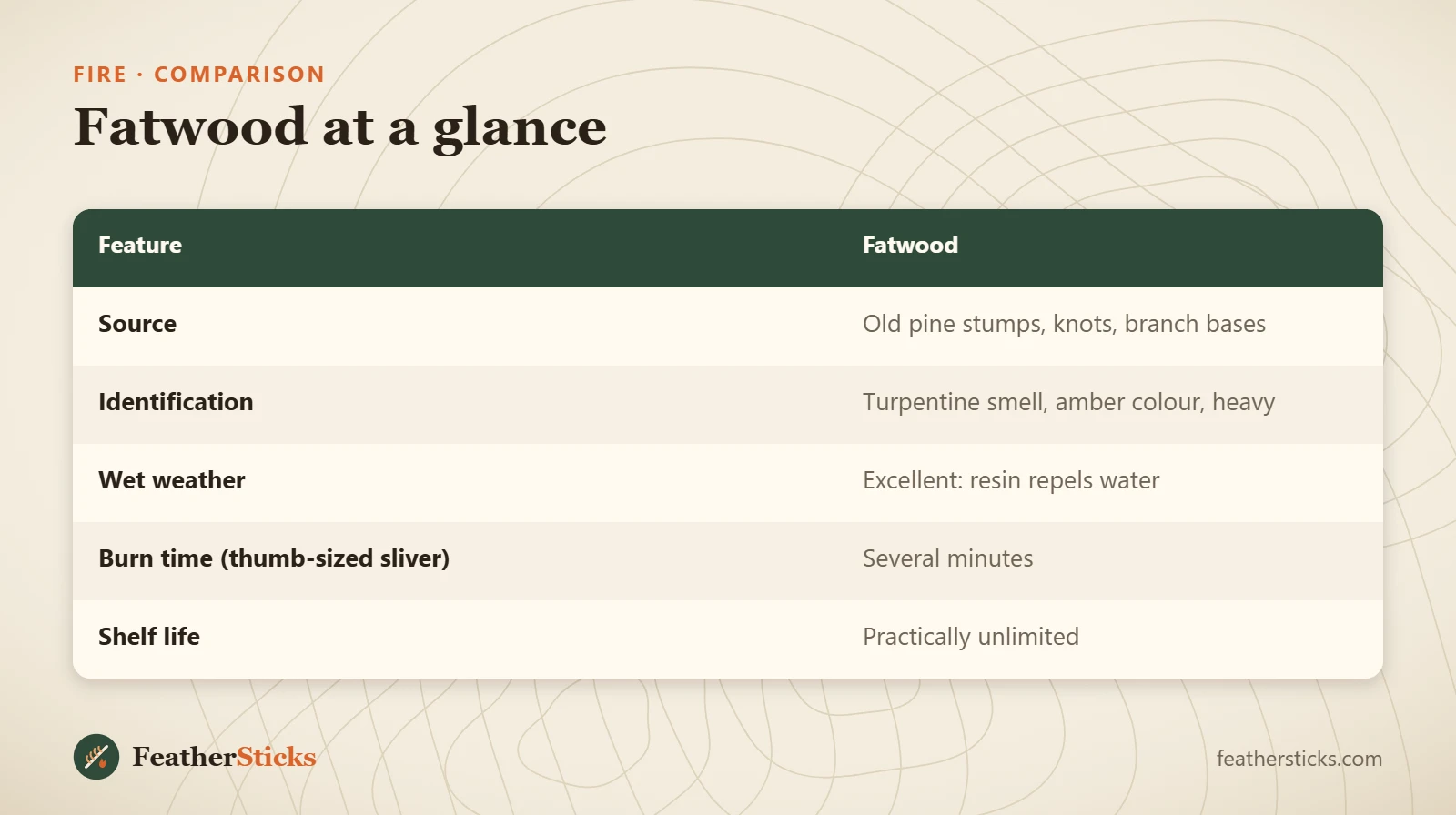
| Feature | Fatwood |
|---|---|
| Source | Old pine stumps, knots, branch bases |
| Identification | Turpentine smell, amber colour, heavy |
| Wet weather | Excellent: resin repels water |
| Burn time (thumb-sized sliver) | Several minutes |
| Shelf life | Practically unlimited |
Common mistakes
- Cutting into living pines to find resin: it harms the tree and is usually illegal.
- Confusing reddish rotten wood with fatwood. Fatwood is heavy, hard and smells of turpentine.
- Harvesting without permission or in protected areas.
- Taking whole stumps when a fist-sized piece is enough for dozens of fires.
- Trying to light thick fatwood chunks directly instead of shaving dust and curls.
- Cooking directly over sooty fatwood flames.
What you need
- Fixed-blade knife with a 90° spine for scraping
- Folding saw for clean cuts from stumps
- Small axe or baton for splitting
- Ferro rod
- Small dry bag for storage
- Oil or alcohol wipe to clean resin off blades