Fire
Campfire Safety: Rules, Site Choice and Leave No Trace
Campfire safety comes down to four things: only light a fire where and when it is allowed, choose a site that cannot spread flames, keep the fire small and attended, and put it out completely by drowning, stirring and feeling until the ashes are cold. Most wildfires caused by people start from campfires that were left unattended or not fully extinguished.
This guide covers fire bans and danger levels, site selection and clearance, wind, fire rings and fire pans, children and groups, how to put out a campfire properly and how to leave no trace. It belongs with every other fire skill, from fire starting to choosing the right fire lay, and is a core part of bushcraft for beginners.
Step by step
-
1
Check bans and danger level
Look up the current fire danger rating and any fire bans for the area. Rules vary by country, region and season.
-
2
Choose a safe site
Use an existing fire ring or a fire pan. Otherwise pick bare mineral soil away from trees, roots, tents and dry grass.
-
3
Prepare water before lighting
Have several litres of water or sand ready, clear a 3 m radius and keep the fire small.
-
4
Never leave it unattended
Someone responsible stays with the fire at all times. Keep children and pets at a safe distance.
-
5
Drown, stir and feel
Pour water on all embers, stir, pour again and feel for heat with the back of your hand until everything is cold.
The golden rules of campfire safety
Fire is one of the most valuable tools in the outdoors: it cooks food, purifies water, dries clothes and keeps you warm. It is also the one tool that can destroy a forest, a home or a life if it gets away from you. Almost every escaped campfire can be traced back to a handful of avoidable errors: lighting a fire during a ban, choosing a bad site, building it too big, leaving it alone or not putting it out properly.
Campfire safety checklist
- Fire is permitted here today: no ban, acceptable danger level, landowner permission
- Existing fire ring or fire pan used where available
- Site on bare mineral soil, at least 3 m clear of flammable material
- No overhanging branches, roots, peat or dry grass nearby
- Wind is light; sparks cannot reach vegetation or tents
- Water (several litres), sand or a shovel within reach
- Fire kept small, only as big as needed
- A responsible adult attends the fire at all times
- Fire fully extinguished and cold before leaving or sleeping
Is a campfire allowed? Fire bans and danger levels
Before you think about wood or tinder, find out whether a fire is permitted at all. Rules vary enormously between countries, regions, land types and seasons, and they can change from one day to the next during dry spells. There is no universal rule, so always check the current local situation.
- Landowner permission: in many countries, lighting a fire on private land requires the owner's consent, and in public forests fires are often limited to designated sites.
- Protected areas: national parks and nature reserves frequently restrict fires to designated fire rings or ban them completely.
- Seasonal bans: many regions issue temporary fire bans or restrictions during dry, hot or windy periods. These can apply even to camping stoves or charcoal in some places.
- Access rights: countries with broad access rights, such as Scotland or the Nordic countries, still expect responsible behaviour and apply fire bans in dry conditions.
Germany, for example, generally prohibits open fires in and near forests outside approved sites under state forest laws; our guide to wild camping rules in Germany explains the background.
Most countries publish a daily fire danger rating through their weather or forestry services, usually on a scale of about five levels. The names and thresholds differ, but the logic is similar. Treat the table below as a general guide, not as a legal rule: the official local rating and any ban always take precedence.
| Danger level | Typical conditions | Campfire guidance |
|---|---|---|
| Low | Damp vegetation, recent rain, cool | Fires possible where permitted; normal precautions |
| Moderate | Drying vegetation, some wind | Use fire rings or pans only; keep fire small; extra water |
| High | Dry litter and grass, warm, breezy | Reconsider; many areas restrict fires; use a stove instead |
| Very high | Very dry, hot, windy | Fires commonly banned; no open fire |
| Extreme | Drought, heat, strong wind | No fire of any kind; forest access may be restricted |
Levels and rules differ by country and region. Always check the official rating and local bans before lighting any fire.
Choosing a safe fire site
The safest fire site is one that already exists. An established fire ring or fire pit concentrates the impact in one place and has usually been placed with some thought. If there is none and fires are allowed, choose the site carefully as part of your overall camp site selection.
What to look for
- Bare mineral soil, sand or gravel. These do not burn. Forest litter, humus and peat do, and can smoulder underground for days.
- No roots. Tree roots can carry fire underground and resurface metres away.
- Nothing overhead. Check for overhanging branches, dead limbs and dry foliage above the site.
- Distance from camp. Keep tents, tarps, hammocks and gear well away: synthetic fabrics melt and burn easily.
- Sheltered, but not enclosed. A spot out of the wind is good; a hollow full of dry leaves is not.
- Water nearby. A site close to a stream or lake makes extinguishing easier, but do not build on the bank itself, where soil and vegetation are sensitive.
Checking a fire site in four steps
 1Look up first
Stand where the fire will be and look straight up. You want at least 3 m of open air above the fire and no dead limbs that heat, sparks or wind could bring down.
 2Clear to bare soil
Scrape leaves, needles and dry grass away in a circle of about 3 m until you reach mineral soil or sand. If you only find dark, spongy humus or peat, choose another place.
 3Place tents upwind
Keep tents, tarps and hammocks at least 5 m away and on the upwind side. Downwind, sparks and smoke drift straight onto the fabric, so double the distance there.
 4Firewood upwind too
Stack your firewood 2–3 m from the fire on the upwind side, close enough to feed the fire without leaving it, far enough that sparks cannot reach the pile.
| Object | Minimum distance | Why |
|---|---|---|
| Flammable ground cover (leaves, needles, grass) | Clear about 3 m radius | Stops creeping ground fire |
| Tents, tarps, hammocks | At least 5 m (more downwind) | Synthetic fabrics melt from sparks and heat |
| Overhanging branches | At least 3 m of vertical clearance, more for big fires | Rising heat and sparks can ignite foliage |
| Tree trunks and root zones | At least 3–5 m | Roots can carry fire underground; heat damages bark |
| Firewood pile | At least 2–3 m, upwind | Prevents the stockpile catching |
| Forest edge | Varies by law: often tens of metres or more | Check local rules; many regions set a legal minimum |
These are cautious rules of thumb. Local laws and site rules take precedence.

Wind: the most underestimated danger
Wind feeds a fire with oxygen, pushes flames sideways and carries sparks and embers far beyond the fire ring. Glowing embers can travel tens of metres in a strong gust and land in dry grass or forest litter. Many escaped campfires happened on days when the fire danger was only moderate but the wind picked up.
As a rule, if the wind is strong enough to move small branches constantly or blow dust and leaves around, it is too windy for an open fire. If the wind rises while your fire is burning, let it burn down, stop adding wood and extinguish it early. Build fires on the lee side of natural windbreaks and keep them low: a star fire or Dakota hole throws fewer sparks than a tall teepee.

Quick wind check: watch the smoke of the first minutes. If it rises steeply and drifts only slightly, conditions are fine for a small fire. If it lies flat along the ground or changes direction every few seconds, let the fire burn down and put it out.
Should I light a fire today?
Is there a fire ban or is the danger level high or above?
Yes → No open fire. Use a camping stove where permitted, or go without.No → Go to the next question.Do you have permission and a suitable site (fire ring, fire pan or mineral soil)?
Yes → Go to the next question.No → No fire. Move to a designated site or use a stove.Is the wind strong or gusty?
Yes → Wait or skip the fire. Sparks can travel far.No → Go to the next question.Do you have water ready and someone to attend the fire the whole time?
Yes → Light a small fire and keep it under control.No → Prepare water and a fire watch first.
Fire rings, fire pans and mound fires
Where you build the fire matters as much as whether you build it. Leave No Trace principles recommend using existing fire rings where they exist, and otherwise using a method that leaves no mark: a fire pan or a mound fire.
Existing fire rings
Use them if present. Do not build new stone rings next to existing ones: every ring is a permanent scar. Keep the fire inside the ring and do not make it larger than the ring allows.
Fire pans and fire bowls
A metal fire pan or fire bowl raised slightly off the ground keeps heat away from soil and vegetation and makes it easy to remove every trace of ash. Lightweight folding fire pans exist for backpacking. On sensitive ground, set the pan on a layer of mineral soil or sand to protect the ground from heat.
Mound fires
Where fires are permitted but no ring exists, you can build a mound of mineral soil or sand (from a place already disturbed, like a root ball or stream bar) about 15–20 cm thick on a flat surface such as a groundsheet or a flat rock, and build the fire on top. Afterwards, scatter the cold ash and return the soil to where it came from.
Building a mound fire
 1Lay a base
Spread a groundsheet, fire blanket or a flat rock where the fire will be. It carries the mound and makes clean-up easy.
 2Build the mound
Heap mineral soil or sand 15–20 cm thick, taken from a place that is already disturbed, such as a root ball or a gravel bar. Flatten the top.
 3Keep the fire small
Build a small fire in the middle of the mound, well inside its edges, so heat never reaches the base below.
 4Leave no trace
When the ash is cold, scatter it widely, return the soil to where it came from and pack up the base. Nothing should show that a fire burned here.
Fire pan vs. ground fire
Fire pan or bowl
- No scorch mark on the ground
- Easy to control and to clean up
- Accepted in more places (always check)
- Extra weight to carry
Ground fire
- No equipment needed
- Leaves a scar that lasts years
- Risk of underground fire in humus or peat
- Often not allowed outside designated rings

Keeping the fire small and under control
A small fire is safer, uses less wood and is more pleasant to cook on. Most bushcraft tasks need a fire no larger than about 50–60 cm across. Use the firewood calculator to gather what you need before you light, so you do not wander off for more while the fire burns.
- Never leave the fire unattended, not even for a few minutes. Wind can rise quickly.
- Keep water, sand or a shovel at hand from the moment you light the fire.
- Feed small pieces. Large logs burn for hours and are difficult to extinguish.
- Do not burn rubbish. Plastic, cans, glass and foil do not burn cleanly, release toxic fumes and leave debris. Food scraps attract animals.
- Do not use accelerants. Petrol and similar liquids can explode in a fireball. Use proper tinder and feather sticks instead.
- Stop feeding the fire early. Let it burn down to ash about an hour before you want to leave or sleep.
Use only dead and downed wood where collecting is allowed, never cut living trees, and consider carrying firewood from outside only if it is permitted: in some regions, moving firewood is restricted to prevent the spread of tree pests and diseases. For campfire cooking, a small bed of coals is all you need.
How to put out a campfire: drown, stir, feel
A campfire is only out when every ember is cold. Embers buried in ash can stay hot enough to reignite for many hours, sometimes even a day or more, and a breeze can bring them back to life after you have left. The widely taught method is simple: drown, stir and feel.
Extinguishing a campfire step by step
 1Let it burn down
Stop adding wood about an hour before you leave or sleep, so logs burn down to ash and small embers. A big log added late is the hardest thing to put out.
 2Spread the embers
Use a stick to spread the coals thinly across the ring and pull apart any unburnt pieces, so water reaches every ember.
 3Drown
Pour water slowly over all embers, not just the red ones, until the hissing stops. Stand back from the steam and keep your face out of it.
 4Stir
4StirStir the ashes down to the ground with a stick or shovel. Scrape half-burnt wood so no embers stay stuck to it.
 5Drown again
Pour more water and stir again. Wet the ground around the fire and under the edge stones too.
 6Feel
6FeelHold the back of your hand close to the ashes, then carefully touch them. If anything is warm, go back to drowning and stirring.

How much water? Far more than most people think: typically several litres for a small fire, more for a larger one. If water is scarce, use mineral soil or sand, mixing it thoroughly into the embers and stirring, but do not simply bury the fire: embers under soil can smoulder unseen and reignite. Never leave until the site is cold to the touch.
What "out" looks and feels like
- No steam, no hiss when you pour the last water and stir.
- Ash is a grey, wet paste, with no dry, fluffy pockets and no red specks when you turn it over.
- Half-burnt wood is black and wet on all sides, and you can hold it in your bare hand.
- The ground around the ring is cool when you press your palm on it, including under the stones.
| What you notice | What it means | What to do |
|---|---|---|
| Steam rises again after a few minutes | Embers deeper in the ash are still hot | Stir down to the ground and drown again |
| Water runs off without soaking in | Dry ash layer repels the water | Pour slowly while stirring; break up crusts |
| A log is black but still warm inside | Glowing core under the charcoal | Scrape it, roll it, soak it on all sides or split it |
| Ground under the stones is warm | Heat has moved into the soil or roots | Lift stones, drown the ground beneath, check nearby roots |
| Not enough water left | Too little prepared | Mix mineral soil in and stir, fetch more water; do not leave |
Leave No Trace: fires without a footprint
The Leave No Trace principle "minimise campfire impacts" asks you to consider whether you need a fire at all. A stove is often more efficient for cooking and leaves nothing behind. When you do make a fire, the goal is that the next visitor cannot tell you were there, except at an established fire ring.
- Use existing rings or fire pans, and never build new rings where one exists.
- Burn wood completely to ash. Half-burnt logs are unsightly and hard to disperse.
- Scatter cold ash widely away from the site, once it is cold, unless you used a fire ring.
- Restore the site: return mineral soil, replace sod, scatter unused firewood naturally.
- Pack out everything, including foil, food scraps and anything that did not burn.
Where legal and appropriate, these practices protect soils, vegetation and wildlife. In areas with many visitors, established sites concentrate the impact and keep the rest of the landscape untouched. Good camp setup and a considered kit list make low-impact fires much easier.
Campfire safety with children and groups
Campfires are a highlight for children, and learning fire skills early builds confidence and respect. But children move quickly, underestimate heat and do not see danger in glowing embers. Clear rules and constant supervision make the campfire safe and fun.
Campfire rules for children
- A marked safety circle (1.5–2 m) around the fire that nobody enters without permission
- No running, playing or horseplay near the fire
- Sit on logs or mats, never stand or lean over the fire
- Long hair tied back; no loose, flowing synthetic clothing
- Sticks for roasting are held low and never waved around
- Only adults add large wood and handle the extinguishing
- Teach "stop, drop and roll" if clothing catches fire
- An adult watches the fire at all times
In groups, assign a fire keeper who is responsible for the fire and its extinguishing, and a place where water and first aid are kept. A first aid kit should include burn dressings, and everyone should know the emergency number for the country you are in.
What to do if your campfire gets out of control
If a fire escapes the ring, act quickly but never put yourself or others in danger. A small ground fire of a square metre or two can sometimes be put out with water, soil or by beating it with a green branch or a wet jacket. If it spreads beyond that, or if flames reach bushes or trees, stop fighting it.
- Get people to safety first. Move away from the fire, upwind and downhill where possible, toward roads, water or cleared areas.
- Call the emergency number immediately: 112 in Europe, 911 in the US and Canada, 999 in the UK. Give your location as precisely as possible; the navigation skills and a map or phone GPS help here.
- Do not try to outrun a fire uphill. Fire spreads faster uphill.
- Report even small incidents you managed to put out if there is any chance it is smouldering underground.
The best emergency plan is prevention: fire bans respected, good site, small fire, water ready, never unattended, fully extinguished. Pair this guide with fire in wet weather and our other fire guides to build fires that are useful and safe.
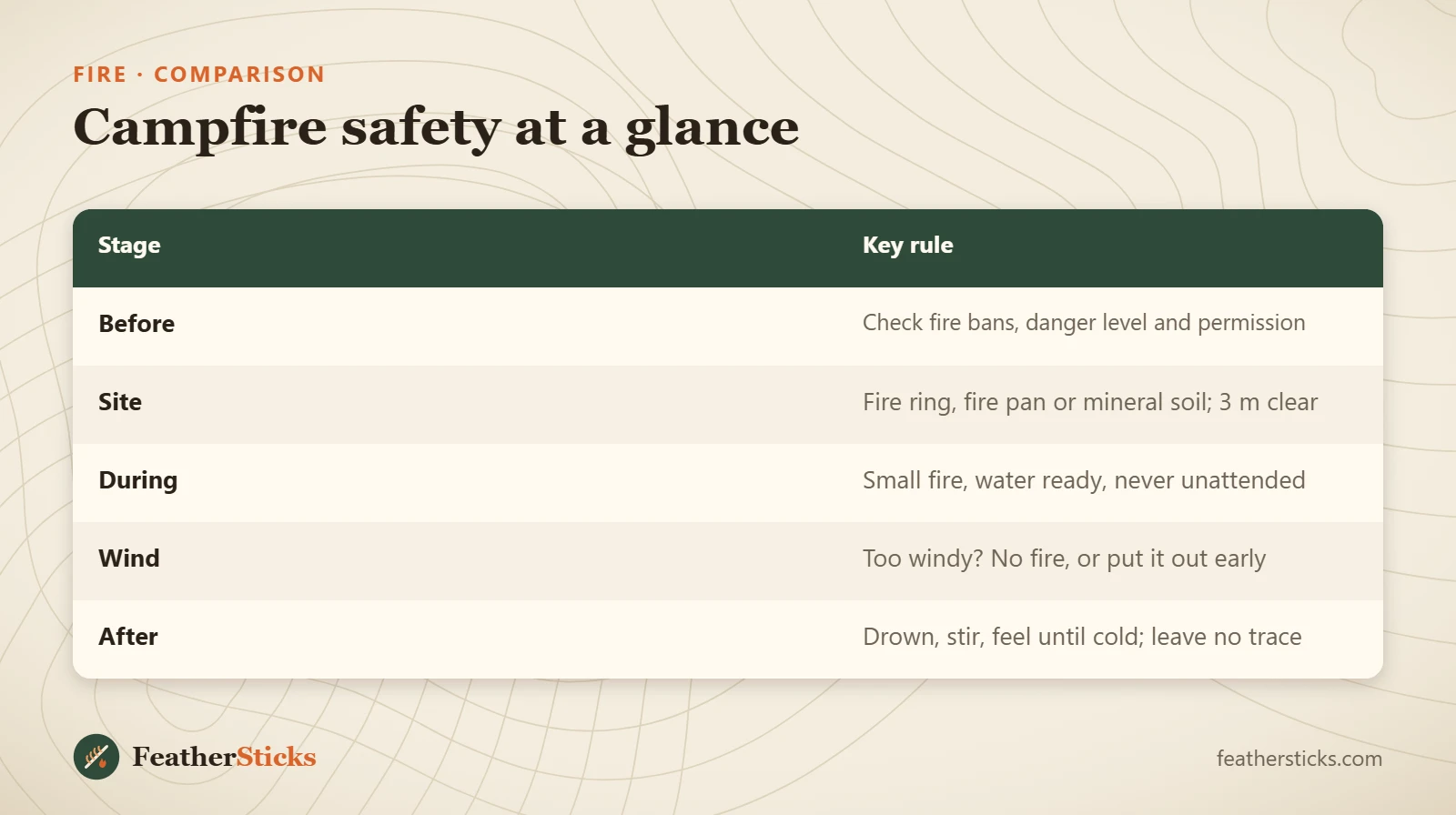
| Stage | Key rule |
|---|---|
| Before | Check fire bans, danger level and permission |
| Site | Fire ring, fire pan or mineral soil; 3 m clear |
| During | Small fire, water ready, never unattended |
| Wind | Too windy? No fire, or put it out early |
| After | Drown, stir, feel until cold; leave no trace |
Common mistakes
- Not checking fire bans and danger levels before lighting a fire.
- Building a fire on forest litter, peat or among roots.
- Lighting a fire under overhanging branches or next to tents and tarps.
- Making the fire far bigger than needed.
- Leaving the fire unattended, even briefly.
- Burying a fire with soil instead of drowning and stirring it.
- Leaving the site while ashes are still warm.
What you need
- Water container or collapsible bucket (several litres)
- Small shovel or trowel
- Fire pan or fire bowl where ground fires are not allowed
- Leather gloves
- First aid kit with burn dressings
- Camping stove as an alternative during fire bans