
Finding Water
How to find water in the wild: read terrain, find springs and streams, use plant and animal signs, collect rain and dew, avoid bad sources.
Find, filter and purify water safely.
You can survive weeks without food but only a few days without water — and drinking untreated water can make you seriously ill. This section follows the path water takes from source to cup. Start with finding water: reading the landscape, spotting springs and plant signs, collecting rain and knowing which sources to avoid.
Then learn to remove sediment, bacteria and parasites by filtering water, and to kill every kind of pathogen by boiling water — one minute at a rolling boil, three above 2,000 m. Our overview of water purification methods compares boiling, filters, chlorine dioxide, chlorine, iodine, UV and SODIS, and shows which combinations cover everything. In winter, water from snow and ice explains how to melt snow without wasting fuel. When the only water is muddy, a DIY water filter clears it before treatment — but never replaces it. Finally, choose the right water containers to carry, boil and store what you have treated.
Two calculators help you plan: the water needs calculator tells you how much to drink and carry, and the boiling point and fuel calculator shows how long to boil at your altitude and how much gas you need.
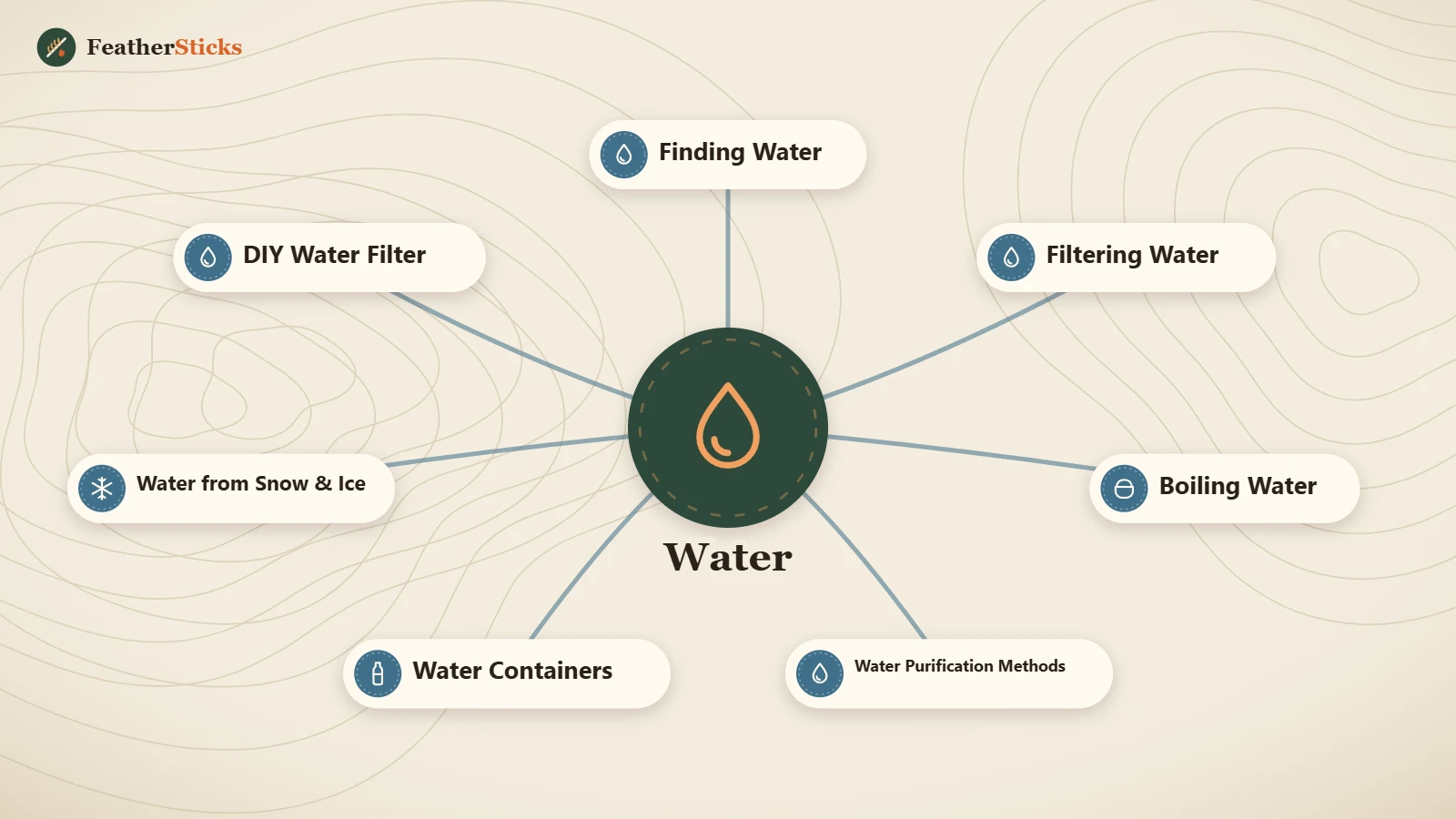
How to find water in the wild: read terrain, find springs and streams, use plant and animal signs, collect rain and dew, avoid bad sources.
How to filter water outdoors: hollow fibre, ceramic, gravity, pump and straw filters compared, pore sizes vs germs, prefiltering, care and frost damage.
How long to boil water to make it safe: 1 minute at a rolling boil, 3 minutes above 2,000 m. Boiling points by altitude, fuel, containers and cooling.
Water purification methods compared: boiling, filters, chlorine dioxide, chlorine, iodine, UV and SODIS — what each kills, contact times, combinations.
Choose water containers for bushcraft and hiking: steel, titanium and plastic bottles, bladders and canteens compared — boil-safe, winter-proof, weights.
How to melt snow for drinking water: seed water, fuel needs, snow vs ice yield, why you should not eat snow and why melted snow still needs treatment.
Build a DIY water filter from a bottle, cloth, sand, charcoal and gravel. It clears muddy water but does NOT make it safe — always boil or disinfect.
Every safe litre of water outdoors passes through the same chain: find, prefilter, treat, store. Skip a step and the whole chain can fail — the best filter is useless if you fill your clean bottle with a dirty hand, and boiling cannot fix water from below a mine. Think of the four steps as a routine you repeat at every source.
The water safety chain
The first step is the only protection against chemical pollution. Boiling, filters, tablets and UV all target germs — bacteria, viruses and protozoa such as Giardia and Cryptosporidium. None of them reliably removes pesticides, fertiliser, fuel, heavy metals, salt or the toxins of blue-green algae. When a source looks or smells wrong, or lies downstream of intensive farming, roads or old mines, walk on.
The second step is often skipped, but it makes every treatment work better. Cloudy water clogs filters, uses up chemical disinfectants and shields microbes from UV light. A bandana, a coffee filter or half an hour of settling costs nothing and can double the life of your filter.
Most adults outdoors need 3–6 litres per day for drinking and cooking, and considerably more in heat or at high effort. Your need depends on body weight, temperature, activity, altitude and the food you cook. The figures below come from the same formula as our water needs calculator: a base of 0.033 L per kg body weight minus the water that comes with food, plus sweat losses by effort and temperature, plus an altitude surcharge, plus cooking water — half of which counts towards drinking because it ends up in tea, soup and rehydrated meals.
| Scenario | Drinking | Total incl. cooking |
|---|---|---|
| Easy day: 18 °C, 4 h light effort, mixed food | ≈ 2.6 L | ≈ 3.4 L |
| Winter day: 0 °C, 6 h moderate effort | ≈ 3.0 L | ≈ 4.2 L |
| Cool day: 10 °C, 6 h moderate effort | ≈ 3.5 L | ≈ 4.7 L |
| Mild day: 18 °C, 6 h moderate effort | ≈ 4.1 L | ≈ 5.3 L |
| Mountains: 10 °C, 6 h moderate, 2,600 m | ≈ 4.5 L | ≈ 5.7 L |
| Warm day: 25 °C, 8 h moderate effort | ≈ 6.2 L | ≈ 7.4 L |
| Hot day: 30 °C, 8 h moderate effort | ≈ 7.5 L | ≈ 8.7 L |
Guideline values — individual sweat rates vary a lot. The gut absorbs only about 1–1.2 L per hour, so in heat reduce effort rather than trying to drink more. Pale urine is the best field check.
Just as important as the daily total is how much to carry at once. That depends on the time between reliable sources: the calculator multiplies your hourly need by the gap and adds a 20 % reserve. In European forests with a stream every hour or two, 1.5–2 litres is often enough; on dry ridges or in summer heat you may need to carry 3–4 litres or more. Cold weather is deceptive — the air is dry, thirst is weak and you lose a lot of water through breathing, so drink on a schedule.
There is no perfect method — each has a gap. Boiling covers everything but costs fuel and time. Microfilters are fast and taste-free but let viruses through and can be destroyed by frost. Chlorine and iodine barely touch Cryptosporidium. Chlorine dioxide handles it only with long contact times. UV fails in cloudy water. Because these gaps hardly overlap, combining two methods is the smartest approach for most trips.
| Method | Bacteria | Viruses | Protozoa (Giardia / Crypto) | Time | Main drawback |
|---|---|---|---|---|---|
| Boiling | Yes | Yes | Yes / Yes | 1 min (3 min > 2,000 m) + cooling | Fuel, time |
| Microfilter 0.1–0.2 µm | Yes | No | Yes / Yes | No wait | Frost damage, clogging |
| Chlorine dioxide | Yes | Yes | Yes / slowly | 30 min – 4 h | Waiting time |
| Chlorine or iodine | Yes | Yes | Partly / No | 30 min + | Crypto; iodine health limits |
| UV pen | Yes | Yes | Yes / Yes | ≈ 1 min per litre | Clear water, batteries |
| SODIS | Mostly | Partly | Partly / uncertain | 6 h – 2 days | Weather-dependent, emergency only |
| DIY sediment filter | No | No | No / No | — | Only clears water — always treat after |
Quick method finder
Is the water cloudy even after settling?
Are you near huts, villages, pasture or travelling abroad (virus risk)?
Could your filter freeze tonight?
Details on every method, including contact times at low temperatures, are in our guide to water purification methods. Boiling times are consistent with the boiling point calculator: water boils at about 98 °C at 500 m, 93 °C at 2,000 m and under 87 °C at 4,000 m.
Spring brings plenty of water but also snowmelt and run-off that make streams cloudy — settle and prefilter. Summer dries up small streams and seasonal springs; dashed blue lines on the map may be empty by August, and warm standing water can host toxic algae blooms. Plan sources carefully and carry more. Autumn is often the best season for clear water, though leaf litter can stain it brown. In winter, liquid water becomes scarce above the snow line, filters are at risk of frost, and melting snow roughly doubles your fuel consumption — see water from snow and ice.
Rain is the easiest water in wet climates: every millimetre on a square metre gives about a litre, so a 3 × 3 m tarp in a 5 mm shower can catch up to 45 litres. The same tarp that keeps you dry becomes your water supply — pitching it well is covered in the shelter section.
Water skills do not stand alone. Boiling depends on a reliable heat source — a stove or a fire lit with solid fire-starting skills where fires are allowed. The pot you boil in is part of your cookware, and at camp you usually treat drinking water in the same session as you cook. Where you camp decides how far you walk for water: choosing a camp site 50–60 m from the water protects the bank, keeps you out of cold air and insects, and keeps toilet areas away from the source.
Put your water system into your bushcraft kit list: one boil-safe metal bottle, light bottles or a bladder for capacity, a filter and a backup such as chlorine dioxide tablets. The Kit Builder adds the weights for you. And if you are just starting out, water is one of the pillars of bushcraft for beginners, right alongside fire and shelter.
Minimum water kit for an overnight trip
How much water to drink, cook with and carry — by weight, heat, effort and altitude.
Boiling point at your altitude, safe boil time and how much gas or wood you need.