Wildlife Encounters: What to Do If You Meet a Wild Boar, Wolf, Deer or Bear
Wildlife encounters while hiking or camping almost always end the same way: the animal notices you first and leaves. If you do meet a wild boar, a wolf or a deer at close range, the answer is nearly always identical – stop, stay calm, keep your distance, give the animal a way out and back away slowly without running. Real problems are rarely about "dangerous animals"; they come from food left in camp, dogs off the lead, young animals that people approach, and roads at dusk.
This guide covers the general rules, then species by species what the animal is doing and what you should do: wild boar, wolf, deer, fox and badger, raccoon and marten, adders, cattle and horses, plus a separate section for bear and moose country abroad. You will also find the camp routine that prevents most night visits – built on proper food storage at camp and a well-chosen pitch – and a table that decodes night noises. It belongs to the basics of bushcraft just as much as fire and shelter.
Step by step
-
1

Be heard on the trail
Talk, walk normally and do not creep through thick cover. Most animals hear you early and move off long before you ever see them.
-
2

Stop and keep your distance
See an animal? Stop. Do not approach for a photo. If it changes its behaviour because of you, you are already too close.
-
3

Dog on a short lead
Bring the dog to heel on a short lead and keep your group together. A loose dog is the most common trigger for trouble.
-
4

Back away slowly, do not run
Leave the animal a clear way out, speak calmly and walk back the way you came. Do not turn and run.
-
5

Keep a clean camp
Cook and wash up away from your bed, seal food and rubbish and store them away from the tent. Never feed wild animals.
-
6

Leave young animals, treat bites
A young animal alone is not abandoned: do not touch it. Any bite from a wild mammal means cleaning the wound and seeing a doctor the same day.
Wild animals and camping safety: the ground rules
Wild animals in Europe and North America have good reasons to avoid people, and most of them do so very efficiently. They hear and smell far better than we do, so on a normal walk you pass dozens of animals that have already stepped aside. An encounter at close range usually means one of four things: the wind and noise hid you (stream, rain, thick cover), the animal is busy with something important (young, rut, food), it has learned that people mean food, or your dog found it first.
That is why the same handful of rules works for almost every species. They are not about bravery but about being predictable: an animal that knows where you are, sees that you are not coming closer and has room to leave will almost always leave.
Eight rules for every wildlife encounter
- Make yourself noticeable: talk, walk normally, use a light at dusk and at night.
- Stop as soon as you see the animal – do not walk on towards it.
- Keep your distance and never approach for a photo; use the zoom.
- Never feed wild animals, on purpose or by leaving food and rubbish around.
- Never approach or touch young animals – a parent is almost always nearby.
- Dogs on a short lead, the group close together, children beside you.
- Give the animal a way out: do not stand between it and cover, water or its young.
- Back away slowly, facing roughly towards the animal, speaking calmly. Do not run.
Where the real risks are
If you rank the things that actually go wrong outdoors, large wild animals are far down the list. The table puts them in proportion – without numbers, because honest figures differ widely by country and year, but the order is consistent in what forestry, hunting and health authorities publish.
| Problem | How it usually happens | What prevents it |
|---|---|---|
| Ticks and insects | Brushing through grass and undergrowth, sitting on the ground | Clothing, evening check – see ticks and mosquitoes |
| Collisions with deer and boar on roads | Driving at dusk and dawn through woodland, especially in autumn and spring | Slow down at dusk, expect a second animal after the first |
| Cattle and horses on pastures | Crossing a field with a dog, walking between cow and calf | Go around the herd, dog on a short lead |
| Food theft at camp | Food, pots or rubbish left out or kept in the tent | Sealed storage away from the sleeping place |
| Dog chases or corners an animal | Dog off the lead finds boar, deer or a sow with piglets | Lead, especially in spring and at dusk |
| Defensive behaviour of a surprised animal | Close surprise in thick cover, animal with young, wounded animal | Be heard, keep distance, back away |
| Snake bite | Stepping or reaching where you cannot see, picking a snake up | Sturdy footwear, look before you sit or reach |
Order of magnitude, not statistics. Check the official sources for your region.

An animal is near – what now?
Use this short path whenever you notice a larger animal close by. It works for boar, deer, wolves, foxes and cattle alike; the species sections below only add detail.
An animal is near – what now?
Has the animal noticed you?
Yes → Stop, stand upright, speak in a calm, normal voice so it can place you.No → Stop, do not sneak closer. Make a quiet noise (talk, cough) so it is not surprised at short range, or simply detour widely.Are young animals, a carcass or a food source nearby – or is your dog loose?
Yes → Leash the dog, gather the group and increase the distance at once; this is the situation in which animals defend.No → Stay where you are for a moment and let the animal decide. Most leave within seconds.Does the animal have a free way out that does not lead past you?
Yes → Good. Wait, or back away slowly the way you came.No → You are blocking it. Move sideways and back to open its path – slowly.Is it coming closer or showing warning signs (snorting, stamping, lowered head, ears back)?
Yes → Speak louder, make yourself tall, keep backing away and put something solid between you – a thick tree, a wall, a vehicle.No → Walk away calmly, keep an eye on it and take another route.Were you or your dog bitten or injured?
Yes → Clean the wound, cover it and see a doctor or vet the same day; call the emergency number for serious injuries.No → Note where it happened if the animal behaved strangely or was injured, and report it to the local forestry office or police.
What it should look like: you are standing still or moving slowly backwards, the dog is beside your leg, your voice is calm, and the animal has open ground or cover behind it. If you are instead walking forward with a phone in your hand, the encounter is going the wrong way.
What to do if you meet a wild boar
Wild boar are the animal most people worry about in Central European forests, and they are also the one you are most likely to hear at night. They are common, strong and fast – but they are not aggressive by nature. A boar that notices a person normally runs, often with a lot of crashing. Trouble arises in a few specific situations:
- A sow with piglets. Striped piglets are born mainly in spring, though litters can appear at other times of the year. The sow stays close and defends them, especially against dogs.
- Surprise at short range. Boar rest by day in thick cover – bramble, young conifers, reed, maize fields. Someone pushing through such cover can end up very close before either side notices.
- A dog that finds them. A loose dog that harasses boar may be attacked and then run back to its owner with the boar behind it.
- The rutting season. In late autumn and early winter males roam and are less cautious than usual.
- Injured animals. After a road accident or during a driven hunt, a wounded boar is unpredictable. Keep well away and report it.
- Animals used to people. On the edge of towns and at picnic sites, boar that have been fed lose their distance. Never feed them.
Wild boar ahead: four moves
 1Stop – look for piglets
Stand still the moment you see or hear boar. Small striped piglets mean the sow is within a few metres even if you cannot see her. Do not go closer, and call children and the dog to you.
 2Let it know where you are
Speak in a calm, normal voice. Boar see poorly but hear and smell very well; an animal that can place you has no reason to feel cornered. No shouting, no waving sticks at it.
 3Back the way you came
Walk backwards or sideways slowly along the route you arrived by, so the animals keep their own escape route. Do not run: you cannot outrun a boar, and a calm retreat is what ends almost every encounter.
 4If it comes closer: solid cover
If a boar keeps coming, put something solid between you – a thick tree, a boulder, a wall, a car – and stay behind it. A boar charge is usually a short rush; stepping aside behind cover is far more realistic than trying to climb.
Reading a boar's signals
Boar announce their mood clearly. Learn the warning signs and you gain the seconds you need to increase the distance. The same signs help you choose a pitch: fresh rooting, wallows and worn trails tell you where boar walk every night – the skills from reading animal tracks and signs pay off here.
| What you notice | What it means | What to do |
|---|---|---|
| Crashing in the undergrowth that moves away | The group has noticed you and is leaving | Stand still for a moment, then walk on |
| Grunting and squealing, steady, not coming closer | A group feeding and rooting | Detour widely, keep the dog close |
| A loud, sharp blowing or snort | Warning: you have been noticed at close range | Stop, speak calmly, back away |
| Jaw clacking, bristles raised, head towards you | Clear threat | Increase distance, solid cover between you |
| Striped piglets on or near the path | The sow is very near | Turn back or detour widely, at once |
| Freshly turned soil, muddy wallow, mud rubbed on trunks | Regular feeding area and trail | Do not camp here – see choosing a camp site |
Wild boar at night around camp
Boar are mostly active from dusk to dawn, so many campers first meet them as sounds: snuffling, grunting, a sudden squeal, branches breaking. In the dark this sounds much closer and much bigger than it is. A group rooting past your tarp is not interested in you. What to do:
- Stay where you are and make a normal human noise – talk, clear your throat, switch the headlamp on. The animals will usually leave immediately.
- Do not walk towards them in the dark and do not let the dog out.
- Keep food out of the sleeping area. Boar have an excellent nose; a bag of trail mix beside your head is an invitation.
- If they return night after night, you are on their route. Move the camp rather than trying to drive them off.
Wolf encounter: what to do
Wolves have returned to many parts of Central Europe and live permanently in large areas of Germany, Poland, Italy, the Alps and Scandinavia. Seeing one is still rare and usually brief. The official bodies – in Germany the Federal Agency for Nature Conservation (BfN), the federal documentation and advisory centre on wolves (DBBW) and the environment agencies of the federal states – give consistent, undramatic advice, and this section follows it.
Wolves normally avoid people on foot. They do not necessarily avoid vehicles, houses or people on horseback, and young wolves can be curious and watch you for a moment before moving off. A wolf that stops and looks at you is not about to attack; it is assessing you.
Wolf in sight: what the official advice says
 1Stop, stay calm, dog close
Stand still and keep your distance. Put your dog on a short lead and keep it right beside you – wolves may regard a dog as a rival or intruder, and a dog next to a person is far safer than one ranging ahead.
 2Stand tall and make noise
If the wolf does not move off or comes nearer, make yourself big, speak loudly and firmly and clap your hands. The aim is to be clearly recognisable as a human and to be unpleasant, not to provoke.
 3Back away slowly
Walk backwards slowly while keeping the wolf in view. Do not run and do not follow it for a photo. If it still follows, stop, get louder and throw an object in its direction.
 4Report the sighting
Note place, time, distance and behaviour, take a photo of the animal or its tracks with a scale if you safely can, and report it to the wolf monitoring office of the region. Reports help the authorities notice animals that behave unusually.
Wolves: the points official bodies agree on
- Keep distance
- Do not approach, do not follow, do not try to lure a wolf for a picture.
- Never feed
- Feeding – including leaving food remains – is what makes wolves lose their caution.
- Do not run
- Retreat slowly; if the wolf approaches, stand tall and get loud.
- Dogs
- On the lead and close to you in wolf areas; do not let dogs roam at dusk or at night.
- Cubs and dens
- Leave the area quietly; never approach.
- Report
- Sightings, tracks, kills and unusual behaviour go to the regional wolf office or environment agency.
Wolf or dog?
Many "wolves" turn out to be dogs – husky types, shepherds, wolfdogs. A wolf typically looks long-legged and lean with a straight back, carries its tail hanging down, has rather small triangular ears and a light area around the muzzle. It usually trots in a very straight, economical line. But even specialists rely on photos, tracks and genetic samples, so report what you saw without deciding the question yourself.
Camping in wolf areas
There is no special technique for sleeping outdoors where wolves live. The normal routine applies: no food in or near the sleeping place, nothing left behind, dog inside the shelter or tied directly beside you at night. If a wolf repeatedly approaches people or shows no caution at all, that is exactly the kind of behaviour the authorities want to hear about – report it and move on.
Red deer, roe deer and the rut
Deer are the large animals you will see most often, and for most of the year they simply flee. Two periods deserve respect.
The rut
During the rut, males are full of hormones, focused on rivals and far less shy. Red deer stags rut in early autumn – in Central Europe and Britain mainly from mid-September into October – and announce it with loud roaring. Fallow deer follow a little later in autumn. Roe deer rut in high summer, from about mid-July to mid-August, when bucks chase does in circles and may run past very close.
- Keep a generous distance from rutting stags, especially in deer parks and open hill country where animals are used to people. Park authorities typically ask visitors to stay tens of metres away – check the signs on site.
- Never get between a stag and his hinds, or between two stags.
- Warning signs: a stag that turns side-on, lowers or shakes his antlers, stamps, or walks stiffly towards you. Back away and put trees between you.
- Dogs on the lead. A dog is seen as a predator; stags and also hinds with calves may charge it.
Watching the rut from a distance is one of the great autumn experiences. Stay on the path, use binoculars, and leave before full dark so the animals can use the open ground at night. To see more, sit still at a sit spot instead of walking. The daylight calculator helps you time the walk out.
Calving and fawning time
Roe fawns and red deer calves are born in late spring and early summer. For the first weeks the mother leaves the young lying alone in tall grass or bracken and returns only to nurse. A fawn lying still on its own is therefore normal, not an emergency – see the section on young animals below. Hinds with a calf can defend it against dogs.
Deer on the road
The most serious deer-related risk is on the drive to and from the forest. At dusk and dawn, particularly in autumn and in spring, slow down on woodland roads, dip your lights if an animal stands on the road, brake in a straight line rather than swerving, and expect a second and third animal to follow the first.
Fox, badger, raccoon and marten at camp
The animals that actually come into camp are the small and medium-sized opportunists. None of them is a threat to a healthy adult; all of them are interested in your food, your rubbish and occasionally your boots.
Fox at the tent
Foxes are curious and adaptable, and near villages, campsites and popular bivouac spots they have often learned that people leave food. A fox circling your tent at night is checking for scraps. It may carry off shoes, socks, a food bag or a pot left outside. Do not feed it, do not try to touch it, and take everything edible or smelly inside a sealed container. A fox that appears unusually tame in daylight, staggers or shows no fear at all should be left alone and reported – see the health section.
Badger
Badgers are shy, strictly nocturnal and rarely seen. You are more likely to hear one: a steady snuffling and scratching as it digs for worms. Badgers defend themselves vigorously if cornered or grabbed by a dog, so keep dogs away from setts – large earth mounds with several wide entrance holes and well-worn paths. Do not camp beside a sett; in the UK and other countries setts are protected by law.
Raccoon
Raccoons are native to North America and have spread widely in parts of Central Europe. They are the most skilful food thieves on this list: they climb, open zips, lids and simple latches and remember where they succeeded. Where raccoons live, a bag hung from a branch is not enough – use a container with a lid they cannot open, and never leave pet food or washing-up outside.
Marten, dormouse and mice
Stone martens investigate huts, sheds and parked cars, where they are known for chewing rubber and cables. In shelters and huts, edible dormice and mice are the usual night visitors and can be astonishingly loud. Hang food in a closed bag from a cord or keep it in a tin, and shake out boots in the morning.
| Animal | Attracted by | Typical damage | What stops it |
|---|---|---|---|
| Red fox | Food scraps, rubbish, greasy pots, leather | Carries off bags, shoes, socks | Everything inside a closed container; shoes in the tent or pack |
| Raccoon | Any food, pet food, washing-up water | Opens bags, boxes, zips | Hard container with a secure lid; no food in the porch |
| Stone marten | Shelter, warmth, rubber and foam | Chewed cables and hoses on cars | Park away from sheds; check before long drives |
| Badger | Worms, grubs, fallen fruit, pet food | Digging, rarely anything at camp | Camp away from setts |
| Mice and dormice | Crumbs, nuts, grain, chocolate | Holes gnawed in packs and bags | Food in a tin or hung on a cord; no crumbs in the pack |
| Crows, jays, gulls | Visible food and wrappers | Open bags torn apart by day | Do not leave food unattended in daylight either |
Adders and vipers: the only venomous snakes in Britain and Germany
In Britain the adder (common European viper) is the only venomous snake. Germany has the adder as well and, in a small area in the far south-west, the asp viper. Further south in Europe there are several other viper species. All of them are shy, protected in many countries and bite people only in defence – typically when stepped on, sat on or picked up.
Adders like sunny edges: heath, moorland, forest clearings, stone walls, the sunny side of a path. On cool mornings they bask and are slow to move away. You recognise an adder by its stocky body and, in most animals, a dark zig-zag band along the back; some are almost entirely black. If you are not sure what snake it is, treat it the same way: leave it alone.
Avoiding a bite
- Wear sturdy shoes or boots and long trousers in snake habitat – see boots and foot care. Do not walk barefoot or in sandals through heather and tall grass.
- Look before you sit, before you put a hand on a sunny rock or log, and before you reach into a wood pile or under a tarp left on the ground.
- Use a light when you walk around camp at night.
- Never try to catch, move or kill a snake. Step back and let it move off.
- Keep dogs on the lead in adder country in spring and summer; dogs are bitten more often than people because they push their noses in.
Adder: encounter and bite
 1Step back and let it go
Stop, take a few slow steps back and give the snake time. It will usually glide into cover within a minute. Walk around the spot; do not prod it with a stick and do not try for a close-up.
 2After a bite: sit down and keep still
Move away from the snake, sit down and stay as calm as you can. Take off rings, watches and tight clothing near the bite before swelling starts, and keep the bitten limb still and supported, roughly at or below heart level.
 3Call for help – nothing else
Call the emergency number (112 in the EU, 999 or 112 in the UK) and follow the instructions. Do not cut, suck, squeeze, cool with ice or tie off the limb. Note the time of the bite and, if possible, what the snake looked like – from a distance.
Grass snakes and smooth snakes, the other common snakes in Central Europe and Britain, are not venomous to humans. The rule is still the same: look, enjoy, leave alone. In other regions – southern Europe, North America, Australia – different and sometimes more dangerous species occur, and local health authorities publish the first aid advice that applies there.
Cattle and horses on pastures: often the bigger real risk
Many paths cross grazing land, and in practice cattle injure far more walkers than any wild animal in Europe does. Cows are large, protective and curious; suckler herds, where calves stay with their mothers on the pasture, are the classic risk – and almost every serious incident involves a dog. Farming and walking organisations and alpine authorities give matching advice.
- Look before you enter. Are there calves? A bull? Is the herd lying across the path? If there is another route, take it.
- Go around, not through. Walk a wide arc around the herd, even if that means leaving the line of the path for a moment. Never walk between a cow and her calf.
- Move calmly and steadily. No running, no shouting, no waving poles. Do not stare the animals down and do not turn your back on a herd that is approaching.
- Dog on a short lead, on the side away from the cattle. Cows see a dog as a predator.
- If cattle charge: let the dog go. This is the one situation where the lead comes off. The dog can outrun the cattle, the cattle follow the dog, and you get out of the field by the shortest route.
- Do not touch or feed calves, and close every gate behind you.

| Behaviour | Meaning | Your move |
|---|---|---|
| Grazing or lying, heads down, ignoring you | Relaxed | Pass calmly at a distance |
| Heads up, all looking at you, calves gathered in | Alert | Stop, widen the arc, shorten the lead |
| Walking or trotting towards you as a group | Curious young stock or a herd that wants you gone | Walk steadily to the nearest exit, stay facing them |
| Head lowered, snorting, pawing the ground | Threat | Leave the field; release the dog if they charge |
Horses
Horses on pasture are usually friendly and nosy rather than defensive, which creates its own problems: they crowd, nibble packs and may kick out at a dog or at each other. Do not feed them – many common foods harm horses – keep clear of their hindquarters and walk on steadily. Give riders on the trail space, speak so the horse recognises you as a person, and keep your dog close.
Livestock guardian dogs
In wolf regions, flocks are increasingly protected by large guardian dogs that live with the sheep. They bark and approach to check you. Stop, stay calm, do not threaten them with poles, keep your own dog close and walk around the flock at a wide distance. Signs at the pasture usually explain the rules.
Dogs, hunters and hunting seasons
You share the woods with other people's dogs and with hunters. Both are easy to live with if you know the pattern.
Other people's dogs
A loose dog that runs up to your camp is usually friendly, but treat an unknown dog like any animal: stand still, keep your hands low, do not stare, speak calmly and let the owner collect it. Keep food packed away. If you are bitten, exchange details with the owner, clean the wound and see a doctor.
Your own dog
Your dog decides how most wildlife encounters go. On the lead it warns you early and stays safe; off the lead it can chase deer onto a road, corner a boar, find a nest or a fawn, or bring an angry cow back to you. In many places a lead is compulsory in forests, nature reserves or during the breeding season, and hunters and landowners take chasing game very seriously. At night, keep the dog inside the shelter or tied directly beside you.
Hunting seasons
Hunting happens in most forests you will walk in, mainly at dawn and dusk from raised hides, and in autumn and winter also as driven hunts with beaters, dogs and many participants. Seasons, methods and rules differ from country to country.
- Be visible. Wear something bright in autumn and winter, and put a bright cover on your pack. In North America, blaze orange during the firearms seasons is standard advice.
- Stay on paths at dusk and dawn in autumn, use your headlamp and talk normally – see headlamps and camp lighting. Do not creep through thickets in camouflage at last light.
- Respect closures. Signs or tape announcing a hunt mean: take another route. Do not enter the area.
- Raised hides and feeding sites are private hunting installations. Do not climb them and do not camp below them or near salt licks and bait sites – game walks there every evening.
- If you meet a hunter, say hello and mention where you are heading. They know the ground and where the animals are.
In Germany, hunting rights are tied to land and each hunting district has a responsible tenant; driven hunts are mostly held between October and January. If you plan to sleep out, the rules in wild camping in Germany apply as well.
Bites, rabies and ticks
The health risks of wildlife are mostly small and unglamorous. Three points cover nearly everything.
Any bite by a wild mammal → doctor
Bites and scratches from mammals – fox, marten, rat, bat, squirrel, stray dog or cat – carry a high risk of infection because teeth push bacteria deep into tissue. Wash the wound thoroughly with soap and running water for several minutes, disinfect, cover it and see a doctor the same day. The doctor will check tetanus protection, decide about antibiotics and assess whether rabies treatment is needed. Do not wait to see whether it becomes inflamed.
Rabies – check the status where you travel
Rabies status differs from country to country. A number of Western and Central European countries are officially regarded as free of rabies in land mammals such as foxes, while bat rabies still occurs there, and in other parts of Europe and the world rabies is present in wildlife and dogs. Do not rely on memory: check the national public health body before a trip – in Germany the Robert Koch Institute (RKI), in the UK the national health and health-security agencies, in the US the CDC – or ask a travel clinic. Whatever the status: do not touch bats or animals that behave strangely, and get medical advice quickly after any bite, scratch or contact with saliva on broken skin.
Ticks and other small things
Statistically, the wildlife that matters most for your health weighs a few milligrams. Ticks transmit Lyme disease and, in some regions, TBE; prevention and removal are covered in ticks and mosquitoes. Wash your hands before eating after handling firewood, soil or anything animals have used, treat surface water before drinking, and do not handle dead animals or droppings. The routines in toilet and hygiene outdoors cover the rest.
International: bear safety when camping, and moose
This section is for trips abroad. There are no wild bears or moose in Britain, and Germany has no resident bear population. Brown bears live in parts of Scandinavia, the Baltic states, the Carpathians, the Balkans, the Alps and a few areas of Italy and Spain; black bears and brown bears (including grizzlies) live in North America; moose – called elk in Europe – live in Scandinavia, the Baltic region, parts of Poland and across the north of North America.
What follows is a short summary of the standard guidance published by national park and wildlife agencies. It is not a substitute for it. Before any trip into bear country, read the rules of the park or wildlife agency responsible for the exact area – food storage requirements in particular are often mandatory and differ from park to park.
Preventing a bear encounter
- Make noise where visibility is poor, near loud streams and in berry patches: talk, call out regularly. Travel in a group where recommended.
- Watch for signs – tracks, droppings, torn logs, dug-up ground, carcasses – and leave areas with fresh sign or a carcass smell.
- Keep the distance the park prescribes. Some North American parks require around 100 yards (about 90 m) from bears and wolves and around 25 yards (about 23 m) from other large animals; use the figure that applies where you are.
- Carry bear spray where the agency recommends it, on your belt or chest strap rather than in the pack, and learn how to use it beforehand. Check whether it is legal and available in the country you visit.
- Never run and never approach. Keep dogs leashed or leave them at home; many parks restrict dogs for exactly this reason.
Food and camp in bear country
Almost all serious bear problems start with food. Agencies therefore regulate storage strictly: approved bear-resistant canisters, food lockers or poles at designated sites, or a proper hang where that is still accepted. Everything with a smell counts as food – toothpaste, sunscreen, rubbish, cooking clothes, pet food.
- Separate sleeping, cooking and storage. Guidance commonly asks for cooking and food storage well away from the tent, often on the order of 60–100 m and downwind where possible. Follow the local figure.
- Nothing scented in the tent, ever, and do not sleep in the clothes you cooked in.
- Pack out all rubbish and food remains; do not burn or bury them.

If a bear makes contact: what park services advise
Black bear
- Do not play dead.
- Try to get away to a secure place such as a car or building.
- If that is not possible, fight back with anything available, aiming at the face and muzzle.
- Do not climb a tree to escape – black bears climb very well.
Brown bear / grizzly
- In a defensive attack (surprise, cubs, carcass): play dead.
- Keep your pack on, lie flat on your stomach, hands clasped behind your neck, legs spread so you are hard to turn over.
- Stay still until the bear has left the area.
- If the attack continues, fight back with everything you have.
Two additions that agencies stress: in the rare case that any bear stalks you or attacks you in your tent at night, treat it as predatory and fight back. And long before contact, the sequence is the familiar one – identify yourself by speaking calmly, stay still or back away slowly and sideways, do not scream or run, and have the spray ready. Most encounters end with the bear leaving.
Moose (elk)
Moose look placid and are not predators, yet wildlife agencies in the north treat them as one of the animals that injure people most often, because people walk up to them. A cow with a calf in late spring and early summer and a bull during the autumn rut are the sensitive cases, as is any moose stressed by dogs or deep snow.
- Give them a lot of room and never get between a cow and her calf.
- Warning signs: ears laid back, raised hair on the shoulders, licking the lips, head lowered, walking towards you.
- If a moose charges, the advice differs from bears: get away and put a large tree, vehicle or building between you and the animal. Moose usually break off quickly.
- On the road, moose are a serious collision hazard at dusk and at night in the north. Slow down where signs warn of them.
A clean camp: food storage, cooking and rubbish
Whether the visitor is a mouse, a fox, a boar or a bear, the mechanism is the same: smell leads the animal to food, food teaches it to come back, and an animal that has learned this becomes a problem for everyone who camps there after you. A clean camp is therefore both self-protection and part of leaving no trace.
The clean-camp routine
 1Cook and wash up away from your bed
Set the kitchen a good few steps from where you sleep, ideally downwind. In Central Europe a short distance is enough to keep smells and crumbs away from your sleeping bag; in bear country follow the distance the park prescribes. See camp setup for the layout.
 2Seal food and rubbish
Pack everything edible into a closed, odour-tight bag or a hard container straight after the meal, and tie rubbish up separately. Greasy pots, the sponge, toothpaste and pet food count as food.
 3Store it away from the tent
Nothing edible stays in the sleeping place. Hang the bag from a branch out of reach, or put the container some distance away. Where raccoons or bears live, only a container they cannot open will do – details in storing food at camp.
 4Check before you leave
Walk the kitchen area and the sleeping place once more: no peelings, no wrappers, no leftover food "for the animals". Scatter strained washing-up water widely away from water sources, and take every scrap of rubbish with you.
Where you pitch matters as much as how you store
Animals move along fixed routes. A camp placed on such a route will be walked past – or through – every night. Before you put up the tarp, read the ground for a minute:
- Game trails: narrow worn paths, often at knee height through undergrowth, with tracks and droppings. Camp well to the side.
- Wallows and rooting: muddy hollows, churned soil, mud rubbed onto trunks – boar territory.
- Water access and fruiting trees: the only easy way down to a stream, or the ground under oak, beech and fruit trees in autumn, is busy at night.
- Setts, dens and nests: large burrows, heaps of fresh earth, a strong smell or feathers and bones at an entrance mean someone lives here.
- Hunting installations: raised hides, feeders and salt licks mark places where game is expected at dusk.

The full site check – dead branches, water, wind, ground – is in choosing a camp site. For a first night out, a simple plan helps: arrive in daylight, look for signs, set the kitchen apart, and pack food away before dark; your first night out walks through it. A hammock or bivvy bag does not change the routine: the food still sleeps somewhere else.
Evening check before you get into the sleeping bag
- All food, snacks and drinks other than water sealed and stored away from the sleeping place
- Pots and cutlery washed or sealed with the food
- Rubbish tied up and stored with the food, not beside the fire
- Toothpaste, sunscreen, lip balm and pet food packed with the food
- Boots and socks inside the shelter or pack
- Dog inside the shelter or tied directly beside you
- Headlamp within reach; fire out or safely banked – see campfire safety
Night noises decoded: what is making that sound?
The first nights outdoors are loud. Darkness removes your main sense, and the brain fills the gap with the largest animal it can think of. In reality the loudest noises come from some of the smallest and most harmless creatures. Knowing the usual suspects is the best cure for a sleepless night.
| Sound | Likely animal | What to do |
|---|---|---|
| Short, harsh barks, repeated, moving away | Roe deer that has scented you (alarm bark) | Nothing – it is telling everyone you are there |
| Hoarse scream or wailing bark, mostly in winter | Red fox (mating season calls) | Nothing; make sure food is stored |
| Loud snuffling, huffing and rustling in leaves, close to the ground | Hedgehog – far louder than its size suggests | Nothing; check with a light if you like |
| Grunting, snorting, squeals, cracking branches | Wild boar feeding | Talk or switch the lamp on; stay in the shelter |
| Deep roaring or bellowing in early autumn | Red deer stag in the rut | Enjoy from a distance; do not go looking in the dark |
| Hooting and a sharp "kee-wick" | Tawny owl | Nothing |
| Chattering, squeaking, scrabbling on wood or roofs | Dormouse, marten or mice | Hang food, close the pack |
| Steady scratching and digging | Badger or boar looking for grubs | Nothing; do not send the dog |
| Soft footfalls circling camp, a brief sniff at the fabric | Fox, sometimes a cat or dog | Speak; it will leave. Store food better tomorrow |
| A single heavy crash | Dead branch falling | Check for dead wood above your pitch in the morning |
Sounds carry differently in still air and at night; when unsure, a calm voice and a light settle most situations.
A practical routine: when a noise wakes you, lie still and listen for half a minute. Is it moving? Coming closer or passing? Then speak in a normal voice or switch on the headlamp. Nearly every animal reacts to a human voice by leaving. Children sleep better when they have heard the sounds explained by day – bushcraft with kids has more on first nights out with a family.
Injured or young animals: leave them and call the right people
Every spring, well-meaning walkers "rescue" fawns, leverets and fledglings that needed no rescue. Many young animals are deliberately left alone for hours: a roe fawn lies still in the grass while the doe feeds nearby, young hares sit alone in a form and are nursed only briefly, and fledgling birds hop on the ground while their parents keep feeding them.
- Do not touch, stroke or pick up young wild animals. Do not sit down next to them for photos.
- Leave the spot quickly and quietly and keep the dog on the lead; the mother will not return while you are there.
- Only if a young animal is clearly injured, is in immediate danger (road, mowing) or the mother is known to be dead, call for advice – do not carry it home.
Injured or dead animals
An injured deer, boar or fox is frightened and can hurt you; a wounded boar or stag is genuinely dangerous. Keep your distance, keep the dog away, note the exact location and call the people responsible: the police, the local forestry office, the hunting tenant or gamekeeper for the area, or a wildlife rescue centre. After a collision with a larger wild animal, secure the scene, call the police and do not put the animal in your car – in many countries, including Germany, such accidents must be reported and taking game away is an offence.
Do not handle dead animals. Report unusual numbers of dead wild birds or dead boar to the veterinary authority; animal disease controls sometimes close areas, and the signs at the forest entrance tell you if that is the case.
Found an animal that seems to need help?
- Stop and watchFrom a distance: is it young and simply lying still, or visibly injured?
- Do not touchNo stroking, no feeding, no carrying. Dog on the lead.
- Note the placeCoordinates or a clear description; a photo from a distance.
- CallPolice, forestry office, hunting tenant or wildlife rescue – and follow their advice.
Legal context in Germany: disturbance, breeding season and dogs
Rules about wildlife differ from country to country, and in Germany also from state to state. This is an orientation, not legal advice; check the rules of the federal state and the protected area you are visiting.
- General protection of wild animals. The Federal Nature Conservation Act (BNatSchG) prohibits wilfully disturbing wild animals or catching, injuring or killing them without good reason, and it prohibits damaging their habitats without good reason. Specially and strictly protected species – among them the wolf, lynx, wildcat, many birds and the native reptiles – have additional protection; disturbing them during breeding and rearing or damaging their dens and nests can be a serious offence.
- Breeding and rearing season (Brut- und Setzzeit). In spring and early summer many states and municipalities apply stricter rules, above all a duty to keep dogs on the lead in the open countryside. Dates and scope vary by state – in some it runs from the beginning of April to mid-July. Protected areas often require staying on paths all year.
- Dogs. Lead rules for forests and open land are set by state forest, hunting and dog laws and by local bylaws. Independently of any lead rule, a dog must not chase or harass game; hunting laws give the hunting authorities far-reaching powers against dogs that do.
- Game belongs to the hunting right. Taking away live or dead game – including a "rescued" fawn, shed antlers or an animal killed on the road – can be a criminal offence under hunting law.
- Feeding. Feeding wild animals is restricted or prohibited in many states and municipalities and is always a bad idea.
- Night and camping. Entering forests is generally permitted for recreation, but camping and fires are regulated separately – see wild camping in Germany: the rules.
Other countries have their own frameworks: in the UK, for example, wildlife and countryside legislation protects many species and their resting places, and access codes ask you to keep dogs under close control around livestock and ground-nesting birds. Wherever you are, the practical rule is the same – keep your distance, keep your dog close, leave nothing behind. You will find more skills that make you a considerate guest outdoors in all bushcraft skills, and the Kit Builder helps you pack the few items this topic needs.
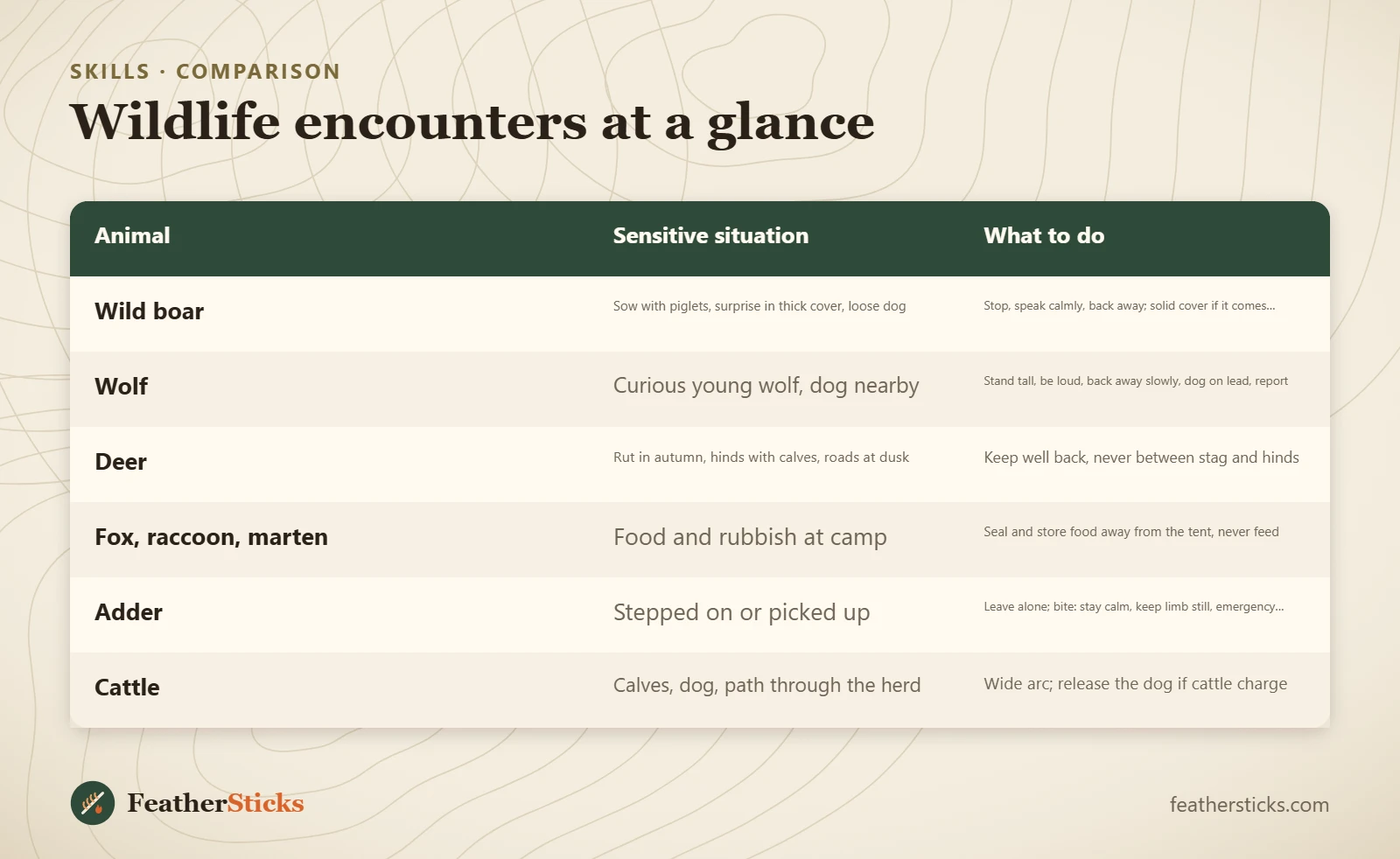
| Animal | Sensitive situation | What to do |
|---|---|---|
| Wild boar | Sow with piglets, surprise in thick cover, loose dog | Stop, speak calmly, back away; solid cover if it comes closer |
| Wolf | Curious young wolf, dog nearby | Stand tall, be loud, back away slowly, dog on lead, report |
| Deer | Rut in autumn, hinds with calves, roads at dusk | Keep well back, never between stag and hinds |
| Fox, raccoon, marten | Food and rubbish at camp | Seal and store food away from the tent, never feed |
| Adder | Stepped on or picked up | Leave alone; bite: stay calm, keep limb still, emergency call |
| Cattle | Calves, dog, path through the herd | Wide arc; release the dog if cattle charge |
Common mistakes
- Running away. You cannot outrun a boar, wolf, bear or cow, and running makes you unpredictable – back away slowly instead.
- Believing that playing dead works for wild boar or wolves. It is specific advice for defensive brown bear attacks; with other animals you create distance and put solid cover between you.
- Relying on climbing a tree. There is rarely time or a suitable tree, and bears climb; stepping behind a thick trunk or other solid cover is the realistic option.
- Walking closer for a photo or to "see what it does", especially with young animals.
- Letting the dog off the lead in spring, at dusk or in areas with boar, wolves or cattle.
- Keeping food, rubbish or toothpaste in the tent, or leaving scraps "for the animals".
- Picking up a fawn, leveret or fledgling that looks abandoned.
What you need
- Dog lead (short, sturdy) and a way to tie the dog at camp
- Odour-tight bag or hard-sided food container with a secure lid
- Cord for hanging a food bag
- Headlamp with fresh batteries
- Sturdy boots and long trousers
- Charged phone with emergency numbers and an offline map
- First aid kit with wound disinfectant and dressings
- Something bright to wear in the hunting season
FAQ
What should I do if I meet a wild boar?
What should I do in a wolf encounter?
Are wild animals dangerous when camping in Germany or the UK?
How do I keep animals away from my tent at night?
What is the first aid for an adder bite?
What does bear safety when camping involve?
Should I let my dog off the lead if cattle charge?
I found a fawn alone – is it abandoned?
Check yourself
Completed6 quick questions from this guide. Nothing is sent anywhere.
Related step-by-step guides
-
 1
-
 1
-
 1