Tree Identification & Wood Types: How to Identify Trees for Bushcraft
Learning how to identify trees is the skill that makes every other bushcraft skill easier: once you know birch from beech and spruce from fir, you know where the tinder is, which wood will hold a fire through the night, which pole will bend and which will snap. You do not need a botany degree. A short, fixed sequence of questions – needles or leaves, how they sit on the twig, bark, buds, shape and site – identifies the dozen or so trees that matter most in temperate woodland.
This guide covers tree identification by bark and leaves, how to identify trees in winter, and what each wood is good for: firewood, kindling, friction fire, carving, poles and cordage. It is written for wood, fire and craft – it gives no advice on eating any part of any tree. It belongs to our bushcraft skills hub; if you are just starting out, read bushcraft for beginners first.
Step by step
-
1

Conifer or broadleaf?
Needles or scales mean conifer, flat leaf blades mean broadleaf. That single look cuts the list of candidates in half.
-
2

Read the needles
Single needles point to spruce, fir or yew. Long needles in pairs mean pine. Soft tufts on little knobs mean larch.
-
3

Read the leaf and its position
Is the leaf simple, lobed or made of leaflets? Then look at the twig: opposite pairs point to maple, ash or elder. Almost everything else alternates.
-
4

Check the bark
Colour, texture and pattern: white and peeling, smooth and grey, deeply furrowed, orange and flaky. Look at the old bark low down and the young bark higher up.
-
5

Look at buds and twigs
Buds are there all winter. Note their colour, shape and whether they sit in pairs or singly: black and paired is ash, long and pointed is beech.
-
6

Step back: shape and site
Look at the whole tree and where it grows – wet ground, dry sand, deep shade. Name it only when three features agree.
How to identify trees: one method for every tree
Beginners usually try to match a whole tree to a picture and get lost. It works far better to ask the same questions in the same order every time. Each answer throws out most of the candidates, and after four or five answers only one or two trees are left.
The order matters. Start with the features that never change (needles or leaves, how they are arranged) and finish with the ones that vary with age and site (bark, shape). A young oak in a dark forest looks nothing like an old oak in a field, but its leaves and buds are the same.
The six questions, always in this order
- 1. Needles or leaves?Conifer or broadleaf.
- 2. How do they sit?Needles single, in bundles or tufts. Leaves opposite or alternate.
- 3. What shape?Simple, lobed or compound; edge smooth or toothed.
- 4. BarkColour, texture, pattern – low down and higher up.
- 5. Buds and fruitColour, shape, position; cones, catkins, seeds.
- 6. Shape and siteSilhouette and where the tree stands.
The rule of three
Never name a tree on one feature. Leaves vary on the same branch, bark changes with age, and many trees share a silhouette. If three independent features agree – say, opposite buds, compound leaves and black bud colour for ash – the identification is solid. If only two agree, write down "probably" and come back in another season.
Use all your senses – except taste
Touch the needles: are they stiff and prickly or soft? Roll one between your fingers: does it roll (four-sided) or not (flat)? Crush a leaf or needle and smell it. Feel whether the leaf is hairy, leathery or thin. All of that is safe and useful. Tasting is not part of identification, and nothing in this article is a reason to put any part of a tree in your mouth.
Where to look
- On the tree: take leaves from a normal branch in the light. Shoots from the base or from a cut stump often have oversized, oddly shaped leaves.
- On the ground: fallen leaves, cones, seeds and twigs under the tree tell you what grows above – but check that they did not blow in from a neighbour.
- Around the tree: wet feet or dry ridge, valley bottom or exposed slope. Site is a strong supporting clue, as explained in choosing a camp site.
Quick path through the first questions
Does the tree have needles or scales?
Yes → Conifer – go to the needle check below.No → Broadleaf – look at how the leaves or buds sit on the twig.Do leaves or buds sit in opposite pairs?
Yes → Short list: maple, sycamore, ash, elder, horse chestnut and a few shrubs.No → Alternate: beech, oak, birch, hazel, lime, alder, willow, poplar, hornbeam, rowan.Is the leaf made of several leaflets on one stalk?
Yes → Compound: ash, rowan or elder (walnut and black locust in parks and plantations).No → Simple: check lobes, teeth and the shape of the base.
Conifers: pine, spruce, fir, larch – and yew
Conifers are the easiest group to learn, because one question does most of the work: how are the needles attached? Pull a single needle or a single bundle off the twig and look at it. In European forests that separates the five conifers you meet most often.
Five conifers by their needles
 1Pine: needles in bundles
Pine needles are long and always grow in bundles held by a small papery sheath. Scots pine has two blue-green, slightly twisted needles of about 4–7 cm per bundle. Count the needles: the number per bundle is the quickest way to tell pine species apart anywhere in the world.
 2Spruce: single and prickly
Spruce needles sit singly all round the twig, each on a tiny woody peg. They are stiff, sharp and four-sided, so they roll between your fingers. Where needles have fallen, the pegs make the twig feel like a rasp. The cones hang down and fall off whole.
 3Fir: flat and friendly
True fir needles are flat, blunt or notched at the tip and will not roll. Turn one over: two white stripes run along the underside. They sit on a small round base and leave a smooth, round scar. Fir cones stand upright on the branch and fall apart on the tree, so you rarely find a whole one on the ground.
 4Larch: tufts that fall in autumn
Larch carries soft, light green needles in tufts of 20 or more on short, knobbly spurs. It is the only common European conifer that turns golden and drops its needles in autumn. In winter the bare twigs with their rows of knobs and small upright cones are unmistakable.
 5Yew: learn it to leave it
Yew has flat, dark green, soft-pointed needles in two rows on green twigs. The underside is pale green with no white stripes, and there are no cones – female trees carry single red, cup-shaped arils. Treat every part of the tree as poisonous and never use it for anything that touches food.
Spruce or fir? The handshake test
Grip a twig gently. Spruce pricks – "spiky spruce". Fir is soft – "friendly fir". Then check the three back-up features: needle rolls or not, white stripes or not, cones hanging or standing. The memory aid works in most of the northern hemisphere, with one common trap: Douglas fir is not a true fir. Its soft needles smell of citrus when crushed, but its cones hang down and have three-pointed bracts sticking out between the scales.
| Tree | Needles | Cones | Bark |
|---|---|---|---|
| Scots pine | In pairs, 4–7 cm, blue-green, twisted | Small, woody, egg-shaped; open when dry | Grey-brown plates below, orange and flaky in the upper trunk |
| Norway spruce | Single, four-sided, sharp, all round the twig, on woody pegs | Long, hanging, fall whole | Reddish-brown to grey, thin round scales |
| Silver fir | Single, flat, blunt, two white stripes beneath, in two rows | Upright, break up on the tree | Pale grey, smooth for decades, later cracked |
| European larch | Soft tufts on short spurs; shed in autumn | Small, egg-shaped, upright, stay for years | Grey-brown, thick, deeply furrowed, reddish in the cracks |
| Yew | Flat, dark, soft-pointed, no white stripes | None – red arils on female trees | Thin, reddish-brown, peeling in flakes |
Sizes are typical values for mature trees; shaded and young shoots vary.
Tree identification by leaves: shape, edge and position
For broadleaved trees, look at the twig before you look at the leaf. Opposite or alternate is the most powerful single question, because only a handful of trees carry their leaves and buds in opposite pairs: maples and sycamore, ash, elder and horse chestnut, plus a few shrubs such as dogwood, spindle and guelder rose. Everything else alternates along the twig.
Then describe the leaf in three words: its outline (round, oval, heart-shaped, triangular, long and narrow), its edge (smooth, wavy, finely toothed, double-toothed, lobed) and its surface (hairy, glossy, pleated). That description is usually enough.

Simple leaves you will meet most
- Birch: small, triangular to diamond-shaped, double-toothed, on a thin stalk. Silver birch leaves are hairless with a drawn-out tip; downy birch leaves are rounder and softly hairy.
- Beech: oval with a wavy, untoothed edge and straight parallel veins. Young leaves have a fringe of silky hairs.
- Hornbeam: the beech lookalike. The leaf is pleated like a folded fan, the edge is sharply double-toothed and the surface feels rougher.
- Oak: rounded lobes. English (pedunculate) oak has an almost stalkless leaf with two small "ears" at the base; sessile oak has a clear leaf stalk and a wedge-shaped base.
- Hazel: large, almost round, with an abrupt little point, soft and hairy on both sides, on a short hairy stalk.
- Lime (linden): heart-shaped, finely toothed, with a lopsided base and a long stalk.
- Alder: round to racket-shaped with a blunt or notched tip, dark green and slightly sticky when young.
- Willow: most tree willows have long, narrow, finely toothed leaves; goat willow has broader, oval leaves with a felted underside.
- Aspen: almost round with coarse, blunt teeth on a long, flattened stalk, so the leaves tremble in the slightest breeze.

Maples and sycamore
All maples have opposite, hand-shaped leaves and paired winged seeds. Norway maple leaves end in a few long, fine points and the leaf stalk shows milky sap when snapped. Sycamore (a maple, despite the name) has coarser, blunter teeth, a paler underside and bark that flakes off in plates on old trunks. Field maple is a smaller tree with small leaves and rounded lobes. Plane trees in towns have similar leaves – but they sit alternately.
Compound leaves: ash, rowan, elder
A compound leaf is one leaf made of several leaflets on a common stalk. The test: a bud sits at the base of a whole leaf, never at the base of a leaflet.

| Pair | First tree | Second tree |
|---|---|---|
| Beech / hornbeam | Beech: smooth leaf edge, smooth round trunk, long buds sticking out | Hornbeam: toothed, pleated leaf, fluted "muscular" trunk, shorter buds pressed to the twig |
| Ash / rowan | Ash: opposite, black buds, big tree | Rowan: alternate, purple-grey hairy buds, small tree, sharply toothed leaflets |
| Ash / elder | Ash: 9–13 slim leaflets, smooth grey twigs | Elder: 5–7 broad leaflets, warty twigs with soft white pith, strong smell when crushed |
| Hazel / lime | Hazel: round, soft and hairy, short stalk, many stems from the ground | Lime: heart-shaped, smooth, long stalk, single trunk |
| Hazel / alder | Hazel: pointed tip, on drier ground | Alder: blunt or notched tip, small woody cones, on wet ground |
| Spruce / fir | Spruce: prickly, needle rolls, cones hang | Fir: soft, flat, two white stripes, cones stand |
| Fir / yew | Fir: two white stripes beneath, resin smell | Yew: plain pale green beneath, green twigs, no resin – toxic |
Tree identification by bark
Bark is there all year and at eye level, which makes it the most practical feature once you know it. It is also the most variable: young trees of almost every species have thin, smooth bark, and the typical pattern only develops with age. Always look at two heights – the old bark at the base and the younger bark further up – and compare several trees.

| Tree | Bark of mature trees | Useful extra clue |
|---|---|---|
| Silver birch | White, peeling in papery bands, black diamond-shaped cracks at the base | Thin, hanging twigs with tiny warts |
| Beech | Smooth, thin, silver-grey even on huge trunks | Old carvings stay visible for decades – a reason never to carve into bark |
| Hornbeam | Smooth grey with pale vertical stripes; trunk fluted like muscles | Trunk rarely round in cross-section |
| Oak | Grey-brown, thick, deep vertical furrows and ridges | Crooked, heavy limbs |
| Ash | Smooth and grey-green when young, later a regular net of ridges | Stout twigs, black buds |
| Scots pine | Thick grey-brown plates below, thin orange flakes above | Long bare trunk, crown high up |
| Norway spruce | Reddish-brown, thin round scales | Resin beads on wounds |
| Alder | Dark brown to blackish, cracked into small plates | Freshly cut wood turns orange-red |
| Aspen and poplar | Smooth, grey-green with diamond-shaped pores; dark and furrowed at the base | Rustling leaves |
| Wild cherry | Glossy red-brown, peeling in horizontal bands with long pores | Often on wood edges |
| Elder | Pale grey-brown, corky, deeply furrowed and warty | Twigs full of soft white pith |
| Sycamore | Grey, smooth, later flaking in irregular plates | Green winter buds |
Bark also tells you about fire materials. White birch bark is the classic natural fire starter, and resin on pine and spruce points to fatwood nearby. Bark is the tree's skin, though: take it only from dead or fallen wood, as explained in our guide to natural tinder. A ring of bark removed from a living trunk kills the tree above it.
How to identify trees in winter
Winter identification looks hard and is actually very systematic, because the same few clues are always available: buds, twigs, bark, leftover fruit and shape. Start as in summer with opposite or alternate – the buds sit exactly where the leaves were. Then look at one bud closely.
Winter twigs you can name at a glance
 1Ash: black and opposite
Stout, grey-green twigs, flattened at the nodes, with matt black buds in opposite pairs and a larger black bud at the tip. No other common tree has black buds, so ash is the best winter tree to start with.
 2Beech: long and pointed
Slender, slightly zigzag twigs with long, thin, sharply pointed, copper-brown buds of about 1.5–2 cm that stick out at an angle. Young beeches and hedges often keep their dry brown leaves until spring.
 3Oak: a cluster at the tip
Plump, egg-shaped, orange-brown buds with many small scales, crowded together at the end of the twig, with single buds below. Look for old acorn cups and lobed brown leaves on the ground.
 4Catkins and cones
Hazel carries its tightly closed catkins from autumn onwards. Alder keeps small, dark woody cones and has purplish buds on short stalks. Birch shows a haze of very fine, dark twigs with slim catkins at the tips.
| Tree | Buds | Other winter clues |
|---|---|---|
| Ash | Black, opposite | Bunches of flat winged seeds ("keys") often hang all winter |
| Sycamore | Green, opposite, plump | Flaking bark on old trunks |
| Norway maple | Red-brown, opposite, pressed to the twig | Finely ridged bark that does not flake |
| Horse chestnut | Big, brown, sticky, opposite | Horseshoe-shaped leaf scars |
| Elder | Opposite, ragged, often already opening purple-green | Warty twigs, white pith |
| Beech | Long, slender, pointed, alternate | Smooth grey bark, husks on the ground |
| Hornbeam | Like beech but shorter and pressed to the twig | Fluted trunk |
| Oak | Clustered at the tip | Furrowed bark, acorn cups |
| Lime | Red, shiny, with two or three visible scales – like a mitten | Zigzag twigs, often shoots at the trunk base |
| Hazel | Blunt, oval, green-brown | Catkins, many straight stems |
| Alder | Purplish, on a short stalk | Small woody cones, wet ground |
| Willow | One single cap-like scale, pressed to the twig | Yellow, red or olive twigs, near water |
| Rowan | Dark purple-grey with pale hairs | Smooth silvery bark |
| Birch | Small, pointed, often sticky | White bark, fine hanging twigs |
Conifers are no harder in winter than in summer, with one exception: larch stands bare and is sometimes mistaken for a dead spruce. Look for the knobbly twigs and the small cones – and do not fell a "dead" conifer in winter without checking.
Winter is also when tree knowledge pays off most. Frozen, snow-covered ground hides fallen wood, so you rely on standing dead timber, birch bark and resinous pine. See winter camping and fire in wet weather for how to use them.
Reference table: 18 trees and what they are good for
The table below collects the trees that matter most for bushcraft in temperate Europe. "Bushcraft use" always means dead wood, fallen material or wood cut with the landowner's permission – see the legal section further down.
| Tree | Key features | Where it grows | Good for | Cautions |
|---|---|---|---|---|
| Birch | White peeling bark, small triangular toothed leaves, fine hanging twigs | Pioneer on poor, sandy and boggy soils, clearings, heath | Bark as tinder, good firewood, green wood carves well | Bark only from dead or fallen trees; dead birch rots fast inside sound-looking bark |
| Scots pine | Needles in pairs, orange upper trunk | Dry sandy soils, heath, bog edges | Fatwood, resin, kindling, quick hot fire | Sparks and soot; resin on blades and pots |
| Norway spruce | Single prickly needles, hanging cones, scaly bark | Mountains and planted forests on cool, moist soils | Dry dead twigs on the lower trunk, long thin roots for binding, poles | Sparks strongly; shallow roots – trees blow over in storms |
| Silver fir | Flat needles with two white stripes, upright cones | Mountain forests, shade | Kindling, soft wood for practice carving | Often protected young growth; do not confuse with yew |
| Larch | Needle tufts, bare in winter, small cones | Mountains, plantations, open sunny slopes | Resinous, durable wood, hot fire | Throws many sparks |
| Beech | Smooth grey bark, wavy-edged leaves, long pointed buds | Rich, well-drained soils; dominant in much of Central Europe | Top firewood, cooking coals, mallets and wedges | Large old beeches drop heavy limbs without warning – do not camp under them |
| Oak | Lobed leaves, furrowed bark, buds clustered at tips | Lowlands, heavy soils, wood edges | Long-lasting embers, durable stakes and pegs | Burns poorly unless very dry; tannins stain steel and hands; hairy processionary caterpillars on some oaks |
| Ash | Opposite compound leaves, black buds | Moist, rich soils, stream sides | Tough, springy poles and handles, excellent firewood | Ash dieback makes crowns brittle – keep away from dying ash |
| Hazel | Round soft leaves, catkins, many straight stems | Hedges, wood edges, coppice | Straight rods: poles, pegs, pot hangers, cooking sticks, bow-drill spindles | Regrows from the stump, but cutting still needs permission |
| Willow | Narrow leaves, single-scaled buds, by water | Riverbanks, wet meadows | Friction-fire wood, flexible withies, bark fibre | Poor firewood; brittle limbs on old crack willows |
| Lime (linden) | Heart-shaped leaves, red mitten buds | Mixed woods, parks, avenues | Best friction-fire wood, soft carving wood, bast fibre for cordage | Low heat as firewood; many old limes are protected monuments |
| Alder | Round notched leaves, woody cones, wet ground | Stream banks, swamps | Easy to carve green, quick fire, wood lasts under water | Wet sites – dead wood is often sodden |
| Aspen and poplar | Round trembling leaves, pale smooth bark | Clearings, riversides, pioneer sites | Friction-fire wood, light and soft for carving | Low heat, rots quickly; brittle branches |
| Maple and sycamore | Opposite hand-shaped leaves, winged seeds | Mixed forests, mountain valleys, towns | Pale, tasteless wood for utensils; good firewood | Sooty bark disease on stressed sycamores – do not handle trunks with black powdery bark |
| Hornbeam | Fluted grey trunk, pleated toothed leaves | Lowland mixed woods, hedges | Very hot, long fire; mallets, wedges, digging sticks | Extremely hard to carve and split |
| Rowan | Compound leaves, smooth grey bark, orange-red berries | Mountains, moors, wood edges | Tough, flexible wood for handles and walking sticks | Small tree – rarely any dead wood worth taking |
| Elder | Opposite compound leaves, warty twigs with pith | Hedges, waste ground, rich soils | Dead dry stems as hand-drill spindles | Leaves, bark, green wood and unripe fruit are toxic – no skewers, blowpipes or whistles |
| Yew | Flat dark needles, red arils, flaking red bark | Old woods, limestone, churchyards | Nothing for the beginner – recognise and avoid | Highly toxic; protected in several countries |
North American counterparts
The same six questions work in North America, and most European trees have close relatives there. The wood properties are usually similar within a genus, so what you learn on one continent transfers to the other.
| In Europe | North American relatives | Worth knowing |
|---|---|---|
| Silver and downy birch | Paper birch, yellow birch, river birch | Paper birch bark is the classic northern tinder |
| Scots pine | Eastern white pine, red pine, lodgepole, ponderosa and many more | Count the needles per bundle: five for white pines, two or three for most others |
| Norway spruce | White, black, red, Sitka and Engelmann spruce | All prickly, all with hanging cones |
| Silver fir | Balsam fir, grand fir and others | Douglas fir is not a true fir – its cones hang |
| European larch | Tamarack, western larch | Tamarack grows in bogs and wet ground |
| Beech | American beech | Same smooth grey bark and long buds |
| English and sessile oak | White oak group (rounded lobes), red oak group (bristle-tipped lobes) | Both are dense, slow-drying firewood |
| Ash | White, green and black ash | Emerald ash borer has killed many ashes – do not move firewood between regions |
| Hazel | American and beaked hazel | Shrubs with the same straight rods |
| Lime (linden) | American basswood | A favourite friction-fire and carving wood |
| Alder | Red alder, speckled alder | Red alder is a major carving wood in the Pacific Northwest |
| Aspen and poplar | Quaking aspen, bigtooth aspen, cottonwoods | Cottonwood and aspen are classic friction-fire woods |
| Maple and sycamore | Sugar, red, silver and bigleaf maple | "Sycamore" in North America is a plane tree with alternate leaves; boxelder is a maple with compound leaves |
| Hornbeam | American hornbeam (musclewood), hophornbeam | Both called ironwood |
| Rowan | American mountain-ash | Not related to true ash |
| Elder | American and red elderberry | Same cautions |
| Yew | Pacific yew, Canada yew | Same toxicity |
In North America also learn poison ivy, poison oak and poison sumac before handling vines and shrubs. Never burn them: the smoke is dangerous to breathe.
Best wood for firewood: heat, sparks and smoke
Which wood burns best? The honest answer has two parts. Dryness beats species: any dry dead wood burns better than the best hardwood when it is damp. And per kilogram, all dry wood gives roughly the same heat – widely published guide values are around 4 kWh per kilogram of air-dry wood, with resinous softwoods slightly higher. What differs is density. A dense log of beech or oak holds far more wood than a spruce log of the same size, so it burns longer and leaves more embers.
For a campfire that means: light and resinous woods to get going, dense hardwoods to keep going.
Heat per log of the same size (rough guide, beech = 100)
The index above is rounded from commonly published forestry guide values for air-dry wood by volume. Real figures vary with the source, the site the tree grew on and, above all, moisture – use it as a ranking, not as a measurement.
| Wood | Heat per log | Sparks | Flame and embers | Dries (green wood, split) |
|---|---|---|---|---|
| Beech | Very high | Few | Calm flame, lasting embers – ideal for cooking | Slowly, about 2 years |
| Hornbeam | Very high | Few | Long, hot ember bed | Slowly, about 2 years |
| Oak | Very high | Few | Little flame, embers for hours | Very slowly, 2–3 years |
| Ash | High | Few | Bright, steady flame | Fairly fast, 1–2 years |
| Birch | High | Few | Bright flame, burns faster; bark lights easily | Fast if split – rots if left in the bark |
| Maple, sycamore | High | Few | Steady, good embers | About 2 years |
| Larch | Medium to high | Many | Hot, lively | 1–2 years |
| Pine | Medium | Some to many | Hot, fast, sooty | About 1 year |
| Spruce, fir | Medium to low | Many (spruce) | Fast, crackling, few embers | About 1 year |
| Alder | Medium to low | Few | Quick, even | About 1 year |
| Willow, poplar, lime | Low | Few | Fast, little ember | About 1 year, very wet when green |
Drying times are rough rules for green wood that is split and stacked under cover. Camp wood is different: you gather wood that is already dead and dry.
Sparks, smoke and what they mean in camp
- Sparks: spruce, larch, pine and sweet chestnut spit glowing embers, because pockets of resin and trapped moisture burst. Keep tarps, sleeping bags and synthetic clothing well back, or choose beech, birch or ash for a fire you sit close to. See campfire safety.
- Smoke: thick smoke nearly always means damp wood or too little air, not the "wrong" species. Resinous woods and birch bark burn with dark, sooty smoke that blackens pots.
- Embers: for cooking you want a bed of coals. Dense hardwoods give it; softwoods collapse to ash quickly. More in campfire cooking.
How much wood you need for an evening or a night is a different question – the firewood calculator gives amounts for tinder, kindling and fuel, and the fire lay picker suggests a matching fire lay. A single thick, dry softwood log is all you need for a Swedish torch.
Tinder, kindling and friction fire: the trees that start fires
Tinder and kindling from trees
Three trees solve most fire-starting problems in northern forests:
- Birch: the papery outer bark burns even when damp because of its natural oils. Take it from fallen trunks and loose pieces. Details in natural tinder.
- Pine: old stumps and the bases of dead branches hold resin-soaked fatwood that lights in the rain and burns like a candle.
- Spruce: the thin dead twigs on the lower trunk, sheltered by the canopy, stay dry in almost any weather. They snap off by hand and make perfect first kindling.
Beyond these, any straight-grained dry wood – pine, spruce, willow, hazel, birch – splits and shaves well into feather sticks. Dead beech and birch trunks may carry hoof-shaped bracket fungi that are used for ember-catching material, covered in tinder fungus.
Best wood for a bow drill
Friction fire needs the opposite of good firewood: soft, light, bone-dry, non-resinous wood that grinds into fine dust instead of polishing. The classic choices in Europe are lime, willow, poplar and aspen, with dead ivy, clematis, alder, sycamore and spruce also in use. Elder and hazel are traditional spindle woods. In North America, basswood, cottonwood, aspen, willow and the cedars fill the same role.
The thumbnail test tells you more than the species name: press your nail into the wood. If it leaves a clear dent without much force, the wood is soft enough; if it will not mark, it is too hard; if it crumbles, it is too rotten. Resinous pine and fatwood glaze over and squeak rather than making dust. The full method is in our bow drill guide.
| Job | Best choices | Why |
|---|---|---|
| Tinder | Birch bark, fatwood scrapings, dry inner bark of dead lime or willow | Oils and resins, fine fibres |
| First kindling | Dead spruce and pine twigs, dead standing hazel and birch twigs | Thin, dry, off the ground |
| Feather sticks | Pine, spruce, willow, straight birch | Straight grain, soft enough to curl |
| Bow-drill hearth and spindle | Lime, willow, poplar, aspen, ivy | Soft, light, no resin |
| Main fuel | Beech, hornbeam, oak, ash, birch | Dense, long burn, good coals |
Carving woods and cooking sticks: what may touch food
Best wood for carving
For whittling you want wood that cuts cleanly and does not fight the knife. Green (freshly cut) wood is far softer than seasoned wood, which is why spoon carvers work green and let the piece dry afterwards.
- Birch: the all-round carving wood of the north – even grain, firm, takes a fine finish.
- Alder: soft and easy when green, turns a warm orange on the cut surface.
- Lime: the softest and most forgiving; ideal for a first figure or a child's first project.
- Sycamore and maple: pale, dense, with no taste or smell, traditionally used for kitchen utensils.
- Willow and hazel: easy to cut for quick camp items such as pegs, hooks and tongs.
- Cherry and other fruit woods: beautiful but harder, and prone to cracking as they dry.
Oak, ash and hornbeam are tough going with a knife and better left for mallets, wedges and handles. Techniques are covered in carving and whittling and carving a spoon; the right tools in carving tools and choosing a bushcraft knife.
Cooking sticks: use what you can name
Anything that touches food – skewers, bread sticks, pot hangers over an open pot, spoons, spatulas, cups – must be made from wood you have identified with certainty and that is known to be harmless. The rule is simple: if you cannot name it, do not cook on it.
Wood for skewers and utensils
Commonly used
- Hazel – straight rods, the classic cooking stick
- Beech, birch, maple and sycamore
- Willow – flexible for grills and tongs
- Ash and lime
- Always: peeled, fresh or clean dry wood, tip carved back to clean wood
Never for food contact
- Yew – highly toxic
- Laburnum – toxic, common in gardens and parks
- Elder – green wood, bark and pith are toxic
- Spindle, cherry laurel, rhododendron, privet, black locust, oleander (Mediterranean)
- Anything you cannot identify, plus rotten, mouldy or treated wood
Resinous conifers are not poisonous as skewers, but they give food a harsh, tarry taste and drip pitch – another reason to keep them for kindling. More on rigs and sticks in cooking on a spit and bannock on a stick.
Shelter poles, pegs, cordage and withies
Poles and pegs
A good pole is straight, strong for its weight and long enough. Hazel grows exactly that way: many straight stems from one base. Ash shoots are tougher and springier, which is why ash is the traditional wood for handles. Young sweet chestnut, sycamore and birch also serve. Dead spruce poles are light and straight but brittle – check them over your knee before you trust them as a ridge pole.
For pegs and stakes, hard dense wood lasts: dead oak branches, hazel, ash, hornbeam. Cut the point with three or four flat facets and chamfer the top so it does not split under the mallet. For everything that bears weight above your head, see building a lean-to and debris shelters; for joining poles, lashings.
Natural cordage and withies
- Lime bast: the inner bark of lime is the classic European cordage fibre. It is taken from dead or felled trees, and traditionally soaked in water for some weeks until the layers separate.
- Willow: thin shoots twist into withies that tie bundles and frames; the bark of young shoots makes quick ties.
- Spruce roots: long, thin and tough once peeled and split. Digging them up damages a living tree, so take them only where it is permitted and where roots are already exposed, for example on windblown trees.
- Hazel and birch withies: thin shoots, twisted until the fibres separate, bend into rings and bindings.
How to turn fibres into rope is explained in natural cordage. For anything that has to hold reliably, carry real cord – see paracord and its uses – and treat natural cordage as a skill to practise.
Which tree for which job
- Ridge pole
- Hazel, ash, sound dead spruce
- Tent pegs
- Hazel, ash, dead oak
- Pot hanger
- Green hazel or willow
- Mallet
- Beech, hornbeam, oak
- Withies
- Willow, hazel, birch
- Bast fibre
- Lime, willow
Dead standing or fallen? How to judge dry wood
In the woods you do not season firewood, you find it dry. The species matters less than where the wood has been lying. Wood on the ground soaks up moisture like a wick and starts to rot. Wood that died standing, or hangs caught in other branches, is dried by wind and sun from all sides.
Four checks for dry dead wood
 1Look up first
Dead branches still on the tree, thin dead stems standing among others and limbs hung up off the ground are the driest wood around. Anything lying in the leaf litter is the last choice. Never stand or work under hanging dead limbs.
 2The snap test
Bend a finger-thick stick. Dry wood breaks suddenly with a sharp crack. Damp or living wood bends, tears into fibres and stays attached. Knock two thicker pieces together: a clear ring is dry, a dull thud is damp.
 3Check that it is dead
Leafless is not dead, especially in winter. Scratch the bark with a thumbnail: a green, moist layer underneath means the branch is alive – leave it. Dead wood is brown and dry under the bark, and the bark often comes off by itself.
 4Split to the core
After days of rain only the outside of dead standing wood is wet. Split wrist-thick pieces: the inside is pale, dry and lights well. That is the whole idea of batoning and of sawing and splitting rather than collecting sodden sticks.
| Sign | Meaning | What to do |
|---|---|---|
| Bark slips off, wood grey and hard | Dead for a long time and dry | Ideal fuel |
| Light for its size, cracks at the ends | Well dried | Use it |
| Heavy, cool to the touch, dull thud | Still wet | Split it or leave it |
| Soft, crumbly, with white threads | Rotten | Leave it – it smoulders, and it is habitat |
| Green under the bark, flexible twigs, plump buds | Alive | Leave it |
| Hisses and oozes at the ends in the fire | Water boiling out | Stack it by the fire to dry first |
Dead standing trees are valuable and dangerous at the same time. Thin dead poles of arm thickness can be taken down with a folding saw where that is allowed. Large dead trees can shed their tops when shaken – leave them alone, and do not pitch a shelter within their falling distance.
Toxic trees, hazards and protected trees
Very few trees in temperate Europe are dangerous to handle. The risks come from using the wrong wood for food contact, from a few plants that cause skin reactions, and from the trees themselves when they are old, diseased or dead.
Poisonous woody plants to recognise
- Yew: flat dark needles without white stripes, red arils. All parts are to be treated as highly toxic.
- Laburnum: small tree with three-part leaves and hanging yellow flower chains, pea-like pods. All parts toxic.
- Elder: leaves, bark, green wood and unripe fruit are toxic. Hollowed elder twigs are a traditional toy material, but they do not belong in the mouth.
- Spindle, cherry laurel, privet, rhododendron, black locust: common in hedges, parks and wood edges; none of them is skewer wood.
This article deliberately says nothing about edible parts of trees. Do not eat any fruit, seed, leaf, sap, bark or fungus on the strength of a tree identification.
Skin and breathing hazards
- Giant hogweed is not a tree, but grows head-high and beyond along streams and paths where you look for willow and alder. Its sap makes skin extremely sensitive to sunlight and causes burns and blisters. Do not touch it, and do not cut it for any purpose. After contact, wash the skin, keep it out of the sun and seek medical advice.
- Oak processionary caterpillars occur on oaks in parts of Europe. Their fine hairs cause rashes and breathing trouble. Stay away from oaks with web nests on the trunk and follow local warning signs.
- Sooty bark disease on sycamore shows as black powder under peeling bark; the spores can irritate the lungs. Do not saw or burn such wood.
Trees that drop things
Dead tops, hanging limbs and diseased trees kill more outdoor people than poison does. Dying ash, old beech and poplar, and storm-damaged spruce are the usual suspects. Look up before you sit, cook or sleep – it is the first rule of setting up camp. Basic treatment for cuts, burns and rashes is in outdoor first aid.
Protected trees and habitats
Old trees with holes, cracks, loose bark and dead limbs are the most valuable habitat in the forest for bats, woodpeckers, owls and insects. Many are legally protected as individual trees or as part of a reserve; some species, such as yew, are protected in several countries. Standing and lying dead wood is part of that habitat, which is one reason to take small amounts and thin pieces only.
Law and ethics: what you may cut and collect
Every tree belongs to someone. Wherever you are, the starting point is the same: cutting or damaging a living tree without the owner's permission is not allowed, and in many places neither is taking wood, bark or roots. What differs from country to country is how small amounts of dead wood are treated. The notes below are general orientation, not legal advice – check the rules for the specific place before you go.
- United Kingdom: there is no general right to collect wood. Wood, living or dead, belongs to the landowner; ask first. Many woods are also protected sites where nothing may be removed.
- Scandinavia: the right of public access lets you walk and camp briefly, but it does not include cutting living trees or taking bark, twigs or branches from them. Rules for fallen twigs and for fires differ between the countries and seasons.
- United States and Canada: rules depend on who manages the land. Many public forests allow gathering dead and down wood for a campfire; most parks restrict or forbid it; cutting standing trees, even dead ones, usually needs a permit. Moving firewood between regions is widely restricted to stop the spread of tree pests – buy or gather it where you burn it.
- Germany and Central Europe: forest and nature conservation laws vary by state. Wood belongs to the forest owner, fires in and near forests are generally forbidden, and protected areas have their own stricter rules.
Carrying a knife or saw to practise is a separate legal question, covered in knife law; sleeping out is covered in wild camping rules.
A simple code for using trees
- Ask the landowner or forester – a friendly question opens more woods than any loophole
- Use dead wood first; cut green wood only with clear permission
- Take thin pieces and small amounts, spread over a wide area
- Leave big dead wood, hollow trees and anything with nests or holes
- No bark from living trees, no roots dug from healthy trees
- Stay out of nature reserves and young plantations with tools
- Leave no stumps at knee height, no shavings piles, no fire scars
Practice drills: how to learn trees for good
Tree identification is learned on walks, not from tables. The trick is to keep the number of trees small and the number of visits high.
A plan for your first year
- Learn five trees first Pick the five most common trees around you – in much of Europe that is birch, pine, spruce, beech and oak. Find ten examples of each. Only then add one new tree at a time.
- Keep a tree notebook One page per tree: a pressed or sketched leaf, a bark rubbing made with paper and a soft pencil or wax crayon, the bud drawn large, where you found it. Drawing forces you to look.
- Adopt one tree per species Choose a single tree close to home and visit it in all four seasons. Note when buds open, when catkins or flowers appear, when leaves turn and fall.
- Identify in winter on purpose Collect one fallen twig from each of your five trees and name them at home by their buds alone. Then mix them up and try again.
- Link each tree to a use Each time you name a tree, say what it gives you: "birch – bark for tinder, good fuel, good carving wood". With permission, make one small thing from each: a peg, a feather stick, a spoon blank.
- Test yourself by touch Close your eyes and tell spruce from fir from pine by the feel of a twig, and beech from oak by the bark. It is a good game with children – see bushcraft with kids.
Trees also help with other skills. Moss, branch growth and lone trees are weak but usable direction clues in natural navigation, and knowing which trees carry which seeds helps when you read animal tracks and signs. A first night out is a good moment to put it all together: see your first night out.
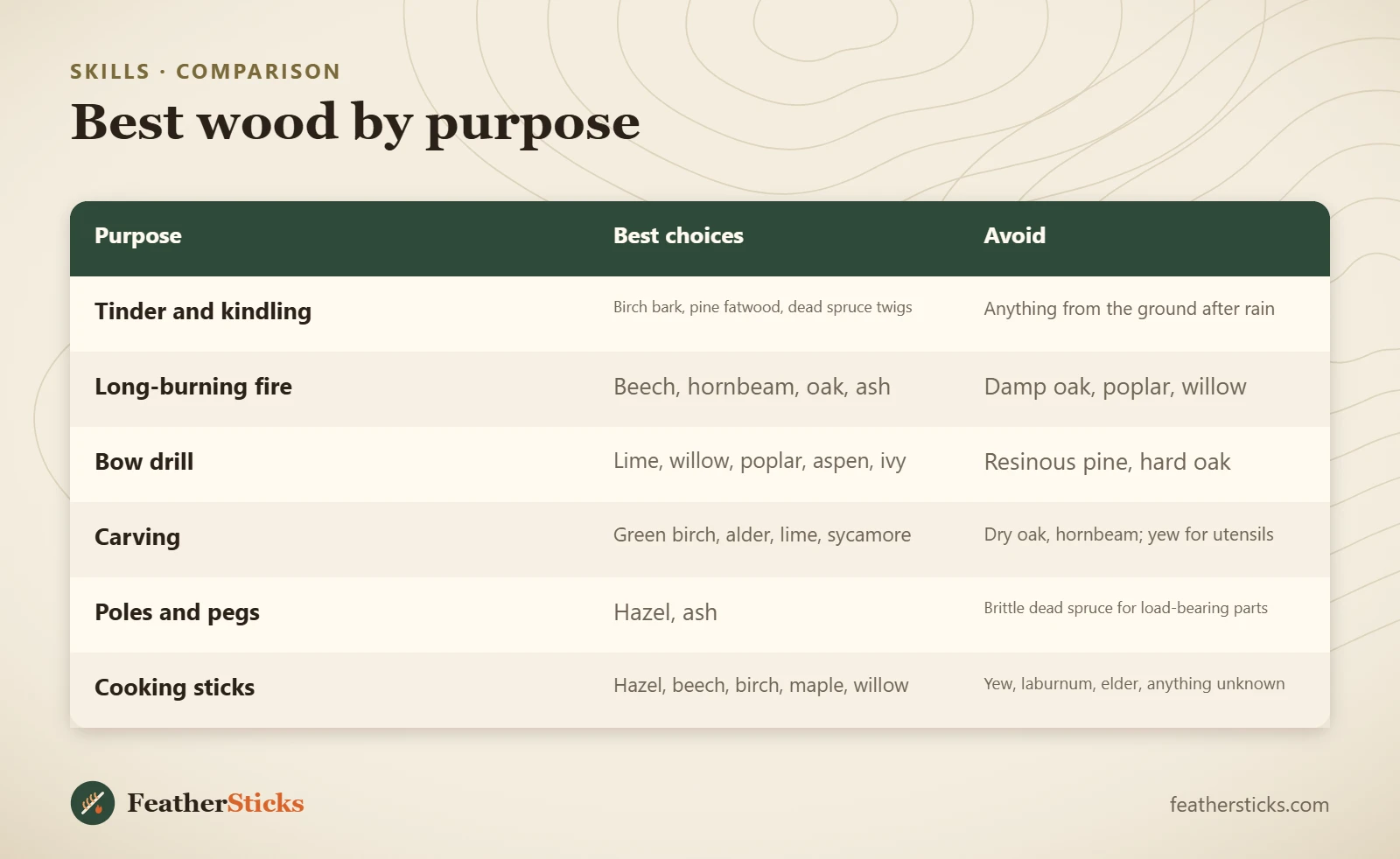
| Purpose | Best choices | Avoid |
|---|---|---|
| Tinder and kindling | Birch bark, pine fatwood, dead spruce twigs | Anything from the ground after rain |
| Long-burning fire | Beech, hornbeam, oak, ash | Damp oak, poplar, willow |
| Bow drill | Lime, willow, poplar, aspen, ivy | Resinous pine, hard oak |
| Carving | Green birch, alder, lime, sycamore | Dry oak, hornbeam; yew for utensils |
| Poles and pegs | Hazel, ash | Brittle dead spruce for load-bearing parts |
| Cooking sticks | Hazel, beech, birch, maple, willow | Yew, laburnum, elder, anything unknown |
Common mistakes
- Naming a tree from one feature – a single leaf or the bark alone – instead of checking three.
- Confusing fir with yew, or using any unidentified stick as a skewer.
- Taking a leafless tree for dead in winter and cutting into living wood.
- Collecting firewood from the ground and blaming the species when it only smokes.
- Peeling birch bark or lime bast from living trees.
- Sitting close to a spruce or larch fire in synthetic clothing and under a tarp.
- Camping under old beech, dying ash or hanging dead limbs.
What you need
- Small notebook and soft pencil or wax crayon for sketches and bark rubbings
- Hand lens (about 10×) for buds, needle undersides and leaf hairs
- Regional tree field guide or identification app as a second opinion
- Folding saw and fixed-blade knife – where carrying and using them is allowed
- Paper bags or envelopes for fallen leaves, twigs and cones
- Work gloves for handling resinous or rough wood
Calculators for this topic
FAQ
What is the easiest way to identify a tree?
How do you identify trees in winter without leaves?
What is the difference between spruce and fir?
Which wood burns best in a campfire?
What is the best wood for a bow drill?
Which wood is poisonous and should not be used for skewers?
Is dead standing wood better than fallen wood?
Am I allowed to collect wood and bark in the forest?
Check yourself
Completed6 quick questions from this guide. Nothing is sent anywhere.
Related step-by-step guides
-
 1
-
 1
-
 1