Skills
Animal Tracking: How to Identify Animal Tracks and Signs in Europe
Animal tracking starts with three questions: does the print show hooves or toes, how many toes and are claws visible? With those answers and a quick measurement you can identify most common European animals – fox, roe and red deer, wild boar, badger, hare, squirrel and marten – from a single clear print. The trail pattern (gait) and signs like scat, feeding remains and rubbed saplings then tell you what the animal was doing.
This guide covers track anatomy, a size table for the most common species, gaits, signs and how to judge the age of a track, plus the ethics of tracking without disturbing wildlife. Tracking trains the same observation skills as natural navigation and is one of the most rewarding bushcraft skills – you need nothing but your eyes and a ruler.
Step by step
-
1
Go out when light is low
Low morning or evening light casts shadows in the print and shows details. Mud, sand and fresh snow are best.
-
2
Read the print
Hooves or toes? Count the toes, check for claw marks and note the shape of the main pad.
-
3
Measure length and width
Measure the clearest print without claws, plus the stride between prints, and photograph with a scale.
-
4
Follow the trail pattern
Look at how the prints are arranged – walk, trot, bound or gallop – to learn speed and species.
-
5
Look for other signs
Scat, feeding remains, rubs, hair and wallows confirm the species and tell the story.
Track anatomy: what a print tells you
Every footprint is made up of a few parts, and knowing their names helps you describe and compare them. Mammal tracks in Europe fall into a few big groups: hoofed animals (deer, wild boar), dog family (fox, dog, wolf – four toes, claws usually visible), cat family (cat, lynx – four toes, claws usually retracted), mustelids (badger, marten, otter – five toes), rodents (squirrel, mice – four toes front, five hind) and hares and rabbits (furry feet, indistinct toes).
Parts of a track
- Toe pads
- The small pads at the front; count them – 4 or 5 is the first key.
- Claw marks
- Small holes or scratches in front of the toes; visible in dog family, badger and marten, usually not in cats.
- Main (heel) pad
- The large pad behind the toes; its shape (triangular, kidney-shaped, lobed) is a key feature.
- Hooves (cleaves)
- Two main hoof halves in deer and wild boar; their shape and spread matter.
- Dewclaws
- Small rear toes above the hoof; wild boar dewclaws print often, deer mainly in soft ground or at speed.
- Negative space
- The raised area between pads; in the fox it forms a clear X or bar shape.
Always look at several prints, not just one. A single print can be distorted by slipping, soft ground or a hind foot landing on top of a front foot. Front and hind feet also differ: in most animals the front foot is larger (it carries more weight), while in hares and squirrels the hind foot is much longer.
How to read a single print in five checks
 1Hoof or toes?
Start with the biggest question: two hoof halves (cleaves) mean deer or wild boar, soft pads with toes mean a paw. Dewclaw marks behind a hoof belong to the hoof print, not to a paw.
 2Count the toes
Count toe pads, not claw marks. Four toes: dog family or cat. Five toes: badger or marten – the smallest toe of a marten often does not print, so check several prints.
 3Look for claws
Small dots or scratches in front of the toes are claw marks. Fox and dog show them in almost every clear print; a cat walks with its claws retracted, so its print looks round and clean.
 4Read the heel pad and the space
In a fox print the heel pad is small and narrow, and the raised ground between the pads forms an X or bar. A dog's heel pad is bigger and its toes splay, so no clean X forms.
 5Measure the clearest print
Pick the sharpest print and measure its length from the back of the heel pad to the front of the toe pads – without claws – plus the widest width. A fox print in firm mud is about 5–6 × 4–4.5 cm.
What it should look like: after these five checks your note reads like "4 toes, claws, narrow heel pad, X-shaped space, 5.5 × 4.2 cm, firm mud" – a description you can check against the size table below. If an answer is "not sure", note it and look for a clearer print further along the trail.
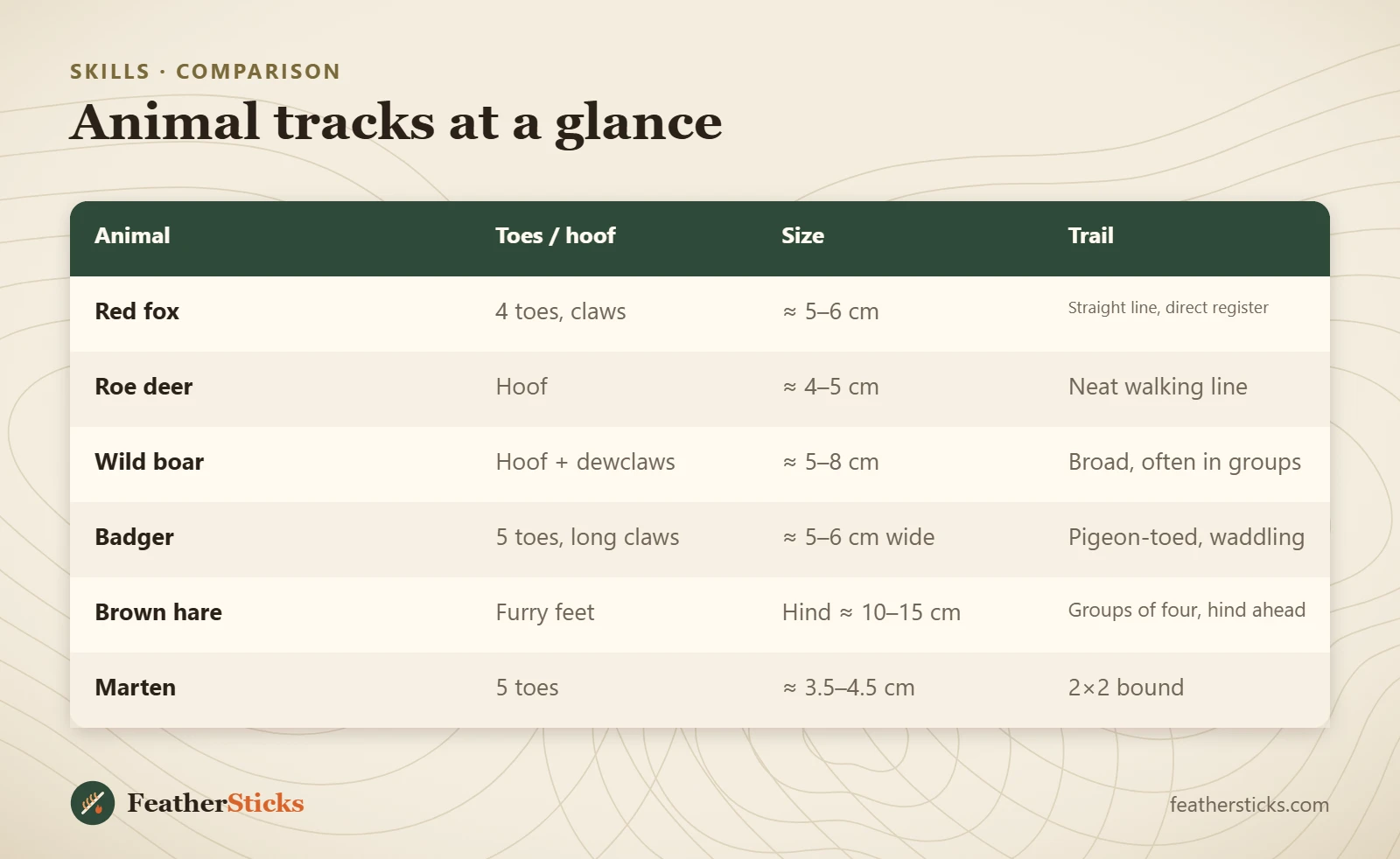
Common European animal tracks: size table
The table shows typical sizes of clear prints in firm mud, measured without claws. Sizes vary with age, sex, ground and speed – prints in snow and soft mud look bigger – so use it as a guide, not an absolute rule.
| Animal | Print type | Length × width | Key features |
|---|---|---|---|
| Red fox | 4 toes, claws | ≈ 5–6 × 4–4.5 cm | Oval, narrow; X-shaped space between pads; straight-line trail |
| Roe deer | Hoof, 2 cleaves | ≈ 4–5 cm long | Small, slender, pointed; dewclaws only when running |
| Red deer | Hoof, 2 cleaves | ≈ 7–9 cm long | Large, broader, rounder tips; stags larger than hinds |
| Wild boar | Hoof + dewclaws | ≈ 5–8 cm long | Rounded tips; dewclaws print behind and wider than the hoof |
| Badger | 5 toes, long claws | ≈ 5–6 cm wide | Broad, bear-like; kidney-shaped heel pad; long front claw marks |
| Brown hare | Furry, indistinct toes | Hind ≈ 10–15 cm long | Hind feet long and land ahead of front feet |
| Red squirrel | 4 toes front / 5 hind | Hind ≈ 4–5 cm long | Bounding in groups of four, trails start and end at trees |
| Pine / stone marten | 5 toes (often 4 visible) | ≈ 3.5–4.5 cm | Paired prints in a 2×2 bounding pattern |
Approximate values from common field guides; measure several prints and combine with gait and signs.
Fox vs. dog: the classic confusion
Fox and small dog tracks are the most frequently confused. A fox print is more oval and compact, with the two front toes pointing forward and a clear raised X or bar between the pads. Foxes walk and trot in a precise straight line, placing the hind foot into the front print ("direct register"), which creates a trail like beads on a string. Dogs wander, sniff, zigzag and have rounder, more splayed prints.

Fox or dog?
Red fox
- Oval, narrow print, about 5–6 cm long
- Clear X-shaped space between pads
- Front toes close together, fine claw marks
- Straight, economical trail, often in direct register
Domestic dog
- Rounder, more splayed print; size varies widely
- Pads larger, no clear X
- Thick, blunt claw marks
- Wandering, zigzag trail, often beside human footprints
Still unsure: fox or dog?
- Follow the trail for 10–20 m: a straight line with evenly spaced prints points to a fox; detours, circles and sniffing stops point to a dog.
- Check the context: human boot prints alongside or a popular path make a dog far more likely.
- Measure several prints: one print can be widened by a hind foot landing half on a front print.
A note on larger canids: wolves have returned to many parts of Germany and Central Europe. Their prints (roughly 10 cm or more) resemble those of large dogs, and even experts need a trail and context to tell them apart. If you believe you have found wolf or lynx tracks, photograph them with a scale and report them to your regional wildlife monitoring office.
Quick identification key
Which animal made this track?
Does the print show hooves (two cleaves)?
Yes → Deer or wild boar. Dewclaws behind and wider than the hoof, rounded tips → wild boar. Slender and pointed → roe deer (small) or red deer (large).No → Continue.Do you see five toes and long claw marks on a broad print?
Yes → Badger (broad, kidney-shaped heel pad). Smaller, paired prints in 2×2 pattern → marten.No → Continue.Four toes with claw marks and an oval shape?
Yes → Dog family – fox (straight trail, X between pads) or dog (round, wandering).No → Continue.Four round toes, no claws, round print?
Yes → Cat family – most likely domestic cat (≈ 3 cm); lynx much larger and very rare.No → Continue.Groups of four prints with two long hind prints in front?
Yes → Hare or rabbit. Groups that start and end at trees, with small hand-like prints → squirrel.No → Check more prints, the gait and nearby signs.

Gaits and trail patterns
The arrangement of prints on the ground – the trail pattern – often identifies an animal before you can see a single clear print, for example in snow or leaf litter. It also tells you how fast it was moving and what it was doing.
| Gait | Pattern | Typical animals | Meaning |
|---|---|---|---|
| Walk / direct register | Single line or narrow zigzag, hind print in front print | Fox, cat, deer (walking) | Relaxed, economical movement |
| Trot | Slightly longer strides, pairs of prints, often offset | Fox, dog, deer | Travelling with purpose |
| 2×2 bound | Pairs of prints side by side, evenly spaced | Marten, weasel, otter | Typical mustelid gait |
| Bound / gallop in groups of four | Hind prints ahead of front prints | Hare, rabbit, squirrel | Normal fast movement for these species |
| Gallop with long leaps | Widely spaced groups, deep toe prints, scattered soil | Deer, fox, boar | Flight or chase |
Measure the stride (from one print to the next print of the same foot) and the trail width: longer strides mean more speed, and a sudden change in pattern means something happened – a startle, a hunt, a stop to feed. You can measure your own stride the same way; the pace count calculator explains how to calibrate your pace length, which is useful for estimating distances between tracks and for map and compass navigation.
The five trail patterns at a glance
 1Walk / direct register
The hind foot lands in the front print, so you see one line of single prints. Typical of fox, cat and walking deer – a relaxed, economical animal.
 2Trot
2TrotSlightly longer strides with the prints in pairs, often offset to one side. Fox, dog and deer trot when they travel with purpose.
 32×2 bound
Pairs of prints side by side at even spacing: the typical gait of marten, weasel and otter. The hind feet land in or next to the front prints.
 4Groups of four
Hare, rabbit and squirrel bound in groups of four, with the long hind prints in front of the small front prints. The animal travelled towards the big prints.
 5Gallop with long leaps
Widely spaced groups, deep toe prints and scattered soil mean flight or chase – deer, fox or boar at speed. Look back along the trail for what changed.
How to follow a trail without losing it
Following a trail is a simple routine: stay beside it, measure the stride once, then use it to predict where the next print must be. Most beginners lose a trail because they search the whole ground instead of that one small spot.
Following a trail step by step
 1Walk beside the trail
Walk parallel to the prints, an arm's length to one side, so you never step on a print you may need again. Your own boot prints should never cover the trail.
 2Mark the stride on a stick
Lay a straight stick next to two prints of the same foot and mark the distance with a rubber band or a grass stem tied round it. That is the stride for this animal at this speed.
 3Project forward
When the trail fades, set the stick at the last clear print of that foot, pointing along the line of travel. The next print lies near its tip – search that small area first.
 4Add low side light
A torch held close to the ground and shining from the side makes shallow prints throw shadows. It works at dusk, in dense forest shade and on grey days.
 5Get low and look into the light
Kneel or lie down and look along the ground towards the light. Faint prints, bent grass and scuffed leaves stand out as shadows or shiny patches.
| Problem | Likely cause | What to do |
|---|---|---|
| Can't find the next print | Hard ground, leaf litter, grass | Mark the last print, project the stride with the stick and search a small circle around its tip; look for scuffed leaves and bent grass. |
| Prints suddenly further apart | The animal speeded up | Measure the new stride; look back for what startled it. |
| Trail ends at a tree | Squirrel or marten climbed | Check the base of nearby trees for where the trail continues. |
| Trail leads into a thicket | Resting place or den | Stop and turn back – do not follow it in (see ethics below). |
Other signs: scat, feeding, rubs and wallows
Tracks are only part of the story. Often signs are easier to find than prints – especially in dry summer woods with hard ground.
Scat (droppings)
- Fox: twisted, sausage-like with a pointed end, full of hair, bone fragments, seeds or berry skins; often deposited deliberately on raised spots like stones, tree stumps or tussocks as a territorial mark.
- Badger: uses latrines – small, shallow dug pits near its sett or along territory borders, often with several droppings.
- Deer: pellets. Roe deer pellets are small and oval, red deer pellets larger and often with a point at one end.
- Wild boar: large, lumpy, sausage-shaped clumps, often dark.
- Hare: round, slightly flattened pellets of fibrous plant material, about 1–1.5 cm.
- Marten: thin, twisted, often on paths, stones or even car bonnets; in autumn full of fruit stones.
Feeding signs
Spruce and pine cones tell you who ate the seeds: squirrels leave cones stripped roughly, with frayed scale remains and a ragged core; mice gnaw them neatly and cleanly, almost like a smooth spindle; woodpeckers wedge cones into cracks in bark (a "woodpecker anvil") and hack them open, leaving piles of shredded cones below. Hazelnuts cracked cleanly in half are typical of squirrels; small round holes with tooth marks point to mice or dormice.
Browsed twigs show who fed: deer have no upper front teeth, so they tear twigs, leaving a ragged end; hares and rabbits bite them off cleanly at an angle. Wide areas of turned-over soil, as if ploughed, are the work of wild boar rooting for roots, grubs and mice – often along forest edges and in meadows.

Rubs, wallows and hair
Male roe deer rub the velvet off their new antlers on young saplings in spring and mark territory, leaving stripped bark about knee to thigh high. Red deer stags do the same in late summer, higher up and on thicker trees. Wild boar wallow in mud holes and then rub against nearby trees, leaving caked mud and bristles on the trunk – the height of the mud line hints at the animal's size. Hair caught on barbed wire or low branches can be identified by colour and texture.
Sign checklist on a tracking walk
- Tracks in mud at puddles, stream banks and forest tracks
- Game trails through undergrowth (tunnels at knee height)
- Scat on stones, stumps and path junctions
- Chewed cones and nuts under trees
- Rooted soil, wallows and mud on tree trunks
- Rubbed saplings and frayed bark
- Hair on fences and branches
- Feathers and plucking sites of birds of prey
Aging tracks: how old is this print?
Judging the age of a track is one of the hardest tracking skills, because it depends on soil, weather, sun and temperature. The best teacher is a reference track: press your own fingertip or boot into the same ground and check it every few hours to see how it changes.
- Edges: fresh prints have sharp, crisp edges; with time they crumble and round off.
- Moisture: a fresh print in damp soil is darker and wetter than its surroundings; as it dries, it lightens.
- Weather: raindrop marks inside the print mean it was made before the last shower; a print without them is newer.
- Debris: fallen leaves, needles or spider webs inside the print mean it has been there a while.
- Snow and frost: sharp edges in fresh snow mean hours at most; melting and refreezing blurs and enlarges tracks.
- Dew: a dark trail through dew-covered grass in the morning is very fresh.
Reading a trail step by step
- FindLook at soft ground: puddles, stream banks, forest tracks, snow.
- IdentifyHoof or toes, number of toes, claws, size.
- MeasurePrint size, stride and trail width; photograph with a scale.
- AgeEdges, moisture, debris, weather since.
- InterpretGait changes and signs tell what happened.
Five clues to the age of a print
 1Make a reference print
Press your fingertip or boot into the same ground next to the animal track. Check both every few hours and compare how edges and colour change.
 2Compare the edges
Fresh prints have sharp, crisp walls. With time the rims crumble, small crumbs fall into the print and the edges round off.
 3Look for raindrop marks
Tiny raindrop pits inside a print mean it was made before the last shower. A clean print in pitted ground is newer than the rain.
 4Check for debris
Fallen leaves, needles or a spider web across the print mean it has been there a while – how long depends on wind and season.
 5Read snow with care
In fresh snow, sharp edges mean hours at most. Melting and refreezing blur prints and make them look larger – do not trust the size table there.
Practice drills: tracking box and sand trap
- Tracking box: fill a shallow box or a garden corner with damp sand or fine soil, smooth it and press in your fingers, a shoe and a few objects. Check them in low light, at midday and every few hours for a day or two.
- Sand trap: rake a strip of fine soil or sand smooth across a path in your garden, or on land where you have permission, and check it at dawn. Use no bait – the aim is to see what passes naturally, not to attract animals.
- One print a day: sketch one clear print per walk with its length, width and ground type, then check it against the size table.
Where and when to find tracks
The best tracking surfaces are soft and fine: mud at the edges of puddles and ponds, sandy stream banks, forest tracks after rain and, best of all, a thin layer of fresh snow. Animals follow the same paths as you would – along forest edges, streams and hedges, and through gaps in fences. Game trails often lead to water, which is why tracking and finding water go hand in hand.
Timing matters: many mammals are active at dusk and night, so early morning is the best time to find fresh tracks, and the low sun at sunrise and sunset casts shadows that make shallow prints visible. The daylight calculator tells you when the sun is low. Hold a torch low and sideways to the ground for the same effect at any time.

Camping near animal highways has downsides, though: game trails, wallows and rooting areas are not good places to sleep – see choosing a camp site and store food so animals are not attracted to your camp, as explained in storing food at camp.
Tracking ethics: observe without disturbing
Good trackers leave animals undisturbed. A few principles:
- Keep your distance from dens, setts, nests and resting places; never follow a trail into thickets where animals lie up during the day.
- Respect the breeding season, roughly spring to mid-summer, when young animals are hidden in the grass and disturbance is most harmful. Keep dogs leashed.
- Stay on paths in protected areas and follow local rules – leaving paths in nature reserves and national parks is often forbidden. Our guide to wild camping in Germany explains protected areas.
- Don't take things home without checking the law: in Germany, for example, shed antlers and dead game generally belong to the holder of the hunting rights, and taking them can be an offence.
- Record, don't collect: photos with a ruler, sketches and notes teach you more than a bag of bones.
Tracking is a quiet, patient skill that fits perfectly into a day in the woods. Combine it with navigation practice, add a ruler and notebook to your kit list, and explore more bushcraft skills.
| Animal | Toes / hoof | Size | Trail |
|---|---|---|---|
| Red fox | 4 toes, claws | ≈ 5–6 cm | Straight line, direct register |
| Roe deer | Hoof | ≈ 4–5 cm | Neat walking line |
| Wild boar | Hoof + dewclaws | ≈ 5–8 cm | Broad, often in groups |
| Badger | 5 toes, long claws | ≈ 5–6 cm wide | Pigeon-toed, waddling |
| Brown hare | Furry feet | Hind ≈ 10–15 cm | Groups of four, hind ahead |
| Marten | 5 toes | ≈ 3.5–4.5 cm | 2×2 bound |
Common mistakes
- Identifying from a single, possibly distorted print instead of several.
- Measuring prints in snow or soft mud and expecting textbook sizes.
- Confusing fox and dog tracks by ignoring the trail pattern.
- Touching scat with bare hands.
- Following tracks into dens or resting places and disturbing animals.
- Taking shed antlers or bones home without knowing the legal situation.
What you need
- Small folding ruler or tape measure
- Notebook and pencil
- Phone or camera for photos with a scale
- Torch for low-angle light
- Pocket field guide to European tracks
- Hand sanitiser