Knife Laws for Bushcraft and Camping: UK, Germany and Travel
Knife laws for camping and bushcraft rarely ask whether your knife is a tool. They ask three other questions: may you own it, may you carry it in public, and how must you transport it to the woods. In the UK, any fixed blade or locking knife in a public place needs a "good reason"; only a non-locking folding pocketknife with a cutting edge of 3 inches or less is exempt. In Germany, one-hand locking knives and fixed blades over 12 cm are restricted, and since late 2024 all knives are banned at public events, on long-distance trains and in knife-free zones.
This guide explains UK and German knife law for an international reader, gives a cautious overview of other countries, and then turns it into a routine: choose a compliant bushcraft knife, pack it away, use it in the woods, pack it again. It is part of the tools section and of bushcraft for beginners. Status October 2026 – general information, not legal advice.
Step by step
-
1

Check the rules where you go
Look up the country, the city and the route before you leave. Stations, events and knife-free zones often ban every knife, whatever the blade length.
-
2

Pick a compliant knife
In Germany a fixed blade up to 12 cm or a two-hand pocket knife is outside § 42a. In the UK only a small non-locking folder is exempt; anything else needs a good reason.
-
3

Pack it away
Sheath the knife, put it in a case or box, ideally locked, and stow it deep in the pack. It should take more than three hand movements to reach.
-
4

Train, event, zone: keep it packed
On trains, in stations, at markets and in knife-free zones the knife stays packed. Never wear it on your belt in town.
-
5

Use it as a tool in the woods
On site the knife is a working tool for carving, cooking and firewood. Follow the landowner’s rules and pack it away again before you head back.
-
6

If checked, stay calm and explain
Be friendly, say where the knife is and do not reach for it yourself. Explain the purpose of your trip in one sentence.
Knife laws for camping: the short answer
There is no international "camping exemption". Every country – and often every city – sets its own rules. But three patterns cover most of what a bushcrafter needs:
- Some knives are banned outright almost everywhere: automatic (flick, switchblade), gravity and butterfly knives, push daggers and disguised knives. Do not travel with them.
- Carrying in public needs a reason – or a knife that falls under a narrow exception. The UK calls it "good reason", Germany "legitimate interest" (berechtigtes Interesse), Sweden "justified under the circumstances".
- Transport is not the same as carrying. A knife packed away deep in your luggage, ideally in a locked case, is treated far more leniently than one on your belt – and in Germany the law says so explicitly.
So the answer to "can I carry a fixed blade knife?" is usually: yes in the woods while you are using it for the trip, no on your belt in town, and packed away in between.
The rules this guide is built on
- UK: Criminal Justice Act 1988, s.139
- Offence of having an article with a blade or point in a public place (England, Wales; Northern Ireland version)
- UK: folding pocketknife exception
- Cutting edge not exceeding 3 inches (7.62 cm); a lock knife does not qualify
- Scotland: s.49, 1995 Act
- Parallel offence with the same 3-inch exception
- Germany: § 42a Weapons Act (WaffG)
- Carry ban for one-hand locking knives and fixed blades over 12 cm
- Germany: § 42 (4a), § 42b, § 42 (5)
- All knives banned at public events, on long-distance public transport and in zones set by the states
- Germany: § 53 WaffG
- Administrative fine of up to €10,000
Status: October 2026. Laws and local orders change; this section is general information, not legal advice. Always check the current official text (legislation.gov.uk and gov.uk for the UK, gesetze-im-internet.de and state ordinances for Germany).
Owning, carrying and transporting a knife: three different things
Most confusion about knife laws disappears once you separate three situations.
Owning
Keeping a knife at home is lawful for almost every ordinary knife in both the UK and Germany. Only the specifically banned types may not be possessed at all.
Carrying
Carrying means having the knife with you in public. The UK offence applies in a "public place", which the statute defines as including any place to which the public have, or are permitted, access – with or without payment. A footpath, a country park, a car park and a train are all public places. German law is even wider: you "carry" (führen) a knife whenever you have it outside your own home, your own business premises or your own enclosed property. Someone else's forest is not your own property, so you are carrying there too.
Transporting
Transport is carrying in a way that makes the knife unavailable for immediate use. German law has two separate tests for this: a "locked container" (verschlossenes Behältnis) under § 42a, and "not ready to hand" (nicht zugriffsbereit) for the event, transport and zone bans – defined in the Act as reachable only with more than three hand movements. UK law has no such formula: a packed knife is still an article "with you" in a public place, so you still need a good reason. Packing it away is simply strong evidence that you are transporting a tool, not carrying a weapon.
| United Kingdom | Germany | |
|---|---|---|
| Owning at home | Lawful except for banned knives | Lawful except for prohibited knives |
| Carrying in public | Offence unless good reason (or small non-locking folder) | Restricted for one-hand locking knives and fixed blades over 12 cm; other knives free outside events, long-distance transport and zones |
| Transport, packed away | No statutory exception – but supports your good reason | Statutory exceptions: locked container (§ 42a), not ready to hand (events, transport, zones) |
| Who decides in a dispute | Ultimately a court | Police, then the fining authority, then a court |
Status: October 2026. Laws and local orders change; this section is general information, not legal advice. Always check the current official text (legislation.gov.uk and gov.uk for the UK, gesetze-im-internet.de and state ordinances for Germany).
UK knife law for bushcraft: the 3-inch rule and "good reason"
UK knife law for bushcraft starts from a simple rule in section 139 of the Criminal Justice Act 1988: it is an offence to have any article which has a blade or is sharply pointed with you in a public place. That covers a bushcraft knife, a carving knife, an axe and a saw alike.
The folding pocketknife exception
The only knife the section does not apply to is a folding pocketknife whose blade has a cutting edge of no more than 3 inches (7.62 cm). Government guidance adds the second condition that matters in practice: it must not be a lock knife. A knife whose blade locks open and needs a button, catch or spring to be released is not treated as a folding pocketknife, however short it is. A classic slip-joint penknife qualifies; most modern one-hand folders and many multi-tools with locking blades do not.

What counts as a good reason?
For everything else, the statute gives you a defence if you can prove you had "good reason or lawful authority". It names three examples: use at work, religious reasons, and national costume. The list is not closed, and camping or bushcraft is not on it. Government guidance is blunt about who decides: a court, if you are charged. It suggests asking your local police or taking legal advice if you are unsure.
In practice, a knife that is clearly part of the kit for a specific trip – packed in a rucksack with a tarp, a stove and a sleeping bag, on the way to a place where you have permission to use it – is the kind of situation the defence exists for. The same knife on your belt in a pub on the way home is not. Do not expect "for protection" to be accepted as a reason.
Private land
The offence is about public places. A private wood where you have the owner's permission and the public has no access is not a public place, which is one more reason why UK bushcraft works best on permission land. The journey there still runs through public places.
Banned knives and sales
Separate rules make it illegal to possess, sell or import a list of banned weapons. For knife users the relevant entries include flick, gravity and automatic knives, butterfly knives, push daggers, disguised knives, belt-buckle knives, "zombie" knives and zombie-style knives and machetes. It is also illegal to sell most knives to anyone under 18.
Scotland and Northern Ireland
Scotland has its own offence in section 49 of the Criminal Law (Consolidation) (Scotland) Act 1995. It is built the same way, with the same exception for a folding pocketknife with a cutting edge not exceeding 3 inches (7.62 cm), but the defence is worded as "reasonable excuse or lawful authority". Northern Ireland uses its own version of section 139.
| Knife | Status | Practical advice |
|---|---|---|
| Non-locking folding pocketknife, cutting edge 3 in or less | Outside s.139 – no reason needed | The everyday choice; still never use or show it threateningly |
| Lock knife (any length) | Good reason needed | Carry only for a specific task or trip, packed away |
| Fixed-blade bushcraft or carving knife | Good reason needed | In the pack, with the rest of your trip kit; use on permission land |
| Axe, hatchet, saw | Bladed or pointed article – good reason needed | Blade guard on, inside the pack |
| Flick, gravity, butterfly, zombie-style knife, push dagger | Banned – possession illegal | Do not buy, do not import |
UK penalties (maximums in the statutes)
- England and Wales, s.139
- Up to 4 years’ imprisonment, a fine, or both
- Scotland, s.49
- Up to 5 years’ imprisonment, a fine, or both
- Repeat conviction
- Government guidance: expect a prison sentence
Status: October 2026. Laws and local orders change; this section is general information, not legal advice. Always check the current official text (legislation.gov.uk and gov.uk for the UK, gesetze-im-internet.de and state ordinances for Germany).
Germany knife law: § 42a and the 12 cm rule
Germany's knife law works the other way round from the UK. There is no general ban on blades in public; instead the Weapons Act (Waffengesetz, WaffG) restricts certain types of knife – and, since 2024, certain places.
Prohibited knives
Annex 2 of the Act prohibits any dealing – including buying and owning – with switchblades (Springmesser), gravity knives (Fallmesser), push daggers (Faustmesser) and butterfly knives. Only a narrow exception remains for side-opening switchblades with a blade of at most 8.5 cm that is not double-edged, and only where there is a legitimate interest that requires one-handed use, or for professional use. Handling a prohibited knife is a criminal offence punishable with up to three years' imprisonment or a fine.
What § 42a restricts
Section 42a makes it unlawful to carry:
- knives with a blade that can be locked with one hand (Einhandmesser) – a folder that opens one-handed and locks, whatever its blade length;
- fixed-blade knives with a blade length over 12 cm;
- cut-and-thrust weapons such as daggers, and imitation firearms.
Everything else is outside § 42a: a fixed blade of up to 12 cm, and a pocket knife that needs two hands to open – even if its blade locks. The wording is "over 12 cm", so exactly 12 cm is still outside; but the Act does not say how blade length is to be measured, so measure the whole blade from the tip to the start of the handle and leave a margin.

How to check your knife against § 42a
 1Measure the blade
Lay a ruler along the blade and measure from the start of the handle to the tip. Measure the whole blade, not just the sharpened edge – that keeps you on the safe side.
 2The 12 cm line
A fixed blade of 10 cm is outside § 42a. A fixed blade of 15 cm may only be carried with a legitimate interest or in a locked container. Typical mistake: knives sold as "about 12 cm".
 3Folders: opening and lock
Can you open the blade with one hand, and does it lock? Then it is an Einhandmesser, whatever its length. A two-hand pocket knife is not.
The exceptions in § 42a
The carry ban does not apply (1) to use in photo, film or television productions or theatre performances, (2) to transport in a locked container, and (3) where there is a legitimate interest. The next sentence of the section has become very important: "further-reaching rules remain unaffected". The location-based bans described below apply on top.
Status: October 2026. Laws and local orders change; this section is general information, not legal advice. Always check the current official text (legislation.gov.uk and gov.uk for the UK, gesetze-im-internet.de and state ordinances for Germany).
Legitimate interest in Germany: does bushcraft count?
Section 42a (3) says a legitimate interest exists "in particular" where the carrying is connected with the exercise of a profession, or serves the maintenance of tradition, sport or a "generally recognised purpose" (allgemein anerkannter Zweck).
Read that carefully: hiking, camping, fishing and bushcraft are not named in the statute. They are commonly treated as a generally recognised purpose – a knife for carving, cooking and wood preparation on a trip is an ordinary tool. But the words "in particular" mean there is no fixed list, and the assessment is made case by case: first by the police officer in front of you, later by the fining authority and, if you object, by a court.
One state interior ministry describes a generally recognised purpose (for its own public-transport knife ban) as one that the legal order approves of, where nothing suggests the knife is being misused. That is a useful way to think about it: what counts is a concrete, plausible use in the concrete situation.
The grey area: the way there and back
At camp, while carving feather sticks or batoning kindling, the purpose is obvious. The difficult part is everything before and after: the suburban train, the supermarket stop, dinner at an inn after the walk. The further the place and moment are from the actual activity, the harder it is to explain why the knife is ready to hand on your body. Two explanations to avoid are "self-defence" and "I always carry it" – neither is named in the Act, and neither describes a concrete use as a tool.
| Situation | Assessment | Better |
|---|---|---|
| At camp, knife in use | Purpose is obvious | Follow the landowner’s rules |
| Walking in the forest, knife on belt | Generally recognised purpose is arguable | Carry discreetly, not in villages |
| Walking through a village to the forest edge | Grey area | Knife packed in the rucksack |
| Supermarket, inn, petrol station after the trip | Hard to justify | Locked container in the pack, or leave it in the car boot |
| Station, train, fair, knife-free zone | Location bans for all knives apply as well | Transport only, not ready to hand |
Status: October 2026. Laws and local orders change; this section is general information, not legal advice. Always check the current official text (legislation.gov.uk and gov.uk for the UK, gesetze-im-internet.de and state ordinances for Germany).
Germany since 2024: knife bans at events, on trains and in zones
This is where many websites are out of date. Changes to the Weapons Act that came into force on 31 October 2024 added rules that do not depend on the type of knife but on the place. They cover knives of every kind, regardless of blade length or opening mechanism – including a small penknife and a multi-tool.
1. Public events (§ 42 (1) and (4a))
Anyone taking part in public amusements, fairs, sports events, trade fairs, exhibitions, markets or similar public events may not carry weapons – and the same applies to knives. The Act expressly includes theatre, cinema and nightclub visits and dances, and it applies whether or not there is an entrance fee. Typical cases: a Christmas market, a town festival, a stadium, an outdoor trade show.
2. Long-distance public transport (§ 42b)
Carrying weapons and knives is banned in long-distance public passenger transport and in its laterally enclosed facilities, in particular buildings and stops. In practice: long-distance trains such as ICE, IC and EC, long-distance coaches, and the stations they use.
3. Weapon- and knife-free zones set by the states (§ 42 (5))
The sixteen state governments may ban or restrict the carrying of weapons and knives by ordinance in certain streets and squares with repeated violent crime, in places where crowds gather, in buildings and areas open to the public, in local public transport and its facilities, and in and around certain youth and educational institutions. The states use this power differently. Two examples we checked: Schleswig-Holstein has banned weapons and knives in local public transport since 23 December 2024, and Lower Saxony in all public transport – including station buildings, platforms, stops and underpasses – since 1 April 2026. Other states and many cities have their own ordinances. The Act contains no national list: check your starting point, your connections and your destination.
In addition, the Federal Police issue temporary orders for individual railway stations; § 42b expressly leaves untouched their power to regulate the carrying of "weapons and dangerous objects", which can go further than knives.

The exceptions
Section 42 (4a) lists ten exceptions. They apply directly to events and, by reference, to long-distance transport; in the state zones a legitimate interest exists "as a rule" in the same cases.
| No. | Exception | Relevance for outdoor people |
|---|---|---|
| 1 | Delivery traffic | – |
| 2 | Tradespeople, their employees and agents, in connection with their work | e.g. a craftsperson with a tool bag |
| 3 | People transporting a knife from one place to another, not ready to hand | The exception for your journey: knife packed in the rucksack |
| 4 | Carrying with the consent of whoever holds the house rights, where it serves the purpose of the visit | e.g. invited by the organiser |
| 5 | Commercial display of knives at fairs, markets and exhibitions | Dealer stands; carry a bought knife home packed |
| 6 | Rescue and civil-protection personnel | – |
| 7 | Participants in photo, film or TV productions, theatre or historical re-enactment | Re-enactors |
| 8 | Maintenance of tradition, hunting or sport | Hunters, traditional dress |
| 9 | Operators of catering businesses, their staff and their customers | The knife at the food stall |
| 10 | Carrying in connection with a generally recognised purpose | e.g. cutting your lunch – then pack it away again |
What "not ready to hand" means
Annex 1 of the Act defines it: a knife is not ready to hand "if it can only be reached with more than three hand movements". A state interior ministry gives examples: a knife in a trouser or jacket pocket is normally ready to hand; a knife in a closed suitcase or trolley normally is not; in a rucksack it should additionally sit in a closed container such as a lunch box or the packaging of a newly bought knife. The same ministry confirms that peeling an apple on the train with a pocket knife remains a generally recognised purpose – but before and after, the knife has to be stowed again.
Checks
Section 42c allows the authorities to stop and question people in these areas, inspect what they carry and search them without specific suspicion. Selecting people on the basis of characteristics such as origin or appearance without objective reason is expressly unlawful.
Status: October 2026. Laws and local orders change; this section is general information, not legal advice. Always check the current official text (legislation.gov.uk and gov.uk for the UK, gesetze-im-internet.de and state ordinances for Germany).
Decision help: may I carry this knife here in Germany?
The questions below follow the logic of the Act. Work from top to bottom and stop at the first answer that blocks you. They do not replace reading the local ordinance.
May I carry this knife here? (Germany)
1. Is it a switchblade, gravity knife, push dagger or butterfly knife?
Yes → Prohibited weapon: even buying and owning it is generally illegal (narrow exception for small side-opening switchblades). Do not bring it.No → Go to question 2.2. Are you at a public event, on long-distance transport or in its stations, in a weapon- or knife-free zone, or on local transport in a state with a ban?
Yes → Carrying any knife is banned here. What remains lawful is above all transport with the knife reachable only with more than three hand movements – or another listed exception. For one-hand locking knives and blades over 12 cm, question 3 applies as well.No → Go to question 3.3. Is it a one-hand locking knife or a fixed blade over 12 cm (or a dagger-type weapon)?
Yes → § 42a applies: go to question 4.No → Outside § 42a. Away from the places in question 2 you may carry it – responsibly and discreetly.4. Is it in a locked container?
Yes → Transport is exempt from the § 42a carry ban.No → Go to question 5.5. Do you have a legitimate interest in exactly this situation (work, tradition, sport, generally recognised purpose)?
Yes → Carrying is lawful – but in a dispute the authority decides case by case. Pack it away for the journey.No → Carrying is banned: administrative offence, fine of up to €10,000 possible.
Status: October 2026. Laws and local orders change; this section is general information, not legal advice. Always check the current official text (legislation.gov.uk and gov.uk for the UK, gesetze-im-internet.de and state ordinances for Germany).
Knife laws in other countries: a cautious overview
The table below is deliberately general. It lists only what we could check against official sources, and it is no substitute for the police or government pages of the country you are visiting. Where we could not verify details, it says "check locally".
| Country | Basic principle | For bushcrafters |
|---|---|---|
| United Kingdom | Any blade in public needs good reason; exception: non-locking folding pocketknife, cutting edge 3 in or less | Fixed blade only for the trip, packed; small slip-joint for everyday use |
| Germany | Carry ban by knife type (§ 42a) plus location bans for all knives | Fixed blade up to 12 cm, travel with it packed |
| Austria | Certain knife types fall under the Weapons Act; local weapon-ban zones exist | A wider public knife-carrying ban has been debated politically – check the current status before you go |
| Switzerland | Certain knives are classed as weapons (among them knives with a one-hand automatic mechanism, butterfly knives, throwing knives, daggers with a symmetrical blade) | Ordinary pocket and work knives are common; check details with the Federal Office of Police (fedpol) |
| Netherlands | Stilettos, gravity knives and butterfly knives are banned; municipalities can impose local knife bans | Transport packed; check municipal rules |
| Sweden | Knives are banned in public places unless justified under the circumstances | Police examples of justified carrying: craftsmen at work, mushroom pickers on a hike, normal use of a pocket knife or multi-tool |
| Norway, Denmark | Similar principle: carrying in public needs a recognised purpose | Normal on a trip, pack it away in town; check the national police pages |
| United States | State and city law; rules differ widely | Check every state and city on your route; no knives in carry-on bags on flights |
| Canada | Certain knives are prohibited weapons, including those that open automatically or by gravity or centrifugal force | Purpose matters; check park and provincial rules |
Status: October 2026. Foreign law changes often and is only summarised roughly here; this is general information, not legal advice. Check the official pages of your destination before every trip.
Choosing a knife that keeps you out of trouble
The legally simplest kit happens to be the most useful one. A fixed blade of 9–11 cm does everything from carving and spoon carving to splitting thumb-thick wood, and it stays clearly below Germany's 12 cm line. For heavier work a folding saw and an axe are the better tools anyway. For blade shape, grind and steel see how to choose a bushcraft knife.
Low-friction vs needs explaining
Low-friction
- Fixed blade up to 12 cm (Germany: outside § 42a)
- Two-hand pocket knife (Germany: outside § 42a)
- Non-locking folder, cutting edge 3 in or less (UK: exempt)
- Plain working look, wooden or simple handle
Needs a reason or a locked case
- One-hand locking folder – any length (Germany: § 42a; UK: lock knife)
- Fixed blade over 12 cm, such as a machete (Germany: § 42a)
- Any fixed blade in a UK public place
- Multi-tool with a one-hand locking blade
Buying checklist
- Blade length with a margin: catalogue figures are rounded. Choose 10 or 11 cm, not "12 cm".
- No thumb stud on the everyday knife: a two-hand slip-joint is the relaxed choice for lunch on the trail – and, if the cutting edge is 3 in or less, the UK-exempt one. Check the main blade of a multi-tool: many open one-handed and lock.
- A working look: legally the classification counts, not the styling. Practically, a plain knife with a wooden handle makes every encounter easier than a black "tactical" model.
- A good sheath that holds the knife securely and fits in your transport case, or one you make yourself.
- The two-knife solution: a fixed blade, packed, for work in the field, and a small non-locking folder for everything else. In German zones and on long-distance trains even the small knife must be packed away.
If you are putting your kit together, the bushcraft kit list and the Kit Builder help.
Status: October 2026. Laws and local orders change; this section is general information, not legal advice. Always check the current official text (legislation.gov.uk and gov.uk for the UK, gesetze-im-internet.de and state ordinances for Germany).
How to transport a knife: in the pack, not on the belt
The safe method is the same for every knife and every country: sheathed, in a container, closed or locked, deep in your luggage.
Germany: "locked container" – what the law leaves open
For one-hand locking knives and long fixed blades, § 42a requires a verschlossenes Behältnis. The Act does not define the term for knives. In ordinary German, verschlossen means more than merely closed – a rucksack with the zip pulled shut is closed, not locked. We could not find an official source that settles the point for every case, so our cautious recommendation is a container that is actually locked: a small case or pouch with a padlock, or a pack compartment whose zip pullers are secured with a small lock.
Germany: "not ready to hand" – the three-movements rule
For the location-based bans it is enough that the knife can only be reached with more than three hand movements. Count them: take off the pack, open the lid, open the main compartment, pull out the stuff sack, open the box. A knife in the lid pocket or a side pocket is in your hand in one or two movements – not enough.
UK
There is no packing formula in UK law, but the same routine is the best evidence of a good reason: a sheathed knife in a box at the bottom of a rucksack full of trip kit is a tool on its way to a job.
Packing a knife in four steps
 1Sheath it
A fixed blade always goes into its sheath first; a folder is closed. That protects you, your kit and the edge.
 2Into a case or box
Give the knife its own container: a sturdy tin, a tool roll inside a stuff sack or a small transport case. It should never lie loose in the pack.
 3Close it – better, lock it
For one-hand locking knives and blades over 12 cm, Germany’s § 42a requires a locked container. A small padlock removes all doubt. Typical mistake: the case is only clipped shut.
 4Deep in the pack
The case goes to the bottom of the main compartment, with the sleeping bag or clothes on top. That takes well over three hand movements. More on packing a rucksack.

Before you leave
- Knife sheathed, in a case or box, closed – locked for knives restricted by § 42a
- Case at the bottom of the main compartment, not in a lid or side pocket
- Second knife, multi-tool and carving knives packed too – nothing forgotten in a trouser pocket
- Route checked: long-distance trains, local-transport bans, zones around stations, events on the way
- By car: knife in the luggage in the boot, not in a door pocket or the centre console
Status: October 2026. Laws and local orders change; this section is general information, not legal advice. Always check the current official text (legislation.gov.uk and gov.uk for the UK, gesetze-im-internet.de and state ordinances for Germany).
Travelling with knives: train, plane and borders
Train and coach
In Germany, treat every rail journey as if the knife ban applied to the whole route: long-distance transport is covered nationally, local transport by more and more states. All knives packed and not ready to hand; restricted knives in a locked container as well. Transport companies can also exclude further dangerous objects through their conditions of carriage and house rules. In the UK a train and a station are public places like any other, and operators have their own conditions – check them, especially for international services.
Plane
No knife belongs in hand luggage. The EU list of prohibited articles for the cabin names knives with blades of more than 6 cm, and airports and airlines may be stricter; the US security agency TSA does not allow knives in carry-on bags at all, and Canada's screening authority does not allow them on flights to the US. Put knife, saw and axe in checked baggage, sheathed and well wrapped, and check the airline's rules and the law at your destination first.
Borders
The law changes completely when you cross a border. A knife that is lawful at home can be a weapon next door. For every country on your route, ask two questions: may I own and import this knife there, and may I carry it in public? Remember that a knife bought abroad must also be lawful to bring home.
| Transport | What applies | How to pack |
|---|---|---|
| German long-distance train, coach, station | Carrying any knife banned (§ 42b); transport not ready to hand allowed | Case at the bottom of the pack; restricted knives locked |
| German local transport | Banned by state ordinance in a growing number of states | Pack as for long-distance |
| UK train or bus | Public place: good reason needed (except small non-locking folder) | Packed with your trip kit |
| Car | Germany: § 42a applies in the vehicle too; UK: do not assume a car is a private place – pack the same way | In the luggage in the boot |
| Plane | No knives in hand luggage; details by country and airline | Checked baggage, blade secured |
Status: October 2026. Laws and local orders change; this section is general information, not legal advice. Always check the current official text (legislation.gov.uk and gov.uk for the UK, gesetze-im-internet.de and state ordinances for Germany).
Knives and children: what parents should know
Whittling is one of the best things children can learn outdoors – bushcraft with kids shows how to do it safely. Legally:
- Germany: the minimum age of 18 in the Weapons Act applies to weapons. A carving or pocket knife is a tool, and the Act sets no minimum age for it. But § 42a and the bans for events, transport and zones apply regardless of age, and a state ministry points out that a generally recognised purpose is often harder to argue for children and teenagers.
- UK: it is illegal to sell most knives to anyone under 18, and the carrying offence applies to young people too.
- Everywhere: schools and youth facilities have their own rules. A knife does not belong in a school bag.
The practical answer: an adult carries all knives, packed, on the journey. The child gets the knife at the carving spot, works under supervision and hands it back afterwards. A short fixed-blade carving knife with a rounded tip suits this better than a folder.
Status: October 2026. Laws and local orders change; this section is general information, not legal advice. Always check the current official text (legislation.gov.uk and gov.uk for the UK, gesetze-im-internet.de and state ordinances for Germany).
If the police check you: how to behave
A check is not an accusation. In German knife-free zones, stations and events, checks without specific suspicion are expressly allowed. If your knife is packed correctly you have little to worry about – and a few simple habits make it easy for everyone.
A police check in three steps
 1Stay calm, hands visible
Stop, be friendly, take your hands out of your pockets. Rushing or arguing about powers helps nobody.
 2Say where the knife is
Volunteer that there is a knife in the pack and exactly where. Do not reach in yourself; wait until you are asked. Typical mistake: silently pulling the knife out.
 3Explain the purpose briefly
One sentence is enough: where you are going and what the knife is for – a trip, carving, cooking. A map, a stove and a sleeping bag in the pack speak for themselves.
If the officers take a different view, the knife will usually be seized and a report written. Stay factual, ask for a record of what was taken, and settle the legal question later – with a lawyer if needed. It will not be decided on the platform.
Status: October 2026. Laws and local orders change; this section is general information, not legal advice. Always check the current official text (legislation.gov.uk and gov.uk for the UK, gesetze-im-internet.de and state ordinances for Germany).
Axes and saws: are they treated like knives?
It depends on the country. In the UK, section 139 covers any article with a blade or point, so a hatchet or a folding saw needs a good reason in a public place just like a fixed-blade knife. In Germany, § 42a and the newer bans speak of weapons and of knives; an axe or a saw is a tool, not a knife. A state interior ministry puts it this way for its public-transport ban: tools are only covered if they are knives, such as a utility knife.
That does not mean "allowed everywhere" in Germany either:
- Transport companies and event organisers can exclude dangerous objects under their house rules and conditions of carriage.
- Federal Police orders for stations can cover "dangerous objects" in general.
- Local ordinances may be worded more widely than federal law – read the text for your city.
- An axe strapped to the outside of a pack causes understandable alarm on a full train.
So pack axe and saw like the knife: edge guard on, inside the rucksack, nothing visible outside. It also protects the edge – see knife and axe care and sharpening in the field.
Status: October 2026. Laws and local orders change; this section is general information, not legal advice. Always check the current official text (legislation.gov.uk and gov.uk for the UK, gesetze-im-internet.de and state ordinances for Germany).
In the woods: landowner rules and cutting wood
Knife law decides whether you may have the knife with you – not what you may do with it. That is governed by property, forestry and conservation law. Every wood belongs to someone, and so does the wood in it.
- Living trees and shrubs: cutting or damaging them without the owner's permission is off limits everywhere.
- Dead wood is ecologically valuable and also belongs to the owner. Whether you may collect any varies by country and region – ask.
- Protected areas have their own, stricter rules.
- Fire is restricted or banned in many forests; see fire safety.
- Sleeping out is a separate question: wild camping rules.
The most relaxed place to practise is land whose owner has agreed, a bushcraft course site or a legal trekking pitch. There the purpose of your knife is obvious to everyone – and in the UK, permission land without public access also takes you out of the public-place offence. For a plan for your first night outdoors, see your first overnight.
Status: October 2026. Laws and local orders change; this section is general information, not legal advice. Always check the current official text (legislation.gov.uk and gov.uk for the UK, gesetze-im-internet.de and state ordinances for Germany).
Penalties: what happens if you get it wrong?
The two systems differ sharply. In the UK, carrying a knife without good reason is a criminal offence. In Germany, most carrying violations are administrative offences punished with a fine – even if merely negligent – while dealing with a prohibited knife is a crime. In both countries, expect the knife to be taken from you.
| Violation | Provision | Consequence |
|---|---|---|
| UK (England and Wales): bladed article in a public place without good reason | Criminal Justice Act 1988, s.139 | Criminal offence: up to 4 years’ imprisonment, a fine, or both |
| Scotland: same conduct | Criminal Law (Consolidation) (Scotland) Act 1995, s.49 | Criminal offence: up to 5 years’ imprisonment, a fine, or both |
| Germany: one-hand locking knife or fixed blade over 12 cm carried without an exception | § 42a (1), § 53 (1) no. 21b WaffG | Administrative offence, fine of up to €10,000 |
| Germany: knife carried at a public event or on long-distance transport | § 42 (4a), § 42b, § 53 (1) no. 21a and 21c WaffG | Administrative offence, fine of up to €10,000 |
| Germany: prohibited knife (e.g. butterfly knife, push dagger) | § 2 (3), Annex 2, § 52 (3) no. 1 WaffG | Criminal offence: up to 3 years’ imprisonment or a fine |
Maximums stated in the statutes; the actual outcome depends on the circumstances.
Status: October 2026. Laws and local orders change; this section is general information, not legal advice. Always check the current official text (legislation.gov.uk and gov.uk for the UK, gesetze-im-internet.de and state ordinances for Germany).
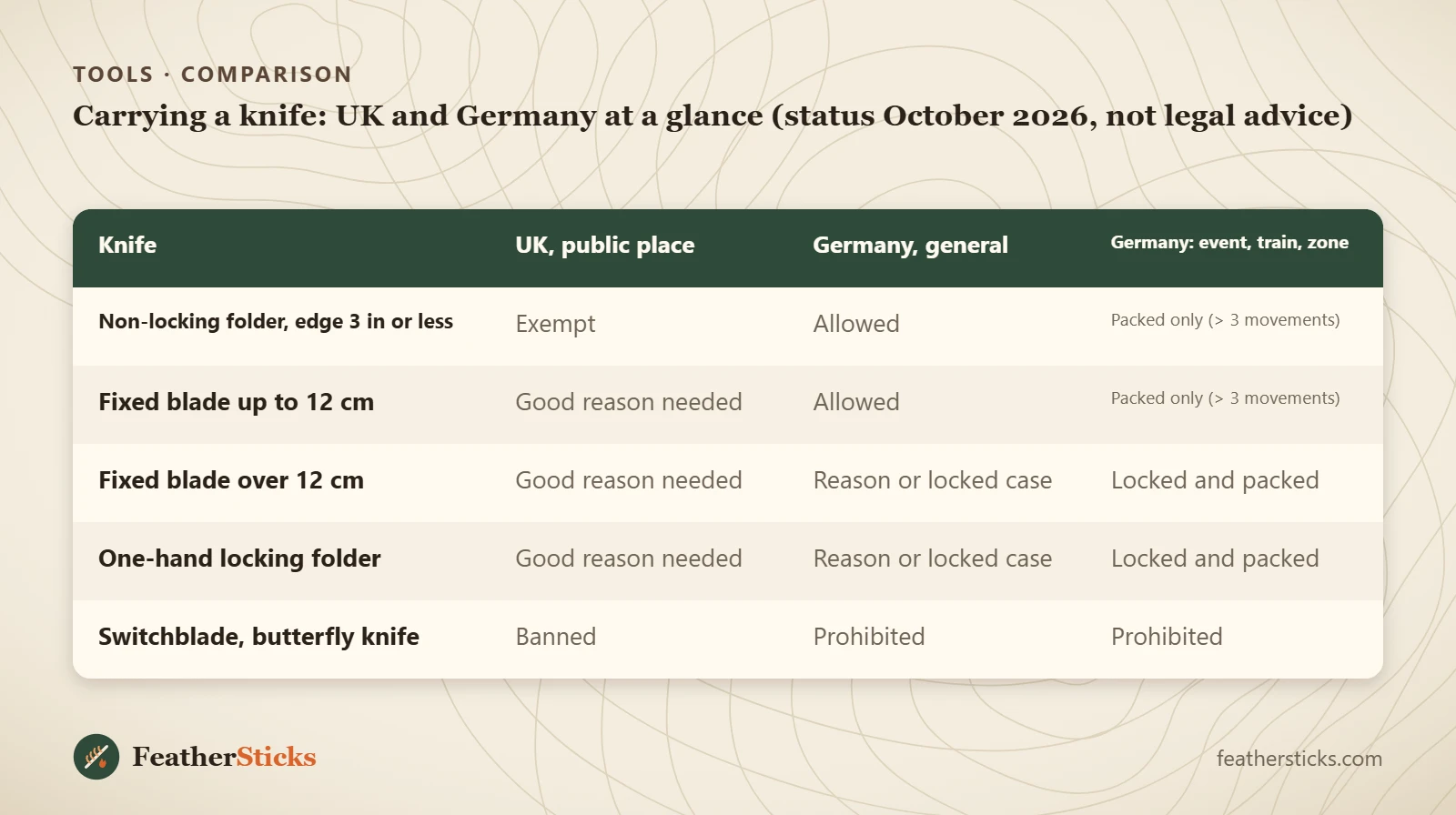
| Knife | UK, public place | Germany, general | Germany: event, train, zone |
|---|---|---|---|
| Non-locking folder, edge 3 in or less | Exempt | Allowed | Packed only (> 3 movements) |
| Fixed blade up to 12 cm | Good reason needed | Allowed | Packed only (> 3 movements) |
| Fixed blade over 12 cm | Good reason needed | Reason or locked case | Locked and packed |
| One-hand locking folder | Good reason needed | Reason or locked case | Locked and packed |
| Switchblade, butterfly knife | Banned | Prohibited | Prohibited |
Common mistakes
- Believing the "palm width" rule – no such rule exists in UK or German law.
- Assuming "under 12 cm is always fine" in Germany: the line only applies to fixed blades, and not at events, on long-distance trains or in zones.
- Thinking a short one-hand locking folder is harmless – in Germany length is irrelevant for these knives, and in the UK a lock knife is never exempt.
- Saying "it is a tool, so it is legal everywhere" – the UK offence covers any blade, and the German bans since 2024 cover any knife.
- Leaving the knife on your belt after the trip and walking into a shop, a pub or a train with it.
- Treating a zipped rucksack as a "locked container".
- Reaching for the knife yourself during a police check, or giving "self-defence" as the reason.
What you need
- Fixed-blade knife with a 9–11 cm blade and a secure sheath
- Small non-locking two-hand pocket knife, cutting edge 3 in (7.62 cm) or less
- Lockable transport case or pouch with a small padlock
- Stuff sack that keeps case, saw and hatchet together at the bottom of the pack
- Edge guards for axe and saw
- Ruler or tape to measure the blade
FAQ
Can I carry a fixed blade knife for camping?
What knife can I legally carry in the UK without a reason?
Is bushcraft a good reason to carry a knife in the UK?
What is the knife law in Germany for tourists?
Can I take a knife on a train in Germany?
Is a multi-tool or Swiss Army knife legal to carry?
Can I fly with a bushcraft knife?
May my child carry a carving knife?
Check yourself
Completed6 quick questions from this guide. Nothing is sent anywhere.
Related step-by-step guides
-
 1
-
 1
-
 1