Pocket Knives & Multitools: Choosing, Carrying and Using Them Safely
The best pocket knife for camping is a small, sharp folder you can open safely, that locks or closes predictably, that you are allowed to carry where you are, and that you will actually keep clean. It handles food, cord, tape and light cuts, while a fixed-blade bushcraft knife does the wood. A multitool adds pliers, a small saw and an awl for repairs; it is a repair tool first and a knife second.
This guide compares the five common types, explains locks, blade length and steel in plain terms, and covers the part that catches people out: how a knife opens decides what the law says about carrying it. It also shows safe handling, the real limits of a multitool saw, care, choosing for children, buying second-hand and a quick "Which one for me?" decision. It belongs to the tools section and to bushcraft for beginners. Rules differ by country; check current rules, this is no legal advice.
Step by step
-
1

Folder or fixed blade?
A folder or multitool is enough for food, cord and repairs. For batoning and serious carving a fixed blade is stronger and safer.
-
2

Pick the type
Slip-joint, locking folder, multi-blade penknife or pliers multitool: choose by the jobs you do and the rules where you carry it.
-
3

Check opening and lock
Does it open with one hand, and does it lock? Both together can make it a restricted knife, for example in Germany.
-
4

Handle it safely
Open it with care, test the lock, cut away from the body inside your safety circle and close it with your fingers out of the blade path.
-
5

Carry it packed
On trains, in towns and at events keep it closed and deep in the pack. Check the current rules for your route.
-
6

Clean, dry, oil
Brush out the pivot, dry the knife completely and add one drop of oil. Check that the lock still engages fully.
Pocket knife or fixed blade: when is a folder enough?
A folder or multitool is enough for cutting food, opening packages, cutting cord and tape, trimming a plaster, making a notch for a tent line, whittling a small peg from a dry stick and any quick job you would otherwise do with scissors. It rides in a pocket, weighs little and, in many countries, is the easier tool to carry in public. See the knife law guide for how much easier.
A fixed blade is better when the knife is pushed, levered or hit. The pivot and the lock are the weak points of a folder: a lock can slip or break if it is loaded sideways, and a blade that folds under load closes on your fingers. So for batoning, for prying, for deep notching and for long carving sessions, a fixed-blade knife with a full or wide tang is the right tool. A fixed blade also has no crevices, so it is easier to clean and dry, which matters for food and for rust.
Folder / multitool vs fixed blade
Folder or multitool
- Pocket size, low weight
- Food, cord, tape, repairs
- Often easier to carry legally
- Pivot and lock limit hard use
- Dirt collects in the joint
Fixed blade
- Strongest, no moving parts
- Batoning, carving, notching
- Easy to clean and dry
- Needs a sheath, bulkier
- More legal friction in towns
This is why many experienced campers carry two: a fixed blade for wood and a small folder for everything else. If you can only carry one into the woods, choose the fixed blade. If your plans are food, cord and feather sticks from a dry stick with a folding saw for the wood, a good folder is genuinely enough. A pocket-sized knife belongs on every kit list. For a very tight budget see the budget kit, which advises skipping fancy multitools in favour of a knife, a saw and cord.

Types of pocket knives and multitools compared
There is no single "pocket knife". The five types below differ in how they open, whether they lock and what else they carry. The table is generic on purpose: shapes and price classes matter more than names.
| Type | Strengths | Weaknesses | Best at camp for | Price class |
|---|---|---|---|---|
| Slip-joint pocket knife (non-locking) | Simple, light, often two-hand opening, few legal worries | Blade can fold on your fingers; not for pushing cuts | Food, cord, light whittling | Budget to mid-range |
| Locking folder (liner, frame or back lock) | Blade held open; stronger; good for one-hand work | Lock needs care; one-hand versions are restricted in some places | All-round second knife, food and small carving | Budget to premium |
| Multi-blade pocket knife with saw, awl and tools | Many small tools, light | Every tool is small; short blades | Light repairs, picnic, kit backup | Budget to mid-range |
| Pliers-based multitool | Pliers, wire cutter, saw, awl, scissors, driver | Short thin blade, awkward for carving, heavier | Repair kit, gear fixes, wire, pot handles | Mid-range to premium |
| Keychain mini tool | Tiny, always with you | Very small blade and scissors; weak | Tape, thread, opening packages | Budget |
Slip-joint pocket knives
A slip-joint knife has a spring along the back that holds the blade open and closed by friction, not by a lock. It is the classic penknife. It opens with a thumbnail in a small groove (the nail nick), which in practice takes two hands. Because nothing locks the blade, a hard push on the spine can close it on your fingers, so it is a tool for pulling cuts and light work only. Its advantage is simplicity: in the UK a small non-locking folder is the one knife you may carry without a special reason (see below).
Locking folders
A locking folder holds the blade open with a catch. That makes pushing cuts safer and the knife stronger, but it adds a mechanism that must be kept clean. Locking folders often have a thumb stud, hole or flipper that lets you open them with one hand, and that is exactly the feature that turns up in German law. Strong, thin blades make them excellent for food and for fine work, but they are not a replacement for a bushcraft knife; see the two-knife system.
Multi-blade penknives
These carry a main blade plus extras: a small saw, an awl, scissors, a screwdriver, a file. Most are slip-joint in the sense that the main blade is held by a spring, although some have a lock on one blade. The tools are small, so expect small results: the saw cuts a thin stick, not a log.
Pliers-based multitools
A pliers multitool folds open to a pair of pliers with a set of tools in the handles. It is the best choice when the job is repairs: bending wire, pulling a bent peg, fixing a zip, tightening a screw on a pot handle. The handles are heavy and awkward for long cuts, and the main blade is short and thin. Many have a one-hand locking blade, which matters legally. For a camp, treat it as a repair kit tool: a small multitool is listed there at roughly 30 to 120 g.
Status: October 2026. Laws change and differ by country and state; this is general information, not legal advice. Check the current official rules, and see our knife law guide for the full picture.
Folding knife locks explained: liner, frame and back lock
A lock stops the blade from closing while you cut. All locks work by putting a piece of metal in the way of the blade's heel, the part behind the cutting edge near the pivot. Here is what the three common designs have in common and how they differ, without any specific models.

- Liner lock: a thin springy strip (the liner) inside one side of the handle moves across behind the blade heel when you open it. You release it by pushing the strip sideways with your thumb. It is common, light and simple.
- Frame lock: the same idea, but the strip is cut out of the metal handle itself, so it is thicker and usually stronger. The handle on that side is metal. It is released the same way.
- Back lock: a lever along the spine of the handle has a hook that drops into a notch on the blade's spine. You release it by pressing the lever at the rear end of the spine. It is robust and easy to check by eye.
There are other designs, and some multitools use a lock on the main blade only. All of them can fail if they are dirty, worn or loaded in a direction they were not made for.
How to check a lock
Open the blade fully. It should click or seat firmly. With the edge pointing away from you, press lightly on the spine of the blade towards the handle, without hitting it. It must not move. Then check sideways play: grip the handle and gently try to twist the blade left and right. A tiny amount of play at the pivot is normal on some knives; wobble you can see or feel is not. If the lock does not seat fully, closes when pressed or rattles, clean it first (care section for folders) and stop using it for real work.
Never test a lock by hitting the spine against a surface; a worn lock can fail on impact.
Status: October 2026. Laws change and differ by country and state; this is general information, not legal advice. Check the current official rules, and see our knife law guide for the full picture.
Blade length and steel for a camping pocket knife
For a pocket knife, small is not a flaw. A blade of about 6 to 9 cm is typical and enough for food, cord and light carving. Longer blades (above roughly 9 cm) make the knife heavier, harder to carry legally and harder to close safely; shorter blades (under about 6 cm) are weaker and fiddly for anything but tape and thread. Fixed-blade length is a different question: see the knife guide.
Steel in general terms
Steel choice sounds complicated, but only a few ideas matter for a camp pocket knife:
- Stainless steel resists rust well. It is the sensible default for a knife that lives in a pocket, a pouch or a wet kit, and that cuts food. It is usually a little harder to sharpen back to a keen edge in the field, and a good one holds its edge for a long time.
- Carbon steel takes a very sharp edge easily and is simple to touch up, but it rusts if it is left wet and stains with food acids. It darkens with use (a patina) and needs more care: see knife care for patina versus rust.
- Harder steel holds an edge longer but can chip; softer steel bends instead of chipping and is easier to sharpen. Heat treatment and thickness matter as much as the type.
One-hand opening or nail nick: why it matters legally
How a knife opens may look like a matter of taste. In some countries it decides whether you may carry it. This section follows our knife law guide, which has the verified details and the sources. Read it before you travel.

Germany: § 42a WaffG
In Germany, one-hand locking knives (Einhandmesser) are restricted: you may own them, but carrying them outside your home is restricted under § 42a of the Weapons Act. A knife counts as a one-hand knife when it can be opened with one hand and its blade locks open. A pocket knife you can only open with two hands, through a nail nick, is not covered, even if its blade locks. The blade length of such a one-hand knife does not matter; the 12 cm line applies only to fixed blades. On top of that, since 31 October 2024 every knife is banned in public events, in long-distance public transport and its stations and in knife-free zones set by the states, unless it is packed so that it takes more than three hand movements to reach. That includes a small penknife and a multitool. Details, exceptions and the "legitimate interest" are in the German section of the knife law guide.
United Kingdom: the 3-inch exception
In the UK, carrying a blade or sharply pointed article in a public place needs a good reason. The exception is a folding pocketknife whose blade has a cutting edge of 3 inches (7.62 cm) or less and which is not a lock knife. A lock knife, however short, does not qualify, and a one-hand opener that locks is a lock knife. Scotland has a parallel rule. Everything else, including fixed blades, needs a good reason that a court would accept.
Travel and flights
For flights, no knife belongs in hand luggage; pack it in checked baggage, sheathed and wrapped, and check the airline and the destination's rules. In many countries a plain, non-automatic knife that is clearly a tool and packed away is the lowest-risk choice. Automatic (switchblade), gravity and butterfly knives are banned or restricted in many places, so do not travel with them. See the travel section for trains, coaches and borders.
| Knife | Germany, general carry | UK, public place | Event, long-distance train, zone (DE) |
|---|---|---|---|
| Non-locking slip-joint, edge up to 3 in (7.62 cm) | Outside § 42a | Exempt | Packed only |
| Two-hand opening with a lock | Outside § 42a | Good reason needed (lock knife) | Packed only |
| One-hand opening and locking | Restricted: § 42a | Good reason needed | Packed and locked |
| Multitool with a one-hand locking blade | Restricted: § 42a | Good reason needed | Packed and locked |
| Switchblade, gravity or butterfly knife | Prohibited | Banned | Do not bring |
Status: October 2026. Laws change and differ by country and state; this is general information, not legal advice. Check the current official rules, and see our knife law guide for the full picture.
How to use a pocket knife safely
Most folding knife injuries happen at two moments: when the blade closes and when the knife is pushed against something it should not be. Both are easy to avoid with a fixed routine. The routine is the same for every folder and works for a multitool blade too.
Open, check, cut, close
 1Open it with a nail nick
Hold the handle in one hand and put the thumbnail of the other hand in the nick. Pull the blade out until it clicks, with the edge pointing away from both hands. Do not flick it open: a slip-joint can snap back on your fingertips.
 2Check the lock
Look at the lock and press lightly on the spine, edge away from you. There should be a click, no wobble and no play. If it closes or rattles, clean it or retire the knife from anything but light work.
 3Cut away from the body
Brace the work on a log or a block, keep the edge facing away from you and cut away, in short controlled strokes. Keep other people outside your arm-length safety circle, see safe grips and the safety circle.
 4Close it, fingers out of the way
Wipe the blade on a cloth, edge away from the hand that holds the cloth. For a lock, press the release and push the spine, not the edge, with the heel of the other hand, so that no finger lies in the sweep of the blade. Never close it against your leg or your palm.
Passing a folding knife
The safest way to give someone a folder is closed, with the lock off. If it has a fixed blade, hand it over handle first. Say "Got it?" and let go only after the answer. Or put the knife down and let the other person pick it up.
Handing over a folding knife
 1Never hand it over open
An open blade between two hands is how a quick favour becomes a cut. Close it, or put it down.
 2Closed, in an open palm
Close the blade and lay the knife across an open palm, or hold the closed handle out. The other person takes it, not you pushing it into their hand.
 3They open it themselves
Your helper opens it, checks the lock and decides how to hold it. This also teaches children the routine. See bushcraft with kids.
Multitool at camp: what the tools can and cannot do
A multitool is a bundle of small tools. The question is not whether it has a saw but what the saw can really do. The sequence below shows four jobs where a multitool earns its place, and the table that follows gives honest limits.
Four multitool jobs at camp
 1Pliers
Pliers bend and cut wire, pull a bent tent peg, hold a hot pot handle for a moment and tighten small screws. Squeeze with the whole hand and keep your fingers out of the jaws.
 2Small saw
The little saw copes with a dry stick up to about the thickness of a thumb. Support the stick, saw with long light strokes and pull more than you push. For firewood use a proper folding saw.
 3Awl
The awl pierces leather, a strap or a tarp patch to start a stitch or a lashing. Press it into a wooden block, not towards your hand, and turn it as you push.
 4Scissors
Scissors cut cord, tape, thread and plaster neatly and with less risk than a knife. They are the safest tool on the multitool for children, under supervision.
| Tool | Good for | Limit |
|---|---|---|
| Main blade | Food, cord, tape | Short and thin; never for batoning or prying |
| Pliers | Wire, pegs, zip sliders, screws | Not a hammer or a wrench for big nuts |
| Saw | Thin dry sticks, small pegs | Far smaller than a real saw; slow and tiring |
| Awl | Piercing a strap, patch or leather | Not for hardwood; the point snaps if levered |
| Scissors | Cord, tape, thread, plaster | Not for heavy fabric or rope |
| Screwdriver, file, opener | Gear repairs, stove or tent hardware | Can break if used as a pry bar |
For repairs a multitool fits neatly in the repair kit next to tape and cord. A minimal budget kit can skip it, as the budget kit explains, because a knife, a saw and cord cover most jobs. The rule is simple: take a multitool when you carry gear that can break, such as a stove, a tent or a bike, and leave it at home when a knife and a saw already do the work. At a base camp one multitool in the repair box can serve everyone.
Caring for a pocket knife: pivot, oil and rust
A folder collects dirt where it moves. Pocket lint, sand, resin and food sit in the pivot and the blade slot, and they can stop the lock from seating fully. The full routine is in our care guide for folders; here is the short version, consistent with it.
- Brush it out. Open the blade fully, lay the knife down with the edge pointing away from you and brush the pivot and slot with an old toothbrush. A wooden toothpick reaches the corners.
- Wash and dry. Rinse in warm water with a drop of washing-up liquid, then rinse clean and shake out the water. Leave the knife open on a cloth until the inside is completely dry; warm air from a distance helps.
- One drop of oil. Put a single drop on the pivot, open and close the blade a few times with care, and wipe off what comes out. Use a food-safe oil if the knife cuts food. Check that the lock engages fully.
Do not take a folder apart unless the maker says so. Multitools are cleaned the same way, one tool at a time.
Rust and what it means
Wet seasons and winter trips (camping through the seasons) are when pivots rust and lint freezes, so clean more often then.
Stainless steel rusts less, not never. Salt, sweat and food acids can leave small pits, especially in the pivot. Light surface rust comes off with a cloth and a drop of oil. Pitting on the flat of a blade is cosmetic; pits in the edge need the edge ground back, see removing rust. Rust deep in the pivot, or a blade that has lost visible thickness, is a reason to retire the knife from hard work. Store knives dry, and not in a sealed leather sheath or a damp pocket for days.
After every trip
- Wipe the blade and dry the knife completely
- Brush out lint and sand from the pivot
- One drop of oil on the pivot, none on the handle scales
- Check the lock engages fully and the blade does not wobble
- Touch up the edge if it no longer slices paper cleanly
- Store it open a little, in a dry place
Pocket knives for children
Whittling is one of the best skills for a child, and a knife is a tool, not a toy. The step-by-step approach is in bushcraft with kids; this section adds what is special about folding knives.
- Start without a blade. A swivel peeler on a green stick teaches the movements; then whittling projects.
- Rounded tip. A kids' blade with a rounded tip and a finger guard hurts less when it slips.
- Folding choices differ. A non-locking folder is the simplest to carry legally, but the blade can close on fingers during a push cut, so it is for pulling cuts under close supervision. The kids guide prefers a short fixed blade or a locking folder, and for young children a short fixed blade with a rounded tip.
- Supervision. An adult is within reach, sets the safety circle and keeps the knife until the child needs it.
- Law and age. Carrying rules apply regardless of age. In the UK most knives may not be sold to people under 18; in Germany the carry rules of § 42a and the location bans apply regardless of age. The adult carries the knife packed on the journey and hands it over at the carving spot.
Carrying a pocket knife: clip, pouch or in the pack?
Where you keep the knife changes how fast you reach it and how the law sees it.

| Method | Pros | Cons |
|---|---|---|
| Pocket clip | Fast, stays in place, hands free | Ready to hand: counts as carrying; may be restricted at events or on trains |
| Loose in the pocket | Nothing to buy | Lint in the pivot; can open or snag; keys scratch it |
| Belt pouch | Protects the knife, quick to reach | Visible; carrying in public in many places |
| Pouch or case inside the pack | Protected; packed away; best for travel | Slower to reach on the trail |
On the trail a clip or a belt pouch is convenient. Before you enter a town, a train, a market or an event, move the knife into the pack, deep and closed, see how to transport a knife. A knife that is not in your hand goes back to the same place every time.
Status: October 2026. Laws change and differ by country and state; this is general information, not legal advice. Check the current official rules, and see our knife law guide for the full picture.
Buying a pocket knife: new or second-hand?
A folding knife does not need to be new or expensive. Decide the class first: budget (a plain, honest tool), mid-range (better steel, a smoother lock and a better finish) or premium (the best steel and fit). A mid-range knife is the sweet spot for most campers.
Second-hand is an excellent way to buy, in line with the thinking in the budget kit. Check these points in person or ask for clear photos:
- Lock: opens with a firm click, no wobble, no play, and holds when you press the spine lightly.
- Pivot: smooth, with no grit, no side-to-side play and no rust at the joint.
- Blade: straight, with an intact edge and tip, centred when closed. A reground edge is fine; a chipped tip is not.
- Legal status: make sure it is not a banned type such as an automatic or gravity knife, and that you can legally own and carry it where you live.
Which one for me? A quick decision
Answer the questions in order and stop at the first line that fits.
Which one for me?
Do you split wood, baton or carve for long sessions?
Yes → A fixed-blade knife is the main tool. Add a small folder or multitool as the second knife.No → Go on.Do you travel by train, through towns or to events with the knife?
Yes → Choose a small two-hand slip-joint (UK: edge 3 in or less, non-locking) or pack any knife away. Avoid a one-hand locking model.No → Go on.Is repair work the main job (stove, tent, wire, bike)?
Yes → A pliers multitool. Check its blade: a one-hand locking blade is restricted in some places.No → Go on.Is it mostly food, cord and tape?
Yes → A small folder or slip-joint penknife is enough.No → Go on.Is the user a child?
Yes → A peeler first, then a kids' knife with a rounded tip, under supervision. See the kids section.No → A mid-range locking or non-locking folder you can open safely is the all-round pick.
Pocket knife problems and how to fix them
| Symptom | Likely cause | What to do |
|---|---|---|
| Blade wobbles when open | Loose pivot screw, worn lock or dirt | Clean it; if the play stays, stop using it for real work |
| Blade closes when pressed | Lock does not seat or is worn | Stop using it; clean it; replace the knife if it persists |
| Slip-joint closes on a push cut | No lock by design | Use pulling cuts only, or switch to a locking folder or fixed blade |
| Rust spots | Left wet or in a damp pouch | Wipe with oil, remove light rust; see tool care |
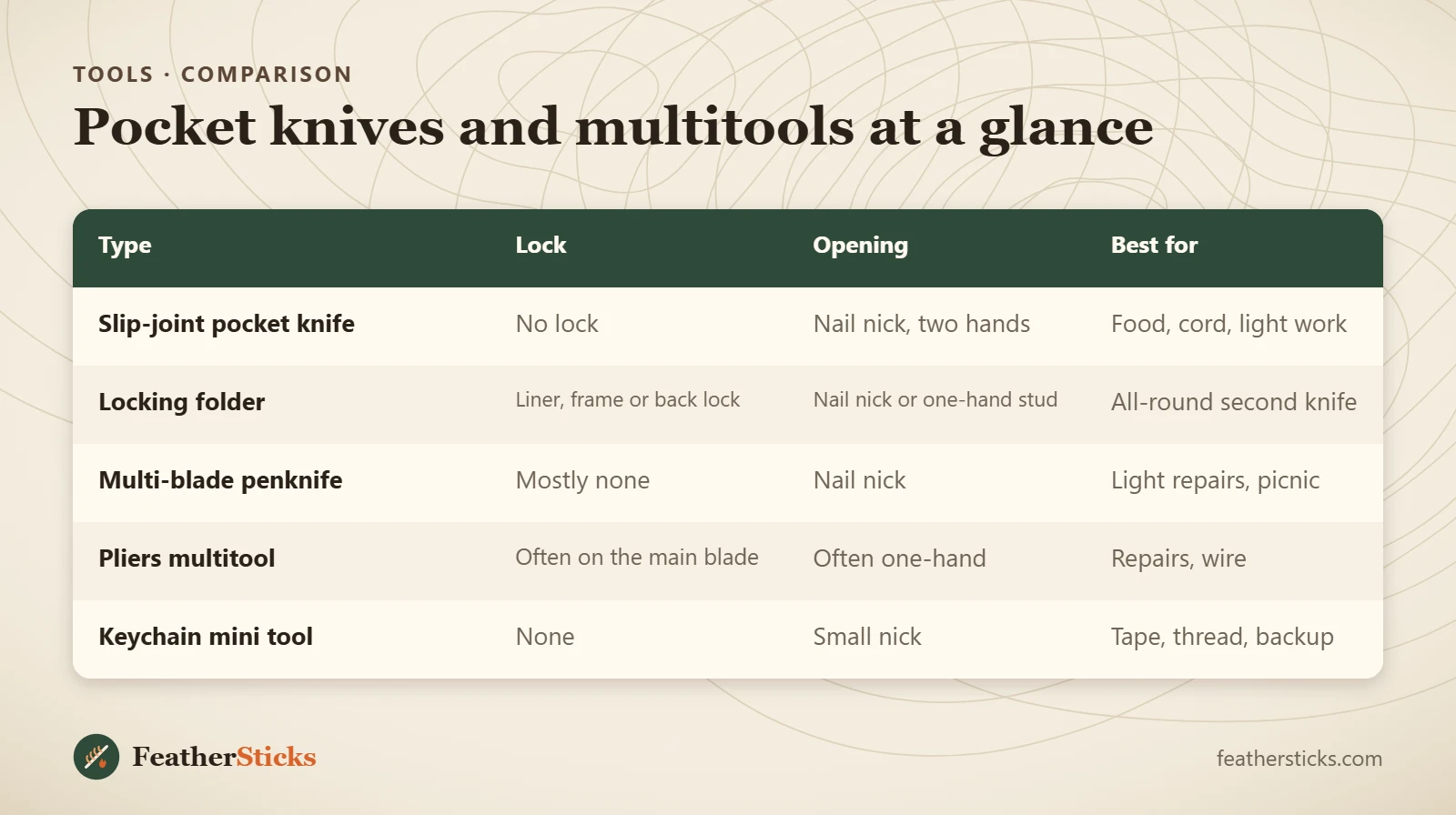
| Type | Lock | Opening | Best for |
|---|---|---|---|
| Slip-joint pocket knife | No lock | Nail nick, two hands | Food, cord, light work |
| Locking folder | Liner, frame or back lock | Nail nick or one-hand stud | All-round second knife |
| Multi-blade penknife | Mostly none | Nail nick | Light repairs, picnic |
| Pliers multitool | Often on the main blade | Often one-hand | Repairs, wire |
| Keychain mini tool | None | Small nick | Tape, thread, backup |
Common mistakes
- Treating a folder like a fixed blade: batoning, prying or pushing a non-locking blade.
- Assuming a short blade is always legal: one-hand locking knives are restricted in Germany whatever the length.
- Carrying the knife on a clip or belt into a train, a market or an event instead of packing it away.
- Never cleaning the pivot, so lint and sand stop the lock from seating.
- Testing the lock by whacking the spine on a table.
- Closing the blade with a finger in its path, or against a leg.
- Buying a multitool for logs: the small saw is for thumb-thick sticks only.
What you need
- Small folder (slip-joint or locking) with a blade of about 6–9 cm
- Pliers multitool for repairs, if you carry a stove, tent or bike
- Pouch or small case for packing the knife away
- Small pocket stone or strop for touch-ups
- Old toothbrush, cloth and a small bottle of oil
- Fixed-blade bushcraft knife for wood work
FAQ
What is the best pocket knife for camping?
Multitool vs pocket knife: which is better?
Is a folding knife good enough for bushcraft?
Is a locking knife safer than a non-locking one?
Is a one-hand opening knife legal in Germany?
What pocket knife can I carry in the UK?
Can I take a pocket knife or multitool on a plane?
How do I clean the pivot of a folding knife?
Check yourself
Completed6 quick questions from this guide. Nothing is sent anywhere.
Related step-by-step guides
-
 1
-
 1
-
 1