Hypothermia Symptoms & Treatment Outdoors: Signs, First Aid, Prevention
Hypothermia symptoms start quietly: shivering, clumsy hands, stumbling, mumbled answers and a companion who has gone oddly silent. Hypothermia means the body is losing heat faster than it can make it and its core temperature falls below about 35 °C. It does not need frost – the classic hypothermia weather for hikers and bushcrafters is 5–10 °C with wind and rain.
This guide explains how to recognise the stages by their signs, how to treat hypothermia outdoors while it is still mild, how to build a hypothermia wrap, when to call the emergency services, and how to prevent it in the first place. It also covers frostbite first aid, trench foot and chilblains. It belongs to our bushcraft skills, builds on the bushcraft basics and complements the first aid kit guide.
Step by step
-
1

Spot the early signs
Shivering, fumbling hands, stumbling, mumbling and a grumpy or very quiet companion are the warning. Take them seriously in any cold, wet or windy weather.
-
2

Stop – out of wind and rain
Do not push on. Get behind a wind break, under a tarp or into a bivvy bag or group shelter straight away.
-
3

Dry layers, hat, off the ground
Once sheltered, swap wet clothing for dry, put a hat on and sit or lie on a pad or pack – never on bare ground.
-
4

Insulate and wrap up
Pad underneath, sleeping bag around, a windproof and waterproof layer outside. Keep the face free.
-
5

Warm sweet drink if fully alert
Give warm, sweet drinks and sugary food only to someone who is fully awake and can swallow. No alcohol.
-
6

Drowsy or confused: call for help
Confusion, drowsiness or shivering that stops means an emergency. Call 112, 999 or 911, handle the person gently and keep them lying flat.
Before you read on
What is hypothermia – and why 5–10 °C is the classic weather
Your body works within a narrow band around 37 °C. In the cold it defends that temperature in two ways: it narrows the blood vessels in skin, hands and feet to keep warm blood in the core, and it makes extra heat by shivering. Hypothermia begins when those defences are no longer enough and the core temperature drops below about 35 °C. From there, muscles, brain and heart work progressively worse – which is why the person affected is usually the last to notice.
Most outdoor cases are not dramatic blizzard stories. They happen on ordinary cool days to people who are wet, tired and under-fuelled: a long walk in drizzle at 8 °C, a windy ridge, a capsized canoe in spring, an evening at camp in damp clothes. Wet clothing and wind strip heat far faster than still, dry cold. At 5 °C, a 20 km/h wind already feels like about 1 °C; the wind chill calculator shows the effect for your conditions, and reading the weather tells you when it is coming.
The five ways the body loses heat

| Path | What happens | What stops it |
|---|---|---|
| Convection (wind) | Moving air carries away the warm layer next to your skin and clothes | Windproof shell, wind break, bivvy bag, getting into the lee |
| Conduction (contact) | Heat flows into anything colder that you touch – ground, rock, snow, water. Water conducts heat around 25 times faster than air | Sleeping pad, pack or branches under you; staying out of water |
| Evaporation (wetness) | Rain-soaked or sweaty clothing cools you as it dries, and wet fabric insulates poorly | Staying dry, venting before you sweat, changing into dry layers |
| Radiation | Uncovered skin radiates heat to colder surroundings | Hat, hood, gloves, covering head and neck |
| Breathing | Every breath warms and moistens cold air and then leaves | Cannot be stopped; a scarf or buff over the mouth helps a little |
Read the table the other way round and you have the whole treatment: get out of the wind, get off the ground, get dry, cover the head, and add insulation. Everything else in this article is detail.
Who is at risk of hypothermia when hiking and camping?
Anyone can become hypothermic, but some situations and people cool much faster. The more points on this list apply, the earlier you should stop and add warmth.
Risk factors – the more apply, the earlier you act
- Wet clothing from rain, sweat, a river crossing or a fall into water
- Wind, especially on ridges, open moor, lakeshores and in a canoe
- Exhaustion – tired muscles make less heat and shiver less
- Too little food and drink during the day
- Alcohol, which widens the skin vessels and dulls judgement
- Children, lean people and older people – they cool faster or produce less heat
- Injury or illness that keeps someone still on cold ground
- Long stops, waiting, navigation errors and an unplanned night out
The typical chain is easy to recognise in hindsight: a late start, a longer route than planned, no proper lunch because it was raining, a soaked base layer under a shell, and then a stop on a windy col. Each link is harmless alone. Good planning breaks the chain early – a realistic route (see the hiking time calculator and the daylight calculator), a turnaround time, and the discipline to stop before everybody is cold.
An injured person deserves special attention. Someone who has twisted an ankle and sits on wet ground cools quickly even in mild weather, because they have stopped making heat by moving and are losing it into the ground. Insulating a casualty is part of first aid for every injury, not only for cold.
Hypothermia symptoms: how to recognise the signs
You will not have a thermometer that measures core temperature in the woods, and you do not need one. First aiders, mountain rescue teams and wilderness medicine guidelines judge hypothermia by what they see: is the person shivering, how alert are they, how do they move and speak?
The "umbles" – signs of hypothermia when hiking
The early signs are easy to remember as the "umbles":
- Stumbles – tripping, wandering off line, slow and unsteady walking.
- Mumbles – slurred, slow or short answers.
- Fumbles – cannot do up a zip, drops things, struggles with laces or a lighter.
- Grumbles – irritable, apathetic, withdrawn, "I'm fine, leave me alone".
Together with shivering and cold, pale skin, they mean the body is struggling. The person often denies it – judgement is one of the first things to go. So the rule in a group is: if you see the umbles in someone else, you decide, not they.

| Stage | Signs you can see | What it means | What to do |
|---|---|---|---|
| Cold, not yet hypothermic | Feels cold, shivers now and then, moves and talks normally | The body is coping but working hard | Add a layer, eat, drink, keep moving, fix what is wet |
| Mild (approx. 35–32 °C) | Constant strong shivering, cold pale skin, clumsy hands, the umbles – but awake and makes sense | The defences are fully switched on and still working | Stop, shelter, dry layers, insulate, warm sweet drinks and food, rest; call for help if no clear improvement |
| Moderate (approx. 32–28 °C) | Shivering weakens or stops, confusion, slurred speech, drowsiness, cannot walk properly | The body can no longer rewarm itself | Emergency call. Handle gently, keep flat, wrap and insulate, nothing by mouth if drowsy |
| Severe (below approx. 28 °C) | No shivering, unresponsive or barely responsive, very slow or hardly detectable breathing and pulse | Life-threatening; the heart is very sensitive | Emergency call at once. Minimal, very gentle movement, insulate, watch breathing, CPR if no signs of life and you are trained |
The temperature bands are the commonly published approximate ranges. They cannot be measured in the field – judge by the signs. People do not follow the table neatly; if in doubt, treat for the worse stage.
Shivering present, shivering stopped
Shivering is the most useful single sign. Strong shivering in someone who is awake and coherent means the body still has fuel and control: with shelter, dry insulation and food it can usually rewarm itself. Shivering that fades in a person who is still cold, still wet and getting quieter is the opposite of good news. It means the energy is running out and the core is cooling further. "They have stopped shivering, so they are better" is one of the most dangerous misreadings in the outdoors. Someone who is genuinely warming up becomes more talkative, more coordinated and pinker – not sleepier.
Buddy checks: an early-warning routine
In cold, wet weather build a short check into every stop. It takes a minute and catches the problem at the stage where a flask of tea still solves it.
Buddy check in three quick tests
 1Ask a simple question
Ask something that needs a real answer – what was for lunch, where are we heading next. A clear, quick reply is reassuring. Slow, slurred, irritated or nonsensical answers are a warning sign.
 2Test the hands
Can they touch the thumb to each fingertip in turn, do up a zip or tie a lace? Fumbling fingers show that the body is already pulling warm blood away from the hands.
 3Watch them walk
Let them walk a few metres in a straight line. Stumbling or drifting sideways on easy ground, together with shivering, means: stop here, get sheltered and warm up now – do not carry on to the planned camp.
On your own, nobody runs the check for you. Set yourself fixed triggers instead: if you cannot work a zip or your lighter, if you have stumbled twice on easy ground, or if you notice you no longer care about being cold, you stop and deal with it. A solo first night out in the cold season should always be close to home or the car.
How to treat hypothermia outdoors while it is still mild
A shivering, alert person can be rewarmed in the field – if you stop the heat loss completely. The order matters: shelter first, then dry, then insulation, then fuel. Changing clothes on an exposed ridge in the rain costs more heat than it saves.
Out of the wind and off the ground
 1Stop early
The moment someone shows the umbles, the walk is paused. "Just to the top" or "only twenty minutes to the hut" is how mild hypothermia becomes moderate. Tell the group clearly that you are stopping.
 2Get into the lee
Move a few metres to the sheltered side of a boulder, a bank, dense young conifers or a wall. If there is nothing, rig a tarp low to the ground with its back to the wind. Avoid hollows that collect water.
 3Pad or pack under you
Sit or lie on a sleeping pad, a pack, a coiled rope or a thick layer of dry branches. Cold, wet ground takes heat much faster than air – insulation underneath is as important as a jacket on top.
 4Wet off, dry on, hat on
Once out of wind and rain, replace wet layers with dry ones, starting with the upper body, and put on a hat and gloves. If there is nothing dry, wring out the base layer and put a wind- and waterproof layer over everything.
 5Bivvy bag or group shelter
Pull an emergency bivvy bag or a group shelter over the person – better still, over the person and a warm companion. Inside, shared body heat and still air make a noticeable difference within minutes.
Food, drink and gentle movement
Shivering burns a lot of energy, so a mildly hypothermic person needs fuel. The standard advice from the NHS and Red Cross societies is the same: give a warm, non-alcoholic, sweet drink and sugary food such as chocolate – but only to someone who is fully awake and able to swallow. The sugar matters more than the temperature of the drink; lukewarm sweet tea is fine, and it must not be scalding. A stove and a mug are part of your emergency kit in the cold season – see camp stoves and boiling water.
What about moving to warm up? Wilderness medicine guidance is cautious. Let the person rest, sheltered and insulated, for about half an hour first and watch them. If they are clearly improving – shivering less because they are warmer, talking normally, hands working – gentle activity such as walking slowly is reasonable and helps make heat. If they are not improving, or were ever confused or drowsy, they are not walked out: you insulate, call for help and wait.
Checkpoint: is the person really getting better?
- Speech is clear again and answers make sense
- Hands work: zip, mug, thumb to fingertips
- Shivering eases while skin gets warmer and colour returns
- They want to eat and drink and take an interest in what is happening
- They can stand and walk steadily – only then think about moving on, and then by the shortest route to warmth
If any of these points is missing after a proper rest, treat it as moderate hypothermia: wrap, call, wait. And after even a mild episode, the trip plan changes – shorten the route, head for a hut, the car or a sheltered camp with a fire (lighting a fire in wet weather is worth practising for exactly this day; in snow and hard frost, see fire in snow and cold).
The hypothermia wrap ("burrito") step by step
A hypothermia wrap is the outdoor version of putting someone to bed: insulation all round, a layer that keeps moisture in and a shell that keeps wind and rain out. Mountain rescue teams and wilderness first aid courses teach it because a cold person in a sleeping bag alone still loses heat into the ground and through wet clothing. You can build it from what a normal camping kit contains.
Building a hypothermia wrap
 1Outer shell first, then pads
Spread a tarp, bivvy bag, poncho or tent fly on the ground in the most sheltered spot. Lay one or, better, two sleeping pads on top – head to foot, no gaps.
 2Sleeping bag and vapour barrier
Open a sleeping bag (or two, or all spare clothing) on the pads. On top goes a vapour barrier: a foil emergency blanket, a large bin bag slit open or a pack liner. It keeps damp clothing from soaking the insulation and stops evaporation.
 3Lay the person in gently
Dry clothes and a hat on if you can manage it in shelter, then lay the person flat on the stack. A warm – not hot – bottle wrapped in a sock may go on the chest over the clothing. Never put heat on bare skin or on arms and legs.
 4Close every layer
Fold the vapour barrier around the body, close the sleeping bag and hood, then fold the outer shell over like a parcel and tie it loosely with cord or straps. The face stays free and visible.
 5Stay, watch, call for help
Stay with the person, talk to them and check breathing and alertness every few minutes. Note the time and any changes for the rescue service. Do not leave a hypothermic person alone unless there is no other way to raise the alarm.
Wet clothing: change or leave on?
For a mildly hypothermic person in shelter, the answer is simple: wet off, dry on. For a moderately or severely chilled person, undressing means moving them a lot and exposing them to wind. First aid sources put it this way: remove wet clothing if you are sheltered and have dry clothing or blankets to replace it. If not, leave it on, wrap the vapour barrier directly over the wet layers and put the insulation outside it. If clothing has to come off a very cold person, cut it away rather than pulling limbs through sleeves.
Heat sources: warm, wrapped, on the torso
Insulation does most of the work. Added heat is a bonus and has to be used carefully, because cold skin burns easily and does not feel it. Advice for lay first aiders (for example from the NHS) is not to use hot baths, hot-water bottles or heat lamps. Mountain rescue and wilderness medicine guidelines do use heat packs and warm bottles, with firm rules: warm rather than hot, always wrapped in cloth and over clothing, placed on the chest, in the armpits or on the upper back – never on bare skin and never on arms or legs – and checked regularly. If you are unsure, leave them out and concentrate on a dry, windproof, well-insulated wrap.
| Layer | Ideal | Improvised |
|---|---|---|
| Outer wind and rain shell | Tarp, bivvy bag, group shelter | Poncho, tent fly, two large bin bags, a rain jacket over the top |
| Ground insulation | Two sleeping pads | Packs, rope, dry spruce branches, bracken or leaf litter 15–20 cm thick |
| Insulation around the body | One or two sleeping bags | All spare clothing, a quilt, insulated jackets laid over and under |
| Vapour barrier | Foil emergency blanket or emergency bag | Bin bag, pack liner, rain trousers and jacket |
| Head | Warm hat plus sleeping bag hood | Spare fleece wrapped round head and neck |
| Heat source (optional) | Large heat pack over clothing on the chest | Bottle with warm water in a sock; a warm companion alongside in the shelter |
A foil blanket alone is a wind and vapour barrier, not insulation. It works when it is part of a wrap with something thick under and around the person.
Moderate and severe hypothermia: what to do until help arrives
Once a person is confused, drowsy, no longer shivering or cannot walk, you are no longer rewarming them yourself. Your job is to stop further cooling, avoid doing harm and get professional help moving. Call early – rescue in bad weather takes time.

Badly chilled person: do and do not
Do
- Call 112 (EU), 999 (UK) or 911 (US/Canada) early and follow the dispatcher's instructions
- Handle very gently and keep the person horizontal
- Shelter from wind and rain where they are, if moving them is difficult
- Insulate from the ground and wrap them up completely, head included
- Stay with them, keep talking, watch breathing and alertness
- Put an unresponsive person who is breathing normally in the recovery position, well insulated
- Start CPR if there are no signs of life and you are trained – and keep going
Do not
- No alcohol – it increases heat loss
- No rubbing or massaging of arms, legs, hands or feet
- No hot bath, hot shower, fire close to the skin or other rapid rewarming in the field
- Nothing to eat or drink if the person is drowsy, confused or cannot swallow safely
- No standing up, walking out or "exercise to warm up"
- Do not jolt, drag or sit the person upright unless there is no alternative
- Do not assume someone is dead because they are cold, stiff and seem lifeless
Why so gentle? Afterdrop and rescue collapse, simply explained
In a deeply chilled person the blood in arms and legs is much colder than the blood around the heart. Rough handling, standing them up, rubbing the limbs or warming the limbs first can send that cold blood back to the core: the core temperature drops further even though the person is now "being rescued". This is called afterdrop. At the same time the cold heart is irritable and blood pressure is fragile, so sudden movement or sitting upright can trigger a dangerous heart rhythm or collapse – rescue services speak of rescue collapse. You do not need to remember the physiology. Remember the behaviour: flat, slow, gentle, warm the trunk and not the limbs.
No signs of life?
A severely hypothermic person can look dead: cold, grey, stiff, with breathing and pulse so slow and weak that they are hard to find. Cold also protects the brain, and people have recovered after long periods in this state. That is why the guidance of resuscitation councils and public health bodies is clear: do not give up on a cold casualty. Look, listen and feel for breathing for longer than you normally would – rescuer guidelines allow up to a minute. If there are no signs of life and you are trained, start CPR, tell the emergency dispatcher and continue until professionals take over. Whether and how long resuscitation continues is a decision for the rescue service and the hospital, not for first aiders on the hill.
When to call for help – and what to tell the dispatcher
Hypothermia: should I call the emergency services?
Is the person unresponsive, not breathing normally, or showing no signs of life?
Yes → Call 112 / 999 / 911 now. Start CPR if trained and there are no signs of life.No → Go on to the next question.Are they confused, very drowsy, slurring badly, unable to walk – or have they stopped shivering while still cold?
Yes → Call now. Handle gently, keep flat, wrap and insulate, nothing by mouth.No → Go on to the next question.Shivering and alert, but also injured, a small child, very exhausted or pulled out of cold water?
Yes → Call and ask for advice; shelter and rewarm while you wait.No → Go on to the next question.Shivering and alert: are they clearly improving after about 30 minutes of shelter, dry layers, food and drink?
Yes → Keep them warm, shorten the trip, watch them closely for the rest of the day.No → Call for help – do not wait for it to get worse or for darkness.
In the European Union the emergency number is 112; in the UK dial 999 or 112 (for the hills, ask for the police and then mountain rescue); in the US and Canada 911. If you are unsure whether it is "bad enough", call anyway – dispatchers would rather advise early than search at night.
What the dispatcher needs to know
- Where
- Coordinates from your phone or map, nearest path, hut or landmark, rescue point code if there is one
- What
- Suspected hypothermia; wet / in water / injured; how long exposed
- Condition
- Awake? Makes sense? Shivering or not? Breathing normally?
- Who
- Number of people, ages, anyone else cold or hurt
- On scene
- Shelter and insulation you have, weather, wind and visibility
- Contact
- Your number; keep the phone warm, charged and free
No signal? Try 112 anyway, move a short way to higher or more open ground if someone can do so safely, and use the whistle and light signals described in emergency and distress signals. If someone has to go for help, send two people if the group allows it, with the location written down – a result of good map and compass work – and leave the warmest, most capable person with the casualty.
Preventing hypothermia: stay dry, fed and ahead of the cold
Hypothermia is far easier to prevent than to treat. Prevention is not about toughness; it is a set of small habits that keep you dry, fuelled and honest about how the group is doing.
Layering and staying dry
Dress in layers that you actually adjust: a wicking base layer, an insulating mid layer and a wind- and waterproof shell. Wet cotton next to the skin is the classic mistake. The details are in our guide to bushcraft clothing and the layering system. Two rules do most of the work:
- Do not sweat. Start walking slightly cool, open zips and take a layer off before you overheat on the climb. Sweat-soaked clothing chills you at the next stop exactly like rain. On snow, see winter hiking in snow.
- Put the shell on before you are wet and the warm layer on the moment you stop – not after ten minutes of standing around.
Eating, drinking and pacing
Your body heats itself with food. Eat something every hour or so in cold, wet weather, even when stopping is unpleasant, and drink regularly – you lose water in cold air without feeling thirsty. Plan food you can eat with gloves on and without unpacking; trail meal planning, the food calculator and the water calculator help with the numbers. Walk at the pace of the slowest member, keep stops short and sheltered, and agree a turnaround time before you start.
Kit that prevents an emergency
Cold-and-wet kit: small weight, big margin
- One complete dry base layer and socks in a waterproof bag – for emergencies and for the night, not for walking
- Warm hat and gloves, even in spring and autumn
- An insulating jacket for stops
- Emergency bivvy bag or foil blanket per person; a group shelter for groups
- Sit pad or sleeping pad that is quick to reach
- Stove, pot, mug and sweet drinks or a filled vacuum flask
- Extra high-energy food that is not part of the meal plan
- Headlamp, whistle, charged phone in a warm inner pocket
The emergency blanket and bivvy bag are part of the first aid kit; the dry layer and flask belong on every cold-season bushcraft kit list. You can check the weight of the whole setup in the Kit Builder.
Camp routine in cold, wet weather
Arriving at camp cold and damp
- Shelter firstTarp or tent up before anything else, on a site out of the wind and off wet ground.
- Dry and insulatedWet layers off, dry layers and warm jacket on, sit on a pad.
- Hot drink and foodStove on, sweet drink first, then a proper meal.
- Then the choresFirewood, water and camp craft once everyone is warm.
- Warm to bedA few squats, a snack, dry socks – get into the bag warm.
Choosing the spot is half the routine: avoid cold hollows and exposed crests, as explained in campsite selection and camp setup. A bivvy bag adds wind protection and a few degrees to any sleep system.
Sleeping warm
Many mild cases start at night, in a sleeping bag that is too thin on a pad that is too cold. A sleeping bag does not make heat; it only keeps what you bring into it. So eat before bed, go to bed warm, wear dry sleep clothes and a hat, and insulate properly from the ground – the pad's R-value matters as much as the bag's rating. The sleeping gear guide explains comfort ratings and pads, the sleep system calculator checks your setup against the forecast low, and the winter camping guide covers nights in frost. If you wake up shivering and cannot stop, do not wait for morning: eat, add every layer, do sit-ups in the bag, make a hot drink – and wake your companion.
Falling into cold water: the 1–10–1 principle
Cold water is the fastest route to hypothermia – and the first danger is not hypothermia at all. The Canadian cold-water researcher Gordon Giesbrecht summarised the phases as the 1–10–1 principle, which boating and water-rescue organisations teach widely:
- 1 minute – cold shock. Sudden immersion causes gasping and fast, uncontrolled breathing. Do not try to swim yet; keep your airway clear and concentrate on getting your breathing under control.
- 10 minutes – useful movement. Hands, arms and legs then lose strength and coordination quickly. This is roughly the time you have to get yourself out or onto something that floats.
- 1 hour – hypothermia. Even in very cold water it generally takes much longer than people think – in the order of an hour – before hypothermia makes an adult unconscious. With a life jacket, staying still and keeping as much of the body out of the water as possible buys time.
The figures are rough teaching numbers, not guarantees; water temperature, clothing, body build and a life jacket all change them. For bushcrafters the lesson is practical: wear a life jacket in canoes and on ice-cold lakes, do not cross rivers in spate, and stay off ice you cannot judge.
Once someone is out of the water, treat them as hypothermic even if they seem fine: out of the wind, wet clothes off and dry on in shelter, insulate, warm sweet drinks if fully alert. Expect delayed cooling – people often feel worse for a while after getting out, not better. Anyone who was in cold water for more than a few minutes, swallowed water or is confused needs the emergency services. Keep them lying down while you wait.
Frostbite first aid, trench foot and chilblains
Hypothermia is cooling of the whole body. Local cold injuries affect the parts furthest from the heart – fingers, toes, nose, ears, cheeks – and often occur together with it. If someone has both, hypothermia is treated first.
Frostnip and frostbite
| Signs | First aid | |
|---|---|---|
| Frostnip (early, reversible) | Skin pale or white and numb, often tingling – but still soft and movable | Get out of the wind, cover the area, rewarm with body heat: warm hand on the cheek, fingers in your own armpits. Do not rub. It should recover within minutes |
| Frostbite (tissue frozen) | Skin hard, waxy or wooden, white or grey-blue, without feeling; later swelling and blisters | Protect from further cold and pressure, remove rings and tight boots or gloves, treat hypothermia, get medical help. Rewarm only if it cannot freeze again |

The key rule for frostbite is: do not rewarm it if it could freeze again. Tissue that thaws and refreezes is damaged far more than tissue that stays frozen a little longer. In practice that means getting to a hut, a vehicle or a doctor first. There, guidance from wilderness medicine societies is to rewarm in a warm water bath of about 37–39 °C – it should feel comfortably warm to an uninjured hand or elbow, never hot – for roughly half an hour, until the skin is soft and its colour has returned. Rewarming hurts; that is normal.
- No rubbing, no massage, no snow. Frozen tissue is easily torn.
- No direct heat – fire, stove, radiator, hot-water bottle or heat lamp. Numb skin burns without warning.
- Do not burst blisters. Cover the area loosely with a dry, clean dressing and pad between fingers or toes.
- Do not walk on thawed feet if it can be avoided, and keep the affected part raised.
- See a doctor for anything beyond frostnip – how deep the damage goes cannot be judged in the field.
How to spot frostnip early on each other's faces is shown in the winter camping guide.
Trench foot (immersion foot)
Trench foot is a non-freezing cold injury: feet that stay wet and cool for many hours or days – in soaked boots, on long rainy trips, in a canoe – suffer nerve and vessel damage well above 0 °C. Signs are cold, numb, pale or blotchy skin, tingling and swelling, and pain when the feet warm up again. First aid is unspectacular: boots and wet socks off, dry the feet gently, let them warm slowly at air temperature in dry insulation, raise them – and no rubbing, no fire, no hot water. Get medical advice if numbness, colour change or blisters remain. Prevention is a routine: dry socks every night, feet aired at every long break, lacing not too tight. The full routine is in our footwear guide.
Chilblains
Chilblains are small, itchy or burning, red-to-purple swollen patches, usually on toes, fingers, ears or nose, that appear some hours after cold, damp exposure – often when cold skin has been warmed up too quickly. They are unpleasant but usually harmless and normally clear on their own within a few weeks. Keep the area warm and dry, do not scratch or rub, and do not put cold feet straight onto a heater or into hot water. See a doctor if they do not heal, break open or keep coming back.
Children and dogs in the cold
Children
Children cool faster than adults: they have more skin surface for their weight, smaller reserves, and they are often carried or sit still while the adults stay warm by walking. They also rarely say "I am cold" – they go quiet, whiny, clumsy or stop playing. Treat a child who has gone silent in cold, wet weather as a warning sign, check hands, neck and belly rather than asking, and act at the first shiver. Plan shorter days, feed them often, carry a complete change of clothes per child, and remember that a child in a carrier needs a layer more than you do. For anything beyond brief, mild shivering in a small child, call for medical advice early. More on safe trips with young ones in bushcraft with kids.
Dogs
Dogs get hypothermic too – especially small, lean, short-haired, old or very young dogs, and any dog that is wet and has to lie still at camp. Warning signs are persistent shivering, a tucked tail and hunched back, slowing down, reluctance to walk on, and later lethargy. Dry the dog, get it off the ground onto a pad or your pack, wrap it in a blanket or spare jacket and let it share your shelter. A dog that is listless, stiff or stops shivering while still cold needs a vet urgently. Check paws for ice balls and pads for cracks in snow, and pack a dog coat and a piece of foam mat for cold-weather overnighters.
Hypothermia myths that cause real harm
| Myth | Fact |
|---|---|
| "A shot of schnapps warms you up." | Alcohol widens the vessels in the skin. You feel warm for a moment while losing core heat faster, and judgement gets worse. No alcohol for cold people. |
| "Rub frozen skin with snow." | Snow cools further and rubbing tears frozen tissue. Rewarm frostnip with body heat; get frostbite to a doctor. |
| "Rub their arms and legs to get the blood going." | Rubbing limbs can push cold blood to the core and damage skin. Insulate the whole body and warm the trunk. |
| "They stopped shivering – they are getting better." | In someone who is still cold and getting quieter, it means they are getting worse. Call for help. |
| "Get them moving, a brisk walk will sort it." | Only for someone who is alert, fed and clearly improving after rest. A confused or drowsy person stays lying flat. |
| "Straight into a hot bath." | Rapid rewarming of a badly chilled person can cause collapse. Hot baths are not field first aid. |
| "It has to be below zero." | Frost is not needed. Wet clothing, wind and exhaustion at 5–10 °C are enough – the classic hiking scenario. |
| "You lose most of your heat through your head." | The head loses heat like any other uncovered skin – but it is often the only uncovered part, so a hat is still one of the best-value items you carry. |
Most of these myths have one thing in common: they try to rewarm fast and from the outside in. Correct first aid does the opposite – it stops the losses, lets the body rewarm from the inside, and hands over to professionals when the body can no longer do that.
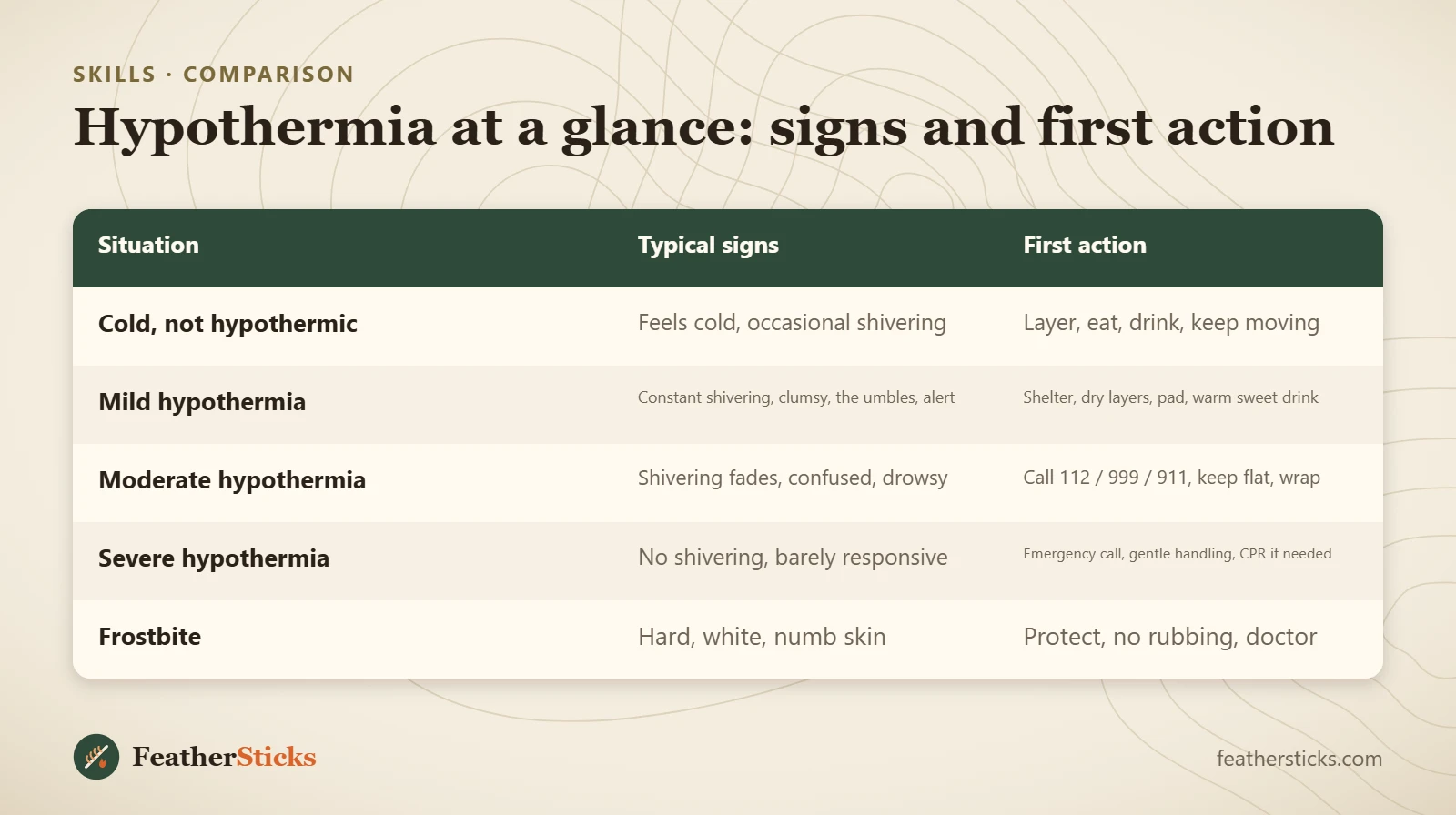
| Situation | Typical signs | First action |
|---|---|---|
| Cold, not hypothermic | Feels cold, occasional shivering | Layer, eat, drink, keep moving |
| Mild hypothermia | Constant shivering, clumsy, the umbles, alert | Shelter, dry layers, pad, warm sweet drink |
| Moderate hypothermia | Shivering fades, confused, drowsy | Call 112 / 999 / 911, keep flat, wrap |
| Severe hypothermia | No shivering, barely responsive | Emergency call, gentle handling, CPR if needed |
| Frostbite | Hard, white, numb skin | Protect, no rubbing, doctor |
Common mistakes
- Pushing on "just to the hut" with someone who is already stumbling and mumbling.
- Believing that a person who has stopped shivering but is still cold and quiet is getting better.
- Giving alcohol, or giving any drink to someone who is drowsy and cannot swallow safely.
- Rubbing arms and legs, rubbing frostbite with snow, or warming numb skin at the fire.
- Wrapping someone in a sleeping bag but leaving them lying on bare, wet ground.
- Making a badly chilled person stand up, walk or exercise to "get warm".
- Walking in a sweat-soaked base layer and carrying no dry spare.
What you need
- Dry spare base layer and socks in a waterproof bag
- Warm hat and gloves
- Emergency bivvy bag or foil blanket; group shelter for groups
- Sleeping pad or sit pad
- Stove, mug and sweet drinks, or a filled vacuum flask
- High-energy snacks
- Charged phone, whistle and headlamp
Calculators for this topic
FAQ
What are the first symptoms of hypothermia?
How do you treat hypothermia outdoors?
At what temperature can you get hypothermia?
Why is it bad when a hypothermic person stops shivering?
Should you give a hypothermic person a hot drink?
What should you not do with frostbite?
Does a foil emergency blanket keep you warm?
Can you get hypothermia in summer?
Check yourself
Completed6 quick questions from this guide. Nothing is sent anywhere.
Related step-by-step guides
-
 1
-
 1
-
 1