How Much Water to Drink Hiking: Hydration, Dehydration Signs & First Aid
How much water to drink hiking depends on your weight, the temperature, your effort and the altitude – there is no single number that fits everyone. Plan from the water calculator, sip little and often, and use pale urine as your field check. Dehydration starts with thirst, a dry mouth, dark urine and a headache, and gets serious with dizziness, confusion and no urine at all.
This guide explains why you lose water outdoors, how to plan and spread your drinking, how to recognise signs of dehydration by severity, what to do about heat illness and cold-weather dehydration, and when salt matters. It belongs to our water skills, builds on finding water and water containers, and is general information, not medical advice.
Step by step
-
1

Plan your water
Enter weight, temperature, effort, altitude and distance between sources into the water calculator. Use its drinking figure, not a fixed number.
-
2

Start hydrated
Drink normally the day before and have a glass or two with breakfast. Do not force large amounts.
-
3

Sip little and often
Take a few swallows every 15 to 20 minutes and a proper drink at every break, before you feel thirsty.
-
4

Refill and treat
Top up at every safe source and treat the water. Carry only what the next dry stretch needs plus a reserve.
-
5

Check urine and signs
Pale straw urine is fine. Dark urine, headache or dizziness mean: drink more and slow down.
-
6

Dehydrated? Act early
Stop, shade, small sips, a salty snack. Confusion, fainting or no urine is an emergency: call 112.
Before you read on
Why do you lose so much water outdoors?
Your body loses water all day, even sitting still: through urine, through breathing and through the skin. Outdoors three things add to it: effort, weather and height. The loss is gradual, which is why it is easy to fall behind without noticing.
- Sweat. Sweating is how you get rid of heat. The harder you work, the warmer the air and the heavier your pack, the more you sweat. Sweat rate varies a lot between people.
- Breathing. Every breath leaves the body saturated with moisture. Hard breathing on a climb loses more than strolling.
- Cold, dry air. Cold air holds little moisture, so breathing loses water even when you hardly sweat. Cold also makes the body pass more urine, and thirst is weak, so people drink less exactly when they need to.
- Altitude. Higher up you breathe faster and the air is drier. The calculator adds 0.5 L per day from 1,500 m and 1 L from 2,500 m.
- Wind and sun. Wind dries skin and sweat evaporates unnoticed, so you may not feel how wet you are.

| Path | When it grows | What helps |
|---|---|---|
| Sweat | Heat, steep ground, heavy pack, clothing that is too warm | Drink to plan, vent layers early, rest in shade |
| Breathing | Hard effort, altitude, cold dry air | Sip regularly, even in the cold |
| Urine | Cold, caffeine and alcohol, drinking a lot at once | Little and often rather than big gulps |
| Illness | Vomiting, diarrhoea, fever | Small sips often, oral rehydration solution, medical advice |
How much water should you drink when hiking?
There is no honest fixed answer. Health bodies give everyday guidance for adults at moderate temperatures – the DGE, for example, speaks of about 1.5 litres of drinks per day on top of the water in food – and active outdoor days need more. Our water calculator turns your situation into a planning figure. It starts from a basic need of 0.033 L per kg of body weight (minus about 20 % that comes with food, so roughly 2 L for 75 kg), adds sweat for your active hours, effort and temperature, adds altitude, and counts half of your cooking water (tea, soup, rehydrated meals) as drinking.
These are guideline values. Treat the result as your starting point and let thirst, urine colour and how you feel adjust it.
Worked examples from the calculator
For a 75 kg hiker with six active hours at moderate effort, dehydrated food and 500 m altitude, the calculator gives:
| Daytime temperature | Drinking | Total incl. cooking | On the move, per hour |
|---|---|---|---|
| 10 °C | ≈ 3.5 L | ≈ 4.7 L | ≈ 0.3 L |
| 18 °C | ≈ 4.1 L | ≈ 5.3 L | ≈ 0.3 L |
| 25 °C | ≈ 5.0 L | ≈ 6.2 L | ≈ 0.4 L |
| 30 °C | ≈ 5.8 L | ≈ 7.0 L | ≈ 0.5 L |
The hourly figure is the calculator's drinking rate on the move (daily drinking ÷ 16 waking hours × 1.3). It is a planning value, not a prescription.
Cold and altitude change the picture less than people expect. For the same hiker at 0 °C with five hours of light effort and mixed food, the calculator gives about 3.1 L per day in total (2.3 L drinking). At 2,600 m with the same inputs it gives 4.1 L (3.3 L drinking) – the extra litre for altitude is built in. The body can absorb only so much per hour: the calculator caps sweat replacement at 1.2 L/h and warns when the daily drinking figure becomes extreme. If it does, the answer is less activity in the heat and more rest in the shade, not more bottles.
What do the numbers mean for your bottle?
At 18 °C, 0.3 L per hour on the move is about 100 mL – a few good swallows – every 20 minutes. That is easy to do if you sip regularly and nearly impossible to catch up in one go at the end of the day. How much to carry at once depends on the gap between sources: in the calculator's example, 2 hours between sources means about 1 L, 4 hours about 2 L. See water containers for bottles and bladders and finding water for reading the map for sources.
Your inputs, at a glance
- Body weight
- Sets the basic need
- Temperature
- Multiplies sweat loss (0.6 at 0 °C, 1.0 at 18 °C, 2.1 from 37 °C)
- Hours and effort
- Light 0.25, moderate 0.45, hard 0.75 L/h at 18 °C
- Altitude
- +0.5 L from 1,500 m, +1 L from 2,500 m
- Food
- Dehydrated meals need the most cooking water
- Gap between sources
- Decides how much you carry at once
Drinking strategy: little and often, before you are thirsty
Thirst is a useful signal on easy days, but it lags behind in heat, during hard effort, in the cold and with age. Drinking only when thirsty means you are always slightly behind. The simple strategy is the one most guidance converges on:
- Start hydrated. Drink normally the day before and have a glass or two with breakfast. Do not force large amounts – pale urine before you set off is enough.
- Sip little and often. A few swallows every 15 to 20 minutes while moving, plus a proper drink at every break. The body can absorb a small amount continuously; a big gulp mostly passes straight through as urine.
- Tie drinking to routine. Drink at each rest stop, each junction, each time you eat. Add salty food to your snacks.
- Drink with meals. Hot drinks at breakfast and dinner count as fluid, and dehydrated food needs water anyway.
- Keep the bottle within reach. If you must stop and unpack to drink, you will drink less.
A simple bottle routine
 1Mark the bottle
Mark your bottle in quarters with a strip of tape or a marker, and decide how many marks you want to finish by each break. Marks make a plan visible.
 2Keep it within reach
Carry a bottle in a side pocket or a bladder hose at your shoulder. If you can drink without taking off the pack, you will.
 3Sip on a timer
A few swallows every 15 to 20 minutes. Set a watch alarm for the first days until it becomes habit.
 4Refill at every safe source
Fill up and treat the water (purification, filtering, boiling). Do not skip a source because your bottle is still half full.

Carrying versus refilling
Water is the heaviest thing in your pack – one litre weighs one kilogram – so plan around sources instead of carrying everything. Refill at every safe source, treat the water (boiling for 1 minute is enough, 3 minutes above 2,000 m) and carry the amount the calculator gives for the next dry stretch plus its 20 % reserve. If the map shows a long dry stretch, plan the route differently, start earlier and use the cool hours (hiking time calculator, trip planning). In an emergency a rain catch or a stream you can reach beats an empty bottle you are "saving".
Signs of dehydration: what to look for
Dehydration builds in steps. The early signs are easy to ignore on the trail, which is why it is worth knowing them. The table is a general guide – people do not follow tables neatly. If in doubt, treat for the more serious stage.
| Stage | Signs | What to do |
|---|---|---|
| Mild | Thirst, dry mouth, darker and less frequent urine, slight headache, feeling tired, reduced performance | Drink small amounts often, take a break, eat something salty, slow down |
| Moderate | Strong thirst, very dry mouth, very dark urine and little of it, dizziness when standing, strong fatigue, muscle cramps, irritability | Stop, rest in shade, sip regularly, salty food, consider oral rehydration solution; end the day early if you do not recover |
| Severe: emergency | Confusion, very drowsy, fainting, fast pulse, no urine for many hours, cold or clammy skin | Call 112 (EU), 999 (UK) or 911 (US/Canada). Lay the person down in the shade, cool them, give small sips only if fully alert |
Headache, dizziness and fatigue also have other causes, including heat illness, exhaustion, low blood sugar and altitude illness. Do not assume dehydration is the only explanation.

Urine colour as a field check
Urine colour is the simplest check you can do outdoors, and the calculator uses it too: pale straw means fine, darker means drink more. Check it when you pass urine, ideally at every long break. Do not chase a colour chart with numbers; the general direction is enough. The first urine of the morning is naturally darker.
Colour can be misleading. Some vitamins turn urine bright yellow, some foods and medicines change the colour, and drinking a lot in a short time makes it clear without hydration being "better". Use colour together with how much you pass and how you feel. Passing little, dark urine is a reason to drink and slow down. Passing none for many hours, together with dizziness or confusion, is a reason to call for help.

The urine check in three steps
 1Look at the colour
Look into the toilet or a clean cup, in daylight. Pale straw is fine; dark yellow to amber says drink more.
 2Compare with the day
Think about how much you passed and how long since the last time. Little and dark means start sipping now, not at the next break.
 3Allow for other causes
Vitamins, some foods and medicines change the colour. Combine the colour with thirst, headache and energy before you decide.
Heat exhaustion and heat stroke: the short version
Dehydration and heat belong together. Heat illness is a spectrum from cramps and heat exhaustion to heat stroke. This is only an overview; the details belong in a first aid course.
| Heat exhaustion | Heat stroke (emergency) | |
|---|---|---|
| Typical signs | Heavy sweating, pale and clammy skin, headache, dizziness, nausea, cramps, fast weak pulse, very thirsty | Very hot skin, confusion, strange behaviour, fits, collapse or unconsciousness; sweating may stop |
| What it means | The body is struggling with heat and fluid loss | The body can no longer control its temperature; life-threatening |
| What to do | Move to a cool shady place, lie down, loosen clothing, cool the skin with wet cloths, sip cool water | Call 112 / 999 / 911 now. Cool the person actively with cool wet cloths, fanning, shade and water on the skin. Nothing to drink if confused or unconscious |
If heat exhaustion does not improve within about 30 minutes of cooling and drinking, treat it as heat stroke and call for help (NHS guidance).
Heat exhaustion: first aid in four steps
 1Stop and get into shade
Stop the walk, get out of the sun and wind, and sit or lie down. Take the pack off. A cool, shaded spot beats the planned lunch place.
 2Loosen and cool
Take off extra layers, loosen clothing and lay a wet cloth on neck, face and wrists. Fan the person.
 3Sip cool water
Give small sips of cool water if they are fully alert and can swallow. Add a salty snack once they feel better.
 4Confused or not better: call
Confusion, fainting, hot dry skin or no improvement after about 30 minutes means call 112 and keep cooling until help arrives.
Prevention is mostly planning: start early, rest in the shade at midday, wear a hat and light clothing, wet a bandana, reduce effort when it is hot and drink to plan. See reading the weather and clothing and layering.
Dehydration in cold weather
Cold-weather dehydration is sneaky. You sweat less visibly, thirst is weak, cold air is dry, heavy layers trap sweat, and drinking cold water is unappealing. People also avoid drinking because they dislike undressing to pass urine. The result is the same: dark urine, headaches and fatigue that make you colder and clumsier.
- Drink on a schedule, not by thirst: warm drinks at every break.
- Keep bottles from freezing: carry them upside down in the pack, in an insulated sleeve or inside your jacket, and use a vacuum-insulated bottle for hot drinks (containers). Never heat a double-wall bottle in a fire.
- Do not eat snow when you are cold; melt it first (snow water).
- Dehydration and cold feed each other. A dehydrated, tired person chills faster, so watch the signs of hypothermia.
Staying hydrated in the cold
 1Bottle upside down
Store bottles upside down in the pack so the ice forms at the bottom, not in the cap. Keep one inside your jacket for the day.
 2Warm drink at breaks
A flask of tea or broth makes drinking attractive and warms you. Sweet drinks give energy too.
 3Check and plan
Check urine at the long break and adjust. The calculator still gives a real need at 0 °C – 3.1 L total in the example above.
Salt, electrolytes and drinking too much
Sweat contains salt as well as water. On most day hikes, water and normal food replace both. On long, hot, sweaty days, or when you have been sweating heavily for many hours, plain water alone may not be enough, and salty food helps: nuts, cheese, crackers, broth, instant soup. Commercial electrolyte tablets and oral rehydration powders exist; follow the packet instructions and do not dose beyond them. People with high blood pressure, kidney or heart conditions, or on diuretics should ask a doctor before adding salt or electrolytes.
Drinking too much is a real risk too
Hyponatraemia means the blood salt level falls too low. It is rarer than dehydration but real. It can happen when someone drinks far more than they lose, over many hours, especially plain water and with heavy sweating. Signs are nausea, bloating, headache and confusion – which look like dehydration. The sensible rules: drink to plan and to thirst, do not force fluids "to be safe", eat salty food on long days, and do not treat confusion by pouring more water into the person. If a person is confused, call 112.
Children, older people and illness: extra attention
Children lose water relatively fast, often do not say they are thirsty and forget to drink when playing. Offer a drink at every stop, make it a game, and watch for dark urine, a dry mouth and tiredness. See bushcraft with kids. For anything beyond mild signs in a small child, get medical advice early.
Older people feel thirst less and may take medicines that affect fluid balance, such as diuretics. Remind them to drink on a schedule, and avoid long hot stretches.
Vomiting and diarrhoea cause fast fluid loss, for example after drinking untreated water. Mainstream advice is small sips often and an oral rehydration solution from a pharmacy (packed in sachets, made up as directed). Seek medical help if someone cannot keep fluids down, is a child or elderly, or shows signs of moderate or severe dehydration. Prevent it by treating water properly (purification).
What to drink: water, tea, broth – and what not
| Drink | Verdict | Notes |
|---|---|---|
| Water | Best default | Treat it if from a natural source |
| Tea and herbal tea | Good | Warm drinks help in the cold; they count as fluid |
| Coffee | Fine in moderation | Most health services count it towards fluid intake; if it upsets you, skip it |
| Broth, soup | Very good | Fluid plus salt, especially on cold or long days |
| Diluted juice, electrolyte drink | Useful at times | Follow the packet; sugary drinks in large amounts upset the stomach |
| Alcohol | Not a fluid | It dehydrates, dulls judgement and increases heat loss in the cold |
| Seawater, urine | Never | The salt makes dehydration worse (finding water) |
Practical systems: bottle, bladder and schedule
The best system is the one that makes drinking effortless. A bladder with a hose encourages regular sips but hides how much is left, is harder to refill and its hose freezes first in winter. Bottles in side pockets are easy to fill and monitor, but you must reach for them. Many hikers carry one of each. An insulated bottle for tea is worth its weight in the cold. See containers for details and backpacks for pocket placement.
| Time | What | Amount |
|---|---|---|
| Breakfast | Hot drink and water | ≈ 0.5 L |
| Morning walk | Sips every 15–20 min | ≈ 0.3 L per hour |
| Midday break | Drink, refill, salty snack | ≈ 0.5 L |
| Afternoon walk | Sips every 15–20 min | ≈ 0.3 L per hour |
| Camp | Water, tea, soup, dinner | Rest of the daily figure |
These values come from our water calculator and are planning figures. Adjust to your urine, thirst and how you feel.
Dehydrated: what now?
I think someone is dehydrated – what do I do?
Are they confused, fainting, very drowsy, with a very hot body, or have they passed no urine for many hours?
Yes → Emergency. Call 112 / 999 / 911. Lay them in the shade, cool them, nothing by mouth if confused.No → Go on to the next question.Dizzy when standing, very dark urine, cramps, strong fatigue?
Yes → Stop. Shade, sit or lie down, small sips often, salty food, oral rehydration solution if available. If not clearly better within about 30 minutes, call for advice or help.No → Go on to the next question.Thirsty, dry mouth, darker urine, mild headache?
Yes → Drink regularly, take a break, eat something salty, slow down. Check urine again at the next break.No → Carry on, keep sipping and keep checking.
Dehydrated person: do and do not
Do
- Stop and rest in shade or shelter
- Give small sips often, not large amounts at once
- Add salty food or oral rehydration solution
- Cool the skin if it is hot
- Stay with them and keep watching
- Call 112 early if signs get worse
Do not
- Do not push on to the destination
- Do not give alcohol
- Do not make them drink litres in one go
- Do not give fluids to someone who is confused or unconscious
- Do not leave them alone
- Do not assume it is "just tiredness" when confusion appears
Checklists
Before you go
- Calculate water for the route with the water calculator
- Map the water sources and the dry stretches
- Bottles and a method to treat water that suits the season
- Salty snacks, tea or broth, and oral rehydration sachets
- Hat, light clothing, sun protection
On the trail
- Sip every 15 to 20 minutes and drink at every break
- Refill and treat at every safe source
- Check urine colour at long breaks
- Rest in shade in the heat and take warm drinks in the cold
- Watch children and older companions closely
Common hydration myths
| Myth | Fact |
|---|---|
| "Drink only when you are thirsty." | Fine on easy days, but in heat, hard effort, cold and with age thirst lags behind. Sip to a plan. |
| "The more you drink, the better." | Over-drinking can cause hyponatraemia. Drink to plan and thirst. |
| "Coffee dehydrates you." | In moderate amounts it counts towards fluid intake for most people. |
| "A cold bottle in hot weather is enough." | Water needs to be drunk in small amounts regularly, not just carried. |
| "Clear urine is the goal." | Pale straw is fine. Very clear urine can mean you are drinking more than you need. |
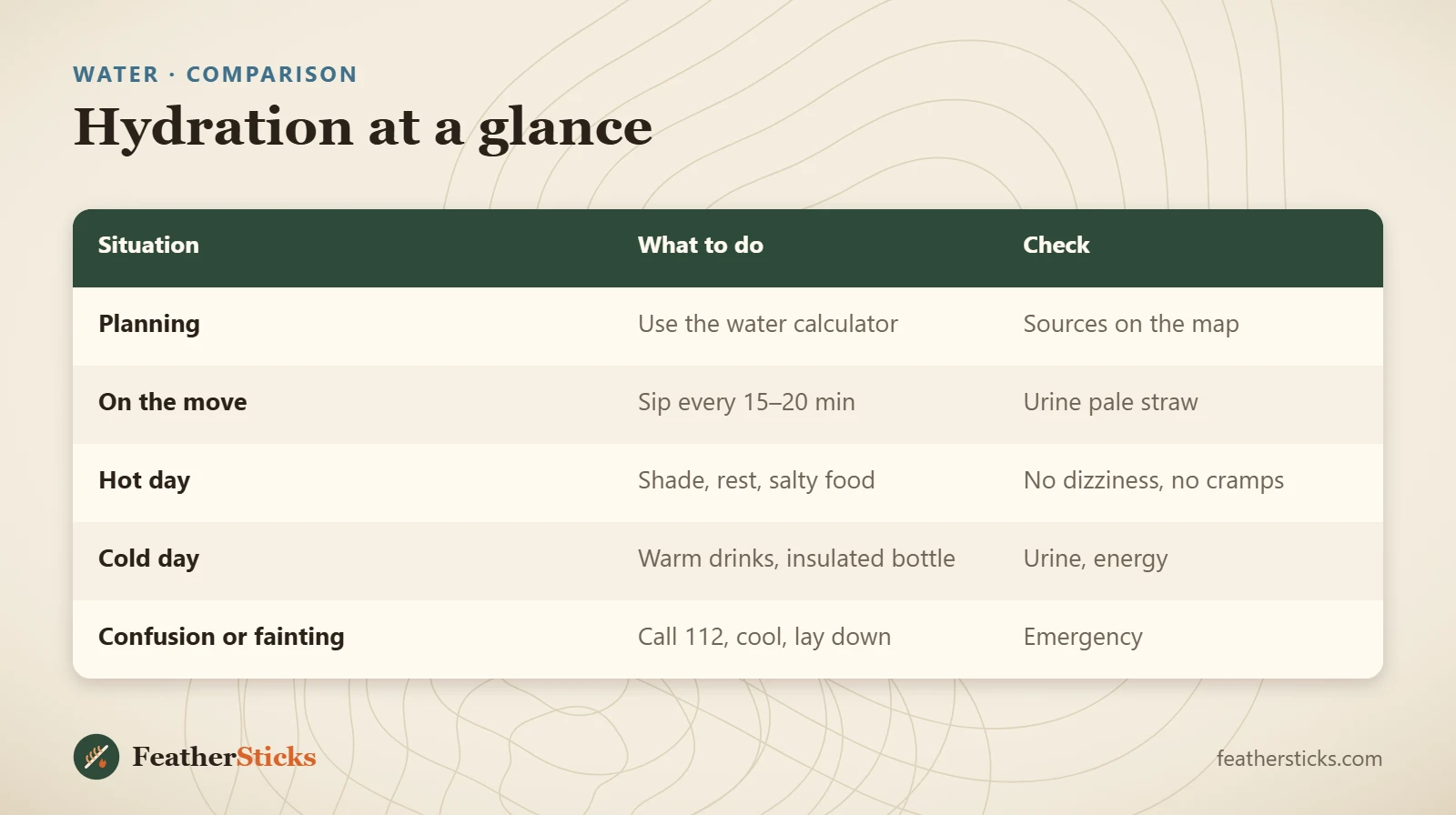
| Situation | What to do | Check |
|---|---|---|
| Planning | Use the water calculator | Sources on the map |
| On the move | Sip every 15–20 min | Urine pale straw |
| Hot day | Shade, rest, salty food | No dizziness, no cramps |
| Cold day | Warm drinks, insulated bottle | Urine, energy |
| Confusion or fainting | Call 112, cool, lay down | Emergency |
Common mistakes
- Waiting until you are thirsty before drinking.
- Drinking nothing for hours, then a litre in one go.
- Skipping a source because the bottle is still half full.
- Not drinking in the cold because you do not feel thirsty.
- Treating alcohol or a hot sweet drink as a cure for dehydration.
- Forcing more and more water into someone who is confused.
- Ignoring dark urine and a headache because "it is only tiredness".
What you need
- Bottles or bladder with a total capacity from the calculator
- Water treatment (filter, tablets, stove)
- Insulated bottle or flask for winter
- Salty snacks, tea bags, instant broth
- Oral rehydration sachets from a pharmacy
- Hat and a bandana to wet
FAQ
How much water should I drink when hiking?
What are the signs of dehydration?
What colour should urine be when hiking?
Do I need electrolytes when hiking?
What is the difference between heat exhaustion and heat stroke?
Can you drink too much water when hiking?
Does coffee or tea dehydrate you?
How do I stay hydrated in winter?
Check yourself
Completed6 quick questions from this guide. Nothing is sent anywhere.
Related step-by-step guides
-
 1
-
 1
-
 1