Hiking in Hot Weather: Heat Exhaustion vs Heat Stroke and How to Stay Cool
Hiking in hot weather is safe when you plan around the heat instead of fighting it: walk in the cool morning and evening, rest in deep shade at midday, wear light, loose clothing and a wide-brimmed hat, and drink to a plan with salty food on long sweaty days. The danger is heat illness. Heat exhaustion – heavy sweating, headache, dizziness, nausea – is the warning. Heat stroke – very hot skin, confusion, collapse – is a life-threatening emergency: call 112 and cool the person immediately.
This guide covers planning a hot day, clothing, shade and camp choice, drinking and salt, food in the heat, how to recognise and treat heat illness, people and dogs at special risk, fire danger, hot nights, sunburn and eyes. It belongs to our bushcraft skills, builds on the bushcraft basics and works hand in hand with drinking right and spotting dehydration.
Step by step
-
1

Plan around the heat
Check the forecast and heat warnings. Start at first light, rest in the shade through the hottest hours and finish in the evening.
-
2

Dress light, loose, covered
Light-coloured, loose clothing with long sleeves, a wide-brimmed hat, sunglasses and sunscreen on every bit of exposed skin.
-
3

Drink to plan, add salt
Plan your water with the calculator, sip every 15 to 20 minutes and eat salty snacks on long, sweaty days.
-
4

Rest in the shade
Take breaks in deep shade, rig a tarp high and open as a sun roof, and choose a camp that is shaded in the afternoon.
-
5

Spot heat exhaustion early
Headache, dizziness, nausea, cramps and heavy sweating mean: stop, shade, lie down, cool the skin, sip water.
-
6

Heat stroke: call 112, cool now
Confusion, collapse or very hot skin is an emergency. Call 112, get into shade and cool at once with water and fanning.
Before you read on
Why heat is dangerous outdoors
Your body has to get rid of the heat your muscles make. Walking uphill with a pack produces a lot of it. The body sends warm blood to the skin and sweats; as the sweat evaporates, it carries heat away. That system works well – until three things stack up against it.
- Air temperature close to skin temperature. The warmer the air, the less heat the skin can shed by itself, and sweating has to do almost all the work.
- Humidity and still air. Sweat only cools when it evaporates. In muggy, windless air it drips off instead, and the body keeps heating up. A humid 28 °C in a sheltered valley can be harder than a dry 32 °C on a breezy ridge.
- Sun and hot ground. Direct sun and heat radiating off rock, sand and tarmac add heat on top of the air temperature. Open slopes facing south or west in the afternoon are the hottest places on any route.
Sweating costs water and salt. If you do not replace them, the body has less fluid to sweat with and to keep blood pressure up, and heat illness follows more easily. That is why heat and dehydration belong together – but drinking alone does not protect you if you keep working hard in the midday sun.
Acclimatisation is the body's own defence: after repeated days in the heat it starts to sweat earlier and more, and loses less salt. Sports medicine sources describe this as taking roughly one to two weeks of regular exposure. Practically, it means the first heatwave of the year and the first days of a summer trip in the south are when you should be most careful.
Planning a hike in hot weather
The single best protection against heat illness is timing. The hottest part of a summer day is usually early to late afternoon, and the sun is strongest around midday. As a rule of thumb for Central European summer time, plan to be in deep shade or resting from about 11:00 to 17:00 on very hot days, and do your walking before and after.
A hot day in three parts
 1Walk the cool morning
Get up at first light and be walking soon after. The air is coolest just after sunrise, the sun is low and forests still hold the night's cool. Plan the climbs and the open stretches for this time.
 2Siesta in deep shade
From late morning, stop in proper shade – a dense wood, a north-facing slope, a stream valley – take the pack off, eat, drink and rest for several hours.
 3Finish in the evening
Walk the last kilometres when the sun is low again, and arrive with enough light to set up camp. The daylight calculator shows when the sun sets on your route.
Forecast and heat warnings
Check the forecast for the whole day, not only the morning. National weather services issue official heat warnings during heatwaves; take them as a reason to shorten or move the tour, not as a challenge. Hot afternoons also breed thunderstorms – reading the weather and thunderstorm safety matter on exactly these days.
Route with water and shade
Plan the route around two resources: water and shade. Mark streams, springs and huts on the map and check that they still run in a dry summer – finding water explains how. Prefer forest paths, north-facing valleys and routes along water over open ridges, heath and south-facing slopes. Walk shorter days than usual: your pace drops in the heat, and the hiking time calculator gives you an honest estimate to which you add generous breaks. Agree a turnaround time and an escape route to a road or village, as described in trip planning.
Going alone in a heatwave needs extra margin, because nobody else will notice your confusion or call for help – see safety when going solo and keep a charged phone, as described in our guide to power banks and batteries.
What to wear hiking in the heat
It sounds backwards, but in strong sun more cover is often cooler than less. Light-coloured, loose, thin clothing keeps the sun off your skin and lets air move along your body so sweat can evaporate. Bare skin in full sun absorbs heat and burns.
- Shirt: loose, light-coloured, long-sleeved and thin. Synthetic fabrics dry fast; on dry, hot days a cotton or linen shirt that stays a little damp can feel cooler – unlike in cold and wet weather, where cotton is the classic mistake.
- Trousers: light and loose; long legs also protect against ticks.
- Hat: a wide brim all round shades face, ears and neck. A cap with a neck flap is a good alternative.
- Neck and face: a wet bandana or neck gaiter around the neck cools noticeably as it dries – soak it at every stream.

The full fabric comparison and the layering system are in our guide to bushcraft clothing; in the heat, the "layers" are simply sun protection outside and nothing that traps heat inside.
Shade and camp choice in a heatwave
Shade is the most effective cooling you can find outdoors. Deep shade under dense trees, on the north side of a slope or in a stream valley can feel many degrees cooler than open ground. For breaks, choose places with both shade and moving air; a still, shaded hollow can be stuffy and full of insects.
A tarp as a sun roof
Where there are no trees, a tarp makes your own shade. For sun, pitch it differently from rain: high, open and with air moving underneath. The general pitching techniques are in tarp shelters.
Rigging a tarp as a sun shade
 1Pitch high and open
Set the tarp above head height when you sit or stand, nearly flat, on two poles or between trees. Keep the sides open so the breeze can pass. A low, closed pitch traps hot air like an oven.
 2Angle it to the afternoon sun
Drop the edge facing the afternoon sun (roughly west to south-west) so it throws a longer shadow when the sun sinks. The high side stays open to the breeze.
 3Follow the shade
The shadow moves with the sun. Re-pitch, add a pole or move your seat every hour or two, and use tree shade when it is available – it is deeper and cooler than any fabric.
Choosing a camp site in the heat
The rules of campsite selection still apply – no dead trees overhead, no flood-prone ground, camp at least 60 m from water – but in a heatwave you add shade and air:
- Afternoon shade: a site with trees on its west side stays shaded when the sun is hottest. A tent in full afternoon sun is far too hot to rest in.
- Morning shade too: in summer an east-facing site in full sun turns the tent into a sauna soon after sunrise.
- A light breeze: a slightly raised, open spot at the edge of a wood is better than a still hollow. Do not camp on an exposed crest when thunderstorms are possible.
Which shelter suits hot nights is covered below and in tent, tarp or hammock.
How much to drink in the heat – and why salt matters
In the heat your water needs rise steeply, mainly through sweat. There is no single number that fits everyone, so plan with the water calculator: it starts from your body weight, adds sweat for your active hours, effort and temperature, and gives a daily drinking figure and how much to carry between sources. For a 75 kg hiker with six active hours at moderate effort, dehydrated food and 500 m altitude it gives:
| Daytime temperature | Drinking | Total incl. cooking | On the move, per hour |
|---|---|---|---|
| 25 °C | ≈ 5.0 L | ≈ 6.2 L | ≈ 0.4 L |
| 30 °C | ≈ 5.8 L | ≈ 7.0 L | ≈ 0.5 L |
| 35 °C | ≈ 6.7 L | ≈ 7.9 L | ≈ 0.5 L |
Planning values, not prescriptions. Individual sweat rates vary a lot, and the calculator does not account for humidity – on muggy days, watch the signs and drink more than planned if you still get thirsty.
Two limits matter. First, the gut can only absorb roughly 1 to 1.2 litres per hour, and the calculator caps sweat replacement accordingly. At 30 °C with six hours of hard effort it shows more than 8 litres of drinking a day and warns that conditions are extreme. The answer then is not more bottles but less work in the heat and more rest in the shade. Second, how much you carry depends on the gap between sources: at 30 °C the calculator suggests about 1.5 L for a two-hour gap and 2.5 L for four hours, each including a 20 % reserve.
Little and often
Sip a few swallows every 15 to 20 minutes and drink properly at every break, before you feel thirsty. Keep the bottle where you can reach it without stopping, refill at every safe source and treat the water (water purification, bottles and bladders). Pale straw-coloured urine is the simplest field check; dark urine means drink more and slow down.
Salt and electrolytes
Sweat contains salt. On long, hot, sweaty days plain water alone may not be enough, and the calculator's own tip for temperatures above 28 °C is to add electrolytes and rest in the shade at midday. Salty snacks – nuts, crackers, cheese, salami, instant soup – usually do the job; electrolyte tablets or oral rehydration sachets are an option, used as the packet says. People with high blood pressure, heart or kidney conditions should ask a doctor before adding salt or electrolytes.
Food in the heat: appetite, salt and food safety
Heat kills appetite, yet the body still needs energy and salt. Eat small amounts often, favour salty and easy foods, and plan a proper meal for the cool evening rather than at midday. Dry, durable foods from trail meal planning travel best, and the food calculator helps with quantities.
Food safety is the bigger issue. Bacteria multiply fastest between roughly 5 °C and 60 °C, and in summer a pack spends all day in that range. Food-safety agencies such as the USDA advise that perishable food should not stay in this range for more than about two hours, or one hour above 32 °C. In practice:
- Take fresh meat, fish, dairy and cooked leftovers only for the first meal, or not at all.
- Rely on foods that keep without cooling: dried foods, hard cheese, cured sausage, nuts, crackers, dehydrated meals.
- Do not keep cooked leftovers for the next day in a warm pack.
How to keep food cool without a fridge, from shady storage to a sealed bag in a cold stream, is explained in storing food at camp.
Heat exhaustion vs heat stroke: recognising heat illness
Heat illness is a spectrum. It usually starts mild and gets worse if the person keeps going. First aid courses teach three stages that you should be able to tell apart at a glance.

| Typical signs | What it means | What to do | |
|---|---|---|---|
| Heat cramps | Painful cramps in calves, thighs or belly during or after heavy sweating | Salt and fluid loss through sweat | Stop, rest in shade, stretch gently, drink with salty food or electrolytes |
| Heat exhaustion | Heavy sweating, pale and clammy skin, headache, dizziness, nausea or vomiting, weakness, fast pulse, great thirst, cramps | The body is struggling with heat and fluid loss – a warning | Stop, shade, lie down, loosen clothing, cool the skin, sip water; should improve within about 30 minutes |
| Heat stroke (emergency) | Very hot skin (dry or still sweating), confusion, strange behaviour, slurred speech, fits, collapse or unconsciousness | Temperature control has failed – life-threatening | Call 112 now. Cool immediately and continuously. Nothing to drink if confused or drowsy |
People do not follow tables neatly. Someone who exercised hard may still be sweating with heat stroke. If in doubt, treat for the worse stage.
The decisive sign: the brain
The most important difference between heat exhaustion and heat stroke is not the skin, but the head. A person with heat exhaustion feels awful but thinks clearly. A person with heat stroke becomes confused, irritable, clumsy, talks nonsense, does not know where they are – or collapses. Any change in behaviour or consciousness in the heat is treated as heat stroke until proven otherwise. As with hypothermia, the person affected often denies the problem, so the group decides.
First aid for heat cramps and heat exhaustion
Stop walking – immediately, not at the next viewpoint. Get into the deepest shade nearby, take the pack off, let the person lie down and raise their feet slightly. Loosen or remove extra clothing, lay wet cloths on the neck, face and wrists and fan them. If they are fully alert and can swallow, give sips of cool water, ideally with salt: a rehydration drink or water with a salty snack. Cramping muscles can be stretched gently.
Heat exhaustion should clearly improve within about 30 minutes. If it does not, or if the person becomes confused, treat it as heat stroke and call 112. Even after a quick recovery, the day's plan changes: no more effort in the heat, rest until evening, and take the shortest, shadiest way out.
Heat stroke first aid: call 112 and cool immediately
Heat stroke is a medical emergency in which every minute of high body temperature can cause damage. First aid has two parts that run at the same time: get professional help moving and cool the person as fast as you can. In a group, one person calls while the others cool.
Heat stroke: cooling until help arrives
 1Call 112 at once
Confusion, collapse, a fit or very hot skin in the heat: call 112 (EU), 999 (UK) or 911 (US/Canada) immediately and say you suspect heat stroke. Give your location as precisely as you can.
 2Into the shade, loosen clothing
Move the person into the coolest shade nearby, take off the pack and extra layers and loosen tight clothing. If moving them is difficult, make shade with a tarp, a jacket or people standing in the sun.
 3Wet and fan
Pour or sponge cool water over the skin – head, neck, body, arms and legs – and fan continuously with a hat, a map or a sit pad. Keep the skin wet; evaporation in moving air does the cooling.
 4Keep cooling until help comes
If you have cold packs, wrap them in cloth and place them on the neck, in the armpits and in the groin. Keep cooling, keep talking to the person and watch their breathing until the rescue service takes over.
Cold water: the fastest method where it is safe
Current first aid guidelines, including those of the European Resuscitation Council, regard cooling in cold water up to the neck as the most effective method for heat stroke after heavy exercise, where it can be done safely. Outdoors that can mean a calm, shallow stream or lake edge – but only with helpers holding the person, the head clearly above water, no current and someone watching the airway the whole time. Never leave a confused or drowsy person in water. Where this is not possible, the wet-and-fan method above is the standard and still works well.
Heat stroke: do and do not
Do
- Call 112, 999 or 911 straight away and follow the dispatcher's instructions
- Cool immediately and keep cooling – do not wait for the ambulance to start
- Shade, extra clothing off, cool water on the skin, constant fanning
- Wrapped cold packs on neck, armpits and groin if you have them
- Put an unresponsive person who is breathing normally in the recovery position and keep cooling
- Start CPR if there are no signs of life and you are trained
Do not
- No drinks for someone who is confused, drowsy or cannot swallow safely
- No alcohol
- Do not let them walk out or "sleep it off" in the shade alone
- Do not stop cooling because they seem a bit better
- Do not leave them alone, and never alone in or near water
Heat illness: what now?
Is the person confused, behaving strangely, drowsy, collapsed, having a fit or unresponsive?
Yes → Heat stroke: call 112 now and start cooling immediately. CPR if there are no signs of life and you are trained.No → Go on to the next question.Heavy sweating, pale, dizzy, headache, nausea or cramps – but clear-headed?
Yes → Heat exhaustion: stop, shade, lie down, cool the skin, sip water with salt.No → Watch them and keep to shade and a slow pace.Clearly better after about 30 minutes of rest and cooling?
Yes → Rest until evening, no more effort in the heat, shortest shady way out.No → Treat as heat stroke: call 112 and keep cooling.
If there is no signal, try 112 anyway and use the signals in emergency and distress signals. A first aid kit for summer trips should include a foil blanket – its silver side also works as a sun shield – and instant cold packs; see the first aid kit guide.
Children, older people and dogs in the heat
Children
Children heat up faster than adults, sweat less and forget to drink while playing. They rarely say "I am too hot" – they get whiny, tired, red-faced or unusually quiet. Plan short days with lots of shade and water play, offer a drink at every stop, keep hats on and sunscreen topped up, and never leave a child in a car or a closed tent in the sun. Babies and toddlers need particular care; get medical advice early if a small child seems unwell in the heat. More in bushcraft with kids.
Older people and people on medication
Older people feel thirst less, sweat less efficiently and often take medicines that affect heat tolerance. They should plan with their doctor, choose shorter, shadier routes and drink on a schedule.
Dogs
Dogs cool themselves mainly by panting and through their paws, not by sweating, which makes heat a serious risk – especially for short-nosed, heavy, old or very young dogs. Warning signs are very heavy panting, drooling, a bright red tongue, restlessness, weakness, stumbling and vomiting. At the first signs, stop, get the dog into shade, offer water and cool it gradually with water on the belly, paws and legs, not with ice; signs of heat stroke are a reason to call a vet urgently. Test hot rock, sand or tarmac with the back of your hand for about five seconds: if it is too hot for you, it is too hot for paws. Walk the dog in the cool hours and never leave it in a closed car or tent. Details in camping with dogs.
Heat, drought and fire danger
Long hot spells dry out grass, leaf litter and forest floors, and the risk of wildfire rises sharply. Many regions then restrict or ban open fires, sometimes also wood-burning stoves, charcoal grills and smoking in or near forests; in extreme cases forests are closed altogether. Rules differ by country and region and change at short notice – check the current fire danger level and local restrictions before you go. This is general information, not legal advice.
Fire in a heatwave: the short rules
- Before the trip
- Check fire danger levels and local bans; if in doubt, no fire
- High danger
- No campfire, even in a fire ring; check whether stoves are allowed
- Stoves
- Only where permitted, on bare ground or rock, never on dry grass
- Water
- Enough water ready to put out a stove fire before you light it
- Cigarettes and glass
- No smoking in the forest; take bottles and shards home
- Wildfire seen
- Move away against the wind and downhill if possible, call 112
On hot days you will rarely miss a fire anyway: cold meals and a stove for an evening drink are enough. When a fire is allowed, the full set of rules – siting, keeping it small, putting it out completely – is in campfire safety, and the principles of Leave No Trace apply even more in a dry summer.
Sleeping in hot nights
Recovery happens at night. After a hot day the body needs a cooler night to bring its temperature down and sleep properly; several hot nights in a row increase the risk of heat illness on the following days. Your aim is a sleeping place with as much moving air as possible.

- Pitch late or in shade. A tent that stood in the afternoon sun is hot inside for hours. Pitch in the evening or in afternoon shade.
- Open everything. Open doors and vents, use the mesh inner only if the weather is settled, or sleep under a tarp with a mosquito net. A hammock lets air flow under you as well.
- Sleep light. A sleeping bag liner or a thin quilt is usually enough on hot nights; open the bag fully and use it as a blanket. A thin pad is cooler than a thick insulated one.
- Cool down before bed. Wash face, arms and neck with water, and lay a damp cloth on your neck.
- Keep an eye on the sky. Hot, muggy nights often bring thunderstorms. Do not sleep on an exposed crest or under isolated trees, and keep rain gear ready.
Sunburn and eye protection
Sunburn is more than an annoyance on a trip: burnt skin is painful under pack straps, sleeps badly and loses its ability to cool. UV radiation is strongest around midday, stronger at altitude, and reflected by water, beach sand, light rock and snow. Clouds do not reliably protect you.
- Cover first: hat, long sleeves and trousers protect better than any cream.
- Sunscreen on the rest: health bodies commonly recommend a broad-spectrum product with sun protection factor 30 or higher. Apply generously before you start, and reapply about every two hours and after swimming or heavy sweating. Do not forget ears, neck, the back of the hands, the scalp parting and lips.
- Sunburn already? Get out of the sun, cool the skin with water, drink, and protect the area. Widespread burns with blisters, fever, chills or feeling unwell, and any significant sunburn in a child, need medical advice.
Eyes
Bright sun, water and light rock can strain and even burn the eyes. Wear sunglasses marked as offering full UV protection that fit well and shield the sides. Choose darker lenses for water, snow and high mountains. Red, painful, watering eyes after a bright day need rest in the shade and, if they do not settle, a doctor.
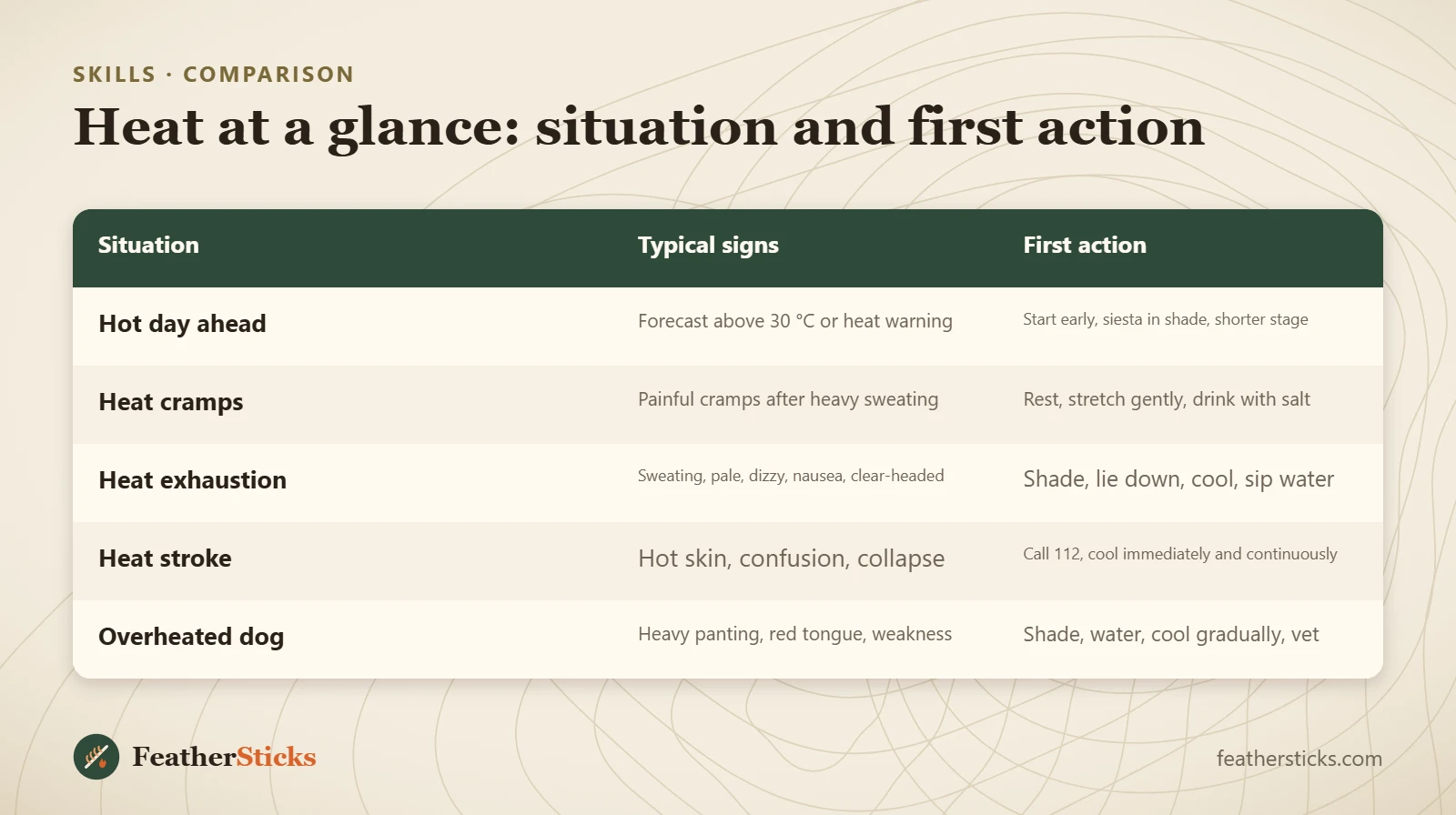
| Situation | Typical signs | First action |
|---|---|---|
| Hot day ahead | Forecast above 30 °C or heat warning | Start early, siesta in shade, shorter stage |
| Heat cramps | Painful cramps after heavy sweating | Rest, stretch gently, drink with salt |
| Heat exhaustion | Sweating, pale, dizzy, nausea, clear-headed | Shade, lie down, cool, sip water |
| Heat stroke | Hot skin, confusion, collapse | Call 112, cool immediately and continuously |
| Overheated dog | Heavy panting, red tongue, weakness | Shade, water, cool gradually, vet |
Common mistakes
- Walking the steep, open climb in the midday sun because the day started late.
- Wearing dark, tight clothing and no hat because "it is too hot for sleeves".
- Drinking only when thirsty – or forcing litres of plain water without any salt.
- Treating confusion as tiredness and letting the person "sleep it off" alone in the shade.
- Waiting for the ambulance before starting to cool someone with heat stroke.
- Lighting a campfire during a drought without checking fire danger and bans.
- Pitching the tent in full afternoon sun and closing it up for the night.
What you need
- Wide-brimmed hat and sunglasses with full UV protection
- Light, loose, long-sleeved shirt and light trousers
- Sunscreen (SPF 30 or higher) and lip balm with sun protection
- Enough bottles for the longest dry stretch plus water treatment
- Electrolyte tablets or rehydration sachets and salty snacks
- Bandana or neck gaiter for wet cooling
- Tarp and cord for shade; instant cold packs in the first aid kit
FAQ
What is the difference between heat exhaustion and heat stroke?
How do you cool someone with heat stroke outdoors?
Is it safe to hike at 30 degrees?
How much water do I need for a hike in hot weather?
What should I wear hiking in hot weather?
How do I sleep in a tent in a heatwave?
Check yourself
Completed6 quick questions from this guide. Nothing is sent anywhere.
Related step-by-step guides
-
 1
-
 1
-
 1