Camping at the Coast & Beach: Tides, Wind, Sand and the Rules
The best beach camping tips come down to four things: check whether camping is allowed at all, read the tide table, pitch well above the high-water line, and anchor your shelter for wind and sand. Camping by the sea is beautiful, but the coast has hazards the forest does not: water that returns twice a day, storm surges, onshore wind full of sand, no shade and no drinkable water.
This guide covers rules, tides, pitching a tent on sand, deadman anchors, sun, fresh water, fire, wildlife, swimming and gear care. It belongs to our shelter section and builds on camping in strong wind, because at the coast there is almost always wind. If you are new to sleeping outside, start with bushcraft basics.
Step by step
-
1

Check the rules first
Beaches, dunes and coastal national parks often ban camping and fires. Find out what is allowed where you are going, or use a campsite.
-
2

Read the tide table
Note the times of high and low water for your nights, whether spring tides are due, and the wind forecast, which can push water higher.
-
3

Pitch above the high water
Find the wrack line of seaweed and debris that marks the last high water and pitch well above it, with a margin for spring tides and surges.
-
4

Low end into the wind
Onshore wind carries sand. Pitch low, point the narrow end into the wind and keep the door on the lee side.
-
5

Anchor with deadmen
Normal pegs pull out of sand. Bury sand-filled stuff sacks, sticks or stakes crosswise 20–30 cm deep and stamp them firm.
-
6

Bring water, leave no trace
Seawater is not drinkable, so carry all your water. Pack out every scrap of rubbish and keep away from dunes and nesting birds.
Camping by the sea: what is different?
Camping by the sea adds a moving water line, open exposure and ground that holds pegs badly. None of it is difficult once you know it.
- The water moves. Where the coast has tides, the sea rises and falls twice a day, and wind can push it higher than the tide table says.
- The wind is stronger and steadier. Nothing breaks it over open water, and it carries sand into zips, pots and eyes.
- The ground is sand or shingle. Standard pegs pull out; you need different anchors.
- There is little shade and no fresh water. Sun reflects off sand and water, and all the water around you is salty.
- Much of the coast is protected. Dunes, salt marshes and breeding areas are fragile, and camping is often not allowed at all.
Is beach camping allowed? Rules come first
In many countries the answer is no, or only in designated places. Beaches and dunes are popular, fragile and often part of protected areas, so wild camping and open fires there are widely prohibited. In Germany, for example, the Wadden Sea coast is protected as national parks, dunes are protected both for nature and for coastal defence, and camping on beaches and dunes is generally not permitted outside campsites. Rules differ by country, region and even by beach section; this article is not legal advice. Our guide to wild camping rules explains the general legal picture and the alternatives.
The legal options at the coast are usually coastal campsites, some trekking or bivouac sites, and in a few countries with a right of access, beaches where a single night is tolerated as long as you leave no trace. Signs at beach entrances, local authority websites and national park visitor centres tell you what applies. If a beach is fenced off, signposted as a nature reserve or marked as a breeding area, that settles it. The glossary entry on wild camping gives the short definition.
Before you plan a night at the coast
- Is the area a national park, nature reserve or other protected area?
- Are dunes, salt marsh or breeding areas fenced or signposted?
- Is camping allowed on this beach, or only on a campsite?
- Are fires and barbecues allowed, and is there a fire ban in force?
- Are dogs allowed on the beach in this season?
- Is there a toilet, and where is the next drinking water?
Tides and camping: how to read a tide table
Tides are the regular rise and fall of the sea caused mainly by the moon. On most Atlantic and North Sea coasts there are two high waters and two low waters a day, with roughly 12 hours 25 minutes between one high water and the next. That means high water comes about 50 minutes later each day: if it was at 06:40 today, expect it around 07:30 tomorrow. Other seas behave differently. The Baltic and the Mediterranean have only very small tides, but there the water level still changes with wind and air pressure.
A tide table lists the times (and usually the heights) of high water (HW) and low water (LW) for a specific harbour or gauge. National hydrographic services and harbour offices publish them, and many weather and marine apps show them. Use the station nearest to your beach; times can differ by an hour or more along the same coast, and the difference between high and low water ranges from a few centimetres to several metres.

The rule of twelfths: how fast does the water rise?
The tide does not rise evenly. A classic sailors' rule of thumb, the rule of twelfths, splits a rising tide of about six hours into hours: the water rises by 1/12 of the range in the first hour, 2/12 in the second, 3/12 in the third and fourth, 2/12 in the fifth and 1/12 in the sixth. Half the rise happens in the middle two hours. On a flat beach or mudflat, that is when the waterline can advance surprisingly fast across the sand. Real tides vary, so treat this as an approximation, not a timetable.
| Hour after low water | Rise in this hour | Total risen | What it means |
|---|---|---|---|
| 1st | 1/12 | 1/12 | Slow start: the water creeps in |
| 2nd | 2/12 | 3/12 | Noticeably faster |
| 3rd | 3/12 | 6/12 | Fastest: half the rise by the end of hour 3 |
| 4th | 3/12 | 9/12 | Still fast: channels and creeks fill |
| 5th | 2/12 | 11/12 | Slowing down |
| 6th | 1/12 | 12/12 | High water: slack before it turns |
Spring tides, neap tides and storm surges
Around full moon and new moon, usually a day or two after, the tidal range is largest: high waters are higher and low waters lower. These are spring tides (nothing to do with the season). Around half moon the range is smallest: neap tides. If the wrack line you see was left by a neap tide, a spring tide later in the week can come further up the beach.
The bigger danger is weather. Strong onshore wind and low air pressure push water against the coast, so the sea can rise well above the level in the tide table. A severe version is a storm surge, which can flood beaches and the foot of the dunes completely. National weather and maritime services issue warnings for this. Check the wind forecast together with the tide table, as our weather guide explains, and with a surge warning, do not sleep on the beach at all.
How to judge where the high water will reach
 1Find the last high water
Walk up the beach and look for the wrack line: a band of seaweed, shells, driftwood and litter. It marks roughly how far a recent high water came. Often there are several lines; the highest one counts.
 2Check for spring tides
Look at the moon phase or the heights in the tide table. Around full and new moon high water is higher, so a wrack line left by a neap tide is not a safe limit.
 3Watch for onshore storms
Strong wind blowing towards the coast pushes water above the predicted level. With a storm or surge warning the wrack line means nothing: stay off the beach and choose a campsite inland.
 4Pitch well above, with margin
Pitch clearly above the highest wrack line and the vegetation edge, on ground that stays dry, and leave a margin. If you have any doubt about the water level, move further up or inland.
Sandbanks, mudflats and getting cut off by the tide
On flat coasts the tide does not only climb the beach, it also floods behind you. At low water, sandbanks and mudflats invite you to walk far out. As the tide turns, the lowest ground fills first: tidal creeks and channels between the sandbank and the shore. You can stand on dry sand and already be cut off from the beach.

Mudflats such as the Wadden Sea add soft mud, channels that are deeper than they look and sea fog that can remove all orientation within minutes. Walking on the mudflats (often called Wattwandern in Germany) should only be done on guided tours with local, certified guides who know the tides and routes; in national parks, large areas are closed anyway. Do not walk out alone, do not walk towards an incoming tide, and turn back early. The navigation basics in navigation do not replace local knowledge here.
Choosing a campsite at the coast
The general method from choosing a campsite applies: think about water, wind, ground and hazards. At the coast, the order of priorities changes.
- Height above the sea first. Above the highest wrack line, with a margin, out of reach of spring tides and waves.
- Off the dunes and vegetation. Dune grass, salt marsh and shingle plants are fragile. On campsites, the pitches behind the dune belt are often the sheltered ones.
- Not at the foot of cliffs. Cliffs erode and drop stones, especially after rain and frost. Keep clear of the base and the edge.
- Not in a hollow or creek bed. Rain and high water both collect in low ground, and a dry tidal creek can fill from the sea.
- Away from river mouths. Water from inland and from the sea meet there, and channels shift.
Look at the ground itself too. Dry, loose sand at the top of the beach is soft to lie on but holds anchors poorly and blows around in wind. Firmer, slightly damp sand holds anchors better, but on the beach it usually lies lower, closer to the water. Shingle is stable and drains well but is hard and noisy; a thicker sleeping pad helps.
| Ground | Comfort | Anchors | Watch out for |
|---|---|---|---|
| Dry sand (upper beach) | Soft, shapes to the body | Poor: deadmen needed | Blowing sand, often near dunes |
| Damp, firm sand | Firm | Better, deadmen still best | Usually lower, close to high water |
| Shingle and pebbles | Hard, noisy | Rocks and deadmen in gaps | Storm waves throw shingle far up |
| Grass behind the coast | Good | Normal pegs | Only where camping is allowed |
| Rock platforms | Hard | Rocks, guylines round boulders | Spray, waves, slippery algae |
Wind and sand: pitching a tent on the beach
At the coast, wind is the normal state. On sunny days a sea breeze often blows from the sea onto the land during the afternoon, and at night it may turn to a weaker land breeze. On top of that come the weather systems, which hit the coast without trees or hills to slow them. The principles from camping in wind apply fully: plan for the gusts, pitch low, point the narrow or low end into the wind and put the door on the lee side. For a quick check of a forecast, the wind and Beaufort camp calculator turns mean wind and gusts into camp advice.
Sand adds its own problems. From a moderate breeze, dry sand starts to move close to the ground, gets into zips, under flysheets and into food, and sandblasts anything left in the open. Keep the tent closed on the windward side, store gear in closed bags or dry bags, and cook in the lee of the tent, not on the windward side where sand flies into the pot.
Good beach pitch
- Low tunnel or dome, narrow end into the wind
- Door on the lee side
- All guylines out, deadmen on the windward side
- Flysheet close to the ground against sand
- Ventilation on the lee side against condensation
Bad beach pitch
- Tall tent broadside to the wind
- Door facing the sea breeze
- Only corner pegs in loose sand
- Gap under the flysheet: sand blows in
- Fully closed tent: wet with condensation
Pitching sequence on sand
Anchor first, unfold second, exactly as in a storm. Prepare your deadmen before you open the tent bag, bury the windward anchors, attach the tent and let the wind stretch it downwind. Then add the lee side and every guyline. A tarp works too, but only as a low A-frame with the windward edge close to the sand; a high, open tarp is mainly a sail at the coast. The tarp shelter guide shows the pitches, and the tarp pitch planner helps with heights.
Coastal air is humid, and the night often brings heavy dew. Expect the outside of the tent to be wet in the morning even without rain, and keep some ventilation open on the lee side. More on airflow in choosing a tent.
Anchoring in sand: deadmen, sand stakes and buried sacks
Normal pegs hold by friction in compact soil. In loose sand there is little friction, so a peg pulled sideways by a guyline simply slides out. The answer is to spread the load over a larger area under the surface: a deadman anchor. The table in our guide to stakes and anchors for every ground gives the same rule: bury the anchor 20–30 cm deep, crosswise to the pull.
Building a sand deadman with a stuff sack
 1Dig crosswise to the pull
Dig a trench 20–30 cm deep where the guyline would meet the ground, running across the direction of pull, not along it. Pile the sand beside the trench. Dig on the side away from the tent so the line runs at a low angle.
 2Fill the sack, tie the line
Fill a small stuff sack or bag with sand and close it. Tie the guyline round the middle of the sack, for example with a clove hitch, so it pulls evenly. A stick, a spare stake or a piece of driftwood works the same way.
 3Lay it in, back-fill
Lay the sack lengthwise in the bottom of the trench with the line coming out towards the tent. Shovel the sand back on top. The deeper and longer the anchor, the more sand it has to lift before it can move.
 4Stamp firm, then tension
Stamp the sand down hard and only then tension the guyline with an adjustable hitch. Wet sand holds better than dry; in very dry sand some people pour a little seawater over the filled trench.
Other anchors for sand and shingle
- Sand stakes: wide, long stakes with a large surface hold better than thin pegs in sand. Push them in at an angle away from the tent and bury them completely, lying flat and crosswise, when the wind is strong.
- Normal pegs as deadmen: two or three pegs tied together in the middle and buried crosswise work like a stick.
- Rocks on shingle: tie the guyline round a heavy rock and pile a second on top. Pegs can also be wedged between pebbles.
- Driftwood: a solid piece of dead driftwood, buried crosswise, is a good deadman. Leave large driftwood piles alone; they are habitat, and in some protected areas you may not take anything.
In the morning, undo the hitch, dig the sack out and fill the trench so no holes are left for others to fall into.
Sun, heat and shade on the beach
The beach is one of the hottest places to camp on a sunny day. There is little natural shade, and sand and water reflect sunlight, so you get sunburnt faster than inland, even when a sea breeze feels cool. A closed tent in full sun quickly becomes unbearably hot. Plan shade from the start: a tarp pitched as a low sun roof with the edge towards the sun, guyed out for the afternoon breeze and anchored with deadmen, gives a cool place to rest at midday.
Wear a hat, light long sleeves and sunglasses, use sun cream generously and reapply it after swimming. Rest in the shade in the hottest hours, drink to a plan and know the signs of heat exhaustion and heat stroke. Our guide to hot weather and heat illness has the first aid; for a confused or collapsed person call 112 at once.
Fresh water at the coast: seawater is not drinkable
All the water around you is undrinkable. Seawater contains so much salt that drinking it dehydrates the body further; that is true even in small amounts. Normal water filters, purification tablets and boiling do not remove salt. Producing fresh water from seawater by distillation or a solar still is possible in principle but slow and gives very little, so it is no plan for a camp.
Bring all the water you need, or know exactly where you can refill: campsites, public taps, cafés or harbour facilities. Our guide to refilling water on the trail covers where to find taps and how to plan the gaps, and the water calculator estimates how much you need for your weight, effort and temperature. Wind and sun dry you out faster than you notice, so plan generously, as hydration and dehydration explains. Streams that reach the beach often flow through farmland or settlements; if you must use them, treat the water as described in water purification.
Campfire on the beach: often banned, never in the dunes
Open fires on beaches are prohibited in many places, and in dunes, near grass and in protected areas practically everywhere. Dry dune grass burns fast, and coastal wind spreads sparks far. Check the local rules and any fire ban first; this is not legal advice. Where fires are allowed, many beaches have designated fire spots or only allow barbecues on stands. A stove is usually the simpler choice; see camp stoves and keep it in the lee of the tent.
If a fire is permitted, keep it small, on bare sand or shingle below the vegetation and well away from dunes, driftwood piles and dry grass. The site-wide distances apply: at least 5 m from tents and at least 3 m from synthetic tarps, and the fire downwind of your shelter. Our campfire safety guide covers the rest.

Nesting birds, seals and other wildlife
Beaches and dunes are breeding places. Several shorebirds lay their well-camouflaged eggs directly on sand or shingle, and a single person or dog walking through can keep the parents off the nest long enough for the eggs or chicks to die. During the breeding season, roughly spring to late summer depending on region and species, many beach sections are therefore closed and marked with ropes and signs.

- Respect closures and signs; never enter fenced breeding areas.
- If birds circle you calling loudly or pretend to be injured, you are close to a nest: leave the way you came.
- Keep dogs on a lead where required; many beaches ban them in the season. See camping with dogs.
- Keep well away from seals resting on beaches or sandbanks and use binoculars. A lone seal pup is usually not abandoned; do not touch it and report it to the local authorities if you are worried.
- Store food in closed containers: gulls and foxes learn fast.
Salt marshes and dune slacks can bring mosquitoes and ticks; the measures in ticks and insects help, and our wildlife guide covers food storage in general.
Cold water and swimming safety
A swim belongs to a beach camp, but the sea is not a lake. Many northern seas are cold even in summer, and sudden immersion in cold water causes a gasp reflex and fast breathing; the phases are explained under the 1–10–1 principle. Currents, waves and tidal flows can carry even good swimmers away.
- Swim at beaches with lifeguards and follow the flags and signs.
- Never swim alone, at night, after alcohol or in tidal channels and harbour entrances.
- Enter cold water slowly and stay close to the shore.
- If a current pulls you out, do not fight it head-on: swim parallel to the beach or float, raise an arm and call for help.
- Do not swim out after inflatables or air mattresses blown out to sea by offshore wind.
Out of the water, get children dry and warm quickly: wind on wet skin chills fast (see bushcraft with kids). In an emergency call 112 (EU) or your local emergency number.
Salt and sand: caring for your gear
Salt and sand wear gear faster than anything in the forest. Sand grinds zips and fabric coatings, salt crystals attract moisture so things never quite dry, and salt water corrodes metal stakes, zip sliders, stove parts and knife blades. A few minutes of care after a coastal trip prevents most damage.
After the beach: sand out, salt off, dry
 1Shake out sand, brush zips
Turn the tent and bags inside out and shake them while still on the beach. Brush sand from zips with an old toothbrush before you work the slider; forcing a zip full of sand wears the slider.
 2Rinse salt with fresh water
At home, rinse tent, stakes, zips, stove and knife with fresh water. Leave no salt crusts on metal; dry blades and oil them lightly as in your normal tool care.
 3Dry completely before storing
Hang the tent and tarp until they are bone dry, including guylines and stuff sacks. Salty fabric absorbs air moisture and stays damp, which encourages mould and smell.
On the trip, keep sleeping bags, clothes and electronics in closed bags; a dry bag keeps out both spray and sand. Carry spare cord and a small repair kit with tape and a needle for tie-outs that the wind rips out. Phones and power banks dislike sand and salt; a zip bag is cheap protection.
Leave no trace at the coast
Coasts collect rubbish from the whole sea, and every camper adds to it or takes some away. The principles of Leave No Trace apply with a few coastal points:
Leave-no-trace checklist for the beach
- Pack out all rubbish, including food scraps, and take a little beach litter with you
- Use toilets; on beaches without them, pack out human waste in a toilet bag as described in toilet and hygiene outdoors
- No soap or detergent in the sea, rock pools or streams
- Fill in deadman trenches and fire pits, leave no holes
- Stay off dunes and vegetation, use marked paths
- Leave shells, stones and driftwood where they are in protected areas
- Keep noise and light low: other people and wildlife share the night
Plan the trip with trip planning and put your gear together with the Kit Builder.
Troubleshooting: coastal camping problems by symptom
| Symptom | Likely cause | Quick fix |
|---|---|---|
| Pegs pull out of the sand | Normal pegs in loose sand | Deadmen 20–30 cm deep, crosswise to the pull |
| Sand inside the tent and food | Door or gap on the windward side | Turn the door to the lee, lower the flysheet, cook in the lee |
| Tent wet inside in the morning | Humid sea air, closed tent | Open a lee-side vent, wipe down, dry in the morning sun |
| Water closer than expected | Spring tide, onshore wind or surge | Move up or inland at once; recheck tide table and wind forecast |
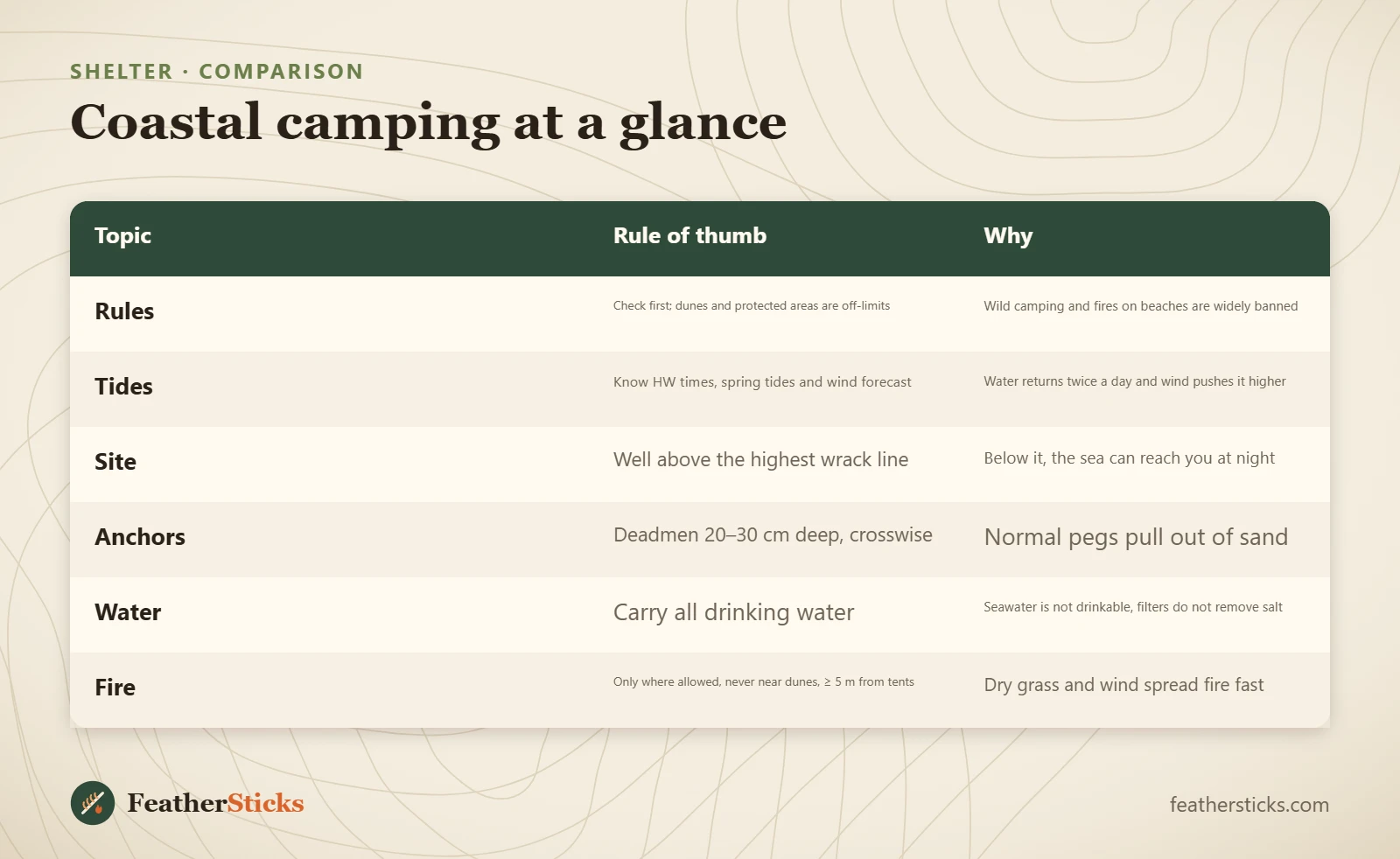
| Topic | Rule of thumb | Why |
|---|---|---|
| Rules | Check first; dunes and protected areas are off-limits | Wild camping and fires on beaches are widely banned |
| Tides | Know HW times, spring tides and wind forecast | Water returns twice a day and wind pushes it higher |
| Site | Well above the highest wrack line | Below it, the sea can reach you at night |
| Anchors | Deadmen 20–30 cm deep, crosswise | Normal pegs pull out of sand |
| Water | Carry all drinking water | Seawater is not drinkable, filters do not remove salt |
| Fire | Only where allowed, never near dunes, ≥ 5 m from tents | Dry grass and wind spread fire fast |
Common mistakes
- Camping on a beach or in the dunes without checking whether it is allowed.
- Pitching on wet sand or between the wrack line and the sea.
- Trusting a wrack line left by a neap tide when spring tides or an onshore storm are due.
- Walking far out onto sandbanks or mudflats without knowing the tide times.
- Using normal pegs in loose sand and watching the tent fold in the first gust.
- Bringing too little drinking water because there is water everywhere.
- Burying a fire in sand instead of drowning it.
What you need
- Tide table for the nearest station and a wind forecast
- All drinking water, plus a little for rinsing
- Stuff sacks or bags for sand deadmen, spare cord, wide sand stakes
- Low tent or tarp with many tie-out points
- Sun hat, sunglasses, sun cream and a tarp for shade
- Dry bags or zip bags against sand and spray
- Rubbish bag and toilet bag
- Phone in a waterproof bag
FAQ
Can you camp on the beach?
How far from the water should I pitch a tent on the beach?
How do I keep a tent from blowing away on sand?
How do I read a tide table for camping?
Can I drink seawater if I filter or boil it?
Is it safe to have a campfire on the beach?
What should I do if the tide cuts me off?
Check yourself
Completed6 quick questions from this guide. Nothing is sent anywhere.
Related step-by-step guides
-
 1
-
 1
-
 1