Camping in Strong Wind: Site, Pitch, Anchors and When to Leave
Camping in wind is safe and even pleasant when you do three things: plan for the gusts rather than the average wind, choose a site sheltered from the wind but free of dead trees, and pitch low with the narrow end into the wind and every anchor secured. A stormy night under the wrong tree, however, is one of the few genuinely dangerous situations in woodland camping.
This guide covers the whole sequence: reading the forecast and the Beaufort scale, choosing a windy campsite, orientation, pitching a tent or tarp in high wind, stakes and deadman anchors, fire, sleep, and when to break camp. It sits in our shelter section and builds on how to set up a tarp shelter. Wet and windy often come together, so camping in the rain is the natural companion piece.
Step by step
-
1

Check mean wind and gusts
Read the forecast for mean wind and gusts, not one number. Plan for the gusts; with a storm warning, or Beaufort 7 and more in forest, postpone.
-
2

Find shelter, but look up
Camp in the lee of a bank, dense young trees or a forest edge. Never under dead trees, hanging branches or, in a storm, any tall trees.
-
3

Narrow, low end into the wind
Point the low or closed end of the tarp or tent into the wind so gusts slide over it. Pitch for the strongest direction expected tonight.
-
4

Stake the windward side first
Keep the tarp in its bag, pull out one end and stake the windward corners first. Unroll it downwind, weight it, then rig the ridgeline low.
-
5

Add guylines, angle the stakes
Guy out every point, add lines on the windward side, drive stakes at about 45° away from the pull and back them up with rocks or a second stake.
-
6

Check at night, leave in time
Re-tension after gusts and check with a headlamp. If the wind rises towards Beaufort 7 or branches fall, break camp early and move to open, sheltered ground.
Camping in wind: the short version
Wind affects a camp in four ways. It loads your shelter. It cools you, sometimes dramatically. It spreads fire, carrying sparks much further than you expect. And it brings things down: dead branches, whole trees, and occasionally your own tarp. The last point is the dangerous one. A tarp that blows away is a bad night; a falling limb can be fatal.
The rest is technique: a low, tight pitch with its narrow end into the wind, good anchors, and a careful look up before you unpack. It is the same logic as setting up camp, with less margin for shortcuts.
The windy-camp system
- ForecastMean wind, gusts, direction and warnings.
- SiteLee of terrain, no dead wood above.
- OrientNarrow, low end into the wind.
- AnchorEvery point guyed, stakes angled and backed up.
- WatchRe-tension, check, and leave in time.
Reading the forecast: mean wind, gusts and the Beaufort scale
Most forecasts give two numbers: the mean wind (an average over several minutes) and the gusts (short peaks). Your tarp does not fail at the average; it fails in the gust. A forecast of 30 km/h mean wind with gusts of 60 km/h means a moderate breeze most of the time, punctuated by blasts twice as strong. Plan the pitch, the site and the fire for the gusts.
The Beaufort scale is a practical way to translate numbers into what you will see and what it means for camp. The table below follows the one in our weather guide, which also explains how to read wind direction and shifts. For a quick check of a specific forecast, the wind and Beaufort camp calculator turns mean wind and gusts into camp advice.
| Beaufort | Speed | What you see | What it means at camp |
|---|---|---|---|
| 3 | 12–19 km/h | Leaves and small twigs in constant motion | Ideal: tarp dries, smoke clears; fire manageable |
| 4 | 20–28 km/h | Small branches move, dust and dry leaves lift | Pitch low, tension guylines; sparks travel further |
| 5 | 29–38 km/h | Small trees in leaf sway | Tarp edge to the wind; keep the fire small or skip it |
| 6 | 39–49 km/h | Large branches move, wires whistle | Storm-pitch the tarp; no open fire; check trees overhead |
| 7 | 50–61 km/h | Whole trees sway, walking against the wind is hard | Avoid camping under tall trees; consider leaving the forest |
| 8+ | 62 km/h and more | Twigs and branches break off | Stay out of forests; find open, sheltered ground or a building |
Gusts can be much stronger than the average wind. On ridges and summits, wind is often one or two Beaufort levels higher than in the valley.

Go, adapt or postpone?
Up to Beaufort 4 most campers only need to pitch a little lower. Beaufort 5 and 6 are manageable with a storm pitch, good anchors and a site you have checked carefully, but they are not beginner nights. A storm warning from your national weather service, or a forecast of Beaufort 7 and above for a forested area, is a reason to postpone or choose a hut, not a test of your skills. Many forestry authorities advise staying out of woodland during storms and for some time afterwards, because damaged trees keep falling. Rules and advice differ by country; check them for where you are going.
Check the forecast again the evening before and on the morning you leave, as trip planning recommends, and note whether the wind will turn overnight. A pitch perfect for a south-westerly at 4 p.m. can be broadside to a north-westerly at 3 a.m.
Choosing a windy campsite: shelter without the widowmakers
A windy campsite balances two needs: shelter, which usually means terrain or trees, and nothing above you that can fall, which in a forest also means trees. The general method is in our campsite selection guide; these are the wind-specific points.
Use the terrain first
Terrain is the safest wind shelter because it cannot fall on you. The lee side of a bank, a low rise, a boulder field or a dip in the moorland can cut the wind at ground level dramatically. Avoid saddles, gaps between hills and valley mouths: they funnel the wind and make it stronger, not weaker. Avoid summits and ridges for the reasons in the table above.
Trees: helpful breeze-breakers, dangerous in storms
Dense young trees, a thicket or the lee side of a forest edge are excellent shelter in a moderate wind. They slow the air without much risk, because young trees are flexible and rarely shed heavy branches. Tall old trees are different. Their crowns catch the wind, and dead limbs in them (often called widowmakers, see the glossary) break off without warning. Our guide on how to spot dangerous trees shows what to look for: dead branches, broken tops hanging in the crown, fungus at the base, cracks, lifted roots and trees leaning over the site.
The rule of thumb is simple: the stronger the wind, the further from tall trees. In a moderate wind, check every tree within reach of your shelter. From Beaufort 7 the advice is not to camp under tall trees at all; at Beaufort 8 and above, stay out of the forest. Shallow-rooted conifers on soaked ground are particularly prone to toppling after long rain, which is why wind after a wet spell deserves extra caution.
Windy-site checklist
- Look up: no dead branches, broken tops or dead trees within reach
- Sheltered by terrain, a bank or dense young growth on the windward side
- Not in a saddle, gap or valley mouth where wind funnels
- Not on a summit or ridge, where wind is often 1–2 Beaufort levels higher
- Soil deep enough for stakes, or rocks available for anchors
- A realistic escape: open ground nearby if the wind rises
- Camping and fires permitted here; see wild camping rules
Orientation: which way should a tent or tarp face the wind?
The golden rule from pitching a tarp in wind applies to every shelter: the low, narrow or closed end faces the wind. An A-frame pitched along the wind lets gusts slide over the ridge and past the sides. Turned broadside, the same tarp catches every gust like a sail, and the load on stakes and seams multiplies.
For tents, the same logic depends on the design. Tunnel tents go with the low, narrow back end into the wind. Dome tents are more forgiving but still do best with the shortest, lowest side to the weather and the door on the lee side. A tent that is pitched door into the wind fills like a balloon when the door is opened. More on tent shapes in choosing a tent.

Reading the real wind direction
In a forest the air at ground level is often calm while the treetops roar. Watch the tops of young trees for a few minutes and use the forecast for the overnight direction. Pitch for the strongest wind you expect, not the breeze you feel while unpacking. If you cannot get two suitable trees in line with the wind, choose different trees or a pole pitch rather than accepting a broadside setup. The tarp pitch planner helps you check heights and sizes for a lower pitch.
Pitching a tent or tarp in high wind, step by step
The classic mistake is to unpack the whole tarp or tent and then try to hold it while fetching stakes; fabric in wind behaves like a kite. The principle: anchor first, unfold second. Have stakes, cord and the mallet or a stone in your pockets before you open anything, and keep the shelter attached to the ground or the bag at every moment.
Pitching a tarp in wind (seen from above, wind from the left)
 1Stake the windward corners
Pull out only one short end of the tarp and stake its two corners on the windward side. The rest stays folded or in its bag, held down by your pack. The tarp is now anchored and cannot fly away.
 2Unroll downwind, weight it
Let the tarp unroll with the wind. It lies flat because the wind presses it down from the anchored end. Put rocks, the pack or a log on the lee corners until you are ready for them.
 3Ridgeline along the wind
Rig the ridgeline low and tight, parallel to the wind direction, and clip or drape the tarp over it. An adjustable hitch such as the taut-line or trucker's hitch lets you tension it with cold hands.
 4Lee corners, then sides
Stake the lee corners, then all side tie-outs. Work round the tarp in order rather than jumping about, so the fabric never has a free edge to catch the wind.
 5Re-tension after gusts
Tighten everything until the fabric no longer flaps, then check again after ten minutes and after the first strong gusts. Cord stretches and stakes settle, and a slack panel starts to flog.
Pitching a tent in wind
The same sequence applies to tents. Stake the windward end of the tent or flysheet first, with the bag still attached or the tent lying on its folded half. For tunnel tents, peg the back end into the wind, then insert the poles and let the wind stretch the tent out downwind before you peg the front. For dome tents, peg the windward corners, raise the poles on the ground and lift the tent with the wind pushing it against the anchored side. Two people make this much easier. Never let go of a tent or tarp that is not attached to anything.
Once the tent stands, guy out every guyline point, not only the corners. Close the windward vents only partly: some airflow reduces condensation, which a closed tent in wind still produces, as explained under tent ventilation.
Guylines, stake angles and anchors that hold in wind
In wind, the anchors decide whether a pitch survives. A shelter rarely fails in the fabric; it fails at the weakest stake, then the next one pulls out under the extra load. Use all your tie-out points, add extra guylines to the windward panels, and choose anchors for the ground you actually have. Stakes for normal soil and their alternatives are compared in stakes and anchors for every ground; the wind-specific methods are below.
Four anchors that hold in wind
 1Stake at about 45°
Drive the stake at roughly 45°, with its head leaning away from the shelter. The guyline then pulls across the stake rather than along it. A stake leaning towards the load slides out in the first strong gust.
 2Double up in soft soil
In leaf litter, moss or loose soil, place a second stake behind the first and tie the head of the front stake back to it. The pair holds far more than either stake alone. Longer V or Y stakes of 20–25 cm help too.
 3Rock on top
On shallow or stony ground the stake may only go in a few centimetres. Set it at an angle and place a heavy rock on top of it, or tie the guyline round one rock and pile a second on top.
 4Deadman in sand or snow
Tie the guyline round the middle of a stick, a stake or a stuff sack filled with sand, and bury it crosswise to the pull 20–30 cm deep. Stamp the sand or snow firm; in snow let it freeze in for 15–30 minutes.
Extra guylines and where they go
In wind, the panel tie-outs halfway up the sides matter more than the corners, because the middle of a panel is where it bellies and flaps. Guy them out on the windward side first, with the line running roughly in line with the panel so it pulls the fabric taut. A spare 10 m of thin cord, a few extra stakes and some cord for improvised tie-outs belong in every autumn pack. For a trekking-pole pitch, guy the pole tops in two directions; a single line lets the pole fall sideways. More on that in trekking poles as shelter poles.
Tension matters as much as the number of lines: a flapping panel wears the fabric and works stakes loose. Check every line after the first strong gusts; wet nylon cord stretches.
| Ground | Best method in wind | Typical mistake |
|---|---|---|
| Firm forest soil | Stake at about 45° away from the pull; extra guyline on windward panels | Stakes driven vertically or leaning towards the shelter |
| Soft soil, moss, leaf litter | Long V or Y stakes; two stakes in tandem | Stake only in the litter layer, not the soil below |
| Stony, shallow ground | Angled stake with a heavy rock on top; or guyline round a rock | One small rock that the first gust rolls away |
| Sand | Deadman 20–30 cm deep: stick, stake or sack of sand | Normal stakes, which pull straight out |
| Snow | Deadman, stamped and left to freeze in for 15–30 min | Loading the anchor before the snow has set |
| Roots, logs, trees | Guyline round a root or a solid, live log | Tying to dead wood or loose branches |
Never cut live branches or saplings for stakes or anchors. Carved stakes from dead hardwood work, as described in the tarp guide; in snow, see also winter camping and snow shelters, where wind and anchoring go hand in hand.
Which tarp setup for wind? Low pitches compared
Not every pitch survives wind. The good ones are low, have small open areas towards the weather and present a sloping surface rather than a flat wall. The full catalogue of setups is in our tarp shelter guide; for wind, these are the ones that matter. If you are choosing a tarp, size and tie-out count make a difference in wind too, see tarps compared.
| Setup | Wind resistance | Use it when | Watch out for |
|---|---|---|---|
| Low storm A-frame (ridge about 70–90 cm) | Excellent | Beaufort 5–6, rain driven sideways | Little headroom; condensation if fully closed |
| Closed-end A-frame / plow point | Very good | Wind from one steady direction | A wind shift turns the open end into the weather |
| Standard A-frame, along the wind | Good | Beaufort 3–4 | Re-tension as the wind rises |
| Lean-to, back to the wind | Moderate | Steady wind, need for a view or a reflector fire | Collapses or scoops wind if the direction turns |
| Lean-to or open pitch facing the wind | Poor | Never in real wind | Flogging fabric, pulled stakes, torn tie-outs |
A lean-to with its back to the wind works in a steady breeze, but if the wind turns it becomes a sail; in variable or rising wind the low A-frame is the safer default. The comparison of systems in tent vs tarp vs hammock includes how each copes with storms.
Hammock camping in wind
A hammock adds two wind problems. First, it hangs from two trees, and both have to be sound: in strong wind, hammock campers depend on trees more than anyone else. Second, the wind blows under you. Moving air strips heat from your back far faster than still air.

Hang lower than usual and pitch the tarp low on the windward side, ends folded in if your tarp allows it. An underquilt or a pad with wings matters more than a thicker sleeping bag, as our hammock shelter guide explains. Most importantly, apply the tree rules strictly: healthy, living trees with no dead branches above, and no hammock in a forest from Beaufort 7. In a real storm, a hammock is the wrong shelter.
Fire and stoves in wind
Wind turns a campfire from cosy to hazardous. Sparks travel further, embers glow hotter, and dry grass or leaf litter catches more easily. First check whether fires are allowed at all: many regions prohibit open fires in forests, and fire bans or a high fire danger rating apply in dry, windy weather. Rules differ by country and region; this is not legal advice.
Where a fire is allowed, the Beaufort table gives the limits: from Beaufort 4 sparks fly further, at Beaufort 5 keep the fire small or skip it, and from Beaufort 6 no open fire. Place it downwind of your shelter, at least 5 m from tents and hammocks and at least 3 m from synthetic tarps, and clear the ground of anything that can burn. Our campfire safety guide covers the rest, and firewood explains which fuel burns calmly without spitting sparks.

Cooking on a stove in wind
A stove is usually the better choice on windy days. Shield the flame with your body, your pack or a windscreen, and cook in the lee of your shelter but outside the fabric. With canister stoves, do not fully enclose the canister in a windscreen, because the canister can overheat; follow the manufacturer's advice and our guide to camp stoves. Never cook inside a tent or under a low, closed tarp: fabric burns and carbon monoxide builds up in closed spaces.
Staying warm and sleeping in wind
Wind makes cold feel colder. At 0 °C, a 30 km/h wind feels roughly like −6 °C on exposed skin, as the wind chill calculator shows. Damp clothing makes it worse. Bring an extra warm layer and a hat, get out of the wind before you start to shiver, and plan your sleeping system with some reserve for a windy night. Your clothing should include a windproof outer layer; a rain shell does the job.
Wind under or through the shelter is the main heat thief at night. Pitch low, close the windward side and keep your sleeping place out of the draught. Cold, wet and windy together is the classic route to hypothermia; know the early signs from our hypothermia guide: shivering, clumsy hands, irritability and poor decisions.
Noise and getting some sleep
Flapping fabric and creaking trees make it hard to sleep, and tired people make poor decisions. Reduce noise at the source: tension every panel, tie off loose straps and drawcords, and add a guyline to any part that still flaps. Earplugs help, but only once you are sure the site is safe; you should still hear a change in the wind. Cracking trees deserve a second look with the headlamp.
Night routine in wind
- Before bed
- Re-tension all lines, check stakes on the windward side
- Layers
- Hat and extra layer ready next to the sleeping bag
- Headlamp
- Within reach for night checks
- Shoes
- Ready to put on fast if you need to move
When to break camp in a storm
Deciding to leave is the most important wind skill, and the hardest, because the moment usually comes in the dark. Make the decision rules before you go to bed, so you do not have to think them through at 2 a.m. The best time to move is early, while you can still see, rather than at the peak of the storm.
Stay or go?
Are branches falling near you, or are trees around the camp cracking or swaying strongly?
Yes → Leave the trees now: move further than one tree height away into open, sheltered ground.No → Next question.Is the wind rising towards Beaufort 7, or has a storm warning been issued?
Yes → Break camp in good time and leave the forest, before dark if possible.No → Next question.Do stakes keep pulling out, poles bend or the fabric tear?
Yes → Lower the pitch to storm mode; if it still fails, pack up and shelter in the lee of terrain.No → Stay, re-tension and check again after the next strong gusts.
When the wind rises: adapt, pack, move
 1Lower the pitch first
Drop the ridge to storm height and bring the windward edge right down to the ground. Close the windward end if your tarp allows it. This is often enough for a rise from Beaufort 4 to 5 or 6.
 2Pack in reverse, tarp last
If you decide to leave, pack the sleeping bag and loose gear first, under the roof. The tarp comes down last, windward stakes very last, so it cannot catch the wind and tear free.
 3Out to open, sheltered ground
Move further than one tree height from tall trees, into the lee of terrain if you can. A clearing, a field edge on the lee side or a building is better than any forest in a storm.
Moving through a forest in a storm at night has its own risks: falling branches, poor visibility and uneven ground. That is why the decision should be made early. If you are already under dangerous trees and branches are coming down, getting out from under them is usually the safer option. Go to open ground, a field edge on the lee side, a large clearing or a building, keep the group together and keep your headlamp on. In an emergency, call 112 (EU) or your local emergency number. The skills from night skills help when you have to move in the dark.
After the storm: aftermath checklist
When the wind drops, the forest is still not safe. Branches can hang loosely in the crowns (so-called hangers) and fall days later, and uprooted trees can be under tension. Walk out on open paths, keep away from fallen trees and root plates, and respect any closures that forestry authorities put in place after storms.
After a windy night
- Look up before you walk: hanging branches, broken tops, leaning trees
- Check every stake and guyline before you take the shelter down
- Inspect the tarp or tent for torn tie-outs, chafed seams and bent poles
- Dry everything at home before storing it, including wet guylines
- Repair tie-outs and seams, restock spare cord and stakes (repair kit)
- Note which anchors failed and which held, and change your kit
- Do not cut storm-damaged trees: that is work for trained people
For a full list of what to carry on exposed trips, use the Kit Builder, and for the foundations of camp craft, start with bushcraft basics.
Troubleshooting: wind problems by symptom
| Symptom | Likely cause | Quick fix |
|---|---|---|
| Fabric flaps and roars | Slack panel, missing mid-panel guyline | Re-tension; add a guyline to the panel; tie off loose straps |
| Stakes pull out | Too vertical or leaning towards the load; soft soil | Angle at about 45° away from the pull; double up; rocks or deadman |
| Wind blows through the shelter | Broadside pitch or open end into the wind | Re-orient narrow end into the wind; lower the windward edge |
| Pitch fails after the wind turned | Planned for the afternoon breeze, not the night forecast | Close the new windward side; repitch along the new direction |
| Cold despite a warm bag | Draught under the hammock or through the shelter | Lower the tarp; close the ends; underquilt or pad with wings |
| Tarp blew away during setup | Unpacked before anchoring | Anchor windward corners first, keep the rest in the bag |
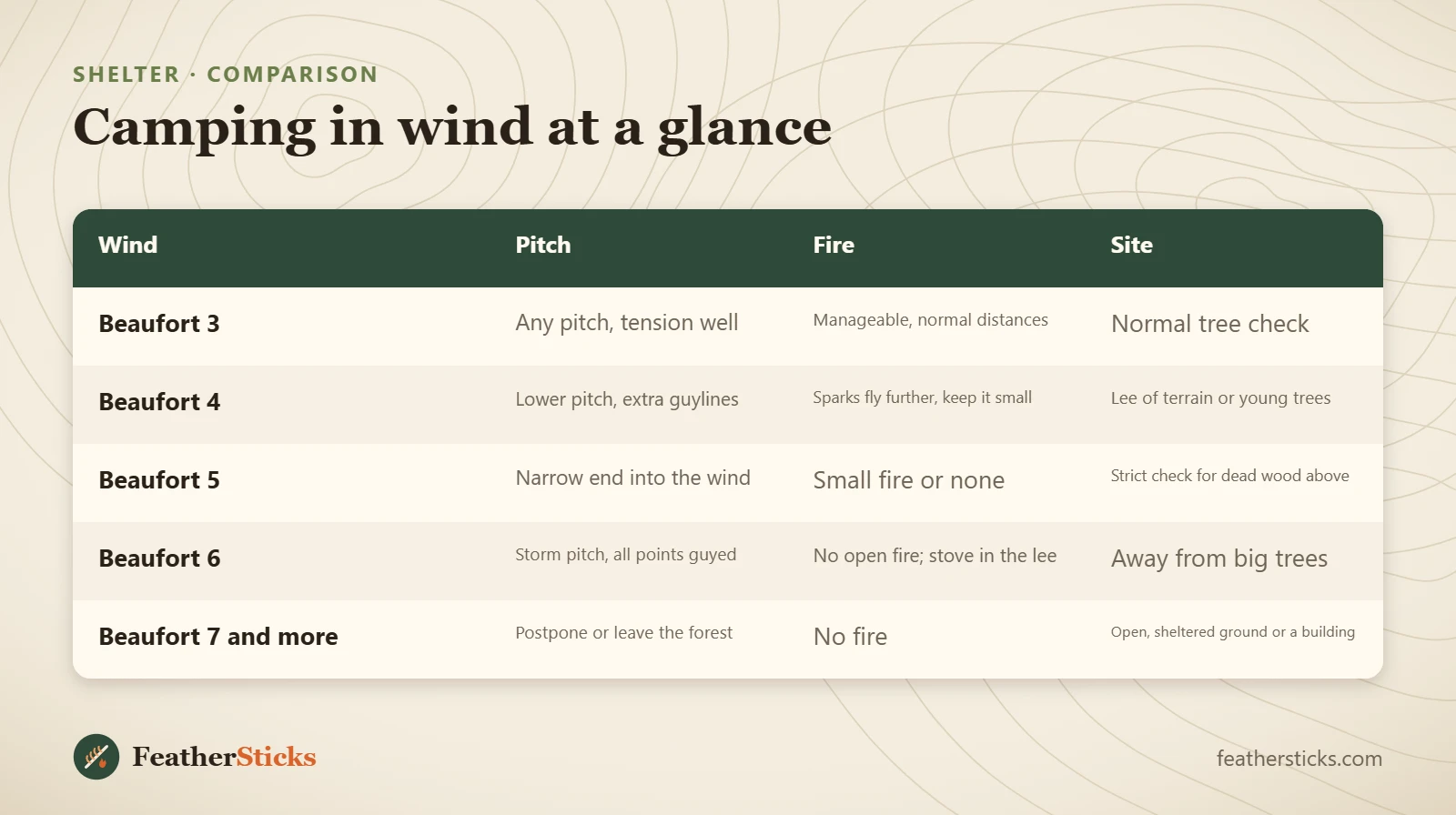
| Wind | Pitch | Fire | Site |
|---|---|---|---|
| Beaufort 3 | Any pitch, tension well | Manageable, normal distances | Normal tree check |
| Beaufort 4 | Lower pitch, extra guylines | Sparks fly further, keep it small | Lee of terrain or young trees |
| Beaufort 5 | Narrow end into the wind | Small fire or none | Strict check for dead wood above |
| Beaufort 6 | Storm pitch, all points guyed | No open fire; stove in the lee | Away from big trees |
| Beaufort 7 and more | Postpone or leave the forest | No fire | Open, sheltered ground or a building |
Common mistakes
- Planning for the mean wind and forgetting that gusts can be twice as strong.
- Camping under tall trees with dead branches because they offer shelter from the wind.
- Pitching broadside to the wind, so the tarp or tent acts like a sail.
- Unpacking the whole tarp before anchoring it, then watching it blow away.
- Driving stakes vertically or leaning towards the shelter, so they slide out in gusts.
- Lighting an open fire upwind of the tent or in Beaufort 6 and more.
- Waiting until the storm peaks at night before deciding to leave.
What you need
- Tarp or tent with enough tie-out points, including mid-panel loops
- 10 m or more of spare cord for extra guylines
- Extra stakes, including longer V or Y stakes for soft ground
- Stuff sacks that can double as sand or snow anchors
- Windproof layer, hat and an extra warm layer
- Headlamp, earplugs and a charged phone with the forecast
- Stove with a suitable windscreen
Calculators for this topic
FAQ
How much wind is too much for camping?
Which way should a tent face in the wind?
How do I pitch a tent in strong wind?
What is the best tarp setup for high wind?
How do I keep tent stakes in the ground in wind?
Is it safe to camp under trees in wind?
Can I have a campfire when it is windy?
Check yourself
Completed6 quick questions from this guide. Nothing is sent anywhere.
Related step-by-step guides
-
 1
-
 1
-
 1