Tent, Tarp or Hammock? How to Choose Your Camping Shelter
The honest answer to tent vs tarp vs hammock is: it depends on terrain, weather and how much you want to learn. A tent is the easiest, the most bug-proof and the warmest per night. A tarp is the lightest and most flexible, but asks for skill and a bivvy bag or good pitching. A hammock is the most comfortable on rough ground, but needs two sturdy trees and real insulation below you.
This guide compares all three side by side, adds the combinations that bushcrafters actually use (tarp plus bivvy, hammock plus tarp), and gives a decision path by situation. Then it sends you to the detailed guides. If you are still choosing the best shelter for bushcraft, read the whole thing once; if you are in a hurry, jump to the decision section. All our shelter guides are one click away, and a multi-day base camp shows how to combine them.
Step by step
-
1

Know the three systems
A tent is a closed shell, a tarp is a roof you pitch with cord, a hammock lifts you off the ground under its own tarp. Each has a different job.
-
2

Read the terrain
Flat ground suits tent and tarp, two sturdy trees 4–5 m apart suit a hammock, and bare alpine ground rules the hammock out.
-
3

Check weather and season
Midges and storms favour a closed tent or a bug net. In warm, dry weather any of the three works.
-
4

Match the bottom insulation
On the ground you need a pad with the right R-value. In a hammock you need an underquilt or a pad inside.
-
5

Check the site rules
Some areas allow tents only on campsites or platforms. Use wide tree straps and always check local rules.
-
6

Start with what you can learn
A tent for the first night, a tarp when you want less weight, a hammock once you know trees and insulation.
What is the difference between a tent, a tarp and a hammock?
All three are answers to the same problem: keep rain, wind and cold off you for eight hours. They solve it very differently.
The tent: a closed shell
A tent is a fully enclosed shelter with its own floor, walls and often a separate rain fly. You pitch it on flat ground, climb in, zip the door and the weather is outside. It traps body heat and blocks wind and insects, which makes it the most forgiving system. The price is weight and bulk, and you stay shut in: no view, no fire next to your door, and condensation in cold, damp air. Details on types and fabrics are in choosing a tent.
The tarp: a roof on cords
A tarp is a sheet of waterproof fabric that you pitch with a ridgeline, guylines and stakes into dozens of shapes: A-frame, lean-to, diamond, storm mode. It has no floor and no walls, so you add a ground sheet, a pad and, in cold or buggy weather, a bivvy bag. It is very light, packs small and lets you sit close to a fire. It also asks for skill, because the pitch has to match wind and rain. See how to pitch a tarp shelter and choosing a tarp.
The hammock: sleeping off the ground
A camping hammock hangs between two trees on wide straps, with a tarp on its own ridgeline above. It ignores roots, rocks, slopes and puddles, and it can double as a chair. But the wind blows under you, so it needs insulation below (an underquilt or a pad inside), and it needs suitable trees. The full method is in how to hang a hammock.
The combinations that matter
Real kits mix these. Tarp plus bivvy bag keeps the tarp's lightness and adds splash protection, a little warmth and a bit of bug defence; our bivouac and bivvy bag guide covers it. Hammock plus tarp is the standard hammock system, and a tent can also be paired with a tarp as a kitchen roof, so you cook and sit dry beside it.

Tent vs tarp vs hammock: the big comparison table
The table gives typical ranges for a 1–2 person three-season set-up. Real values depend on the exact product, so treat them as guides. "Cost class" is relative: one euro sign is cheap, three is expensive, and it counts the shelter only, not sleeping bag and pad.
| Criterion | Tent | Tarp (+ bivvy) | Hammock (+ tarp) |
|---|---|---|---|
| Weight, shelter only | 1.2–2.5 kg (kit list: ≈ 1.8 kg) | Tarp 0.5–1.0 kg (≈ 700 g for 3 × 3 m); +0.4–0.8 kg with bivvy | Hammock, straps and tarp 1.2–2.0 kg |
| Weight with bottom insulation | Add a pad, 0.3–0.6 kg | Add a pad, 0.3–0.6 kg | Add an underquilt, 0.4–0.8 kg |
| Pack size | Medium to large; poles are long | Very small, fits in a bottle pocket or lid | Small; tarp and hammock stuff sacks |
| Rain protection | Excellent, fully enclosed | Good if pitched low and angled; splash at the edges | Good if the tarp is long and low; drip lines needed |
| Insects | Excellent with inner net | Poor without a bivvy with net | Good with an integrated or add-on bug net |
| Wind and storm | Good with a low dome and guylines | Medium; needs a low, compact storm pitch | Medium; wind chills from below, tarp can flap |
| Cold and insulation | Traps heat; the calculator gives about +3 °C | Little shelter effect, about +1 °C | No bonus; underquilt or pad essential |
| Terrain needed | Flat, clear ground about 1.2 × 2.2 m or more | Flat-ish ground plus anchors for the ridgeline | Two healthy trees 4–5 m apart; slope and rocks do not matter |
| Set-up time | 5–10 minutes with practice | 10–20 minutes, varies with pitch | 10–20 minutes including tarp |
| Learning curve | Low | Medium to high (knots, pitches) | Medium (angle, insulation, trees) |
| Privacy | High, walls on all sides | Low, open sides | Low to medium, depends on tarp walls |
| Campfire nearness | Keep the fire away: fabric melts | Close, with a safe distance and a reflector | Possible, but keep embers away from fabric |
| Cost class | € to €€€ | € to €€ | €€ to €€€ |
Read the table by rows that matter for you. If bugs and storms top your list, the tent column wins. If weight and flexibility lead, the tarp column wins. If you often camp where the ground is rocky, wet or sloping, the hammock column wins, as long as there are trees and you accept the insulation work. Compare the same logic on your own kit in the Kit Builder.
Which shelter is best? Decision guide by situation
Instead of one winner, use the situation. Each line below names the best fit and the reason. Where two answers are close, the second one is the fallback.
| Situation | First choice | Second choice | Why |
|---|---|---|---|
| Forest with suitable trees | Hammock + tarp | Tarp + bivvy | Off the ground, no flat spot needed, uses what is there |
| Open land, meadows, dunes | Tent | Tarp + bivvy | No anchors and no windbreak, so a low closed shell holds best |
| Alpine, above the tree line | Tent | Bivvy bag in good weather | No trees, strong wind and fast weather change |
| Winter, snow, frost | Tent or winter tarp | Snow shelter, see below | Heat retention and wind; condensation is the trade-off |
| Long, steady rain | Tarp or hammock with a big tarp | Tent | Dry sitting and cooking space under the roof |
| Heavy midge or mosquito season | Tent with inner net | Hammock with bug net | Bugs are the one thing a tarp cannot stop |
| Kids and groups | Tent (one per small group) | Large tarp for a shared roof | Enclosure, safety and calm sleep matter most |
| First night out | Tent, ideally near home | Tarp + bivvy near a car or hut | Few failure modes; learn the rest later |
Forest with trees
If you camp in woodland and your trees are healthy and 4–5 m apart, a hammock is hard to beat for comfort. A tarp also shines here: trees give you free anchors for the ridgeline and a bit of shelter from wind. See choosing a camp site for how to judge the canopy.
Open land
No trees means no hammock and no easy tarp anchors. You can tie a tarp to poles or hiking sticks, but a tent with guylines is the simpler, calmer answer. Always choose the lowest, most compact shape, because exposed ground has more wind.
Alpine and winter
Above the tree line the hammock is out, and the tarp has to be a low, snug storm pitch. A tent is the most forgiving. For snow, a tent or a purpose-built winter tarp are the common choices, and in deep snow you can also dig a snow shelter. The winter camping guide covers the extras: bottom insulation, stoves, condensation and cold-weather checks.
Rain and midges
A tarp or hammock tarp gives you an outdoor "living room" in rain, which a tent does not. For the full rain playbook, read camping in the rain. For midges, mosquitoes and ticks, a closed tent or a hammock with net is the right tool; see ticks and insects.
Kids, groups and first nights
With children, the enclosure of a tent makes bedtime easier and keeps small explorers inside. Groups can share a big tarp as a communal roof but need individual sleeping spaces. For a first night, choose the system with the fewest ways to fail, and see bushcraft with kids and your first overnight.
Read the terrain in four looks
 1Open, flat ground
A clear patch of about 1.2 × 2.2 m or more suits a tent or a ground-level tarp. Check for slope, rocks and drainage first: a tent set in a dip floods in rain.
 2Two sturdy trees
Living trunks at least 15–20 cm thick and 4–5 m apart are a hammock site. Check for dead branches above and always use wide straps.
 3Slope, stones and roots
On uneven ground a tent needs clearing and levelling, but a hammock hangs above it. This is where the hammock beats both other systems.
 4Above the tree line
No trees, strong wind, little shelter: the hammock is out and the tent is the safest choice. Weigh the stakes down with stones if the soil is thin.
Pros and cons of each system
Every system has a real weak spot. Knowing it in advance is what keeps a trip enjoyable. These blocks sum up the trade-offs before you spend money.
Tent
Pros
- Fully enclosed, warmest night
- Best insect protection
- Easiest to learn
- Privacy and a dry place for gear
- Good in storms when pitched properly
Cons
- Heaviest and bulkiest
- Needs flat, clear ground
- Condensation in damp, cold air
- No fire close by, limited view
- Higher price for a good one
Tarp
Pros
- Lightest and smallest
- Many pitches for many conditions
- Open view and fire nearby
- Lowest cost for a basic set-up
- Doubles as a kitchen or hammock roof
Cons
- Needs pitching skill and knots
- No insect protection without a bivvy
- Wind-driven rain can reach you
- No privacy
- Anchor points are needed
Hammock
Pros
- Comfortable on rough ground
- No roots, rocks or puddles
- Fast to hang once learned
- Works on a slope
- Chair by day
Cons
- Needs two healthy trees
- Cold from below without insulation
- Solo sleeper only
- Not for bare or alpine land
- Tree rules and tree care
Rain, wind and insects: which shelter protects best?
A good tarp keeps rain off you, but wind decides whether it stays that way. Wind-driven rain can travel almost sideways, so an open side of a tarp is its weak point. The fix is a pitch that is low on the windward side, high enough on the lee side for air, and long enough to overhang your sleeping space by at least 15–30 cm. For hammocks the same logic applies to the ends. A tent's fully closed shape is naturally the strongest in a storm, but a poorly guyed tent flaps and tears just like a tarp does.
How each system handles rain and wind
 1Tarp with an open side
If the windward edge is high, rain flies in sideways and soaks the bag. This is the most common tarp mistake, and the fix is not a bigger tarp but a lower edge.
 2Tarp with a low windward edge
Drop the windward edge to a hand above the ground, pointing the closed end into the wind and keeping the lee side higher. The same fabric now shelters well.
 3Tent in wind
A closed dome gives wind nothing to catch, and the rain bounces off. Guy it out properly and face the narrow end into the wind.
 4Hammock under a long tarp
The tarp must extend past the hammock ends by 15–30 cm, and drip lines on straps keep trunk water out. Our rain guide shows more.
Insects
This is the clearest dividing line. A tent with an inner net is nearly bug-proof. A hammock with a built-in or add-on net does well in summer, though thin fabric can still be bitten through if your body presses against it. A tarp alone offers none, so use a bivvy bag with a net, a head net or avoid peak-insect seasons. In tick country, the ground matters too: sleeping off the ground reduces the crawl-in risk, but you still need to check yourself afterward (see ticks and insects).
Wind and storms
Sheltered spots matter more than the system you choose. Pitch behind a ridge or a stand of trees, never under dead branches, and check wind direction before you guy anything. If the forecast is rough, step down to the most compact, closed option. The wind chill calculator shows how much colder a breezy camp feels, and reading the weather helps with deciding in advance.
How to sleep warm in a tent, under a tarp or in a hammock
The common thread is that the cold comes from below. Your sleeping bag or quilt loses most of its insulation underneath you, because your body weight squashes the filling flat. What stops the heat loss is a pad on the ground, or an underquilt under a hammock. The R-value numbers below are the same as in our sleeping gear guide and the sleeping bag and pad calculator.
| Night low | Minimum pad R-value | Typical solution |
|---|---|---|
| Above 10 °C | R 2 | Closed-cell foam pad |
| 5 to 10 °C | R 3 | Self-inflating pad (≈ R 3.5) |
| 0 to 5 °C | R 4 | Insulated air pad (≈ R 4.5) |
| −10 to 0 °C | R 5 | Foam + self-inflating or warm air pad |
| −20 to −10 °C | R 6 | Foam + insulated air pad (≈ R 6.5) |
| Below −20 °C | R 7+ | Winter air pad + foam (≈ R 8.5) |
The calculator also adds a shelter bonus to the bag rating you need: about 3 °C for a tent, about 1 °C for a tarp or bivvy bag, and nothing for a hammock. In a hammock the calculator gives an underquilt rating instead of a pad R-value: roughly your night low, minus 5 °C if you sleep cold, minus the wind deduction. That is why hammock sleepers often want a warmer system than tent sleepers on the same night.
The same night (0–5 °C) in four set-ups
 1Tent: pad under you
The ground is the cold part. A pad with R 4 for a 0–5 °C night keeps you off it, and the tent shell adds a few degrees of air warmth.
 2Tarp plus bivvy: pad and bag
Same pad, R 4, plus the bivvy bag for splash protection and about one degree of extra warmth. The tarp roof is mostly about rain.
 3Hammock with a pad inside
A pad works but slides, and the shoulders and hips can slip over the edge. Moving air under the fabric still cools the unprotected sides.
 4Hammock with an underquilt
The underquilt hangs below the fabric with full loft, so nothing squashes it. This is the warmest and most comfortable hammock answer.
See the full list of pad types and bag ratings in the sleeping gear guide. If you wear dry clothing, a hat and warm socks, the same layers help in all three systems; see bushcraft clothing. And if you ever feel persistently cold or start shivering hard, take it seriously: hypothermia can set in faster than you expect.
Tent, tarp or hammock by season
Season changes what matters. In summer, bugs and comfort count; in autumn, rain and wind; in winter, heat retention and bottom insulation. The table is a rough guide for temperate Europe and similar climates, not a rule.
| Season | Tent | Tarp (+ bivvy) | Hammock (+ tarp) |
|---|---|---|---|
| Spring | Good; watch for cold, wet ground | Good with a pad and bivvy | Good; underquilt for cold nights |
| Summer | Good; ventilation matters, nets for midges | Very good; add a net against bugs | Excellent; light underquilt or pad, bug net |
| Autumn | Very good; dry in long rain and storm | Good with a low storm pitch and bivvy | Good; full underquilt and long tarp |
| Winter | Very good with a warm bag and R 5+ pad | Demanding; winter pitch and warm bag needed | Demanding; winter underquilt and top quilt |
If you only want one system for the whole year in temperate woods, a tent covers every season with the fewest surprises. If you want two, add a tarp for good-weather trips. A hammock is the most seasonal: it excels from late spring to early autumn and becomes demanding below freezing.
How much do tent, tarp and hammock systems weigh?
Weight is where the systems differ most on paper and least in practice. The shelter alone is only part of the picture, because the hammock needs an underquilt and the tent and the tarp need a pad. The comparison below uses the same reference trips as the bushcraft kit list and the Kit Builder: a two-day trip, without the pack itself, summer and autumn.

In the kit list, a 3 × 3 m tarp is about 700 g and a one to two person tent about 1.8 kg. A rule of thumb from the guide: a tarp saves roughly 1 kg compared with a typical tent. In the Kit Builder the gap is smaller, around 0.6 kg in summer and 0.2 kg in autumn, because the tarp trip also carries a bivvy bag and groundsheet. Hammock weight is not a Kit Builder option. Our hammock guide puts a complete three-season hammock system, including straps, tarp, underquilt and top quilt, at about 2–3.5 kg, similar to a light tent with pad and bag.
| System | Shelter | Bottom insulation | Approx. total |
|---|---|---|---|
| Tent, summer | 1.2–1.8 kg | Foam pad 0.3–0.5 kg | 1.5–2.3 kg |
| Tarp + bivvy, summer | Tarp 0.5–0.8 kg + bivvy 0.4–0.8 kg | Foam pad 0.3–0.5 kg | 1.2–2.1 kg |
| Hammock + tarp, summer | 1.2–2.0 kg | Light underquilt or pad 0.4–0.8 kg | 1.6–2.8 kg |
| Tent, autumn | 1.8–2.5 kg | Insulated air pad 0.4–0.6 kg | 2.2–3.1 kg |
| Hammock + tarp, autumn | 1.5–2.0 kg | Full underquilt 0.6–0.8 kg | 2.1–2.8 kg |
What these numbers say: the difference between systems is often smaller than the difference between a light and a heavy product within one system. If your pack feels heavy, look first at the sleeping bag, the pack and the food, not the shelter. A shelter that is a bit heavier but that you actually use and enjoy beats a light one that fails in the rain. The pack that carries all this is covered in choosing a backpack.
Where can you pitch a tent, tarp or hammock? Site rules
Rules decide the choice before weather does. In many countries and regions, wild camping is limited or forbidden, and some areas allow only tents on designated campsites. Rules differ by country, state and even forest district, and they change. This article gives no legal advice: always check the current rules for the exact place before you go, and ask the landowner or local authority if unsure. Our wild camping guide explains how to approach the question.

Campsites, platforms and designated spots
On a campsite or a marked trekking site you usually pitch on the offered spot, often a flat clearing or a raised platform. A tent is the natural fit for platforms, because there are no trees or anchors. Where a site shows a tent sign, assume tents are the allowed form of shelter and ask about tarps and hammocks if the rules are unclear.
Hammocks, trees and bark
If hanging from trees is allowed, use wide tree straps of about 2.5 cm or more, never thin cord. Thin cord under load cuts into the bark and damages the layer the tree needs to live. Some parks forbid hammocks for this reason or require wide straps. Choose a different pair of trees each night when staying longer, and read our hammock guide for the tree check.
Fires and protected areas
Fire rules are separate from shelter rules, and a ban on open fire usually also applies to your cooking set-up near a tarp. Protected areas such as nature reserves often forbid camping entirely. When you see a reserve sign, treat it as a hard no, not a suggestion. Read campfire safety before you plan anything involving flames.
Which shelter should a beginner start with?
If you are new to camping, start with a tent. It has the fewest ways to fail: you can learn to pitch it in a garden, it keeps out rain, wind and insects, and a bad pitch still works. After a few nights you will know what you miss and what annoys you.
Then ask yourself one question: what bothered me most? If it was weight or bulk, add a tarp. If it was the closed, stuffy feeling or the flat-ground hunt, try a hammock. You do not have to commit to one system, and many bushcrafters own two or all three.
A learning path that costs little
- Tent near homeCamp in a legal spot near home, or borrow a tent. Learn to pitch it, sleep warm and pack it.
- Tarp over the tentAdd a tarp as a kitchen roof. Practise ridgelines and knots without risking the night.
- Tarp and bivvy aloneLeave the tent at home on a good-weather trip. Test your pitch and your pad.
- Hammock if it fitsTry it in a wooded area with permission. Learn the angle and the underquilt.
Budget matters too. A basic tent, a tarp or a hammock set can all be bought at low or medium cost, and good second-hand gear exists for all three. Our budget bushcraft gear guide shows where to save and where not to, and the field repair kit guide helps you keep any of them alive. Spend first on the sleeping bag and pad, since they decide whether you are warm, then on the shelter. Before a first night, read your first overnight and plan the trip with the trip planning guide.
Which shelter should I take on my next trip?
Is this your first night out?
Yes → Take a tent.No → Next question.Are there two healthy trees 4–5 m apart, and is hanging allowed?
Yes → A hammock is possible. Next question.No → Tent, or tarp plus bivvy.Do you have an underquilt or a pad that fits the hammock?
Yes → Hammock with tarp.No → Take a tent or tarp, or add the insulation.Are midges, storm or deep cold expected?
Yes → Choose the tent instead.No → Tarp, hammock or tent: your choice.
Before you commit to a system
- You know the terrain and the trees at your usual camps
- You have checked local camping and fire rules
- You have a pad or underquilt that fits the night low
- You can pitch or hang it in daylight and in the dry first
- You have a backup plan for storm or bugs
- You know the pack weight and your limit
Pitching, camp layout and comfort: what changes by system
Each system changes how you lay out the camp. With a tent you pitch first and set the kitchen away from the fabric. With a tarp the roof is the camp: you plan the fire, cooking and sleeping around the one sheet. With a hammock the trees decide the layout, so you hang first, then find a flat place for the stove or kitchen. Setting up camp covers the general layout, and a short session at your sit spot can teach you the wind and light before you pitch.
Light changes your schedule too. Pitch with an hour of daylight to spare, and check the daylight calculator for your date. Whichever system you choose, learn the key knots first: a ridgeline hitch and a taut-line hitch cover most needs, and a stock of paracord and a tarp planner help with every one of them. See knots for camp for the short list.
Comfort extras are small and cheap: a ground sheet for the tarp, a pack liner for dry gear, a hat for sleeping. Tent sleepers add a vestibule or tarp for wet boots; hammock sleepers add a small gear sling.
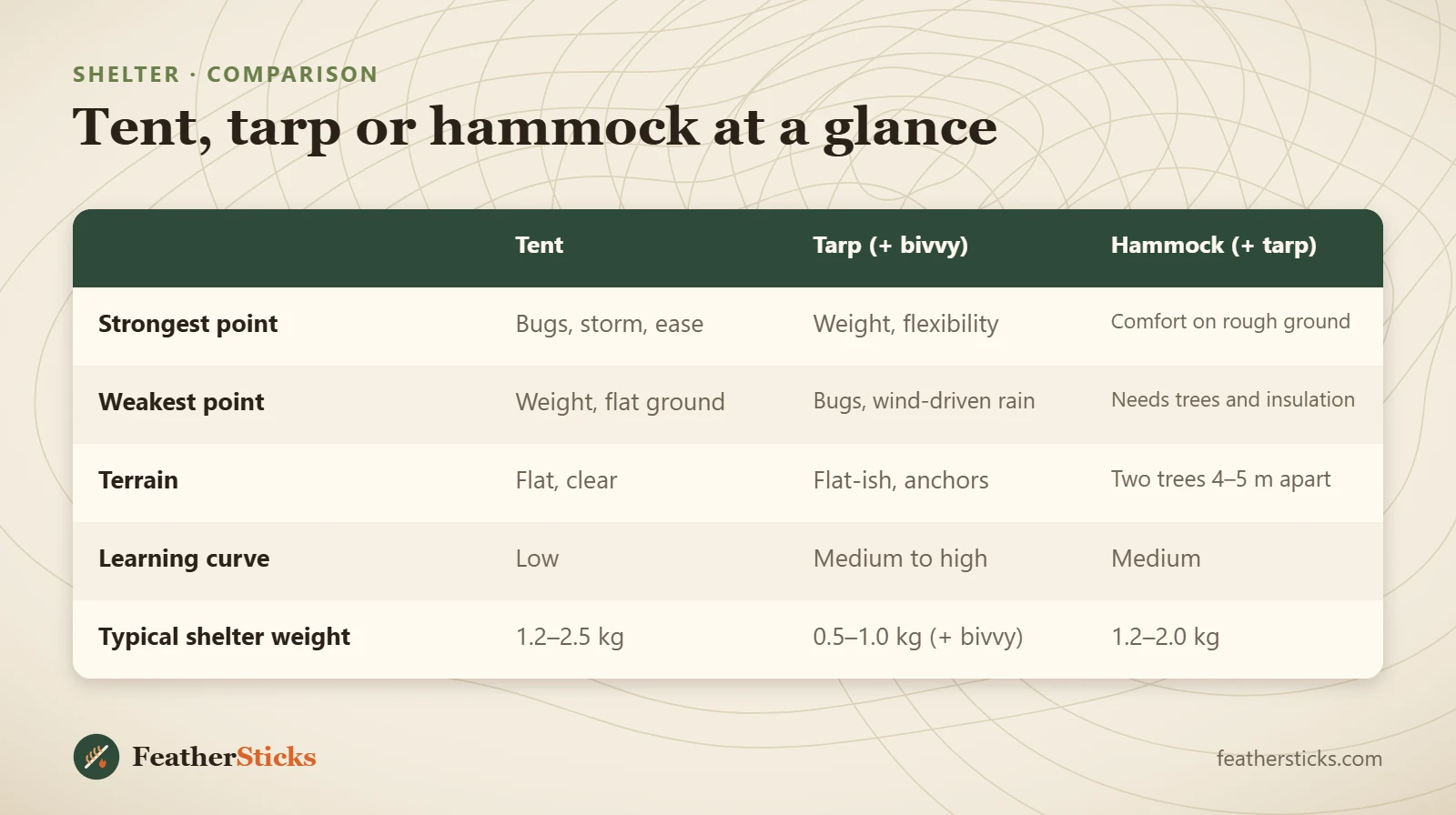
| Tent | Tarp (+ bivvy) | Hammock (+ tarp) | |
|---|---|---|---|
| Strongest point | Bugs, storm, ease | Weight, flexibility | Comfort on rough ground |
| Weakest point | Weight, flat ground | Bugs, wind-driven rain | Needs trees and insulation |
| Terrain | Flat, clear | Flat-ish, anchors | Two trees 4–5 m apart |
| Learning curve | Low | Medium to high | Medium |
| Typical shelter weight | 1.2–2.5 kg | 0.5–1.0 kg (+ bivvy) | 1.2–2.0 kg |
Common mistakes
- Choosing a system for how it looks, not for your terrain: a hammock without suitable trees, or a tent with no flat spot.
- Buying the lightest option before learning the basics, and then freezing or getting soaked on the first wet night.
- Ignoring the ground: a pad that is too thin or an underquilt that is missing makes any system cold.
- Pitching a tarp with a high windward edge so wind-driven rain reaches the sleeping bag.
- Hanging a hammock tight like a washing line instead of at about 30° with a deep sag.
- Tying thin cord around living trees instead of using wide straps.
- Cooking or sitting by a fire right next to a tent wall: fabric melts and burns.
- Not checking site rules, so the shelter is the wrong kind for the area.
What you need
- Tent, tarp or hammock with matching stakes and guylines
- Pad (R-value for the night low) or underquilt
- Bivvy bag for tarp sleepers (optional)
- Wide tree straps if you hang a hammock
- Ground sheet for tarp and tent
- Cord for ridgelines and guylines
- Repair tape and a needle with strong thread
FAQ
Is a hammock better than a tent?
Is a tarp warmer than a hammock?
Can I use a tarp instead of a tent?
Which shelter is best for a beginner?
Do I need a tarp with a hammock?
What do I sleep on in a hammock?
Is wild camping with a tarp or hammock legal?
How heavy is each shelter system?
Check yourself
Completed6 quick questions from this guide. Nothing is sent anywhere.
Related step-by-step guides
-
 1
-
 1
-
 1