Thunderstorms & Lightning Safety Outdoors: Camping and Hiking Guide
Lightning safety when camping and hiking starts with one honest fact: in a thunderstorm, there is no safe place outdoors. Tents, tarps, trees and caves do not protect you; only a solid building or a closed hard-top car does. Everything else is about reducing risk – and the biggest reduction comes from acting early, long before the first strike is close.
This guide shows what to do in a thunderstorm outdoors: how to read forecasts and warning signs, how to count flash to thunder and apply the 30-30 rule, which terrain to leave, what to do with trekking poles and a group, why the lightning crouch is only a last resort, how to choose a camp in storm season and how to help someone who has been struck. It builds on reading the weather and is part of the core bushcraft skill set.
Step by step
-
1

Check forecast and storm warnings
Read the official forecast and warnings before you go. On storm days, plan to be off summits, ridges and open water by early afternoon.
-
2

Watch the sky from late morning
Cumulus growing taller than wide, hard cauliflower towers or an anvil top mean storms are building. Change the plan now, not at the first thunder.
-
3

Count from flash to thunder
About 3 seconds per kilometre. Under 30 seconds the storm can reach you: move to lower, less exposed ground at once.
-
4

Get off ridges and summits early
Descend from peaks, ridges and open slopes towards lower terrain and, if possible, a building or car. Leave via-ferrata cables and metal fences behind.
-
5

Avoid lone trees, water and metal
Never shelter under an isolated tree, mast or rock pinnacle. Get out of water, away from wire fences, put poles away and spread the group out.
-
6

Help a struck person at once
Lightning victims carry no charge. Call 112, check breathing and start CPR if they are not breathing normally.
Why no place outdoors is safe in a thunderstorm
A lightning flash carries an enormous current for a tiny fraction of a second, and it does not need to hit you directly to hurt you. Lightning safety guides from weather services and alpine clubs describe several ways people are injured: a direct strike; a side flash, where current jumps from a struck tree or pole to a person standing next to it; contact with something that is struck, such as a wire fence or a via-ferrata cable; and ground current, where the current spreads through the surface and through the legs of anyone standing or lying within reach.
Because of these paths, there is no spot outdoors where you are protected. A tent, a tarp, a picnic shelter, a hut without a lightning protection system, a rock overhang or a shallow cave all leave you exposed. What you can control is how likely a strike is to reach you – by timing, terrain and posture. That is why this whole article is about reducing risk step by step, and why leaving early always beats any trick on the spot.

Before you go: forecasts, warnings and a storm-proof plan
The most effective lightning protection is never being on a ridge when the storm arrives. In much of Europe and North America, summer thunderstorms build on warm, humid afternoons, and in the mountains they often develop faster than in the lowlands. Thunderstorms also come with cold fronts, which can arrive at any time of day or night. Read the forecast from your national weather service the evening before and in the morning, and check its warnings: many services publish thunderstorm warnings by district, often with timing.
Then build the day around it. Start early, put exposed sections (summits, ridges, long open plateaus, lakes) in the morning, and set a turnaround time – for example "off the ridge by 1 pm" – that you keep even if the sky still looks harmless. Mark escape routes on the map: paths that drop quickly into a valley or forest, huts, car parks and villages. The hiking time calculator shows how long a descent really takes, and the trip planning guide covers route plans and leaving details with someone at home.
| Forecast says | Plan | Exposed terrain |
|---|---|---|
| Isolated thunderstorms possible in the afternoon | Early start, turnaround time, escape routes ready | Mornings only |
| Thunderstorms likely, warnings issued | Shorter, lower route near buildings or cars | Avoid summits, ridges and open water |
| Severe thunderstorm warning (large hail, storm gusts) | Postpone or choose a route with real shelter | Avoid; skip forest camps too |
| Cold front with thunderstorms | Know when the front arrives; storms can come at night | Off exposed ground well before the front |
Warning names and levels differ between countries. Use the official national service where you are.
Thunderstorm warning signs while hiking
Forecasts cover large areas; the storm that hits your valley shows itself in the sky. The classic sequence is described in detail in thunderstorm warning signs: small flat cumulus in the morning, clouds that grow taller than they are wide by late morning, hard, bright cauliflower towers by midday, and finally the mature cumulonimbus with a flat, spreading anvil, a dark base and thunder. Each stage is a signal to change the plan – the earlier you react, the more options you have.
Signs that a storm is close
- Cumulus towering fast by midday
- Storms likely within hours – start your descent
- Dark base, anvil top, sudden cool gusts
- Storm is mature and near – leave exposed ground now
- Distant rumbling, flicker on the horizon
- You may already be within reach – count and move
- Hair standing up, buzzing from metal, tingling skin
- Strike may be imminent – crouch at once (last resort)
Do not let the sun overhead fool you. Lightning can strike well away from the rain shaft and ahead of a storm, from what looks like a clear sky. Many weather services sum it up simply: if you can hear thunder, you are within reach of lightning. At night, flashes on the horizon without audible thunder are worth watching too – note the direction and whether they come closer.
How far away is the storm? Flash-to-bang and the 30-30 rule
Light arrives almost instantly; sound travels at roughly 343 m per second, or about 1 km in 3 seconds. Count the seconds between the flash and the thunder and divide by 3 to get the distance in kilometres (divide by 5 for miles). Count steadily ("twenty-one, twenty-two…") or use the second hand of a watch. The thunderstorm distance calculator does the maths and, with a second count a few minutes later, tells you whether the storm is approaching.
Counting flash to bang
 1Start at the flash
Start counting the moment you see the flash, even if it is only a flicker in the clouds. Pick one flash and stay with it – thunder from several strikes can roll together.
 2Stop at the first thunder
Stop at the first sound of thunder, not at the loudest crack. Wind, rain and terrain can muffle distant thunder, so a long count is not a guarantee of safety.
 3Divide by 3 and act
Twelve seconds means about 4 km. Under 30 seconds the storm is roughly 10 km away or closer and within reach: move now. Then wait 30 minutes after the last thunder before going back to exposed ground.
| Seconds | Distance (approx.) | What to do |
|---|---|---|
| 60 s or more | 20 km or more | Watch the sky, count again in a few minutes, prepare to descend |
| 30–60 s | 10–20 km | Start moving to lower, less exposed terrain now |
| Under 30 s | About 10 km or closer | Within reach: no exposed ground, spread out, poles away |
| Under 10 s | About 3 km or closer | Storm is overhead: lowest risk position you can reach, crouch if a strike seems imminent |
The 30-30 rule as commonly cited has two parts: under 30 seconds between flash and thunder, seek the best protection available; and wait 30 minutes after the last thunder before you return to ridges, open ground or water, because the trailing edge of a storm still produces strikes. Many weather services now prefer the stricter version – any audible thunder means act – and that is the safer habit. Use the 30-second mark as the latest point to act, not the first.
Where to go: terrain that raises or lowers your risk
Lightning tends to strike high, isolated points and anything that sticks out of its surroundings. That makes a few places outdoors clearly worse than others – and some a little less bad. Plan your escape from the worst places first.

| Place | Risk | Why |
|---|---|---|
| Summit, ridge, open plateau | Very high | You are the highest point around |
| Under a lone tree, mast or rock pinnacle | Very high | Frequent strike point; side flash and ground current |
| On or in water, on the shore, beach | Very high | Open, flat and exposed; no cover |
| Next to wire fences, cables, rails, via ferrata | Very high | Current travels long distances along metal |
| Open field or meadow | High | You stick out; ground current spreads |
| Forest edge next to open ground | High | Edge trees are exposed like lone trees |
| Inside forest of uniform tree height, lower ground | Lower, not safe | No single tree stands out; keep distance from trunks |
| Valley floor or depression (no gully) | Lower, not safe | Below surrounding terrain; mind flash floods |
| Closed hard-top car, solid building | Relatively safe | Metal body or building protection carries current around you |
Forest: less bad, not safe
Dense forest where the trees are of similar height spreads the risk: no single tree is an obvious target. If you are caught in woodland, move away from the tallest trees, the forest edge and lone giants, keep at least a few metres from any trunk and from low branches, and stay off ridges within the forest. Forest does not make you safe – trees are still struck and side flashes still happen – but it is better than open ground or an isolated tree.
Mountains and via ferrata
On a ridge or summit, every minute counts. Descend at once, away from the crest and from steel cables and ladders. Gullies, narrow couloirs and wet rock channels can carry current along water and are prone to rockfall in heavy rain, so do not use them as shelter. Overhangs and shallow caves are not safe either: current can jump across the opening. Huts with a lightning protection system are the right target, and alpine clubs advise planning tours so that you are there before the typical afternoon storms.
Water
If you are swimming, paddling or fishing, get out and away from the shore as soon as you hear thunder. A canoe or SUP on a lake makes you the highest point on a flat surface. Wet ground, streams and boggy meadows also carry current over wider areas.
What to do in a thunderstorm outdoors when you are caught
Sometimes the storm is faster than the plan. If you cannot reach a building or car before the count drops under 30 seconds, work through the following, in this order: lower terrain, away from isolated objects and water, metal away, group spread out – and the crouch only when a strike seems imminent.
Reducing risk when you cannot reach shelter
 1Poles and metal away
Collapse trekking poles and lay them on the ground a few metres away, together with an ice axe or a pack with a metal frame. Metal does not "attract" lightning, but it can carry current to you.
 2Spread the group
Keep several metres apart – about 15 m is often recommended – so one strike or its ground current cannot injure everyone, and the others can give first aid. Stay within sight and earshot.
 3Insulate from the ground
Put a closed-cell sit pad, a folded foam mat or a rucksack without metal parts under your feet. It may reduce ground current a little – no more than that.
 4Crouch as a last resort
If a strike seems imminent (hair standing up, buzzing, tingling): crouch on the pad, feet together, head down, hands over your ears. Never lie flat – it increases contact with the ground.
Why feet together and why not lying down
Ground current flows through the surface outwards from a strike point. If your feet are apart, the current can use your legs as a shortcut between two points on the ground; with feet together that difference is small. Lying down does the opposite – your whole body touches the ground over its full length. The crouch also makes you lower, but it is tiring to hold and offers limited protection. Many experts stress it as a last resort, not a strategy: moving to lower, less exposed terrain is more effective as long as you still can.
Trekking poles, metal and electronics
Height and isolation matter more than metal, so a phone or a watch on your wrist makes no measurable difference – keep your phone for the emergency call. Long metal objects held up into the air, like a raised trekking pole, an ice axe on the pack or a fishing rod, make you taller and can carry current. Put them down and away. More about pole use in normal conditions is in using trekking poles.
Groups, children and dogs
The group leader decides early and clearly. Brief everyone in the morning on the turnaround time and the crouch, so nobody has to learn it in heavy rain. Keep children close enough to call to but not touching each other, and keep a dog on a lead at your side rather than letting it run onto open ground – see bushcraft with kids for more on safety rules in groups.
Thunderstorms at camp: tents, tarps, hammocks and cars
A thunderstorm at night in the tent is unsettling, and the honest answer is that a tent, tarp or hammock gives no protection from lightning. The pole material does not turn a tent into protection either way – the tent simply does nothing to stop the current – but keep metal poles away from your body, as in any storm. What protects you is choosing a site in storm season that is not a strike point and, when a severe storm is forecast, considering not camping in the forest at all.

Camp site check in thunderstorm season
- Not on a summit, ridge, open plateau or exposed spur
- Not under or next to a lone tree or the tallest tree in the area
- Not at the forest edge next to open ground
- Not in a dry stream bed, gully or narrow valley floor that can flood
- No dead trees or large dead branches overhead (storms bring them down)
- Away from wire fences, power lines and long metal structures
- Know the way to the nearest car or building, even in the dark
The full method for picking a spot is in choosing a camp site for thunderstorms; for the gusts that come with storms, see camping in strong wind, and for long wet spells camping in the rain. A low, well-tensioned tarp survives storm gusts better than a high pitch, but it changes nothing about the lightning risk.
If the storm reaches your tent
If a car or building is close and the storm is still more than 30 seconds away, go there. If not, stay in the tent rather than walking around in the open: sit or crouch on your sleeping pad, off the ground as far as possible, keep away from the poles and the tent walls, and keep your boots on and ready. In a group, people in different tents are already spread out. A hammock lifts you off the ground but is hung between two trees – in a storm, leave it and crouch on a pad on the ground at a distance from the trunks.
Cars: relatively safe
A closed car, van or bus with a metal roof works like a cage: the current flows around the outside of the body into the ground. Close the windows and doors, sit back and do not touch metal parts, the door frame or the steering column. Convertibles, soft-top vehicles, plastic-bodied vehicles, motorbikes and bicycles give no protection. If you parked at the trailhead, the car is often the best destination of a storm-day descent.
First aid after a lightning strike
A person struck by lightning does not carry an electrical charge and can be touched immediately. Lightning often stops the heart or breathing, and quick help can make a real difference. The steps below follow general first aid principles; they do not replace a first aid course – an outdoor or wilderness first aid course is the best preparation.
Helping someone struck by lightning
 1Go to them – they are safe to touch
Do not wait. If the storm is still active, move yourself and the casualty only as far as needed to a less exposed spot; lightning can strike the same place again.
 2Call 112
Call 112 (Europe; 911 in North America, 999 or 112 in the UK). Say where you are, what happened and how many people are hurt. See emergency signals if you have no signal.
 3Check breathing
Speak to the person and check whether they are breathing normally. If they are breathing but unresponsive, put them in the recovery position and keep checking.
 4No normal breathing: start CPR
Start chest compressions in the middle of the chest, about 100–120 per minute, as taught in first aid courses. The dispatcher can guide you. Use an AED if one is available.
With several casualties, first aid courses for lightning incidents usually teach to help those who are not breathing first – people who are conscious and talking are very likely to survive, while a stopped heart needs help within minutes. Afterwards, treat burns gently (cool, cover; see burns), protect the casualty from rain and wind with a jacket, a pad and an emergency blanket, because shock and wet clothing quickly lead to hypothermia. Anyone who was struck or close to a strike should see a doctor, even if they feel fine: hearing, eye, heart and nerve injuries are not always obvious at first.
After the storm: hail, flash floods and falling branches
Lightning is not the only danger a thunderstorm brings. Wait at least 30 minutes after the last thunder before you go back to exposed ground – and keep an eye on the following hazards during and after the storm.

- Hail: protect your head and neck with a rucksack or the hood of a jacket. Large hail is painful and can injure; get under a solid roof or into a car if one is close, otherwise crouch with your back to the wind.
- Flash floods: heavy storm rain can turn a dry stream bed, gully or small valley into a torrent within minutes, even if it does not rain where you are. Never camp or wait out a storm in such places, and do not cross a stream that is rising or brown with mud – wait until it falls.
- Falling branches and trees: storm gusts break dead wood and uproot shallow-rooted trees on soaked ground. Damaged trees keep falling for hours or days afterwards. Check overhead before you walk on through woodland, and read about widowmakers before choosing a camp after a storm.
- Cold: storms often bring a sharp drop in temperature. Wet clothing plus wind cools the body fast – change into dry layers early.
Lightning myths that put people at risk
| Myth | Reality |
|---|---|
| "Shelter under a tree, it keeps the rain off." | Isolated trees are frequent strike points. Side flash and ground current injure people under and next to them. |
| "Some tree species are safe" (old rhymes about oaks and beeches) | No tree species is safe. Any tree that stands out can be struck. |
| "Lightning never strikes the same place twice." | It often does – tall, exposed objects are struck again and again. |
| "Rubber soles or tyres protect you." | A few millimetres of rubber mean nothing to lightning. A car protects through its metal body, not its tyres. |
| "If it is not raining, I am safe." | Lightning can strike far from the rain. If you can hear thunder, you are within reach. |
| "Lie flat to be as low as possible." | Lying increases ground contact. Crouch with feet together on a pad – and only as a last resort. |
| "A struck person is still electrified." | Lightning victims carry no charge. Touch them and help at once. |
Many myths contain a misunderstood grain of truth. Metal does conduct current, which is why fences and cables are dangerous – but small metal items do not "pull" lightning towards you. Low places are better than high ones – but lying flat in a wet meadow is not a good way to get low.
Storm decisions on the trail: a quick guide
Thunder on the trail: what now?
Can you reach a building or closed car before the count drops under 30 seconds?
Yes → Go there now and stay until 30 minutes after the last thunder.No → Go on to the next question.Are you on a summit, ridge, open slope, in or near water, or next to metal?
Yes → Leave immediately towards lower, less exposed ground.No → Go on to the next question.Are you under or near a lone tree or at the forest edge?
Yes → Move away into lower ground or uniform forest, keeping distance from trunks.No → Stay low, put poles away, spread the group about 15 m apart.Hair standing up, buzzing or tingling?
Yes → Crouch on a pad at once: feet together, head down, hands over ears.No → Keep counting; move on when the last thunder is 30 minutes ago.
Lightning safety is mostly a planning skill: start early, read the sky, know your escape routes and turn around in time. Combine it with map and compass navigation so you can find the fastest way down in poor visibility, check sunset with the daylight calculator when a storm delays you, and browse all bushcraft skills for more.
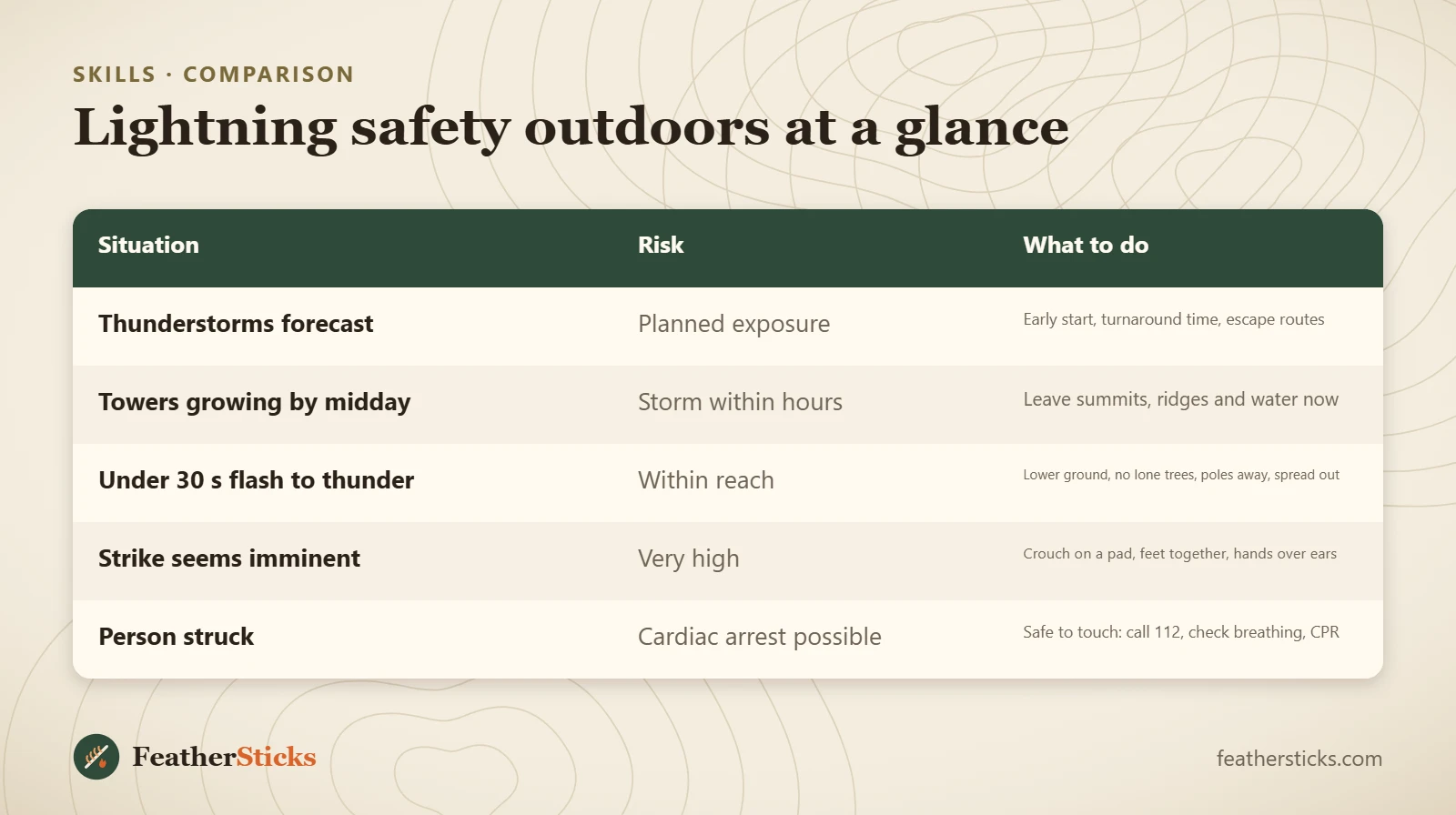
| Situation | Risk | What to do |
|---|---|---|
| Thunderstorms forecast | Planned exposure | Early start, turnaround time, escape routes |
| Towers growing by midday | Storm within hours | Leave summits, ridges and water now |
| Under 30 s flash to thunder | Within reach | Lower ground, no lone trees, poles away, spread out |
| Strike seems imminent | Very high | Crouch on a pad, feet together, hands over ears |
| Person struck | Cardiac arrest possible | Safe to touch: call 112, check breathing, CPR |
Common mistakes
- Waiting for the first thunder before leaving a summit or ridge.
- Sheltering under a lone tree, a rock overhang or in a shallow cave.
- Believing a tent or tarp protects you from lightning.
- Huddling together as a group instead of spreading out.
- Lying flat on the ground instead of crouching with feet together.
- Returning to exposed ground as soon as the rain stops instead of waiting 30 minutes.
- Camping in a dry stream bed or gully in thunderstorm season.
What you need
- Forecast and warning app, downloaded before you lose signal
- Watch to count flash to thunder
- Closed-cell sit pad (also for the lightning crouch)
- Rain jacket and a dry warm layer
- Map with escape routes, huts and car parks marked
- First aid kit and emergency blanket
- Charged phone for the 112 call
Calculators for this topic
FAQ
What should I do in a thunderstorm while hiking?
Is it safe to stay in a tent during a thunderstorm?
What is the 30-30 rule for lightning?
How do I tell how far away a thunderstorm is?
Is the forest safe in a thunderstorm?
Should I lie down during a thunderstorm?
Can you touch someone who has been struck by lightning?
Am I safe in a car during a thunderstorm?
Check yourself
Completed6 quick questions from this guide. Nothing is sent anywhere.
Related step-by-step guides
-
 1
-
 1
-
 1