Sleeping Under a Rock Overhang: Natural Shelters, Hazards & Rules
Sleeping under a rock overhang can be dry, quiet and wind-sheltered — but only if the roof is solid, no water runs through, sleeping there is allowed and you insulate yourself from the cold rock. Natural shelters such as overhangs, large boulders, the root plates of fallen trees and dense conifers save you building time, yet each comes with its own hazards, from rockfall to flash floods. Caves are a different matter: they are no place to sleep.
This guide shows how to read a natural shelter, how to check the roof and the floor, why fire under rock is a bad idea, what the German Boofen tradition really allows and how a tarp turns an overhang into a good emergency camp. For everything else about sleeping outside, visit the shelter hub or start with our bushcraft basics.
Step by step
-
1

Know the rules and the type
Check that sleeping there is allowed and choose a solid overhang, boulder or dense conifer stand. Never sleep in a cave.
-
2

Inspect roof and floor
Look for cracks, loose blocks and fresh, light-coloured debris on the ground. If anything looks doubtful, move on.
-
3

Check water and weather
Sleep inside the drip line on a dry floor, away from runoff and gullies. An overhang gives no protection from lightning.
-
4

Insulate from the cold rock
Put a pad plus leaves or your pack between you and the ground. Rock draws heat from your body all night.
-
5

Add a tarp, leave no trace
Hang a tarp at the front against wind and rain, light no fire and leave the place exactly as you found it.
Which natural shelters are there?
A natural shelter is anything the landscape already provides that blocks rain, wind or both: a rock roof, the lee of a boulder, the upturned roots of a fallen tree or the dense lower branches of conifers. Using one is faster than building a debris shelter and has less impact than cutting material. The trade-off is that you do not control the structure — nature built it, and nature may still be working on it.
Judge every natural shelter with the same questions you would ask on any camp site: what can fall on me, where does water go, how cold is the ground, and am I allowed to be here?

| Type | Protects from | Main hazards | Best use |
|---|---|---|---|
| Rock overhang | Rain from above, often wind | Rockfall, runoff, cold rock, lightning | Designated sites; emergency roof with a tarp in front |
| Undercut boulder | Wind from one side, some rain | Rockfall, unstable blocks on slopes | Windbreak for a short stop or an emergency night |
| Root plate of a fallen tree | Wind from one side | Plate can tip back into the pit, wet pit, insects | Windbreak only; never sleep in the root pit |
| Dense conifers | Light rain, wind, some cold | Dead branches, drips once saturated, fire risk in needle litter | Tarp or bivvy camp under healthy trees |
| Cave | Rain and wind | Disturbing bats, getting lost, cold, flooding, CO with fire | Not for sleeping |
Rock overhangs and boulders
Overhangs form where softer rock weathers back below a harder layer — typical in sandstone, limestone and conglomerate. The same process that created the roof is still going on: frost, water and roots keep loosening grains and blocks. A large, undercut boulder in a forest gives a similar but smaller lee. On slopes, check that the boulder itself is stable and not resting on a few small stones.
Root plates of fallen trees
When a spruce or beech is blown over, its flat root system stands up like a wall of soil, with a pit in front of it. The plate makes a good windbreak. But it is held only by the weight of the trunk: if the trunk is sawn off, rots or shifts, the plate can tip back into the pit. Never sleep in the pit or under the plate — camp on the trunk side, on level ground, and use the plate only as a wall against the wind.
Dense conifers
Under a dense spruce or fir, the ground often stays dry in a light shower, and the branches break the wind. Look up first for dead branches and leaning dead trees (the classic "widowmaker"), and remember that once the needles are saturated, the drips go on long after the rain stops. A small tarp under the trees is still the better roof — see our tarp shelter setups.
Is it safe to sleep under a rock overhang? Checking for rockfall
Rockfall is the main risk of sleeping under a rock overhang, and it cannot be ruled out completely. Most rockfall is triggered by water, frost and thaw, roots and strong wind — which is exactly the weather in which you want a roof. Many overhangs stand for centuries; others shed blocks every winter. Your job is to spot the signs of an active roof and walk away from it.
The four-minute roof check
 1Read the floor first
Fresh debris is light-coloured, sharp-edged and lies on top of leaves or moss. Old, rounded, mossy blocks are less alarming; fresh fragments under the roof mean the roof is active.
 2Scan the roof with a torch
Look for open cracks, blocks separated by a dark gap, flaking slabs and roots growing into fissures. Only look — never pry, hammer or pull at loose rock to "test" it.
 3Look above the lip
Step back and check what is above the overhang: loose boulders, trees rooted at the edge, a steep slope or a climbing route. Stones from above land in front of and under the lip.
 4In doubt, move on
If you see fresh debris, open cracks or loose blocks, do not sleep there. A tarp in the open forest is safer than a roof you are unsure about.
Where to lie under the roof
Even under a solid overhang, position matters. Stones falling from above the cliff land in front of the lip and just inside it, and rain drips from the lip. Lie well inside the drip line, but not tight against the back wall, where water often seeps out and cold air collects. Keep your head towards the back so a stone bouncing in from the front would hit your feet first.

Water, flash floods and lightning
A rock roof keeps rain off from above, but water also comes from the sides and from below. Rain runs over the cliff and drips from the lip, seeps out of the back wall and flows across the floor. In valleys, overhangs often sit at the edge of a gully or a dry streambed — a natural channel that can fill within minutes after a cloudburst upstream.
Three water checks
 1Find the drip line
The line where water drops from the lip is usually visible as a strip of wetter soil, a row of small craters or a gap in the dry dust. Sleep clearly inside it.
 2Read the back wall and floor
Dark streaks, green algae and moss on the back wall show where water seeps out. Fine sediment, washed-out channels and leaf drifts on the floor show where it runs.
 3No gullies, no storm refuge
Never sleep in a gully, dry streambed or narrow ravine, and never rely on an overhang in a thunderstorm. Current can jump across the opening of overhangs and shallow caves.
Lightning: overhangs do not protect you
It is tempting to crawl under a rock roof when a thunderstorm arrives. But overhangs and shallow caves are not lightning shelters: a strike on the cliff can arc across the opening or travel through the ground and wet rock, and you are in the path. If a storm is forecast, plan to reach a building or a hard-top car, or follow the risk-reduction steps in our lightning safety guide. Check the weather signs and the forecast before choosing a rock shelter for the night.
Flash floods are the second weather danger. A storm you cannot even see can send a wall of water down a dry channel. Sleep at least a few metres above the highest flood debris you can find — branches jammed in the rocks, lines of sand or dried mud — and never in the lowest part of a valley.
Should you use this overhang tonight?
Is sleeping here allowed (designated site, landowner permission or genuine emergency)?
Yes → Continue to the next question.No → Move on — see wild camping rules for legal options.Is there fresh debris, an open crack or a loose block?
Yes → Do not sleep here; pitch a tarp in safer terrain.No → Continue to the next question.Is it in a gully, dry streambed or below a runoff channel?
Yes → Do not sleep here; move to higher, open ground.No → Continue to the next question.Are thunderstorms or heavy rain forecast?
Yes → Choose a hut, a building or a safer camp; an overhang is no refuge.No → Use it — inside the drip line, insulated and without fire.
Cold rock: why overhangs feel colder than expected
Many people expect a rock shelter to be cosy and wake up chilled. Rock and stony ground conduct heat away from your body much faster than air, and a large rock mass stays cool long after a warm day. Cold air also flows downhill and pools in hollows and at the base of cliffs. Without insulation underneath, a rock floor steals warmth all night, even in summer.
The fix is the same as on any ground: insulation below you matters more than cover above you. Use a closed-cell or inflatable pad, and add a layer of dry leaves, grass or your empty pack underneath. Our camp bed guide explains how thick a natural bed needs to be; as a rule of thumb, compressed leaves of 20–30 cm under a sleeper make a real difference. The sleeping bag calculator helps you match pad and bag to the expected low, and the sleeping gear guide explains R-values.
Sleep system under rock (top = above you)
- Keeps off rain from above — check it first.
- Dry base layers, hat; keep sweaty clothes out of the bag.
- The most important layer on cold rock.
- Extra insulation and padding, collected loosely and scattered again in the morning.
- Keeps damp sand and dust away from your gear.
- Draws heat from you all night.
Is it safe to sleep in a cave? Why caves are off-limits
No — sleeping in a cave is not a good idea, and in many places it is not allowed. Shallow rock shelters that are open to daylight are one thing; real caves that run back into darkness are another. They combine natural hazards with strict nature protection.

Bats hibernate in caves
Many bat species spend the winter hanging in caves, mines and rock crevices, where the temperature stays cool but frost-free. In hibernation their body temperature drops and they live on fat reserves. Every disturbance — light, voices, warmth, smoke — can wake them, and each awakening burns reserves they cannot replace before spring. In Europe all bat species are strictly protected, and disturbing them in their winter roosts is prohibited; in Germany this follows from federal nature conservation law. Many caves are therefore closed or gated in winter, often from about October to April. Respect signs and gates, and do not enter caves for shelter at any time of year.
Air, fire and carbon monoxide
Air in caves does not always circulate well. A fire, stove or candle produces carbon monoxide, an odourless gas that can build up to dangerous levels in an enclosed space; some caves also collect carbon dioxide in low spots. Smoke stays trapped under the ceiling. Never burn anything in a cave.
Getting lost, cold and floods
Caves are dark, branch unexpectedly and stay cool all year. Without proper equipment, training and someone who knows the system, it is easy to get disoriented, injured or stuck — and phones do not work underground. Some caves flood quickly in heavy rain. Caving is a sport with its own clubs, gear and rules; a bushcraft overnight is not the time to try it.
Fire under a rock overhang: why you should not
A campfire under a rock roof looks romantic in pictures. In reality it is one of the most damaging things you can do in a natural shelter, and it is often prohibited. Leave the fire out.

| Effect | Why it matters |
|---|---|
| Soot on the roof | Black stains stay for decades, destroy lichens and can cover rock art and archaeological traces |
| Heat damage to the rock | Heat makes sandstone and other rock flake and crumble; the roof can loosen over time |
| Bursting stones | Moisture trapped in porous rock and river stones can turn to steam and make them crack or spall violently |
| Smoke and CO | Smoke collects under the roof; in deep, enclosed shelters carbon monoxide can build up |
| Fire spread | Dry leaves, needles and roots in and above the shelter catch easily; fire can creep into crevices |
| Legal trouble | Fire is banned in most protected areas and at designated rock shelters, including the Boofen in Saxon Switzerland |
If you need hot water, use a small stove outside the overhang, in the open, on bare ground and only where stoves are allowed — see our camp stove guide and the general fire safety rules. Better still, bring a thermos of hot drink from home. Warmth at night comes from your sleep system and dry clothes, not from a fire you have to watch.
Boofen in Saxon Switzerland: the German overhang tradition
In the sandstone mountains of Saxon Switzerland, south-east of Dresden, sleeping under rock overhangs has a long tradition. Climbers call it Boofen, and the overhangs used for it are Boofen (singular Boofe). The tradition goes back to climbers who spent the night close to their routes.
Today much of the area is a national park, and overnight stays under rock are strictly regulated. In general terms, sleeping out is permitted only at designated Boofen, it is traditionally tied to climbing, and fire is forbidden. Parts of the national park are closed entirely, some sites have seasonal restrictions to protect breeding birds, and the rules are set and changed by the national park administration. Bohemian Switzerland on the Czech side has its own, separate rules.
If you plan to sleep at a designated Boofe
- Check the current national park rules and the list of permitted sites before the trip
- Use only a designated, marked site — not any overhang that looks suitable
- No fire, no candles, no grill; cook with a stove only where permitted, or eat cold
- Bring a pad, sleeping bag and head torch; sandstone floors are cold and dusty
- Pack out everything, including food scraps and toilet paper
- Keep quiet, especially at dusk and dawn, and stay on marked paths
Outside such designated places, sleeping under rock follows the general rules for sleeping outdoors, which in Germany depend on the federal state and on whether you are in a protected area. Our overview of wild camping in Germany explains the framework, and the bivouac guide covers the difference between a tent and a simple night under the sky. Elsewhere, national access rules apply — rules differ by country, and this is not legal advice.
Natural shelters in an emergency
In a genuine emergency — injured, lost, caught by darkness or weather — a natural shelter can buy you a much better night. Rules about camping matter less than getting through the night safely, but the hazards do not change: a cracked roof or a gully is just as dangerous at 2 a.m. as at noon. Our guide to an unplanned night outdoors covers the full routine; here is how natural shelters fit in.
Emergency routine with a natural shelter
- Stop early Decide while there is still light. Check sunset with the daylight calculator when planning and keep at least an hour of daylight to find and check a spot.
- Call for help if needed If someone is hurt or you cannot get out safely, call 112 in Europe. Use a whistle and torch to signal — see distress signals.
- Pick the safest option, not the cosiest A root plate as windbreak or a stand of dense conifers is often safer than a doubtful overhang.
- Get off the ground Sit or lie on your pack, a pad, rope, leaves or spruce litter. Insulation underneath comes first.
- Close the windward side Use an emergency blanket, a tarp, your pack or dead branches to block the wind at the front.
A head torch makes the roof check possible after dark and is one of the most important items in any day pack. If you are alone, read our tips on solo safety and always leave a route plan with someone.
Improving a natural shelter with a tarp
A natural shelter rarely works perfectly on its own. Overhangs are open at the front, boulders shelter only one side and conifers drip. A small tarp of about 2 × 3 m, a groundsheet and a few metres of cord turn them into a comfortable camp without changing the site.
Upgrading an overhang without leaving marks
 1Groundsheet, leaves, pad
Clear loose stones by hand, lay a groundsheet and add loose leaves or grass under your pad. Do not dig or level the floor — in many shelters the soil is an archaeological layer.
 2Tarp as a front curtain
Hang a tarp at the open front against driving rain and wind. Tie it to trees or roots outside the shelter or weigh the edges down with loose stones. Never drill, bolt or hammer pegs into the rock.
 3Stove outside, no campfire
Cook in the open in front of the shelter, at least 3 m from a synthetic tarp, only where stoves are allowed. No fire under the rock.
 4Leave it as you found it
Untie everything, scatter the leaves where you found them, put stones back and check for micro-litter. The next visitor should not see that you were there.
Pitch the tarp so it sheds water away from the shelter, not into it. A low, angled pitch on the weather side works best; our tarp pitch planner suggests a configuration for the wind and rain you expect. For fabric and sizes, see choosing a tarp, and for nights with steady rain the tips in camping in the rain apply under rock too. A comfortable sit pad and a small light make a long evening under an overhang much more pleasant — see camp comfort.
Leave no trace at rock shelters
Rock shelters are concentrated, fragile places. Lichens and mosses on the rock grow extremely slowly, the dry floor may hold archaeological remains, and many shelters are home to insects, birds and bats. Because so many visitors use the same few overhangs, small impacts add up fast. The general Leave No Trace principles apply with extra force here.
Do and don’t at rock shelters
Do
- Use designated or permitted sites only
- Sleep on a pad and groundsheet
- Use a stove outside, in the open, where allowed
- Pack out all waste, including food scraps
- Use toilets or go at least 60 m from water and the shelter
- Keep quiet and keep lights low at dusk
Don’t
- Light fires or candles under the rock
- Dig, level or build stone walls
- Scratch, carve, chalk or paint the rock
- Collect stones, bones or artefacts
- Enter caves or gated areas
- Cut branches or strip moss for bedding
If you find old fire rings, litter or graffiti, do not add to them. Report damage to the landowner or protected-area administration where possible. Animals such as foxes, badgers and martens may use the same shelters, and ticks are common in leaf litter at the entrance — store food sealed, see wildlife encounters and check yourself for ticks in the morning as described in tick protection.
Problems under rock and how to fix them
| Symptom | Likely cause | Fix |
|---|---|---|
| Cold from below all night | Pad too thin, stone floor | Add leaves, rope or your empty pack under the pad; next time bring a warmer pad |
| Damp sleeping bag by morning | Seepage from the back wall, condensation on cold rock | Move away from the back wall; keep a gap between bag and rock |
| Drips on your feet | Lying in the drip line | Move further inside or hang a tarp along the lip |
| Sand and grit everywhere | Dusty sandstone floor | Use a groundsheet; keep gear in bags |
| Small stones falling during the night | Active roof, frost or rain loosening grains | Leave the overhang as soon as it is safe to move; do not go back |
| Rustling and visitors at night | Mice, martens or foxes after food | Seal food, keep it away from your head, clean up crumbs |
Practice drill: read three overhangs
On a day hike, find three overhangs or boulders and spend five minutes on each with the roof check and the water check, without sleeping there. Note fresh debris, drip lines and seepage, and decide where you would lie — or why you would not. After a few such checks, judging a natural shelter becomes quick and reliable. Navigation practice fits well with this; see map and compass navigation for finding shelters on a map.
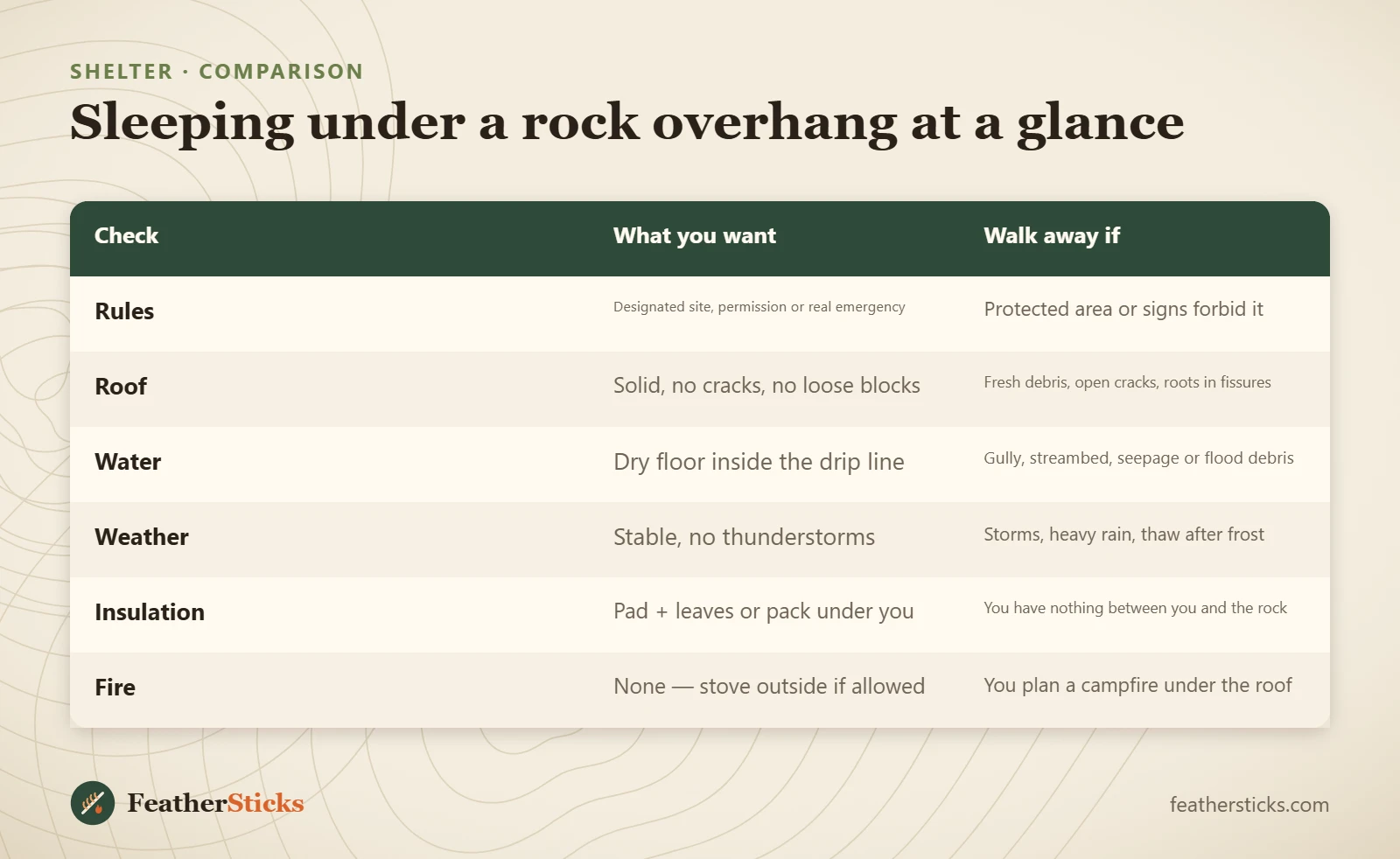
| Check | What you want | Walk away if |
|---|---|---|
| Rules | Designated site, permission or real emergency | Protected area or signs forbid it |
| Roof | Solid, no cracks, no loose blocks | Fresh debris, open cracks, roots in fissures |
| Water | Dry floor inside the drip line | Gully, streambed, seepage or flood debris |
| Weather | Stable, no thunderstorms | Storms, heavy rain, thaw after frost |
| Insulation | Pad + leaves or pack under you | You have nothing between you and the rock |
| Fire | None — stove outside if allowed | You plan a campfire under the roof |
Common mistakes
- Trusting an overhang without looking at the floor for fresh rockfall.
- Sleeping in the drip line, against a seeping back wall or in a gully.
- Sheltering under rock or in a shallow cave during a thunderstorm.
- Lying directly on cold rock without a pad or other insulation.
- Lighting a fire under the roof — soot, heat damage, smoke and bursting stones.
- Entering caves, especially in winter when bats hibernate.
- Sleeping in the pit of an upturned root plate.
What you need
- Sleeping pad (closed-cell or insulated inflatable)
- Sleeping bag suited to the expected low
- Head torch with spare batteries
- Small tarp (about 2 × 3 m) and 10 m of cord
- Groundsheet
- Thermos with a hot drink
- Whistle and charged phone
FAQ
Is it safe to sleep under a rock overhang?
Is it safe to sleep in a cave?
Can I make a fire under a rock overhang?
What is Boofen?
Does a rock overhang protect against lightning?
How do I stay warm under a rock overhang?
Can I sleep under the root plate of a fallen tree?
Check yourself
Completed6 quick questions from this guide. Nothing is sent anywhere.
Related step-by-step guides
-
 1
-
 1
-
 1