Camp Comfort: Sit Pads, Pillows & More
The best camping comfort items are small, light and do a real job: a foam sit pad that keeps cold ground from draining your heat, a pillow that lets you sleep, dry socks and camp shoes for tired feet, a warm drink and a soft light in the evening. They are not luxury. Good sleep and good morale keep you warm, careful and safe – and they decide whether you want to go out again.
This guide covers what each item does, what it typically weighs and which ones are worth carrying on a long walk versus a short walk-in camp. You will also learn how to build a seat from fallen wood, make a pillow from a stuff sack and use a hot water bottle safely. It builds on the bushcraft kit list and the bushcraft basics, and links to the gear guides for each piece.
Step by step
-
1

Sit on foam, not on the ground
A closed-cell sit pad of about 30 × 40 cm stops cold, damp ground from drawing heat out of you. It weighs 40–80 g and has several other uses.
-
2

Make a pillow that stays put
Fill a stuff sack loosely with your fleece or carry a 50–100 g inflatable pillow. Keep it in the hood or strapped to the pad.
-
3

Choose seating by the trip
On a short walk-in a compact chair is a treat; on a long trek a log or stone plus your sit pad costs nothing extra.
-
4

Change into camp shoes and socks
At camp, take off your boots, open them to dry, and put on dry socks and light closed shoes.
-
5

Build a warm evening routine
A hot drink, a small light and a warm bottle in a sock in the sleeping bag make cold nights much easier.
-
6

Weigh and decide
Weigh each comfort item, keep the ones you use every evening and swap or leave the rest.
Why camping comfort items matter: sleep and morale, not luxury
Bushcraft is often described as doing more with less, and many people feel slightly guilty about packing a pillow. That misses the point. A tired, cold, uncomfortable person makes worse decisions: they skip the tick check, handle the knife carelessly, cut corners with water treatment and give up on a fire that only needed five more minutes. Good rest is part of safety, not an add-on.
Three things decide how comfortable a night out feels:
- Warmth. Most heat is lost into the ground when you sit or lie on it, and to the air when you sit still after a day of walking. A sit pad, dry socks, a warm drink and a warm bottle all attack the same problem at low weight. For the full picture of staying warm see preventing hypothermia.
- Sleep. Your sleeping bag and pad do most of the work, as explained in the sleeping gear guide. Small items fill the gaps: a pillow for your neck, ear plugs against rustling leaves and an eye mask for early summer mornings.
- Morale. A dry seat, a hot cup and a calm light turn a damp evening into a pleasant one. That matters more on your first night outdoors than on any other.
The trick is to choose items that solve a real problem and weigh little: a 60 g sit pad you use every evening beats a 900 g chair you use for ten minutes.
Typical weights at a glance
- Closed-cell sit pad
- 40–80 g
- Inflatable pillow
- 50–100 g
- Ear plugs + eye mask
- 10–20 g
- Mosquito head net
- 20–40 g
- Pair of spare wool socks
- ≈ 70 g
- Light camp shoes (pair)
- 200–400 g
- Folding stool
- 0.3–0.6 kg
- Compact camp chair
- 0.5–1 kg
Sit pad camping: the most useful 60 grams in your pack
If you only add one comfort item, make it a sit pad: a piece of closed-cell foam of roughly 30 × 40 cm and 1–2 cm thick, often folded like an accordion. It weighs about 40–80 g and goes in a side pocket or under the lid.
Why the ground feels so cold
When you sit on a log, a stone or the forest floor, your body heat flows into it by conduction. Soil, rock and especially wet wood and moss conduct heat far better than still air, and the ground is so large that it never warms up under you. Within minutes your backside and thighs are cold, even in a warm jacket. Moisture makes it worse: damp ground soaks your trousers, and wet fabric loses its insulation. The same physics is behind the advice for sleeping, explained in detail in building a bushcraft bed – a thick, dry layer of trapped air between you and the ground is what keeps the heat in.

Which sit pad material works best?
Closed-cell foam is the classic, because it cannot puncture, does not soak up water and still insulates when it is wet on the surface. Inflatable sit cushions are softer and pack smaller, but they are thin when you sit on them and a thorn ends their working life. Some people simply cut a piece from an old foam sleeping mat – that works perfectly well and costs nothing.
| Type | Typical weight | Strengths | Weak points |
|---|---|---|---|
| Closed-cell foam, folding | 40–80 g | Cannot puncture, works wet, many other uses | Bulky; strap it outside or under the lid |
| Offcut from an old foam mat | 30–70 g | Free, any size you want | Edges fray; no carry strap |
| Inflatable sit cushion | 50–120 g | Soft, packs small | Can puncture; thinner when loaded |
| Folded spare clothing | 0 g extra | Always with you | Gets damp and dirty; compresses flat |
Weights are typical ranges, not product data. A wider pad also serves as a kneeling mat at the fire.
One pad, three jobs
The sit pad earns its place because it does more than keep you warm while you eat. Two of its other uses are about safety, and they follow the advice in our dedicated guides:
- Lightning crouch pad. If you are caught by a thunderstorm in the open and a strike seems imminent, the lightning safety guide recommends crouching with your feet together on a closed-cell pad or a rucksack without metal parts. The pad may reduce ground current a little – no more than that. The crouch is a last resort; moving early to lower, less exposed terrain matters far more.
- Splint padding. In first aid a closed-cell foam mat is one of the best improvised splints. A sit pad is big enough to pad a forearm or wrist; for a lower leg use the full sleeping mat. Pad bony points, tie it firm but not tight, check that fingers or toes stay warm and pink, and call for help (112 in Europe).
- Everyday helper. Kneeling mat at the fire, clean surface for food prep, or extra insulation under your feet at night.

Camping pillow options: inflatable, stuff sack or hood
Many people sleep badly outdoors not because they are cold but because their neck is bent at an odd angle all night. A camping pillow fixes that, and you have three options.
The stuff sack pillow (0 g extra)
Fill a stuff sack or a soft dry bag loosely with the clothes you are not wearing – usually a fleece or an insulated jacket. It costs nothing, and the clothes stay dry and warm for the morning. It can slide around and feel lumpy – the tricks below fix that.
How to make a pillow that stays put
 1Fleece into the sack
Fold a fleece or puffy and push it into a stuff sack or small dry bag. Put the smooth, soft side of the fabric towards the opening, so it ends up against your face.
 2Loose, not rock-hard
A pillow of about 30–40 cm that is filled loosely moulds to your head. Packed hard, it rolls away and presses on your ear. Add or remove a layer until it feels right.
 3Inside the hood or tied to the pad
Slide the pillow into the hood of a mummy bag so it moves with you, or tie it to the top end of the pad with a short cord or a strap. Side sleepers often prefer it slightly higher.
 4Inflatable: let some air out
An inflatable pillow feels best only partly filled. Blow it up, lie on it and let air out with the valve until your head sinks in a little. A thin layer of clothing over it stops the plastic feeling.
The inflatable pillow (50–100 g)
An inflatable pillow weighs about 50–100 g and packs to the size of a fist. Many people who try one never leave it at home again, which is why our sleeping gear guide calls it a luxury that is easy to justify. Choose one with a soft surface or put a buff or T-shirt over it.
The hood and the sleeping bag itself
A mummy bag hood stuffed with a soft layer is a pillow too, and it does not slip. In winter you may need every piece of clothing on your body; then the hood plus a rolled hat or buff under the neck is the lightest solution.
| Pillow | Extra weight | Comfort | Best for |
|---|---|---|---|
| Stuff sack with clothes | 0 g | Good once adjusted | Every trip, ultralight, summer |
| Inflatable pillow | 50–100 g | Very good, adjustable | Side sleepers, long trips |
| Hood + rolled hat | 0 g | Basic | Winter, when all clothes are worn |
Lightweight camp chair, stool or log? The weight trade-offs
The question every camper asks sooner or later: is a lightweight camp chair worth carrying? The honest answer depends on how far you walk and how long you sit.

Compact camp chair (0.5–1 kg)
Compact backpacking chairs with a fabric sling and shock-corded poles typically weigh around 0.5–1 kg. The back rest is the big advantage: after a long day, leaning back for an hour does your lower back a lot of good. On soft forest floor the narrow feet sink in, so look for wider feet or put the chair on a flat stone or a piece of bark.
Folding stool (0.3–0.6 kg)
A three-legged stool is lighter and packs into a side pocket, but has no back rest and can tip on uneven ground. It is useful if you have knee problems and find it hard to get up from the ground, or for cooking at a fire without kneeling.
Log, stone or sit pad (0 g extra)
In most forests you find a fallen log or a stone to sit on within a few minutes. With your sit pad on top it is warm and dry. Leaning against a tree trunk or your pack gives you a back rest. This is the classic bushcraft solution and the right choice when every gram counts.
Chair or no chair?
Carry a chair when…
- The walk-in is short and the camp lasts several days
- You have back or knee problems
- Campsites have no logs or stones (open meadows, managed sites)
- You sit for hours: base camp, group evenings, fishing
Leave it at home when…
- You walk long distances with a full pack
- Your pack is already over the usual weight guide line
- The forest offers plenty of fallen wood
- You sit mostly at the fire, kneeling or cooking
Put the numbers in before you decide. The pack weight calculator adds base weight, food, water and fuel and shows your total as a share of body weight. Its rules of thumb are about 10 % for a day hike, about 15 % for an overnight and about 20 % for multi-day trips. If a chair pushes you well beyond that, the backpack guide and the "big three" in the kit list show where to save first – or leave the chair and pack the sit pad.
Bushcraft camp furniture from wood
At a longer camp, simple furniture made from dead wood is part of the fun: a bench at the fire, a pot shelf, a table for the kitchen, a rack for boots. The skills are lashings and basic carving – see how to tie lashings and the work table in setting up a camp kitchen.
A simple log bench in four steps
 1Use dead, fallen wood
Look for sound, dead wood lying on the ground. Never cut living trees or branches without the landowner's permission – rules differ by country and region.
 2Level, stable, test it
Set two short rounds or flat stones level and lay a split log or a straight dead pole across. A seat height of about 40–45 cm is typical for a chair. Sit down carefully and rock a little before you trust it.
 3Pad on top
Put your sit pad on the bench. Dead wood is often damp inside; the pad keeps you dry and warm. Check the wood first for rot, ants and sharp stubs.
 4Take it down and scatter it
When you leave, take the bench apart and return the wood roughly to where you found it, so the place looks untouched. That is the core of leave no trace.
What you can build
- Log bench or seat: the bench above, or simply a fallen log rolled into place. Place it upwind of the fire and at a safe distance so sparks do not land on clothing or the pad.
- Back rest: two stakes driven into the ground with a pole lashed across, or a sloping pole against a tree. Combined with a sit pad it comes close to a chair.
- Table and pot shelf: square lashings on four uprights with a top of thin poles – the camp kitchen guide shows the full build. A base camp is where this kind of furniture really pays off.
- Boot and clothes rack: two forked sticks and a cross pole, a little away from the fire, so boots and socks can air out.
Camp shoes, booties and dry sleeping socks
After a day in boots, your feet want air. The routine is simple and described in more detail in the footwear guide: take your boots off as soon as camp is set up, wipe and dry your feet, put on dry socks and slip into light camp shoes. Open the boots wide, pull out the insoles and let them air under the tarp – not right next to the fire, where leather and glue can be damaged.
Which camp shoes?
Light camp shoes weigh roughly 200–400 g a pair. Closed toes are better than flip-flops around a fire and on rough ground, and they double as stream crossing shoes on shallow, slow crossings. Foam clogs, light trail shoes or sandals with a toe guard all work. In winter, insulated booties are a real comfort item: pulled over dry socks, they keep your feet warm in camp and in the sleeping bag.
Dry socks only for sleeping
One pair of wool socks (about 70 g) that you wear only in the sleeping bag is one of the best comfort investments there is. Keep them in the sleeping bag's stuff sack so they are always dry. Never put on damp socks for the night: wet wool keeps some warmth, but your feet will be cold and the moisture goes into the bag. Cold feet at night can also be helped with a warm bottle, as described below.
Small light and cosiness after dark
In autumn and winter you can spend more than half the day in the dark. A pleasant light makes those hours much nicer – and a harsh headlamp beam in everybody's face makes them worse. Our lighting guide covers headlamps, batteries and lanterns in detail; for comfort, three points matter:
- Warm, low light. A small lantern on a low setting, a headlamp turned upside down into a water bottle (the bottle spreads the light) or the red mode of your headlamp is enough for eating and talking. Bright white light ruins your night vision.
- Light where you need it. Hang a small lantern from the ridgeline at the entrance of the shelter, so you find things without pointing your head at everything.
- Candles only in the open. A candle lantern gives a calm, warm light – on a stable, non-flammable base, away from fabric and dry grass, and never left burning while you sleep.
Cosiness is also about the place: a camp sheltered from the wind, a dry spot under the tarp and a fire at the right size. Choosing a good camp site and a clear camp layout do more for a comfortable evening than any gadget.
Ear plugs, eye mask and night noises
The forest is not quiet at night. Wind in the leaves, rain on the tarp, a hedgehog in the dry leaves, an owl, a tent mate snoring – all can keep a light sleeper awake for hours. Foam ear plugs and a soft eye mask together weigh about 10–20 g and are among the cheapest ways to sleep better.
- Ear plugs: roll them thin, insert them and let them expand. If you camp alone and want to hear what is going on, use only one, or keep them for the early morning hours.
- Eye mask: in early summer it is light at four or five in the morning; a mask helps you sleep on. A buff pulled over the eyes works too.
- Get used to the sounds: most night noises are small animals – see night skills.
Ear plugs also help when rain drums on the tarp all night – see camping in the rain.
The warm evening routine: hot drink and hot water bottle
Sitting still after a day of walking, you cool down quickly. A routine of warm food and drink before bed is one of the most effective comfort habits. A hot cup in your hands warms you directly, the drink adds fluid you need anyway, and the ritual itself is relaxing. The camp coffee guide covers coffee, tea and cocoa – in the evening, caffeine-free drinks help you sleep. Eat something with fat and carbohydrates before bed as well, so your body has fuel for the night.
The hot water bottle trick
A hot water bottle in the sleeping bag is the best low-weight comfort item for cold nights, because it uses kit you already carry. The method follows our winter water guide:
Hot water bottle in the sleeping bag – safely
 1Boil the water
Heat the water on the stove or fire. Treat wild water first – a rolling boil for 1 minute makes it safe (3 minutes from 2,000 m).
 2Let it stand a few minutes
Use hot, not boiling, water: let freshly boiled water stand for a few minutes before you fill the bottle. Pour slowly – spills scald.
 3Steel bottle, closed tightly
Use a single-wall steel bottle or a bottle rated for hot liquids. Close it tightly and hold it upside down for a moment: no drops, no hiss.
 4In a sock, between the thighs
Wrap it in a sock or piece of clothing and take it into the bag. Between the thighs it warms the blood flowing to the rest of the body; at the feet it warms cold toes. Do not leave it against bare skin for long.
By morning the bottle holds liquid water instead of ice – a second benefit in winter. Add a short walk or a few squats before getting into the bag (warm up, don't sweat) and a dry hat.
Mosquito head net: comfort in midge season
In summer the biggest comfort killer is often not cold but insects. A mosquito head net weighs about 20–40 g and can turn an unbearable evening at a lake or bog into a tolerable one. Worn over a hat with a brim, the mesh stays off your face, so mosquitoes cannot bite through it.
Combine the head net with long sleeves, thin gloves at dusk in midge country and a breezy camp site away from still water. The ticks and insects guide covers repellents, mesh for shelters and the daily tick check – which belongs to the evening routine just like dry socks.
Which camp comfort items are worth carrying?
Comfort items are easy to accumulate, and a few hundred grams here and there add up to a heavy pack. A simple approach: give yourself a comfort budget – for example around 250 g on a long trek and more on a short walk-in – and fill it with the items that give the most comfort per gram.

| Item | Typical weight | Benefit | Verdict |
|---|---|---|---|
| Dry sleeping socks | ≈ 70 g | Warm feet, better sleep, every night | Always |
| Sit pad | 40–80 g | Warm seat, crouch pad, splint padding | Always |
| Ear plugs + eye mask | 10–20 g | Sleep through noise and early light | Always for light sleepers |
| Head net | 20–40 g | Calm evenings in mosquito season | Summer, near water |
| Inflatable pillow | 50–100 g | Better sleep, less neck strain | Most trips (or stuff sack: 0 g) |
| Hot water bottle | 0 g extra (your steel bottle) | Warm bag on cold nights | Autumn and winter |
| Camp shoes | 200–400 g | Rest for feet, stream crossings | Overnight and longer |
| Compact chair | 0.5–1 kg | Back rest for long sitting | Short walk-ins, base camps |
Weights are typical ranges. Weigh your own items – the kitchen scale is the most honest tool.
Should this comfort item come along?
Did you use it on most evenings of your last trips?
Yes → Keep it – it is part of your system, not a luxury.No → Leave it at home or pack it only for base camps.Can something you already carry do the same job?
Yes → Use that instead: stuff sack pillow, steel bottle as warm bottle, log as seat.No → Check its weight against your comfort budget.Does it keep you warm, dry or rested?
Yes → High value – especially in autumn and winter.No → Nice to have: only if the pack weight allows it.
For new campers on a budget: most comfort items do not need to be bought. An offcut of foam mat, a stuff sack with a fleece, old socks reserved for sleeping, a steel bottle and a buff as an eye mask cover most needs. Our guide to bushcraft gear on a budget explains what to buy first – and comfort items come after the sleep system, rain jacket and boots. The base weight of your kit, not single items, is what you feel on your back.
Camp comfort kit by season and trip type
What counts as comfort changes with the season. In summer it is insects, heat and early light; in autumn damp and long evenings; in winter cold feet and the long night. The table gives a starting point.
| Situation | Core comfort items | Optional extras |
|---|---|---|
| Summer trek | Sit pad, stuff sack pillow, sleeping socks, head net | Eye mask, light sandals with toe guard |
| Autumn overnight | Sit pad, pillow, sleeping socks, camp shoes, hot drink | Warm bottle, ear plugs, small lantern |
| Winter camp | Sit pad, sleeping socks, insulated booties, warm bottle, thermos with hot drink | Extra foam pad, hood as pillow |
| Base camp, short walk-in | Chair or log bench, pillow, camp shoes, lantern | Lashed table, wash stand, boot rack |
| Day trip | Sit pad, warm drink in a vacuum flask | Light warm layer to sit in |
For winter, read the winter camping guide – there, comfort and safety are the same thing. With children, comfort items matter even more: a child who sits warm and dry, has their own small pillow and a hot cocoa stays happy far longer. See bushcraft with kids for age-appropriate kit and routines.
Comfort checklist for an overnight
- Closed-cell sit pad (40–80 g)
- Pillow: inflatable or stuff sack for clothes
- One pair of wool socks only for sleeping
- Light closed camp shoes (overnight and longer)
- Ear plugs and eye mask or buff
- Steel bottle that can be filled with hot water
- Drink for the evening: tea, cocoa or coffee
- Head net in mosquito season
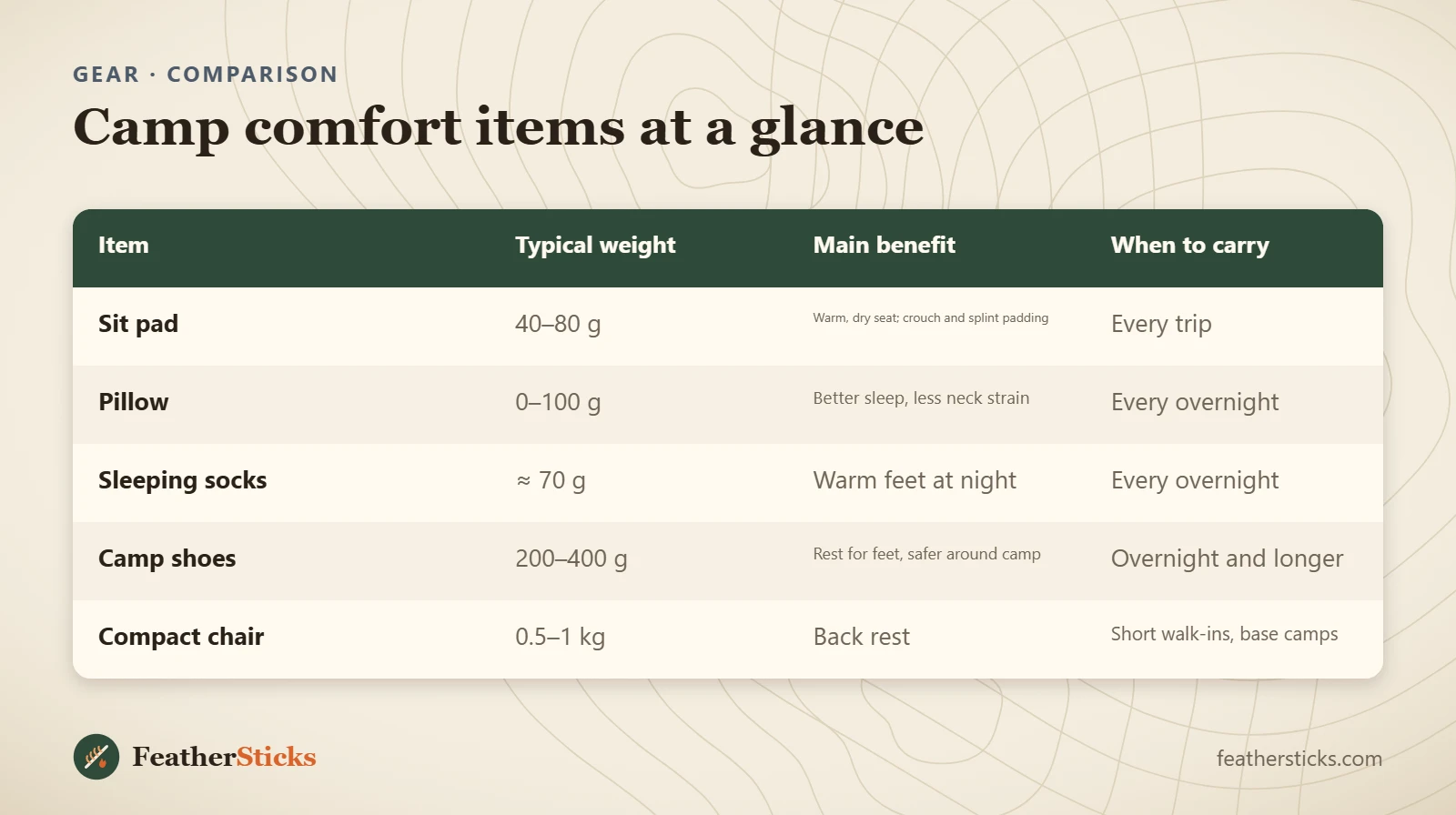
| Item | Typical weight | Main benefit | When to carry |
|---|---|---|---|
| Sit pad | 40–80 g | Warm, dry seat; crouch and splint padding | Every trip |
| Pillow | 0–100 g | Better sleep, less neck strain | Every overnight |
| Sleeping socks | ≈ 70 g | Warm feet at night | Every overnight |
| Camp shoes | 200–400 g | Rest for feet, safer around camp | Overnight and longer |
| Compact chair | 0.5–1 kg | Back rest | Short walk-ins, base camps |
Common mistakes
- Sitting on cold, damp logs or ground all evening without insulation – you lose heat before you even get into the sleeping bag.
- Packing a heavy chair for a long trek while leaving the light sit pad at home.
- Sleeping in the damp socks of the day instead of a dry pair kept only for the night.
- Filling the warm bottle with boiling water or using a bottle that leaks.
- Using candles or gas lanterns inside a closed tent.
- Building camp furniture from living trees or leaving it standing when you go.
What you need
- Closed-cell foam sit pad
- Inflatable pillow or a soft stuff sack
- Wool socks reserved for sleeping
- Light closed camp shoes or insulated booties
- Ear plugs and eye mask
- Single-wall steel bottle for hot water
- Small lantern or headlamp with red mode
- Mosquito head net for summer
FAQ
What are the most useful camping comfort items?
Is a sit pad worth it for camping?
What can I use as a camping pillow?
Is a lightweight camp chair worth the weight?
Is it safe to sleep with a hot water bottle in a sleeping bag?
Do I need camp shoes for bushcraft?
How do I sleep better in the woods?
Check yourself
Completed6 quick questions from this guide. Nothing is sent anywhere.
Related step-by-step guides
-
 1
-
 1
-
 1