Camping with Dogs: Rules, Gear and a Safe Night Routine
Camping with a dog works best when you plan for the dog as a full member of the group: it needs fitness, a plan for water and shade, a safe place to sleep and an owner who knows the local rules. Most problems on a trip are not exotic. They are a dog that is off the lead near wildlife, paws that were never checked, a hot afternoon without shade, or a dog that has never slept anywhere but home.
This guide combines dog camping gear, hiking with dogs tips and routines in the order you will meet them: is your dog ready, which rules apply, wildlife and livestock, ticks, heat and cold, paws and first aid, water and food, sleeping, the camp routine, children and dogs, and a short decision block for the question "should my dog come this time?". It builds on wildlife encounters, ticks and insects and the basics of bushcraft. Health questions about your dog belong with your vet; this page gives general camping know-how, not veterinary advice.
Step by step
-
1

Build up with day hikes
Increase distance and difficulty step by step. Practise recall, calm waiting and sleeping away from home before the first night out.
-
2

Check the rules
Leash duty, breeding season, nature reserve and campsite rules differ by country and region. Look them up for every trip.
-
3

Short lead near wildlife
Keep the dog close and leashed near wildlife, livestock and in rule zones. It protects the animals and your dog.
-
4

Shade, water, rest
Carry extra water and a bowl, rest in shade and plan the hot hours. Watch for signs of overheating and of getting too cold.
-
5

Check paws and coat
Every evening look at pads, toes and coat for cuts, seeds and ticks. Ask your vet about parasite prevention.
-
6

Secure place to sleep
Give the dog its own mat close to you and secure it on a short line. Keep food, fire and the door out of its reach.
Is your dog ready for camping?
A dog that loves a one-hour walk is not automatically a dog that enjoys a two-day trip. Before you pack, look at the dog honestly in five areas: fitness, age and health, recall, behaviour around other dogs, people and animals, and calm at night. If one of these is weak, you can train it, shorten the trip or leave the dog at home this time.
Fitness, age and health
Dogs need to build up distance just like people. Puppies and young dogs whose joints are still growing, older dogs and dogs with joint, heart or breathing problems need a lower pace and shorter days, and some breeds with short muzzles overheat quickly. How far is sensible for your dog is a question for your vet, who also knows which vaccinations, parasite prevention and health checks suit the region you are visiting.
Recall, lead manners and nerves
The question is not whether the dog comes back when you call in the garden, but whether it comes back when a deer crosses the path. If recall is not rock solid, the dog stays on a lead or a long line in open country, and in many places it stays on the lead whatever its recall is. Also check how the dog reacts to strangers, other dogs, livestock, loud noises and the smell of food.
Calm at night
Many dogs bark or whine in their first nights in a tent, because every rustle is new. Practise at home: put the dog on its travel mat in the room where you sleep, in the garden tent or in a quiet corner at a friend's place.
| Stage | What you do | What you check |
|---|---|---|
| 1. Short walks with the full kit | Walk with harness, lead, pack and mat in your normal area | Dog accepts the gear and stays calm |
| 2. Day hikes, getting longer | Add distance and some hills on different surfaces | Pads, energy and recovery the next day |
| 4. Garden or car-park night | Sleep in the tent a few steps from home or the car | Barking, restlessness, tent manners |
| 5. One easy overnight | A short walk to a permitted site, good weather | Everything above plus sleep and routine |
Leash rules, breeding season and campsite rules
Rules for dogs outdoors vary by country, region, municipality and individual site, and they change. Treat everything below as orientation, not legal advice, and check the official source for the exact area before every trip: the park or forestry authority, the municipality, the campsite or the operator of the site.
Leash duty in forests and nature reserves
In some countries and regions dogs must be on a lead in forests and open country all year, in others only in certain seasons or zones, and in others a "close control" standard applies. Nature reserves and national parks often require the lead and staying on marked paths, and some parks restrict dogs on trails altogether to protect wildlife. A lead is also standard around livestock and in towns and villages.
Breeding and setting season
In spring and early summer many animals have young: ground-nesting birds, hares, deer fawns and boar piglets. That is why many regions apply a stricter lead duty in this period. In Germany it is known as Brut- und Setzzeit and in some federal states runs roughly from April to mid-July, with exact dates and scope set by each state and municipality. Even where no rule applies, the same logic does: from spring to midsummer, keep the dog close.
Hunting law context
Dogs that chase or harass game are a serious matter almost everywhere. Hunting and forest laws give hunters, landowners and authorities far-reaching powers against dogs that roam, and the owner can be held responsible for damage or injury. In autumn and winter there may be driven hunts with many participants and dogs. Read more in dogs, hunters and hunting seasons and, for Germany, the legal context in Germany. A bright vest or collar for the dog and a bright jacket for you are sensible in hunting season.
Campsites and trekking sites
For a longer stay at one place see base camp. Organised campsites usually allow dogs but impose conditions: lead at all times on the site, dogs not left alone in the tent or caravan, quiet hours, some areas or sanitary buildings off limits, a duty to pick up waste, sometimes a fee or a limit on the number of dogs. Some sites have no dogs at all. Simple trekking sites and shelter sites, often run by park or forestry authorities, have their own rules, and some do not allow dogs.
Wildlife, livestock and your dog
Your dog decides how many wildlife encounters go. On a short lead beside you it warns you early and stays safe; ranging ahead it can chase deer onto a road, corner a boar, find a nest or bring an angry cow back to you. Keeping the dog close protects the animals and protects the dog. The detailed species advice is in wildlife encounters; here is the dog-specific part, in line with that article.
- Wild boar: stop, put the dog on a short lead right beside you and back away slowly. A sow with piglets defends them, especially against dogs. See what to do if you meet a wild boar.
- Wolf: keep the dog on a short lead right beside you and do not let it roam at dusk or at night. A dog next to a person is safer than one ranging ahead. See wolf encounter: what to do.
- Deer and young animals: a loose dog can chase deer and find fawns that lie still in the grass. Dogs on the lead, no touching, walk on.
- Cattle and horses: the dog on a short lead on the side away from the herd, a wide arc around the animals and never between cow and calf. If cattle charge, the standard advice is the one exception: release the dog and leave the field by the shortest route. Details in cattle and horses on pastures.
- Livestock guardian dogs: stop, stay calm, keep your own dog close and walk around the flock at a wide distance.
- Adders: dogs are bitten more often than people because they push their noses in. Keep the dog on the lead in adder country and go to a vet at once after a suspected bite.
Ticks, parasites and other nasties
Dogs run exactly where ticks wait in grass and undergrowth, and they carry them into the tent. Ticks can transmit diseases to dogs as well as to people, and some tick-borne diseases of dogs depend on the region. Prevention is something you arrange in consultation with your vet, who knows which protection suits your dog and the area you visit.
What you can do yourself is the camping routine: check the dog after every walk and before it comes into the sleeping area, run your fingers against the lie of the coat, and remove ticks with a tool made for the purpose. The method is described in the daily tick check, which includes the dog. Take a look at places that are easy to miss: ears, around the eyes and muzzle, under the collar or harness, armpits, belly, groin, between the toes and under the tail.
Other things in the coat and on the ground
- Grass seeds and burrs. Seeds with barbs can work into ears, toes, eyes or nose. Check after walks in dry grass. If the dog keeps shaking its head, sneezes violently, licks a paw or squints, see a vet.
- Processionary caterpillars and stinging insects. Fine irritating hairs and stings affect dogs too; see ticks and insects and keep the dog away from nests and old webs.
Heat and cold: signs, shade and a dog coat
Dogs cool down mainly by panting and through their paws, not by sweating like we do, which makes heat a serious risk. They also feel cold, especially short-haired, small, thin, old or wet dogs. Plan for both.
Heat: signs and what to do
General warning signs of overheating include very heavy or noisy panting, drooling, a bright red tongue, restlessness, weakness or stumbling, vomiting and, in the worst case, collapse. Do not wait for all of them. At the first signs, stop, move the dog to shade, offer water, and cool it gradually with water on the belly, paws and legs, not with ice. If the dog stumbles, vomits, collapses or does not recover quickly, treat it as an emergency and go to a vet immediately. Flat-faced breeds, heavy coats, overweight and older dogs are at higher risk.
Prevention is simple: walk in the cool morning and evening hours, rest in shade at midday, carry extra water (see the water section below) and never leave a dog in a closed car or tent. Ground matters too. Test hot surfaces such as rock, sand or asphalt with the back of your hand for about five seconds as a rule of thumb: if it is too hot for you, it is too hot for the paws. See also hydration for planning water for people and the signs of heat problems in humans.

| Situation | Typical signs | First reaction |
|---|---|---|
| Too hot | Heavy panting, drooling, bright red tongue, slows down, lies down, weakness, vomiting | Shade, water, cool gradually, stop; vet if it does not improve quickly |
| Too cold | Shivering, curled up tight, lifts paws, slow, seeks body contact, reluctant to move | Dry the dog, add coat or blanket, insulate from the ground, warm food and shelter; vet if it stays weak |
| Wet and windy | Shaking, tucked tail, hunched stance | Towel dry, coat, shelter from wind, keep moving or rest in a sheltered place |
Cold: coat, mat and shelter
Check the seasons and the forecast when you choose the trip; see hypothermia for the logic in people.
Dogs with thin coats or little body fat get cold quickly when it is wet, windy or when they lie on cold ground. A dog coat that fits well, a towel to dry the dog after rain and swimming, and an insulated mat make a big difference at night. Choose the mat like you choose your own pad: ground cold is what steals the warmth (see sleeping gear for the logic).
Paws and first aid: what to check and what to pack
Paws take the beating on every trip. Pads can be cut by glass, sharp rock or thorns, worn raw on rough ground, burnt on hot surfaces, and clogged by snow balls or ice in winter. Check them at every longer break and every evening.
The evening check
 1Look at the pads
Lift each paw and look at the pad: cracks, cuts, worn spots, thorns or glass. A dog that licks a paw a lot or limps usually has a reason.
 2Spread the toes
Gently spread the toes and look between them for seeds, burrs, resin and balled snow. Do not pull anything deep out of a paw: that is for a vet.
 3Coat and ticks
Stroke against the lie of the coat and feel for small bumps behind the ears, around the neck and under the harness. Remove ticks with a tick hook as described in the ticks guide.
 4Cut or limping: cover and ask a vet
Keep the dog calm, rinse off dirt only as far as you know how, cover the paw lightly and stop walking. Ask a vet about every deep cut, heavy bleeding or persistent limping.

Protecting paws
On rough or hot ground, short breaks and softer surfaces help. Some owners use dog boots for long rocky stretches or in snow; they must fit properly and the dog must be used to them, so practise at home first. In winter, check the toes often for snow balls and ask your vet about paw care for your dog.
A small dog first aid kit
A dog kit is a small addition to your own first aid kit. It is for stabilising a problem until you reach a vet, not for treating it. Ask your vet what they recommend for your dog; do not pack medication without that advice.
Dog first aid kit (general list)
- Self-adhesive bandage and non-stick pads
- Medical tape and blunt-tip scissors
- Tweezers and a tick hook
- Clean towel and a thin emergency blanket
- Spare lead or short line and a spare collar
- Disposable gloves and a clean bag
- A way to protect yourself from a hurting dog, as shown to you by your vet (for example a soft muzzle)
- Phone numbers of your vet and the nearest emergency vet, plus a copy of vaccination and identification papers

Water and food for the dog
Water: carry more than you think
Plan the dog's water as part of the trip, not as an afterthought. Dogs often drink more when it is warm or when they are working hard, and they do not carry a bottle. An often quoted rule of thumb is around 50 ml per kilogram of body weight per day at rest, so a 20 kg dog needs about a litre as a baseline, and clearly more on warm, active days. Your vet can tell you what is right for your dog. Add that to your own figure from the water calculator, plan refills along the route with finding water, and carry a collapsible bowl so you can offer water at every rest stop.
Wild water: algae, standing water and currents
Dogs love to jump in and drink from anything. Standing, warm, green or scummy water can carry blue-green algae (cyanobacteria), which can be toxic to dogs, and stagnant puddles and ponds can carry other germs. Keep dogs away from water that looks green, foamy or like paint on the surface, and from signs that warn about algae. If a dog has been in such water or shows vomiting, weakness or odd behaviour afterwards, go to a vet and say where it was.
Food plan
Stick to the dog's normal food so that its stomach has one thing less to deal with on the trip. Feed in the evening after the hike rather than before a long walk, and pick up the bowl afterwards: leftover food draws wildlife. Dog food is stored just like your own, see storing food at camp.
Sleeping: tent, tarp and the dog on its mat
A good night starts with a clear place for the dog: its own mat or bed, close to you, and a way to keep the dog from wandering off or reaching the door, the fire or the food. In wolf, boar or other wildlife areas the guidance in wildlife encounters applies: the dog sleeps inside the shelter or tied directly beside you.
In the tent or under the tarp
In a tent, the dog sleeps on a mat on the floor beside or at the foot of your pad or in the vestibule if it is big enough and safe. Under a tarp or in a hammock set-up, the dog lies on its mat nearby, on a short line from its harness to a fixed point, with you between the dog and the way out into the dark. Pick a roomy tent and see tarp shelter and site selection for pitching on dry, flat ground away from game trails.
Mat, bed and warmth
Use a dog mat that insulates from the ground, plus a blanket or coat in cold weather, like the pad logic in sleeping gear. In hot weather, choose a shaded pitch, ventilate the tent and give the dog a place to stretch out, never a closed, sunlit tent.
Keeping the dog secured
Use a harness, not only a collar, for anything attached to a line, and keep the line short enough that the dog cannot reach the door, fire or tent walls but long enough to stand, turn and lie down. Never leave a tied dog unattended where it can tangle or be left in distress. If the dog barks in the night, speak calmly and check outside with a headlamp rather than scolding; a barking dog may have heard a real animal.
Setting up the night
 1Own mat next to your pad
Place the mat beside or at the foot of your pad so you can reach the dog, and not in the door. Introduce it at home so the smell is familiar.
 2Harness and a short line
Clip a short line to the harness and to a loop or fixed point so the dog cannot reach the door. Check that the line cannot wrap around the poles.
 3Food stays out of the tent
Dog food and treats go into a closed container or a sack, away from the sleeping place, like your own food.
 4Cold night: coat and insulation
A coat that fits, a dry dog and an insulated mat under it keep a thin-coated dog warm. Check the dog is not shivering when you turn in.
Camp routine: tie-out, fire, food and waste
Once the pitch is up, a few habits keep the camp safe for the dog and for the surroundings.
Tie-out line
A tie-out line between two trees or a long line to a fixed point gives the dog room without the dog running off. Use it only while you are present, on clear ground, away from the fire and cooking area, with the dog in a harness and water within reach. Check that it cannot wrap around trunks, tent guylines or other dogs.
Around the fire
Sparks, hot stones and embers hurt dogs, and curious dogs step in the ash. Keep the dog well away from the fire pit, beyond reach of sparks, with a line too short to bring it near the flames. The fire itself stays at least 5 m from tents and hammocks. Never leave a dog alone near a fire, and put the fire out fully before sleeping; read fire safety and the fire pit for the details.
Food storage
Dog food, treats and the bowl smell strong to wildlife. Store them like your own food in a closed, odour-tight container or hung bag away from the tent, as in storing food at camp, and clean the bowl after feeding.
Dog waste
Dog waste is not "natural fertiliser". It carries germs that can harm people, other dogs and wildlife, and it fouls water. On paths, near water, at campsites and in popular places, pick it up and carry it out in a bag, and do not leave bags beside the trail. Only in remote places with no facilities, treat it like human waste: bury it in a cathole 15–20 cm deep, at least 60–70 m from water, trails and camp, as described in outdoor hygiene.
Camp routine at a glance
 1Tie-out line
A line between two trees at a height the dog cannot tangle in, harness only, bowl within reach. Stay in sight.
 2Distance from the fire
Dog beyond sparks and hot stones, and a line too short to reach the fire, with the fire at least 5 m from tents.
 3Food away from the tent
Dog food and treats in a closed box or a hung bag, like your food.
 4Waste: pack out, or bury in remote areas
Bag it and carry it out. In remote places only, a cathole 15–20 cm deep and 60–70 m from water.

Dog camping gear list
The right dog camping gear is not expensive, but it must fit and the dog must know it. Try everything at home first; the Kit Builder covers your own kit.
| Item | Why | Notes |
|---|---|---|
| Harness | Safer and more comfortable than a collar for walking and for a line | Check the fit and rubbing points; use for tie-out and night line |
| Short lead and long line | Short lead in rule zones, long line for training in open ground | A tangle-free long line only in open areas, never around livestock |
| Collapsible bowl | Water at every rest | Light, clips to the pack |
| Light and reflective collar or vest | Visibility at dusk and in hunting season | A small light on the collar helps you find the dog at night |
| Mat or bed | Insulation and a familiar place | Foam mat for cold ground; practise at home |
| Dog coat | For thin-coated dogs in cold and wet | Fits without restricting legs |
| First aid and papers | Small problems and emergencies | See the kit list above; vaccination and ID papers |
Camping with children and dogs
Children and dogs make a great team, and need rules. A dog that knows the family is usually patient, but camp is crowded, noisy and full of food, and tired dogs and children both lose patience. See also bushcraft with kids for age-based expectations.
- Adult responsibility. An adult is responsible for the dog at all times. Children may hold the lead only under supervision, and never be pulled along by a big dog.
- Space. Give the dog a place that is its own, with the mat and bowl, where children do not go. Do not disturb a dog that is sleeping or eating.
- Other dogs. Teach children not to approach unknown dogs and to ask the owner first.
- Checks. Tick checks for everyone, children and dog, every evening.
A first overnight is a good test run; see the first overnight for the planning and bring the dog only if both the dog and the children are ready.
Should my dog come this time?
Dog or no dog on this trip?
Are dogs allowed at the campsite, site or area and have you confirmed it with the operator or authority?
Yes → Continue, and note the lead rules and any seasonal restrictions.No → Choose a different place or arrange care for the dog.Is the dog fit for the planned distance, weather and terrain and has your vet cleared it?
Yes → Continue.No → Shorten the route, choose cooler days or stay near home this time.Can you keep the dog leashed and close near wildlife and livestock?
Yes → Continue.No → Train more at home with day hikes and a long line, or leave the dog behind.Does the dog settle on its mat and sleep away from home?
Yes → Continue.No → Practise nights in the garden or near the car first.Is there a plan for water, shade, food storage and waste?
Yes → Go, and check the weather before you leave.No → Plan it now: those are the points where most problems start.
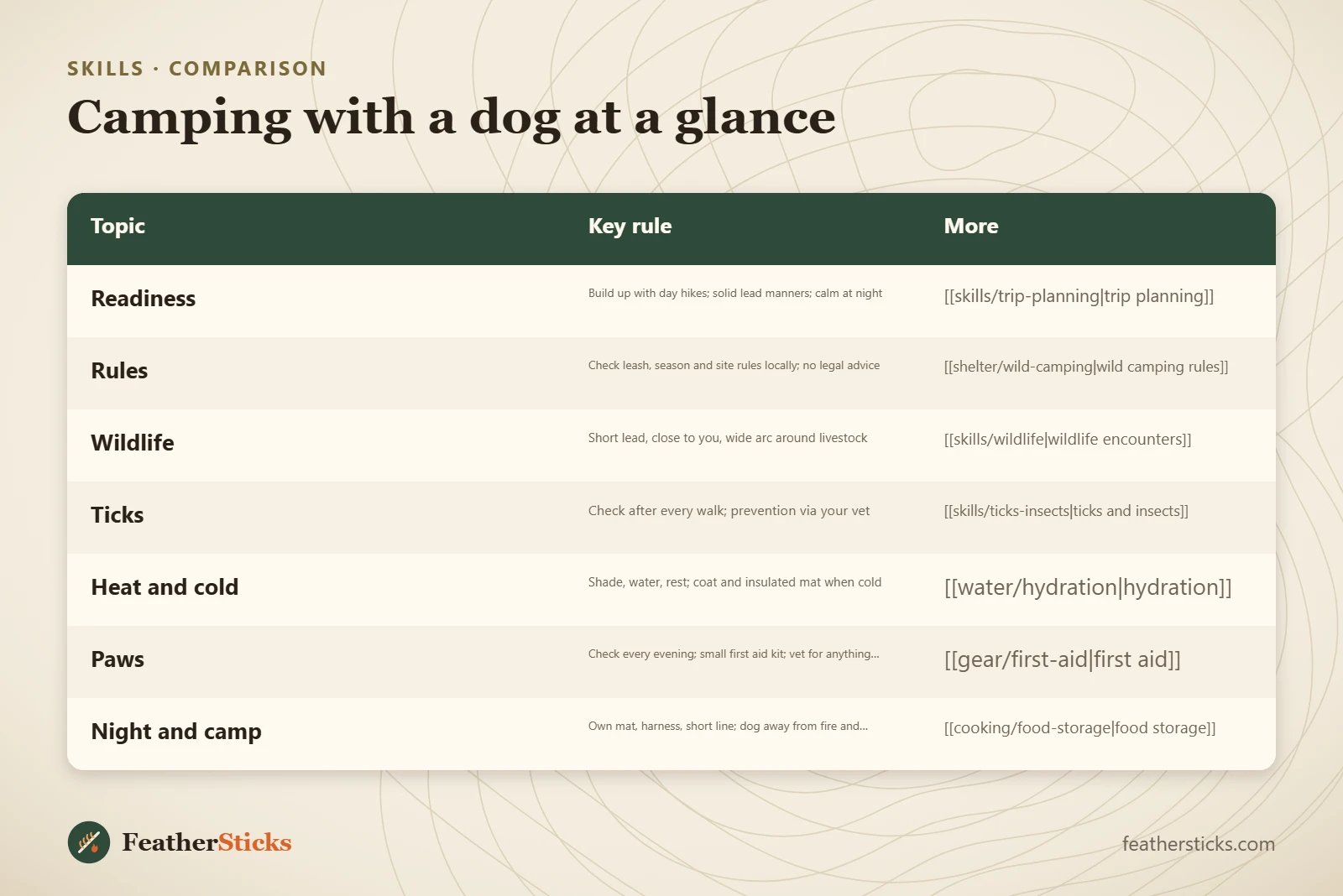
| Topic | Key rule | More |
|---|---|---|
| Readiness | Build up with day hikes; solid lead manners; calm at night | [[skills/trip-planning|trip planning]] |
| Rules | Check leash, season and site rules locally; no legal advice | [[shelter/wild-camping|wild camping rules]] |
| Wildlife | Short lead, close to you, wide arc around livestock | [[skills/wildlife|wildlife encounters]] |
| Ticks | Check after every walk; prevention via your vet | [[skills/ticks-insects|ticks and insects]] |
| Heat and cold | Shade, water, rest; coat and insulated mat when cold | [[water/hydration|hydration]] |
| Paws | Check every evening; small first aid kit; vet for anything deep | [[gear/first-aid|first aid]] |
| Night and camp | Own mat, harness, short line; dog away from fire and food | [[cooking/food-storage|food storage]] |
Common mistakes
- Taking a dog on a long trip without any build-up. Fitness, calm nights and gear manners need weeks of practice.
- Assuming that good recall replaces the lead. In forests, nature reserves, in spring, near livestock and at dusk the dog stays leashed or close.
- Walking in the heat of the day and carrying too little water for the dog, or leaving the dog in a closed tent or car.
- Never checking paws and coat, so that cuts, seeds and ticks are found days later.
- Letting a dog drink from or swim in green, foamy or stagnant water.
- Tying the dog to a thin peg or a collar only, or leaving it tied alone, where it can tangle or reach the fire.
- Leaving dog food, treats or dog waste at camp, which attracts wildlife and spoils the site for others.
What you need
- Harness that fits and a short lead
- Long line for open areas where it is allowed
- Collapsible bowl and extra water
- Mat or bed and a towel
- Light or reflective collar and vest
- Small dog first aid kit and papers
- Waste bags
FAQ
Can I go camping with my dog?
What dog camping gear do I really need?
Do dogs need to be on a lead when hiking?
How do I keep my dog safe from ticks when camping?
How do I know if my dog is too hot or too cold?
Can my dog sleep in the tent with me?
Is it OK to let my dog swim or drink from lakes and streams?
What do I do with dog poo when camping?
Check yourself
Completed6 quick questions from this guide. Nothing is sent anywhere.
Related step-by-step guides
-
 1
-
 1
-
 1