Trail Food Planning: Calories, Grams per Day and Sample Meal Plans
Trail food planning comes down to two numbers: how many calories you burn per day and how many grams of food it takes to deliver them. A hiking day typically needs about 2,500–3,300 kcal for an average adult, more in the cold or on hard days. With energy-dense trail food at around 4 kcal per gram, that is roughly 600–850 g of food per person per day.
This guide shows you how to estimate calories by activity and temperature, turn them into grams, balance carbs, fat and protein, and build 1-, 3- and 5-day meal plans. It also covers repacking, cook versus no-cook, water and fuel for cooking, and food safety. The numbers match our trail food and calorie planner, and the whole topic sits within bushcraft cooking and our bushcraft basics.
Step by step
-
1

Estimate calories per day
Base metabolism times activity, plus a surcharge for cold nights. A hiking day for an average adult is roughly 2,500–3,300 kcal.
-
2

Convert calories into grams
Divide daily calories by the energy density of your food. At about 4 kcal per gram, 3,000 kcal weigh around 750 g.
-
3

Build a daily menu
Breakfast, a grazing lunch, snacks and a hot dinner. Aim for roughly half the energy from carbs, a third from fat and 15 % from protein.
-
4

Repack into day bags
Remove boxes, weigh portions into zip bags and label each with the day, the meal and the water it needs.
-
5

Plan water and fuel
Count cooking water per meal, about 0.4–1.2 L per person and day, and the gas or wood to boil it.
-
6

Pack, store and eat safely
Eat perishables first, keep food dry and away from animals, wash hands and carry one reserve meal or day.
How much food per day do you need on the trail?
Your daily energy need is your basal metabolic rate (what your body burns at rest) multiplied by an activity factor, plus extra for cold. Our planner uses the Mifflin-St Jeor formula with factors of 1.55 for a camp day, 1.9 for 4–6 hours of hiking and 2.3 for hard days of 8 hours or more. For cold, it adds 1.5 % for every degree the night low falls below 10 °C, up to a maximum of 40 %.
That sounds technical, but the result is intuitive: a lighter, smaller person on a relaxed camp day may need around 2,000 kcal; a larger person hauling a pack uphill in frost can need well over 4,000 kcal. The table shows typical ranges.
| Activity | Mild night (10 °C+) | Cool night (0 °C) | Cold night (−10 °C) |
|---|---|---|---|
| Camp day (base camp, short walks) | 2,000–2,600 kcal | 2,300–3,000 kcal | 2,600–3,400 kcal |
| Hiking 4–6 hours with a pack | 2,450–3,200 kcal | 2,850–3,700 kcal | 3,200–4,200 kcal |
| Hard day 8 hours+, climbs, heavy load | 3,000–3,900 kcal | 3,400–4,500 kcal | 3,900–5,100 kcal |
Lower value: woman, 60 kg, 165 cm, 35 years; upper value: man, 75 kg, 178 cm, 35 years – calculated like the calorie planner. Heavier, taller and younger people need more. Estimates, not medical advice.
From body to grams: the calculation in four steps
 1Base metabolism
Weight, height, age and sex give the energy your body burns at rest – around 1,300 kcal for a 60 kg woman and 1,700 kcal for a 75 kg man in our examples.
 2Multiply by activity
Camp day ×1.55, hiking 4–6 hours ×1.9, hard day ×2.3. The 75 kg hiker lands at about 3,200 kcal.
 3Add the cold
+1.5 % per degree the night low falls below 10 °C, up to +40 %. At 0 °C that is +15 %, so about 3,700 kcal.
 4Divide by energy density
Kcal ÷ kcal per gram = grams per day. 3,700 kcal of standard trail food at 4 kcal/g weigh about 925 g.
How many grams of food per day? Energy density explained
Weight is what you actually carry, so the key figure is energy density: kilocalories per gram of food as packed. Fresh food is mostly water – an apple has around 0.5 kcal/g, bread about 2.5 kcal/g. Dry staples such as oats, pasta and couscous sit around 3.5–3.8 kcal/g, nuts and chocolate at 5–6 kcal/g, and oil tops the scale at almost 9 kcal/g.
Our planner uses three styles: fresh and heavy at 2.5 kcal/g, standard trail at 4.0 kcal/g and ultralight at 5.0 kcal/g. For a 3,000 kcal day that means about 1,200 g, 750 g or 600 g of food.
Food weight for a 3,000 kcal day

A practical target for trips of three days or more is 100 kcal or more per 25 g – that is 4 kcal/g. You do not need to hit it with every item; mix a few very dense foods (nuts, oil, chocolate) with bulky but satisfying staples. Weigh each day's bag at home: if it is over about 900 g for an average adult, look for water-heavy items to swap.
Carbs, fat and protein: the right mix for the trail
Carbohydrates are your quick fuel for climbing and cold mornings, fat is the densest energy store (9 kcal/g against 4 kcal/g for carbs and protein) and protein repairs muscles. The planner uses a simple split: 15 % protein, 35 % fat and the rest carbohydrates. When the nights drop below 0 °C, fat goes up to 42 %, because fatty food is compact and digests slowly, releasing heat through the night.

Macros for a 3,000 kcal day (mild conditions)
- Carbohydrates (50 %)
- about 375 g – oats, couscous, pasta, bread, dried fruit
- Fat (35 %)
- about 117 g – nuts, cheese, salami, oil, chocolate
- Protein (15 %)
- about 113 g – cheese, jerky, lentils, milk powder, nuts
- Below 0 °C
- fat about 140 g, carbs about 320 g
Do not overthink it on short trips – the split matters more on long ones. Two easy rules: add a spoonful of olive oil to every dinner, and eat a fatty snack such as cheese or nuts before sleeping on cold nights. Pair it with a warm sleep system and you sleep noticeably warmer.
The best trail foods by meal
Good trail food is energy-dense, keeps without a fridge, cooks quickly or not at all, and is something you actually like. Food you do not want to eat after a hard day is dead weight. Always test new foods at home.
| Food | kcal per 100 g | Cook? | Keeps | Best for |
|---|---|---|---|---|
| Oats / muesli | 370–400 | Hot water or cold soak | Months | Breakfast |
| Instant couscous | 350–370 | Hot water, 5 min | Months | Dinner base |
| Instant noodles | 430–470 | Hot water, 3–5 min | Months | Quick dinner |
| Freeze-dried meal (dry) | 400–500 | Hot water in the bag | Years | Easy dinners |
| Tortilla wraps | 290–320 | No | About 1–2 weeks | Lunch |
| Hard cheese | 380–420 | No | Several days unrefrigerated when cool | Lunch, snacks |
| Dry-cured salami | 400–500 | No | Several days to weeks if whole | Lunch |
| Nuts / trail mix | 500–650 | No | Months | Snacks |
| Dark chocolate | 520–580 | No | Months (melts in heat) | Snacks, evening |
| Olive oil | about 880 | Add to meals | Months | Boosting dinners |
| Whole milk powder | about 500 | Mix with water | Months | Porridge, drinks |

For bread baked fresh at camp from a light dry premix, see our bannock bread recipe. For evening meals over the fire, our bushcraft recipes and campfire cooking guide (with foil packets for no-wash dinners) have ideas that start from these staples; at a base camp, a Dutch oven turns the same dry staples into bread and stews.
Vegetarian, vegan and gluten-free trail food
Special diets work well on the trail – the only real challenge is getting enough protein and energy without fresh food. Plan the day in the same grams-and-kilocalories way, then check that protein reaches roughly the 15 % the planner assumes.
| Food | Protein per 100 g | kcal per 100 g | Suitable for |
|---|---|---|---|
| Red lentils (quick-cooking) | 23–26 g | 330–350 | Vegetarian, vegan, gluten-free |
| Dried soy mince (TVP) | 45–50 g | 330–360 | Vegetarian, vegan |
| Hard cheese | 25–30 g | 380–420 | Vegetarian, gluten-free |
| Whole milk powder | 24–26 g | about 500 | Vegetarian, gluten-free |
| Peanuts / peanut butter | 24–26 g | 580–620 | Vegan, gluten-free |
| Pumpkin or sunflower seeds | 20–30 g | 560–600 | Vegan, gluten-free |
| Soy or pea protein powder | 70–85 g | 370–400 | Vegan; stir into porridge or drinks |
- Vegetarian: cheese, milk powder, eggs on day one, lentils and nuts cover protein easily. Swap salami for extra cheese or a nut butter wrap at lunch.
- Vegan: use plant milk powder or soy protein in porridge, TVP or red lentils in dinners, and nut butters, seeds and dark chocolate for fat. A spoonful of oil in every dinner closes the energy gap left by missing cheese.
- Gluten-free: rice noodles, instant rice, polenta, quinoa flakes, potato flakes and certified gluten-free oats replace couscous, pasta and wheat tortillas. Corn tortillas or rice cakes work at lunch. Check sauce mixes and bars – many contain wheat.
For group trips, ask about diets and allergies before shopping, pack special portions separately and label them clearly. A gluten-free fire bread that works in the pan is described in our bannock guide.
Sample meal plans for 1, 3 and 5 days
Most trips are built from one "standard day" that you repeat with small variations. Here is a standard day of roughly 3,200 kcal in about 750 g – energy density around 4.3 kcal/g – which suits an average adult hiking 4–6 hours in mild to cool weather. Scale portions up or down to your own number from the calorie planner.
| Meal | Food | Weight | Approx. kcal |
|---|---|---|---|
| Breakfast | Oats 100 g, whole milk powder 25 g, nuts 25 g + tea or coffee | 150 g | 650 |
| Snacks (all day) | Trail mix 100 g, 2 bars (100 g), dark chocolate 50 g | 250 g | 1,200 |
| Lunch | 2 tortillas (120 g), hard cheese 50 g, salami 40 g | 210 g | 750 |
| Dinner | Couscous 100 g, olive oil 20 g, soup or sauce mix 20 g | 140 g | 600 |
| Total | about 750 g | about 3,200 |
1 day / 1 night: fresh and simple
On an overnighter weight hardly matters, so eat well: sandwiches or rolls for lunch, a sausage or something on a stick over the fire, bannock or twist bread, fresh fruit, a proper breakfast. Plan about 1–1.2 kg of food per person, mostly fresh.
3 days: fresh start, dry finish
Day one uses fresh food (sandwiches, cheese, vegetables for dinner), days two and three switch to the standard dry day. Expect around 2.5–3 kg of food per person, plus a few extra snacks.
5 days: dry, dense and counted
Only the first lunch is fresh; everything else follows the standard day with rotating dinners (couscous, noodles, lentil stew, freeze-dried meals) so you do not get bored. Add one spare day as a reserve. That is roughly 3.8–4.5 kg of food per person – the heaviest single item in many packs, so this is where energy density pays off.
Food weight per person by trip length (average adult)
Dehydrating your own trail meals
Drying your own food at home gives you tastier, cheaper and lighter meals than many shop-bought options, and you know exactly what is in them. A food dehydrator is easiest; a fan oven on its lowest setting with the door slightly open also works, just less efficiently.
| Food | Preparation | Drying | Done when |
|---|---|---|---|
| Vegetables (peppers, carrots, peas, mushrooms) | Slice thin; blanch firm vegetables briefly | About 50–60 °C, 6–12 h | Brittle or leathery, no moisture when snapped |
| Cooked lean mince | Cook thoroughly, drain and blot off fat | About 60–70 °C, 6–10 h | Hard, crumbly granules |
| Chilli, bolognese, stew | Cook, use lean meat, spread thin on baking paper | About 55–65 °C, 8–12 h | Dry, crumbly "leather" that breaks |
| Fruit (apple, banana, berries) | Slice evenly; berries halved | About 55–60 °C, 8–14 h | Leathery, no sticky wet spots |
| Cooked rice or beans | Cook fully, spread in one layer | About 55–60 °C, 5–8 h | Hard and dry throughout |
Times vary with slice thickness, humidity and the machine. For meat, food-safety agencies such as the USDA advise heating it to 71 °C (160 °F) before or during drying.
Making it keep
Fat is what spoils home-dried food: it turns rancid within weeks. Use lean meat, blot away fat and add oil only at camp. Let the dried food cool completely, then pack it airtight in portion bags. As a rough guide, home-dried vegetables and fruit keep for months in a cool, dark place, while dried meat dishes are best used within a few weeks – or kept in the freezer until the trip. Anything that smells off, feels soft or shows mould goes in the bin.
Rehydrating at camp
Home-dried meals need a bit more time than commercial freeze-dried ones: add boiling water to just cover the food, stir, and let it stand 10–15 minutes in an insulated cozy – or soak it in cold water for an hour before you heat it, which saves fuel. Write the water amount on the bag when you pack it.
Repackaging trail food into day bags
Shop packaging is bulky, heavy and produces rubbish you have to carry out. Repacking takes an evening and pays back every day of the trip: you know exactly what you have, you cannot accidentally eat Thursday's dinner on Tuesday, and the food bag fits your pack better.
Repacking food, step by step
 1Unbox everything
Take food out of cardboard boxes and bulky wrappers. Cut out cooking instructions and keep them in the bag.
 2Weigh portions
Weigh each meal on a kitchen scale into a zip bag – for example 100 g oats with 25 g milk powder for breakfast.
 3Label each bag
Write the day, the meal and the water it needs with a permanent marker: "Day 2 – dinner – 300 ml".
 4Bundle by day
Put all bags for one day into a larger bag. Check its weight against your target – about 600–850 g for most adults.
 5Pack the food bag
Stack the day bundles in a dry bag or food bag, last day at the bottom, today on top. Add one reserve meal.

Cook or no-cook? Hot meals versus cold soaking
Carrying a camp stove costs weight and fuel; going without costs comfort. For most trips a middle way works: a hot breakfast drink and a hot dinner, cold food during the day. On short summer trips some hikers go completely stoveless and "cold soak" – leaving couscous, oats or instant noodles to soften in cold water in a sealed jar for 30–60 minutes.
Hot meals vs. no-cook
Cooking
- Warm food lifts morale, especially in cold and wet weather
- Wider menu: pasta, rice, soups, bannock
- Needs stove, pot and 20–30 g of gas per day
- Boiling water also purifies it
No-cook / cold soak
- Saves stove, fuel and time
- Works well on short summer trips
- Limited menu, cold meals in bad weather
- Soaking water must already be safe to drink
Fuel-saving dinner: rehydrate in a cozy
 1Boil the exact amount
Measure the water on the label – for 100 g couscous about 150 ml, for a freeze-dried meal usually 300–500 ml – and bring it just to the boil with the lid on.
 2Pour it in
Pour the hot water into the food bag or pot, stir well and push out the air before sealing. Take care: freezer bags must be rated for boiling water.
 3Insulate and wait
Put the bag or pot into an insulated cozy or wrap it in a jacket for 5–10 minutes. The food finishes cooking without burning gas.
 4Stir and eat
Stir, add a spoon of olive oil and eat straight from the bag or pot. No pot to scrub, less water for washing up.
Water and fuel for cooking
Food planning is also water planning. Dry food saves weight only because you add the water later – so you need a water source at camp or have to carry it. Our water calculator counts 0.4 L of cooking water per person and day for ready-to-eat food, 0.8 L for mixed and 1.2 L for fully cooked dry meals, on top of drinking water.
| Meal | Water | Method |
|---|---|---|
| Porridge (80–100 g oats) | 250–300 ml | Hot or cold |
| Couscous (100 g) | about 150 ml | Boiling water, 5 min covered |
| Instant noodles (1 pack) | 300–400 ml | Boiling water, 3–5 min |
| Freeze-dried meal | 300–500 ml (see pack) | Boiling water in the bag |
| Pasta (100 g, absorption method) | about 300 ml | Simmer, lid on |
| Hot drink | 250–300 ml per cup | Boil |
How much fuel for trail cooking?
Our boiling point and fuel calculator models a typical canister stove: roughly 15–20 g of gas per litre in calm air with a lid and windscreen, and more than 30 g per litre in strong wind. For boiling 1–1.5 L per person and day, plan about 20–30 g of gas per person per day in mild, slightly breezy conditions. A 100 g canister therefore lasts one person roughly 3–4 days, a 230 g canister about a week. Simmering pasta or melting snow needs much more – melting snow can double or triple fuel use; see water from snow.
Water from streams and lakes must be made safe before you drink it or use it for cold soaking. Boiling does that on the way; otherwise use a filter or chemical treatment – see filtering water, water purification methods and boiling water. Collapsible water containers let you carry the evening's cooking water from the last source to camp. The right pot size and material are covered in camp cookware.
Eating on the move: snacks, salt, heat and appetite
On hiking days, lunch is less a meal than a string of snacks. A steady intake keeps energy even and avoids the slump that comes from walking on empty for hours.
- Snack rhythm: roughly every 60–90 minutes, 200–300 kcal – a handful of trail mix, a bar, a piece of cheese. That is how the standard day above fits about 1,200 kcal into snacks. Planning breaks with the hiking time calculator or the pace calculator makes the rhythm easy to stick to.
- Hot weather: appetite often drops while sweat losses rise. Salty foods such as crackers, nuts, soup powder or salami help replace salt; chocolate melts, so switch to hard sweets or dried fruit. Drink regularly – the water calculator estimates how much.
- Cold weather: keep the day's snacks in a jacket pocket so they stay chewable, and eat something fatty before bed. Hot drinks count as fuel for morale, too.
- Loss of appetite: common on the first day, at altitude and when exhausted. Small, familiar, tasty portions work better than large meals; liquid calories such as hot chocolate or soup go down easily.
Resupply on longer trips
Beyond five to seven days, food weight becomes hard to carry, so most people resupply: buying in villages along the route, sending parcels ahead to accommodation or post offices, or leaving a cache where that is allowed. Check opening hours and routes before you rely on a shop; plan resupply points on the map using map and compass navigation. Carry enough to reach the next point plus one reserve day, and plan campsites near reliable water – see finding water.
Food safety on the trail
Without a fridge, the risk is not dry food but moist, protein-rich and cooked food that sits warm. A few habits prevent almost all problems.
Food safety habits
- Eat fresh meat, fish and soft cheese on the first day only, kept cool
- Prefer hard cheese, dry-cured sausage and dry foods for later days
- Eat rehydrated and cooked meals straight away; do not keep leftovers overnight in warm weather
- Wash or sanitise hands before cooking and eating and after the toilet
- Clean the spoon and pot after every meal and let them dry
- Keep food dry, sealed and away from animals at night
- Check allergies in the group and label bags clearly
Planning for groups, children and winter
Groups: share dinners in one big pot to save fuel and weight, but give everyone their own breakfast, lunch and snacks – people eat at different times and tastes differ. Split shared food evenly between packs.
Children: the calorie planner is designed for teens and adults (from 14). Younger children eat less in total but need frequent small snacks and familiar food; pack generously and bring favourites. More tips in bushcraft with kids.
Winter: expect up to 40 % more calories, more fat, and more fuel for melting snow and hot drinks. Chocolate and cheese go rock-hard in frost – keep the day's snacks in a jacket pocket. Our winter camping guide covers the rest.
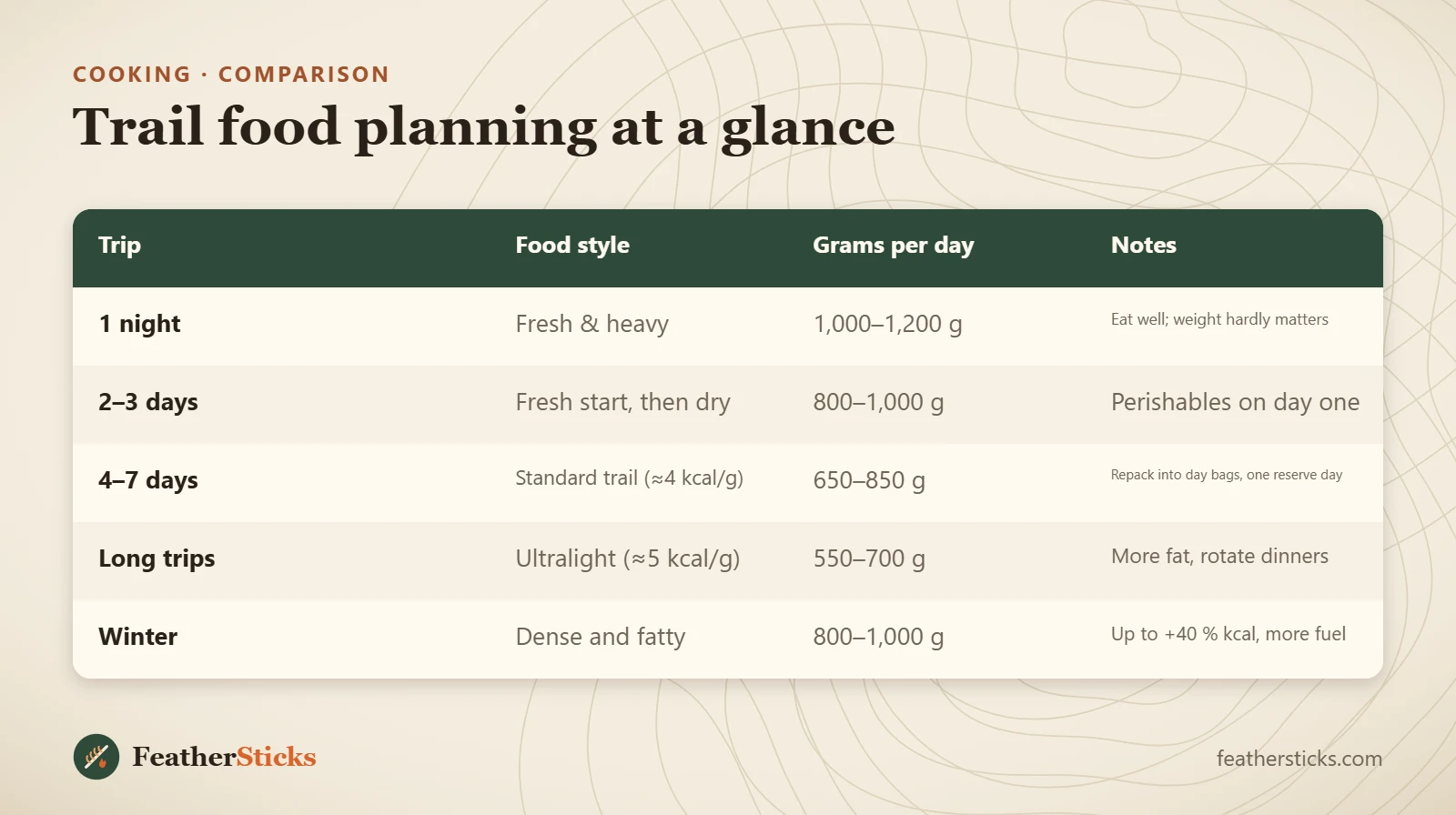
| Trip | Food style | Grams per day | Notes |
|---|---|---|---|
| 1 night | Fresh & heavy | 1,000–1,200 g | Eat well; weight hardly matters |
| 2–3 days | Fresh start, then dry | 800–1,000 g | Perishables on day one |
| 4–7 days | Standard trail (≈4 kcal/g) | 650–850 g | Repack into day bags, one reserve day |
| Long trips | Ultralight (≈5 kcal/g) | 550–700 g | More fat, rotate dinners |
| Winter | Dense and fatty | 800–1,000 g | Up to +40 % kcal, more fuel |
Common mistakes
- Planning in meals instead of calories and grams – and ending up with a pack full of heavy, watery food.
- Taking new foods on a trip without testing them at home.
- Forgetting that dry food needs water – and camping far from a source.
- Underestimating fuel for cold weather, wind or melting snow.
- Keeping cooked leftovers overnight in warm weather.
- Carrying no reserve on trips longer than three days.
What you need
- Kitchen scale for portioning
- Freezer-grade zip bags and a permanent marker
- Food bag or dry bag
- Stove, gas canister and windscreen
- Pot with lid and an insulated cozy
- Long-handled spoon
- Small bottle of olive oil
- Hand sanitiser
FAQ
How many calories do I need per day when hiking?
How much food should I pack per day for backpacking?
What is the best food for multi-day hikes?
How much gas do I need per day for cooking?
Can I go without a stove on a trail trip?
How do you keep food safe without a fridge?
How do I dehydrate food for backpacking?
What do vegans eat on multi-day hikes?
How often should I eat while hiking?
Check yourself
Completed6 quick questions from this guide. Nothing is sent anywhere.
Related step-by-step guides
-
 1
-
 1
-
 1