Cooking
Bushcraft Recipes: 14 Easy Campfire Meals, Foil Packets & One-Pot Dishes
The best bushcraft recipes use few ingredients, one pot or a sheet of foil, and the steady heat of a bed of coals rather than open flames. This guide collects 14 easy campfire recipes — breakfasts, one-pot camping meals, foil packet recipes, trout, bannock, desserts and hot drinks — each with ingredients per person, clear steps, cooking time and approximate calories.
If you are new to fire cookery, start with the basics of cooking over a campfire and the right fire lay for cooking. Plan how much food you need with the trail food & calorie planner, and read the food safety section before you cook meat or fish outdoors. Everything here fits a normal bushcraft kit list: one pot, a pan or lid, foil, a knife and a spoon.
Step by step
-
1
Plan meals and calories
Pick one breakfast, one one-pot dinner and a hot drink per day. Check your daily energy need and pack food in daily bags.
-
2
Build a cooking fire early
Light a small log-cabin fire 30–45 minutes before cooking. Cook over glowing coals, not tall flames, for even heat and less soot.
-
3
Prep on a clean surface
Wash or sanitise hands, cut vegetables before raw meat, and keep raw and ready-to-eat food apart on separate boards or lids.
-
4
Cook one pot at a time
Start with the longest-cooking item. Stir often, keep the lid on to save fuel, and move the pot to the edge to simmer.
-
5
Check doneness safely
Meat and fish must be cooked through: poultry to about 74 °C core, fish until opaque and flaking. Use a thermometer if you can.
-
6
Clean up and put out the fire
Scrape pots, pack out leftovers and foil, wash up away from water sources, then drown, stir and drown the fire until cold.
What makes a good bushcraft recipe?
A good bushcraft recipe is forgiving. It tolerates uneven heat, a pot that is too small and a cook who is also watching the fire. That is why most of the dishes below are either one-pot meals, foil packets or simple pan dishes: they need no precise oven temperature and few utensils.
The second rule is weight versus freshness. On an overnighter you can carry fresh potatoes, eggs and sausages. On a five-day trip you switch to dry, calorie-dense staples such as oats, couscous, lentils, pasta, nuts, hard cheese and cured sausage. Every recipe notes which version suits which trip.
Third, the recipe must match the fire. Boiling water needs a hot, compact flame; simmering a stew needs steady coals; foil packets and baked apples want embers at the edge. If you know the fire, you can cook almost anything — the bushcraft basics of fire, water and shelter come first, recipes second.
Overview: all 14 recipes at a glance
The table shows cooking time on the fire (without prep), approximate calories per serving and the heat you need. Calories are rounded estimates from standard nutrition values for the listed ingredients; brands and portion sizes vary.
| Recipe | Serves | Time on fire | Approx. kcal/serving | Method | Difficulty |
|---|---|---|---|---|---|
| Nutty porridge | 1 | 5–8 min | ≈ 640 | Pot, flame or coals | Easy |
| Campfire hash with eggs & bacon | 2 | 20–25 min | ≈ 630 | Pan over coals | Easy |
| One-pot bean chilli with rice | 2 | 30–35 min | ≈ 780 | Pot, simmer on coals | Easy |
| Red lentil stew | 2 | 20–25 min | ≈ 360 (510 with bread) | Pot, simmer | Easy |
| One-pot tomato pasta | 2 | 15–18 min | ≈ 560 (675 with salami) | Pot, rolling boil | Easy |
| Ultralight couscous | 1 | 5 min (boil only) | ≈ 850 | Boil water, soak | Very easy |
| Potato, veg & sausage foil packet | 2 | 30–40 min | ≈ 540 | Foil on embers | Easy |
| Trout in foil or on a plank | 1 | 15–25 min | ≈ 360 | Foil on coals / plank beside fire | Medium |
| Bannock (pan or stick) | 1 | 12–20 min | ≈ 490 | Pan or stick over coals | Easy |
| Banana boat | 1 | 5–10 min | ≈ 250 | Foil in embers | Very easy |
| Baked apple | 1 | 20–30 min | ≈ 270 | Foil in embers | Very easy |
| Camp chai | 2 | 10 min | ≈ 105 | Pot, simmer | Easy |
| Hot chocolate | 1 | 5 min | ≈ 220 | Pot or mug | Very easy |
| Cowboy coffee | 2 | 8 min | ≈ 5 | Pot, steep | Easy |
Calories are approximate, calculated from typical values per 100 g. Adjust portions with the calorie planner.
How do you plan meals and calories for a bushcraft trip?
Start with energy, then weight. An active day outdoors with walking, wood processing and cold nights easily needs 2,500–4,000 kcal, depending on body size, effort and temperature. The food and calorie planner estimates your need from body data (Mifflin-St Jeor formula × activity factor, with a cold surcharge) and converts it into grams of food per day.
The key number is calorie density: kilocalories per 100 g of food as carried. Fresh food (potatoes, fruit, eggs) sits around 50–150 kcal/100 g. Dry staples are 340–380 kcal/100 g. Nuts, chocolate and oil reach 500–900. The planner assumes about 250 kcal/100 g for a fresh-and-heavy menu, 400 for a standard trail menu and 500 for ultralight.
Pantry list with calorie density
| Food | Approx. kcal/100 g | Keeps without cooling | Used in |
|---|---|---|---|
| Rolled oats | 370 | Weeks | Porridge, bannock add-in |
| Couscous / bulgur | 355–360 | Weeks | Ultralight couscous, side dish |
| Dry pasta | 350–360 | Weeks | One-pot pasta |
| Red lentils | 340 | Weeks | Lentil stew |
| White rice (quick-cook) | 350 | Weeks | Chilli |
| Plain flour | 340–365 | Weeks | Bannock, thickening |
| Whole milk powder | 490–500 | Weeks (sealed) | Porridge, chai, hot chocolate |
| Nuts (walnut, hazelnut, almond) | 580–650 | Weeks | Porridge, couscous, snacks |
| Dark chocolate | 530–550 | Days in heat, weeks when cool | Banana boat, snacks |
| Olive or rapeseed oil | ≈ 880–900 | Weeks | Frying, adding calories |
| Hard cheese (aged) | 380–400 | Several days if cool | Pasta, couscous |
| Cured sausage / salami | 380–450 | Several days if cool | Pasta, chilli, couscous |
| Fresh potatoes | 75–80 | Days | Hash, foil packets |
| Eggs | 140–155 | 1–2 days unrefrigerated (see storage) | Hash |
Values are rounded typical figures; check the labels of your products. How to keep food safe and away from animals: storing food at camp.
A practical rule: plan one hot breakfast, one cold lunch and one hot dinner per day, plus a hot drink morning and evening. Repack each day into a labelled bag. Carry one spare dinner on longer trips, and never let the food bag rely on refrigeration after day one unless you have a cool box.
Water and fuel for cooking
Budget roughly 0.5–1 litre of water per person per hot meal for cooking and washing up, on top of drinking water. If you use natural sources, treat the water first — see water purification methods and how long to boil water. The boiling point and fuel calculator shows how altitude lowers the boiling point, which lengthens cooking times for pasta, lentils and rice in the mountains.
Minimal recipe kit
- Pot of 1–1.5 litres with a lid (2 litres for two people) — see bushcraft cookware
- Small pan or a lid that works as a pan
- Heavy-duty aluminium foil, about 1 m per person per day
- Knife and a thin cutting board — see bushcraft knives
- Long spoon or spatula, gloves or pot grip
- Salt, pepper, chilli, stock cubes, cinnamon in small tins
- Biodegradable soap, scraper, small cloth, hand sanitiser
- Pocket meat/food thermometer (optional but recommended)
Food safety outdoors: temperatures, hygiene and cooling
Food poisoning is one of the most common reasons outdoor trips end early, and a campfire makes it easy to char the outside of meat while the inside stays raw. Three habits prevent most problems: keep hands and boards clean, cook to a safe core temperature and do not leave cooked food warm for hours.
The US Department of Agriculture (USDA/FSIS) publishes safe minimum internal temperatures. Other food agencies, such as Germany’s BfR, give similar guidance in a different form (for example around 70 °C in the core for at least two minutes for many foods). The table lists the commonly cited USDA values; when in doubt, cook a little longer and check with a thermometer in the thickest part.
| Food | Minimum core temperature | Visual cue (not a guarantee) |
|---|---|---|
| Poultry (whole, pieces, minced) | 74 °C (165 °F) | Juices run clear, no pink at the bone |
| Minced beef, pork, lamb; fresh sausages | 71 °C (160 °F) | No pink in the centre |
| Whole cuts of beef, pork, lamb | 63 °C (145 °F) + 3 min rest | Firm, juices mostly clear |
| Fish | 63 °C (145 °F) | Opaque flesh that flakes easily |
| Egg dishes | 71 °C (160 °F) | Yolk and white set firm |
| Reheated leftovers | 74 °C (165 °F) | Steaming hot throughout |
Values as commonly published by USDA/FSIS; national agencies may round differently. Precooked smoked sausages only need thorough reheating.

What "done" looks like for each recipe
| Recipe | Done when | Not yet |
|---|---|---|
| Porridge | Thick and creamy, no dry oats | Watery, oats still firm |
| Campfire hash | Golden crust on the potatoes, egg white and yolk firm | Pale potatoes, runny egg |
| Chilli, lentil stew | Rice or lentils soft all the way through, stew thick | Hard core in the rice, lentils still whole |
| One-pot pasta | Pasta tender with a light bite, sauce glossy | Chalky centre, thin watery sauce |
| Foil packet | Potato slice soft when pierced | Knife meets resistance |
| Trout | Opaque at the backbone, flakes easily, 63 °C | Glassy, translucent flesh |
| Banana boat, baked apple | Chocolate melted; knife slides into the apple | Firm fruit, solid chocolate |
Hygiene without a kitchen sink
Wash hands with soap and treated water before cooking, or at least use alcohol-based sanitiser after toilet visits and before handling food. Cut vegetables and bread first, raw meat or fish last. Use the pot lid or a second board for cooked food so it never touches a surface that held raw meat.

Cooling and leftovers
Bacteria multiply fastest between roughly 5 °C and 60 °C. Food safety agencies generally advise not to keep perishable cooked food in that range for more than about two hours, or one hour in hot weather above about 32 °C. Outdoors, the easiest rule is: cook what you will eat, eat it hot, and pack leftovers into a sealed bag with the rubbish rather than saving a lukewarm stew for tomorrow.
Easy campfire breakfast recipes
Breakfast should be fast. In the morning the fire is usually small or has to be relit, so both recipes work on a modest flame. Porridge is the dry-food classic; the hash is the fresh-food feast for day one or a base camp.
1. Nutty porridge with dried fruit
Serves 1 · 5–8 minutes · approx. 640 kcal per serving · pot over flame or coals
- 80 g rolled oats
- 20 g whole milk powder (or use milk on day one)
- 20 g chopped walnuts or hazelnuts
- 25 g raisins or chopped dried apricots
- 10 g sugar or honey, a pinch of salt and cinnamon
- about 250 ml water
At home, mix the oats, milk powder, fruit, sugar, salt and cinnamon in one bag and pack the nuts separately so they stay crunchy.
Nutty porridge
- Boil the water. Bring about 250 ml treated water to the boil in a small pot.
- Stir in the mix. Pull the pot to the edge of the fire and stir in the oat mix to avoid lumps.
- Simmer briefly. Let it bubble gently for 3–5 minutes, stirring constantly — oats catch on the bottom quickly.
- Rest and top. Put the lid on, rest 1–2 minutes off the heat, then scatter the nuts on top.
Variations: stir in a spoon of peanut butter (about +90 kcal), swap raisins for freeze-dried berries, or cook the oats in chai (recipe 12) for a spiced version. For cold mornings, a knob of butter adds calories and keeps you warm for longer.
2. Campfire hash with eggs and bacon
Serves 2 · 20–25 minutes · approx. 630 kcal per serving · pan over coals
- 500 g waxy potatoes, boiled at home or the evening before, cut into 2 cm cubes
- 100 g smoked streaky bacon or lardons
- 1 onion (about 100 g), chopped
- 4 eggs
- 1 tbsp oil (10 g), salt, pepper, paprika
Campfire hash
 1Render the bacon
Fry the bacon in a dry pan over medium coals for 4–5 minutes until the fat runs. It should sizzle steadily, not spit and smoke – if it smokes, lift the pan.
 2Add onion and potatoes
Add oil, onion and the precooked potato cubes. Fry 10–12 minutes and turn only every few minutes: a golden crust only forms where the potatoes stay put.
 3Make wells for the eggs
Push the potatoes aside to make four hollows and crack an egg into each. Crack each egg into a mug first if your hands are sooty.
 4Cover and set
Cover with a lid or foil for 4–6 minutes until whites and yolks are set firm, then season. No lid? Flip each egg once.
Precooking the potatoes is the trick that makes this recipe work on a fire: raw cubes take 25–30 minutes and burn before they soften. Eggs without refrigeration are best used on day one; the section on keeping food cool at camp explains why. Because young children, pregnant people and older adults are more vulnerable to salmonella, cook the eggs until firm rather than runny.
One-pot camping meals: chilli, lentil stew, pasta and couscous
One-pot camping meals are the backbone of bushcraft cooking: one vessel to carry, one to clean, and all the flavour stays in the pot. They need a stable pot position — a tripod, a pot hanger or two green logs either side of a bed of coals — which is covered in detail in campfire cooking techniques. A heavy cast-iron pot works too; see Dutch oven cooking for stews and bread in the embers.
3. One-pot bean chilli with rice
Serves 2 · 30–35 minutes · approx. 780 kcal per serving · pot, simmer over coals
- 1 tbsp oil, 1 onion, 1 clove garlic
- 100 g cured chorizo or smoked sausage, sliced (vegetarian: leave out and add 50 g cheese at the end)
- 1 tin kidney beans (400 g, drained), 1 small tin sweetcorn (140 g drained)
- 1 tin chopped tomatoes (400 g)
- 150 g quick-cook white rice
- 2 tsp chilli spice mix (cumin, paprika, chilli, oregano), salt, 1 stock cube
- about 350 ml water
One-pot chilli
 1Fry the base
Fry onion, garlic and sausage in oil for 3–4 minutes over hot coals, stirring so nothing catches, until the onion is soft and glossy.
 2Add tomatoes and liquid
Add spices, tomatoes, the crumbled stock cube and water. Bring to the boil – the whole surface should bubble before the rice goes in.
 3Cook the rice in the sauce
Stir in the rice, cover and simmer 15–20 minutes at the edge of the fire, stirring every few minutes and scraping the bottom.
 4Finish with beans
Add beans and corn for the last 5 minutes. Add a splash of water if it gets too thick; it is ready when the rice has no hard core.
Tins are heavy, so this is a base-camp or first-night recipe. For a lighter version, use dried bean flakes or 60 g dried soy mince and increase the water. Rice at altitude cooks more slowly because water boils below 100 °C — the boiling point calculator shows by how much.
4. Red lentil stew
Serves 2 · 20–25 minutes · approx. 360 kcal per serving (about 510 with a flatbread) · pot, simmer
- 150 g red lentils, rinsed
- 1 onion, 1 carrot (about 100 g), diced small
- 1 tbsp oil, 1 tbsp tomato paste (a tube is lighter than a tin)
- 1 stock cube, 1 tsp curry powder or ground cumin, salt
- about 600 ml water
- optional: 2 flatbreads (120 g in total)
Red lentil stew
- Sweat the vegetables. Fry onion and carrot in oil for 3 minutes, then stir in tomato paste and spices for 1 minute.
- Add lentils and water. Add lentils, water and stock cube. Bring to the boil and skim off foam.
- Simmer to a stew. Simmer 15–20 minutes over gentle coals, stirring often, until the lentils break down into a thick stew.
- Season and serve. Season with salt, and serve with flatbread or a quick bannock.
Red lentils are ideal outdoors because they need no soaking and cook in about 15 minutes, unlike brown or green lentils (30–45 minutes). The stew thickens as it cools, so add a little water before reheating. It is also a reliable meal for vegetarians and a good calorie base when you add a spoon of oil or a handful of nuts.
5. One-pot tomato pasta
Serves 2 · 15–18 minutes · approx. 560 kcal per serving (675 with salami) · pot, rolling boil
- 200 g short dry pasta (penne, fusilli)
- 1 tin chopped tomatoes (400 g) or 400 ml passata
- 1 tbsp olive oil, 2 cloves garlic, dried oregano, salt, chilli flakes
- 60 g hard cheese, grated or shaved
- optional: 60 g salami, diced
- about 500–600 ml water
One-pot pasta
- Everything in one pot. Put pasta, tomatoes, water, oil, garlic, oregano and salt into the cold pot.
- Boil and stir. Bring to the boil over a hot fire and stir every 1–2 minutes so the pasta does not stick.
- Reduce. Cook uncovered for the time on the pasta packet plus 1–2 minutes until the liquid becomes a glossy sauce.
- Finish. Stir in salami and half the cheese; top with the rest.
Because the pasta cooks in the sauce, there is no starchy water to drain — a big plus when water is scarce and you should not pour food waste near streams. If the sauce dries out before the pasta is soft, add water in small splashes.
6. Ultralight couscous (boil-only meal)
Serves 1 · 5 minutes (boil water only) · approx. 850 kcal per serving · boil and soak
- 100 g couscous
- ½ stock cube, 1 tsp dried herbs or ras el hanout
- 20 g sun-dried tomatoes, chopped
- 25 g almonds or cashews
- 50 g hard cheese or cured sausage, diced
- 1 tbsp olive oil (10 g), carried in a small leak-proof bottle
- about 150 ml water
Ultralight couscous
- Boil water with stock. Bring 150 ml water with the stock cube to the boil.
- Soak. Take it off the heat, stir in couscous, herbs and tomatoes, and cover tightly for 5 minutes.
- Fluff and enrich. Fluff with a spoon, then stir in oil, nuts and cheese or sausage.
This is the fastest and most fuel-efficient dinner on the list, and it works just as well on a small stove when a fire ban is in force. At about 850 kcal for around 245 g of dry weight, it lands close to 350 kcal per 100 g — typical of a well-planned trail menu.
One-pot troubleshooting at the fire
Most one-pot problems show up in the pot long before the meal is ruined. Lift the lid every few minutes, look at the surface and drag the spoon across the bottom: if it meets a sticky layer, act now rather than at the end.
| What you notice | Why | What to do |
|---|---|---|
| Spoon scrapes a sticky layer on the bottom | Too much heat under the pot, too little stirring | Pull the pot to the edge, stir from the bottom, add a splash of water; do not scrape burnt bits into the food |
| Rice, pasta or lentils still hard, pot almost dry | Liquid boiled off faster than the grain cooked | Add hot water in small amounts, lid on, lower heat |
| Sauce thin and watery | Too much water or lid on during reducing | Cook uncovered for a few minutes, stirring |
| Everything tastes smoky | Cooking over flames or resinous wood, lid off | Wait for coals, use hardwood, keep the lid on |
| Pot boils over into the fire | Pot too full, heat too high | Fill to about three quarters, lift the pot higher or to the edge |
Practice drill: cook your first one-pot meal of a trip on a stove or at home in the pot you will use outdoors. You learn how much water your pot loses and how fast the base catches – knowledge that carries straight over to the campfire.
Fresh versus dry one-pot meals
Fresh / tinned (chilli, hash)
- Tastes like home, great morale boost
- No rehydration, forgiving to cook
- Heavy: tins and fresh vegetables add 1–2 kg
- Best for day one or base camps
Dry staples (lentils, pasta, couscous)
- Light and compact, keeps for weeks
- Needs more water and fuel (except couscous)
- Needs spices and oil for flavour and calories
- Best for multi-day trips
Foil packet recipes for the campfire
Foil packet recipes are the easiest way to cook without a pot: wrap food tightly, lay it on embers, turn once, done. The foil traps steam, so vegetables cook through and meat stays moist. The main risks are burning the underside and piercing the foil, so use heavy-duty foil or two layers.
How to fold a foil packet
- Two sheetsLay two sheets of foil (about 40 × 30 cm) crosswise, shiny side in, lightly oiled.
- Food in the middlePile food in a flat, even layer about 3–4 cm thick in the centre.
- Fold the top seamBring the long edges together above the food and fold down twice, leaving air space.
- Crimp the endsRoll both short ends in tightly so no steam escapes.
- Onto embersPlace seam up on a thin layer of glowing embers, not in flames. Turn once halfway.
7. Potato, vegetable and sausage foil packet
Serves 2 (two packets) · 30–40 minutes · approx. 540 kcal per serving · foil on embers
- 400 g waxy potatoes, sliced 5 mm thin
- 1 bell pepper, 1 small courgette, 1 onion, cut into chunks
- 200 g precooked smoked sausages (e.g. frankfurters), sliced
- 1 tbsp oil, salt, pepper, paprika, dried thyme or rosemary
Foil packet
- Slice thin. Slice potatoes thin (5 mm) so they cook in the same time as the vegetables.
- Season and wrap. Toss everything with oil and spices, divide between two double-layer foil sheets and seal tightly.
- Cook on embers. Place on a shallow bed of embers for 15–20 minutes per side, turning once with tongs or sticks.
- Test and serve. Open one corner carefully (hot steam!) and pierce a potato slice; it should be soft all the way through.
Precooked sausages are chosen on purpose: they only need to be heated through, so the packet is safe even if the heat is uneven. If you use raw chicken or fresh sausages instead, cut them small, cook longer and check that the core reaches the temperature in the food safety table. Other good packet fillings: sweet potato with feta, salmon with lemon and courgette, or halloumi with peppers.
How do you cook trout on a campfire?
Trout is the classic campfire fish: small enough to cook whole, with mild flesh that flakes when done. Buy it gutted from a fish farm or fishmonger and keep it cool, or catch it legally. Fishing almost always requires a licence or permit: in the US a state licence, in Canada a provincial licence, in England and Wales a rod licence plus the fishery owner’s permission, and in Scandinavia and elsewhere local permits. Closed seasons, minimum sizes and humane killing rules apply. Rules vary by country and water, so check before you fish.
8. Trout in foil (or on a plank)
Serves 1 · 15–25 minutes · approx. 360 kcal per serving · foil on coals, or plank beside the fire
- 1 whole trout, gutted and cleaned (about 300 g; roughly 180 g edible flesh)
- 15 g butter
- ½ lemon, sliced
- a few sprigs of bought herbs (dill or parsley), salt, pepper
Trout in foil
 1Season the cavity
Salt the fish inside and out. Fill the belly with lemon slices, herbs and butter.
 2Wrap tightly
Wrap in two layers of oiled foil, seams on top, so the juices stay inside and nothing leaks into the coals.
 3Cook over coals
Lay on a grate or on thin embers for about 7–12 minutes per side, depending on thickness. Turn once with tongs.
 4Check doneness
Open the foil and look at the backbone: the flesh should be opaque and lift off the bone easily, about 63 °C core. Translucent, glassy flesh needs a few more minutes.
Plank variant
For a planked trout, split the fish along the back or belly so it opens flat (butterfly). Pin it skin-side down to a split board of dry, untreated, non-resinous hardwood with wooden pegs or stainless steel nails. Prop the plank upright or angled near a bed of hot coals, flesh facing the heat, and turn the plank once so both ends cook evenly. It takes 20–30 minutes. Avoid resin-rich softwood, which gives an acrid taste, and never use painted, treated or unknown wood.
A sharp, thin blade makes gutting and filleting much easier — see choosing a bushcraft knife. For whole fish or meat on a stick over the fire, spit cooking explains distances, heat zones and turning.
Bannock and campfire bread variants
Bannock is the simplest bread you can make over a fire: flour, baking powder, salt, fat and water, cooked in a pan or wrapped around a stick. It turns any stew into a full meal. The full guide with ratios, troubleshooting and flavour ideas is in bannock and campfire bread; here is the short version.
9. Basic bannock
Serves 1 · 12–20 minutes · approx. 490 kcal per serving · pan or stick over coals
- 100 g plain flour, 1 tsp baking powder, a pinch of salt
- 10 g milk powder (optional), 10 g oil or butter
- 60–70 ml water
Bannock variants
- Pan bannock
- Flatten to 1.5 cm, cook in a lightly oiled pan over low coals, 6–8 min per side, lid on.
- Stick bannock
- Roll into a 1 cm-thick snake, wind around a thumb-thick peeled green stick, bake 10–15 min, turning.
- Sweet
- Add 15 g sugar, cinnamon and raisins; serve with chocolate spread or honey.
- Savoury
- Add diced cheese, dried herbs or a little chopped salami to the dough.
- Done when
- Sounds hollow when tapped and the centre is no longer doughy.
For a stick, use a clean, peeled hardwood stick and avoid species that are known to be toxic, such as yew. Bannock burns on the outside long before it cooks inside if the heat is too high — hold it over coals, not flames, at about hand-hot distance.
Campfire desserts: banana boats and baked apples
Desserts are where foil shines. Both recipes cook in the dying embers after dinner, when the fire is too low for a pot but still hot enough to melt chocolate. They are also the best recipes to cook with children, provided an adult handles the foil and the embers.
10. Banana boat
Serves 1 · 5–10 minutes · approx. 250 kcal per serving · foil in embers
- 1 ripe banana, unpeeled
- 20 g dark chocolate, broken into pieces
- 10 g mini marshmallows (optional)
Banana boat
 1Cut the boat
Slit the banana lengthways through the peel on the inner curve, without cutting through the bottom peel.
 2Fill
2FillOpen the slit slightly and press chocolate pieces and marshmallows into the gap.
 3Wrap and bake
Wrap in foil, opening up, and set it at the edge of the embers for 5–10 minutes until the chocolate melts.
 4Eat from the peel
Let it cool for a minute and spoon it out of the peel – the filling is very hot, especially for children.
11. Baked apple
Serves 1 · 20–30 minutes · approx. 270 kcal per serving · foil in embers
- 1 firm apple (about 180 g), cored with a knife
- 15 g raisins, 10 g chopped nuts
- 10 g honey or brown sugar, 5 g butter, cinnamon
Baked apple
- Core the apple. Cut a cone-shaped hole from the top with a knife point, leaving the bottom closed.
- Fill. Mix raisins, nuts, honey and cinnamon, press into the hole and top with butter.
- Wrap and bake. Wrap in double foil and nestle upright in warm embers for 20–30 minutes.
- Check. A knife should slide in easily. Let it rest for 2 minutes before opening.
Firm, slightly tart apples hold their shape best. If you prefer a cleaner method without foil, a Dutch oven with embers on the lid bakes four apples at once.
Hot drinks: camp chai, hot chocolate and cowboy coffee
A hot drink warms you from the inside and turns a break into a proper rest. All three recipes start with water brought to a rolling boil. If it comes from a stream or lake, boiling also makes it microbiologically safe — the guide to boiling water explains how long and why altitude matters.
12. Camp chai
Serves 2 · 10 minutes · approx. 105 kcal per serving · pot, simmer
- 400 ml water, 200 ml milk (or 25 g whole milk powder plus 200 ml more water)
- 2 black tea bags
- 1 cinnamon stick, 4 cardamom pods (crushed), 3 cloves, a slice of fresh ginger or ½ tsp ground ginger
- 20 g sugar or honey
Camp chai
- Simmer the spices. Simmer water with the spices for 5 minutes.
- Add tea. Add tea bags and steep 3 minutes off the heat.
- Add milk and sugar. Stir in milk and sugar, reheat until steaming but not boiling over, and pour through a spoon to hold back the spices.
13. Hot chocolate
Serves 1 · 5 minutes · approx. 220 kcal per serving · pot or mug
- 250 ml water
- 25 g whole milk powder, 10 g cocoa powder, 15 g sugar (pre-mixed at home)
- optional for cold nights: 10 g butter or a few squares of chocolate (+60–90 kcal)
Mix the powder with a splash of warm water into a smooth paste first, then add the rest of the hot water and stir. This avoids lumps. A cup before bed on a cold night adds calories that help you sleep warmer.
14. Cowboy coffee
Serves 2 · 8 minutes · approx. 5 kcal per serving (black) · pot, steep
- 500 ml water
- 30 g medium-coarse ground coffee
- a splash of cold water to settle the grounds
Cowboy coffee
- Boil, then pause. Bring water to the boil, take the pot off the fire and wait about 30 seconds.
- Add the coffee. Stir in the grounds, cover and steep for 4 minutes.
- Settle the grounds. Add a splash of cold water, tap the pot and let it stand 1 minute so the grounds sink.
- Pour gently. Pour slowly so the grounds stay in the pot.
Boiling the grounds continuously makes coffee bitter; the short pause after boiling brings the water to roughly 93–96 °C, the range usually recommended for brewing. Pack spent grounds out or bury them as your local rules require — they do not belong in water.
Which fire is best for which recipe?
Most failed campfire meals are heat problems, not recipe problems. Tall flames blacken pots and burn the outside of food; a small, established bed of coals gives even, controllable heat. Light the fire 30–45 minutes before you want to cook, using the techniques in fire starting basics, and let it burn down.

Choosing the heat for your recipe
Do you only need to boil water (couscous, drinks, porridge)?
Yes → A small, hot teepee fire or a stove is enough — fast and fuel-efficient.No → You need steady heat; go to the next question.Will the dish simmer for 15 minutes or more (chilli, lentils, pasta)?
Yes → Build a log-cabin fire and cook over its coals with a pot hanger or on two logs. The fire lay picker helps choose.No → Go to the next question.Is the food wrapped in foil (packets, fish, fruit)?
Yes → Rake a thin, even layer of embers to one side and cook there, away from flames.No → Use a pan over medium coals for frying, or a stick for bannock.
Firewood matters too. Dry hardwood (beech, oak, ash, birch in the north) makes long-lasting coals; softwood burns fast with more soot and sparks. A cooking fire for one meal needs surprisingly little wood — typically an armful of wrist-thick pieces plus kindling. Estimate it with the firewood calculator, and read fire in wet weather if rain is forecast.
Relative heat needed per recipe type
Clean-up, washing up and Leave No Trace
Cleaning up is part of the recipe. Food smells attract foxes, bears (in bear country), wild boar, rodents and insects. Scrape pots clean while they are still warm, pack out all leftovers and foil, and store food and rubbish away from where you sleep, as described in storing food at camp.
After every meal
- Scrape the pot with a spoon or scraper and eat or pack out the scrapings
- Wash up at least 50–60 m (about 200 ft) from lakes and streams, with a drop of biodegradable soap or none
- Scatter strained grey water widely; pack out food particles
- Fold foil flat and pack it out
- Store food and rubbish sealed, away from the sleeping area
- Drown, stir and drown the fire again until the ashes are cold to the touch
Where open fires are banned — increasingly common in dry summers across Europe, North America and Australia — cook the boil-only recipes (couscous, porridge, drinks) on a stove instead, if stoves are permitted. Rules vary by country, region and land owner, and they can change daily with fire danger levels, so check before you go. More skills that make camp cooking easier are gathered on the cooking hub and in setting up a camp.
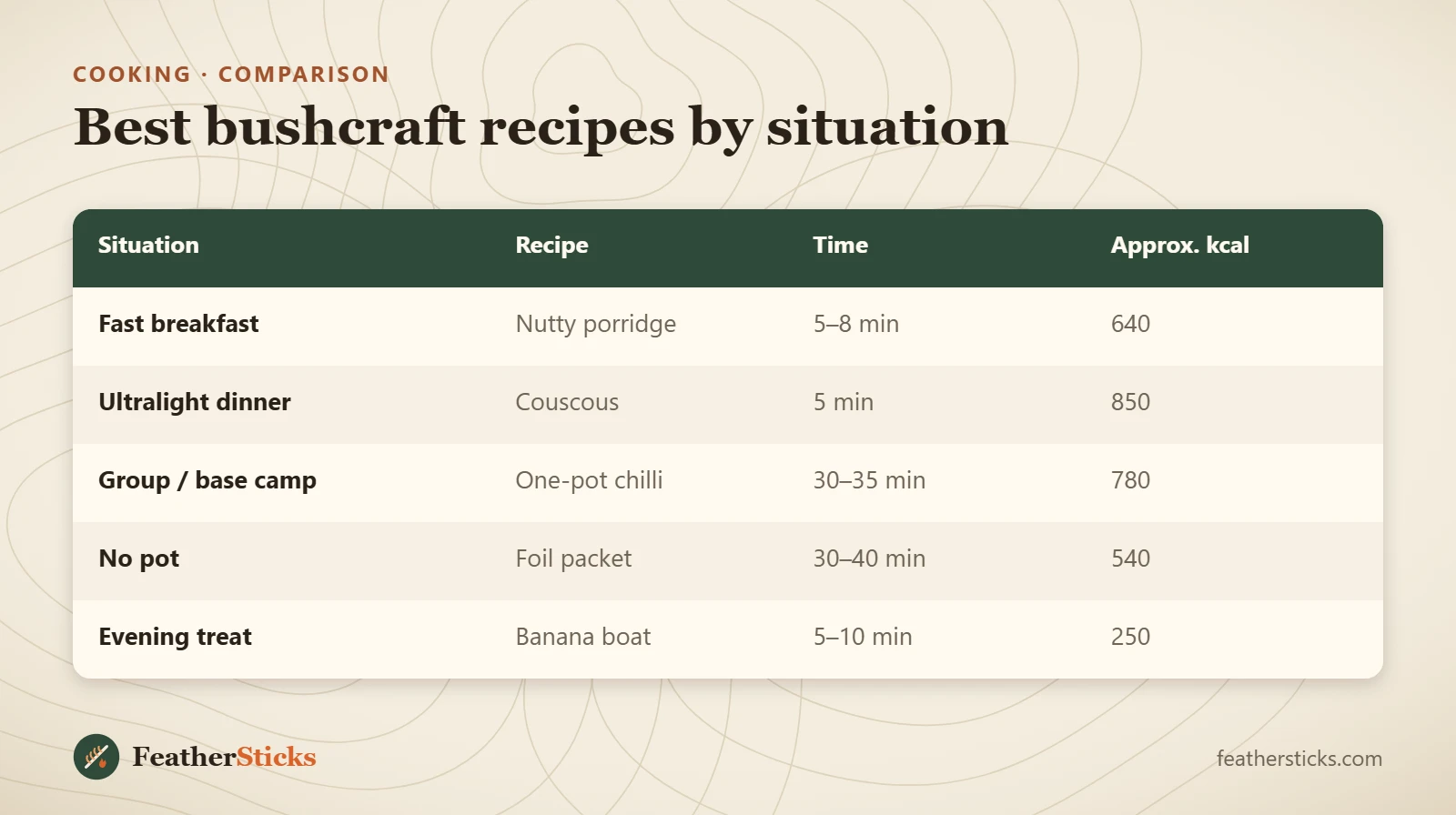
| Situation | Recipe | Time | Approx. kcal |
|---|---|---|---|
| Fast breakfast | Nutty porridge | 5–8 min | 640 |
| Ultralight dinner | Couscous | 5 min | 850 |
| Group / base camp | One-pot chilli | 30–35 min | 780 |
| No pot | Foil packet | 30–40 min | 540 |
| Evening treat | Banana boat | 5–10 min | 250 |
Common mistakes
- Cooking over tall flames instead of coals — food burns outside and stays raw inside.
- Cutting potatoes too thick for foil packets: slice them 5 mm or precook them.
- Trusting colour alone for chicken or fish; use a thermometer or cut to check the core.
- Carrying tins and fresh food on a multi-day trip instead of dry, calorie-dense staples.
- Keeping lukewarm leftovers for the next day without cooling.
- Leaving foil and food scraps in the fire pit.
- Forgetting salt and spices — bland food is the fastest way to lose appetite outdoors.
What you need
- Pot with lid (1–2 l) and a small pan
- Heavy-duty aluminium foil
- Fixed-blade or folding knife and a thin cutting board
- Long spoon, tongs or two sticks, heat-proof gloves
- Pocket food thermometer
- Spice kit, oil bottle, stock cubes
- Biodegradable soap, scraper and hand sanitiser