Foil Packet Cooking: How to Cook in Foil on a Campfire
Foil packet cooking means wrapping food in a sealed double layer of aluminium foil and letting it cook in its own steam on a bed of coals. It works because the packet holds moisture and spreads heat, so vegetables, fish and small pieces of chicken cook through without a pot and without washing up. The secret is coals, not flames: a packet in open fire burns on the outside long before the middle is done.
This guide shows how to cook in foil on a campfire from start to finish: cutting the food, folding a tight packet, placing it on the right coals, timing it, checking it safely and cleaning up so no foil stays behind. You get a times table, eight simple recipes, a troubleshooting table and honest notes on foil and health. For the fire itself, read the campfire cooking guide; for more meals, see the bushcraft recipes.
Step by step
-
1

Cut food to an even size
Slice potatoes about 5 mm thick and cut everything else to a similar size, so all of it is done at the same time.
-
2

Two layers of foil, oil, seasoning
Put the food in the middle of a double layer of heavy-duty foil with a little oil and seasoning. Leave a free edge of at least 5 cm.
-
3

Fold a tight packet
Bring the edges together above the food, fold them over twice and roll the ends. Keep some air inside for steam.
-
4

Place it on medium coals
Lay the packet seam up on a thin bed of medium coals or at the edge of the ember bed. Never put it into open flames.
-
5

Turn once at half time
Turn the packet once with tongs and rake the coals if one side runs hot. Start checking after the shorter time in the table.
-
6

Open carefully and check
Lift it out, rest a minute and open one corner away from your face. Test with a knife or thermometer, then pack the foil out.
Why and when do foil packets work on a campfire?
Foil packets work because foil does three jobs at once. It is a container that keeps juices and steam in, a heat spreader that smooths out hot spots on the coals, and a wrapper that keeps ash and soot out of the food. The food steams and bakes in its own moisture, which is why a packet is hard to dry out and needs little fat.
It is also an easy method for beginners, groups and children. You prepare everything at home or on a clean board, wrap it, and the cooking needs only a bed of coals and a pair of tongs. There is no pot to scrub, which matters when water is scarce. Each person can have a packet with their own ingredients, which helps with allergies and picky eaters.
Coals, not flames
The most important rule is to cook over coals. Foil is thin, and a flame touches it directly and unevenly, so the underside blackens or even burns through while the inside stays raw. A bed of glowing hardwood coals gives steady heat. As explained in the heat zones section of the campfire cooking guide, a hardwood fire needs 30–45 minutes to burn down to coals, and the medium zone (one even layer of coals) is where foil packets belong. Packets can also sit in the cooler warm zone for a slower cook.
When foil is a good choice
- You want a meal with no pot and almost no dishes.
- The food is cut small: vegetables, potato slices, fish, small chicken pieces, sausages.
- The fire is a bed of coals, for example after dinner when the flames have gone down.
- You cook for several people with different tastes or allergies.
When another method is better
- You want a crust, char or crisp skin: use a grate or pan. Foil steams rather than browns.
- You need a lot of liquid, such as soup or stew: use a pot.
- The food is acidic or very salty and would sit in the foil for a long time: see the section on aluminium below.
How do you fold a foil packet that does not leak?
A good packet is double-layered, sealed with a folded seam and has a little air space inside. The classic closure is the drugstore fold, also called a butcher fold: bring the long edges together, fold the joined edge down in several tight folds, then roll up the ends. Folds hold steam in far better than twisting or scrunching the foil.
Use heavy-duty foil if you can. Standard household foil is thin and tears easily on sharp bones, corn kernels or tongs, so double it. Tear sheets about 40 × 30 cm per packet; for a hungry adult one packet with 300–400 g of vegetables is plenty. Oil the inside layer lightly so the food does not stick; foil is not non-stick.
Folding a tight foil packet in five moves
 1Food in the middle, free edge all round
Lay two sheets of foil on top of each other and put the food in the centre, in an even layer 3–4 cm thick. Keep at least 5 cm of free foil on every side. Oil and season the food, not the foil edge, so the seam stays dry.
 2Edges meet above the food
Lift the two long edges and bring them together above the food so that the foil forms a tent. Do not pull tight; the foil must not touch the top of the food. A typical error is flattening the tent so that the food ends up in direct contact with the foil roof.
 3First fold
Fold the joined edges over together by about 1.5 cm and crease firmly. Run your thumbnail along the crease. Both layers move as one piece.
 4Second fold, press flat
Fold it over a second time, closer to the food, and press the seam flat. A double fold forms a channel that steam cannot easily find. A third fold is fine for thin foil.
 5Roll both ends
Fold the ends up and roll them tight against the food, leaving the packet full of air in the middle. Check the packet for pinholes by holding it against the light; patch any with a spare piece of foil.

Steam needs room: an air gap of 2–3 cm lets it circulate and cook the food from all sides, instead of scorching the contact side.
Label your packets
Once wrapped, packets look the same, and you cannot open them to check. Mark them with a code in the foil: one ridge crimped into the corner for vegetables, two for fish, three for chicken, or a turned-up corner for a packet without nuts. This lets you pull the quick packets first and avoid mixing up allergy portions.
How do you manage the heat for foil packets?
Place packets on a thin bed of medium coals or at the edge of the ember bed, seam up, and turn them once at half time. In terms of the hand test from the campfire cooking guide, that is a spot where you can hold your palm at grate height for roughly 5–10 seconds, about 150–200 °C. Hotter, and the underside burns; cooler, and the cooking time grows long.

Building the bed
Let the fire burn down to coals covered with a thin layer of grey-white ash. Rake the coals into one even layer a few centimetres deep, with a cooler edge where you can park packets that are done, or that are cooking too fast. Keep a small feeder fire to the side and rake in fresh coals every 15–20 minutes on longer cooks, as described in the campfire cooking guide. Do not bury packets completely: they cook fast and are hard to monitor.
Turning
At half time, lift each packet with tongs, turn it over and re-rake the bed. If one packet is much hotter than the rest, move it to the cooler edge. Wear leather gloves and long tongs; in rain or wind see the wet weather fire guide.
Placing, labelling and turning packets
 1Rake a thin, even bed
Use a long green stick to spread the coals into one layer, a few centimetres thick, with no large flaming logs. Break up big chunks. A level bed gives a flat, stable base so the packet does not tip and spill.
 2Seam up, on the coals
Lay the packet seam up on the coals, or at the edge of the bed. Seam up means juices stay in. If you see flames licking at the foil, move the packet or rake the bed flatter.
 3Mark the contents
Crimp one, two or three ridges into the corner, or use a different corner fold, so you know which packet is vegetables, fish or chicken. Lay the finished ones on a board or flat stone.
 4Turn once at half time
Use tongs to turn the packet over. Do not poke holes with the tongs; grip at the seam or the rolled ends. Re-rake the coals and set the packet back down.
How long do foil packets take on a campfire?
Most foil packets take 15–40 minutes on medium coals; whole potatoes in embers need 45–60 minutes. These are typical starting values, not promises. The real time depends on the coal heat, the wind, the thickness of the food and the foil. Check a test piece early and use the shorter time as your first checkpoint.
| Food | Cut / size | Time | Done when |
|---|---|---|---|
| Potato slices | 5 mm thick, with vegetables | 30–40 min | A slice is soft all the way through |
| Whole potatoes in foil | Medium, in embers | 45–60 min | A knife slides in without resistance |
| Root vegetables (carrot, beetroot, parsnip) | Rounds or sticks, 5–8 mm | 25–35 min | Tender when pierced |
| Mixed vegetables (pepper, courgette, onion) | Chunks, 2 cm | 15–25 min | Tender, slightly soft |
| Fish fillet or small whole fish | Up to about 3 cm thick | 15–25 min | Flesh is opaque and flakes easily |
| Chicken pieces | Small, boneless, cut 2 cm | 25–40 min | No pink, juices clear, core 74 °C |
| Sausages, precooked | Whole or sliced | 10–15 min | Piping hot throughout |
| Raw sausages | Whole, in a packet | 20–30 min | No pink inside, juices clear |
| Apples | Halved or whole, cored | 20–30 min | Soft when pierced |
| Bananas (banana boat) | Whole, slit, in foil | 5–10 min | Skin dark, chocolate melted |
| Bread dough (bannock) | Flat round 1–1.5 cm thick, oiled foil | 15–25 min, turning | Hollow sound, no raw dough inside |
Times are rough starting values; coal heat, wind, altitude and food thickness change them a lot. Use the shorter time as the first check, and use a thermometer for meat and poultry.
The numbers for apples, bananas and fish agree with the foil packet recipes. Potato slices take longer than mixed vegetables because of their density; slice them thin or precook them for a faster packet. The bread dough timings are consistent with the bannock guide, where a stick bannock takes 10–15 minutes over embers and a flat round in a pan 6–10 minutes.
The test piece trick
Make one extra small packet with the same ingredients and open it early. If a potato slice in it is soft at the shorter time, everything else is nearly done. Precooking slow ingredients at home cuts the time roughly in half; keep them cold, see keeping food cold.
How do you check and open a foil packet safely?
Lift the packet out with tongs, set it on a board or flat stone, wait a minute and then open one corner, tilting the corner away from your face. The steam inside is far hotter than boiling water and causes scalds. Once opened, check the food with a knife for vegetables or a thermometer for meat.
Checking a packet in four moves
 1Lift out with tongs and rest
Take the packet off the coals and put it on a board or flat stone, away from the fire. Wait about a minute so the steam settles. Do not set it on grass or plastic.
 2Open one corner, away from your face
Wear a glove and cut or peel back a corner at the far side. The first rush of steam is the dangerous part, so keep your face and hands behind the packet.
 3Pierce test for vegetables
Push the tip of a knife into the thickest piece. It should slide in without resistance. If not, close the corner tightly again, return the packet to the coals and check in five minutes.
 4Thermometer for meat
Insert a probe into the thickest piece of chicken, not touching bone. The widely used official figure for poultry is 74 °C (165 °F) in the core. Juices should run clear and no pink should remain.
Is foil packet food safe? Meat, fish and the cool chain
Foil packet food is safe if the food is cooked through, kept cold until cooking and handled with clean hands and tools. The foil itself hides the food, so you cannot see doneness. For meat, poultry and fish, test with a thermometer, or at minimum make sure there is no pink, the juices run clear and the food is piping hot.
Cooked through, not guessed
Official food-safety bodies such as the USDA's Food Safety and Inspection Service publish minimum internal temperatures: poultry 74 °C (165 °F), minced meat 71 °C (160 °F), and whole cuts of beef, pork and lamb as well as fish 63 °C (145 °F). The campfire cooking guide uses the same figures. Other countries publish slightly different numbers, so check your own authority's guidance. A small probe thermometer weighs only a few grams and removes the guesswork, especially because coals heat packets unevenly.
In a packet, cut chicken small and thin, about 2 cm, so that it cooks through quickly. A large piece of meat on the bone may be burnt outside and raw at the bone; for that, use a grate, a spit or a Dutch oven. Beginners should start with precooked sausages, fish or vegetables.
The cool chain from home
Raw meat, fish and marinades should travel in a cool box at 4 °C or below and stay there until the packet is wrapped. Prepare packets at home when possible and keep them cold, so nothing warms up in the sun. Bacteria multiply fastest between roughly 4 °C and 60 °C, so do not leave perishables out for long; the food storage guide has the details, including how to build a cool box that holds its temperature. If a packet has sat unrefrigerated for more than a couple of hours, especially on a warm day, do not eat it.
Foil packet safety checklist
- Raw meat and fish stay in the cool box until wrapped
- Chicken cut small (about 2 cm) and cooked until no pink, juices clear
- Probe thermometer in the thickest piece of meat before eating
- Hands washed; separate board for raw meat
- Gloves and long tongs for lifting packets
- Open one corner away from your face; steam scalds
- Leftovers chilled quickly or thrown away
Which simple foil packet recipes work best on a campfire?
These eight recipes are deliberately simple. Amounts are for one person, use no special ingredients and are meant as starting points. All of them use the same packet fold, a bed of medium coals and the times in the table above. The bushcraft recipes guide has more dishes with calories and shopping lists, and the food calculator helps you plan portions.
| Ingredients (per person) | Method | Time |
|---|---|---|
| 1 medium potato in 5 mm slices, 1 small onion, 1 carrot in thin rounds, 1 precooked sausage in pieces, 1 tbsp oil, salt, pepper, paprika | Toss everything with oil and seasoning, wrap in double foil, medium coals, turn once | 30–40 min |
| Ingredients (per person) | Method | Time |
|---|---|---|
| 2 small potatoes (or 1 medium), 1 tsp oil, salt, dried herbs, optional garlic clove | Prick the potatoes, coat with oil, wrap tightly in two layers, bury in warm embers, turn every 15 min | 45–60 min |
| Ingredients (per person) | Method | Time |
|---|---|---|
| 1 carrot, 1 parsnip, half a beetroot, all in 5–8 mm pieces, 1 tbsp oil, salt, thyme | Wrap in double foil and cook on medium coals, turning once | 25–35 min |
| Ingredients (per person) | Method | Time |
|---|---|---|
| 1 fish fillet (about 150 g), half a courgette in slices, 1 tsp oil, salt, dill or parsley | Lay the fish on the courgette, season, wrap in two layers. Keep lemon to a few drops; see the aluminium section | 15–25 min |
| Ingredients (per person) | Method | Time |
|---|---|---|
| 120 g boneless chicken in 2 cm pieces, 1 pepper and 1 onion in chunks, 1 tbsp oil, salt, paprika | Wrap in double foil, cook on medium coals, turn once, check with a thermometer | 25–40 min |
| Ingredients (per person) | Method | Time |
|---|---|---|
| 2 precooked sausages, half a pepper, half an onion in strips, 1 tsp oil, pepper | Wrap in double foil; just heat through, then serve in bread | 10–15 min |
| Ingredients (per person) | Method | Time |
|---|---|---|
| 1 firm apple, cored, 1 tsp butter, 1 tsp sugar or honey, cinnamon, a few nuts or raisins | Fill the core, wrap in double foil, nestle upright in warm embers | 20–30 min |
| 1 banana, a few squares of chocolate | Slit the banana lengthwise without cutting through, fill the slit, wrap loosely, set at the edge of the embers | 5–10 min |
| Ingredients (per person) | Method | Time |
|---|---|---|
| 1 portion of bannock dough, pressed into a flat round 1–1.5 cm thick, 1 tsp oil | Wrap loosely in oiled foil, put on the cool edge of the coals, turn every 5 minutes, check for no raw dough | 15–25 min |
Recipes 7 and 8 are the best ones for cooking with kids, and they cook in the dying embers after dinner. For more fillings, try sweet potato with a little feta, halloumi with peppers or beans with sweetcorn. Keep each packet to one flat layer so that everything cooks at the same speed.
What are the alternatives to aluminium foil, and what about the waste?
Foil has one big drawback outdoors: it does not burn. In a campfire it turns into silvery flakes that stay in the ashes, and small pieces end up in the soil or blow around. Treat foil as something you carry in and carry out. Every packet should leave the site in your rubbish bag, not the fire pit.

Reduce, reuse, pack out
- Use less: a double layer is plenty. Cut sheets to the size you need.
- Reuse: clean, undamaged foil can serve a second packet, or serve as a pot lid, a grate liner or a wind shield for a stove.
- Cool, then collect: let hot foil cool, fold it flat and pack it into a dedicated bag. Wipe off food residue first.
- Clean the pit: before you light a fire, remove old foil and rubbish from an existing ring, as covered in the Leave No Trace fire guide.
- Recycle: foil that is reasonably clean may be recyclable; check your local rules, which differ between countries and regions.
Alternatives to foil
| Option | How to use it | Notes |
|---|---|---|
| Lidded steel or cast iron pot | Put the food in with a splash of water and cook on coals | Reusable; best for stews and acidic food. See cookware and cast iron care |
| Dutch oven | Coals under and on the lid | Bakes like an oven; see the Dutch oven guide |
| Steel pan with lid | Steam vegetables or fish on a grate | Good for two to four people |
| Large leaves from your food bag | Wrap fish or vegetables in cabbage or chard leaves, then wrap in wet cloth or foil | Leaves char outside but protect the food; use only food leaves you brought, no foraged ones |
| Corn husks | Cook corn cobs in their own husks in the embers | Soak husks first; peel the charred husk off |
| Baking paper layer inside foil | Wrap food in baking paper first, then foil | Acts as a barrier between acidic food and foil; may brown at hot spots |
| Skewers or a stick grill | Cook over coals without a wrapper | Good for sausages and vegetables; see the improvised grill |
A lidded pot or Dutch oven steams food just like a packet and lasts for years; the camp stove guide covers lidded pans when fires are banned. Never burn rubbish: plastic and foil spoil the fire site. See the fire safety guide and fire lays for building cooking fires.
Is it safe to cook in aluminium foil? The question of acidic and salty food
Aluminium foil is widely used for cooking, and an occasional foil packet is not a reason for alarm. At the same time, authorities such as the German Federal Institute for Risk Assessment (BfR) have advised that acidic or salty foods should not be wrapped in aluminium foil for long, or prepared in it, because small amounts of aluminium can transfer into the food. This advice is general, and we do not give figures here; check the current wording of the BfR or your own national food-safety authority.
Foods that this advice points to include tomatoes and tomato sauce, citrus fruit and juice, vinegar-based marinades, sauerkraut, pickled items and heavily salted or brined food. The longer the contact and the hotter the food, the more transfer is possible. A short cook of a packet with salt and a few drops of lemon is not the same as storing salted fish in foil for days.
What this means for foil cooking
- Salt after cooking: season sparingly at the start and add salt and lemon juice at the table.
- Keep acidic food out of the foil: put tomato, citrus, vinegar and pickles on the plate afterwards, or cook such dishes in a steel or enamel pot.
- Do not store food in foil: do not leave leftovers wrapped in foil overnight; use a box or a pot with a lid.
- Add a barrier: wrap the food in baking paper before the foil, as in the alternatives table.
- Do not mistake foil for a container: do not use it as a storage wrapper for marinating salty or sour food.
Cooking in foil with kids
Foil packets are one of the best campfire meals for children, because each child can fold their own packet and eat it. The folding is a craft task, and the waiting is built in. The danger is heat, so the rules are strict: an adult handles the coals, the tongs and the opening of the packets, and a marked zone of at least a metre around the fire stays free of play.
Pick recipes with a short time and an easy result, such as the banana boat or baked apple. Keep hair and loose sleeves away from the fire, and have cool water ready for first aid; cool burns under running water for about 20 minutes, as official first-aid guidance advises, and see the first aid guide. More age-appropriate ideas are in bushcraft with kids and the fire safety guide for children and groups.
Troubleshooting: burnt outside, raw inside, soggy and ash in the food
Most foil packet problems have one of three causes: too much heat, too thin a wrap or food that is not cut evenly. Use the table to match the symptom to a fix.
| Problem | Likely cause | Fix |
|---|---|---|
| Burnt outside, raw inside | Heat too high, packet in flames, pieces too thick | Move to the cooler edge, rake the coals flatter, cut smaller |
| Packet burst or leaked | Pierced foil, thin foil, steam with no way out, tight fold | Use two layers of heavy-duty foil, leave air space, avoid sharp bones |
| Soggy, boiled food | Too much liquid, wet vegetables, a loose seam | Pat food dry, add only a spoonful of liquid, fold the seam tight |
| Ash in the food | Foil not sealed or torn, packet buried in ash | Check for holes; keep seam up; brush off ash before opening |
| Potatoes hard in the middle | Slices too thick or heat too low | Slice to about 5 mm, precook, add 5–10 minutes |
| Fish dry | Cooked too long, thin fillet | Check at the short time; use thicker fillets |
| Food stuck to the foil | No oil, packet too tight | Oil the inner layer, leave air space |
| Chicken pink near the bone | Piece too big or uneven heat | Cut smaller, cook longer, always use a thermometer |
If the bottom keeps burning, put a second layer of foil under the packet only, or place a flat dry stone on the coals to slow the heat. A packet that has been left on the coals too long can be rescued by opening the top to let steam out and eating the unburnt parts. Never eat food that is blackened and tastes of burnt plastic or smoke. When in doubt, throw it out and start a new packet.
What do you need? Packing and planning foil packets
Foil packets are one of the lightest campfire methods: a roll of foil weighs little and replaces a pot. Bring more than you think you need, since foil tears and a spare layer saves a meal. A small, tough pair of tongs and a leather glove do most of the work, and a probe thermometer takes the guesswork out of meat.
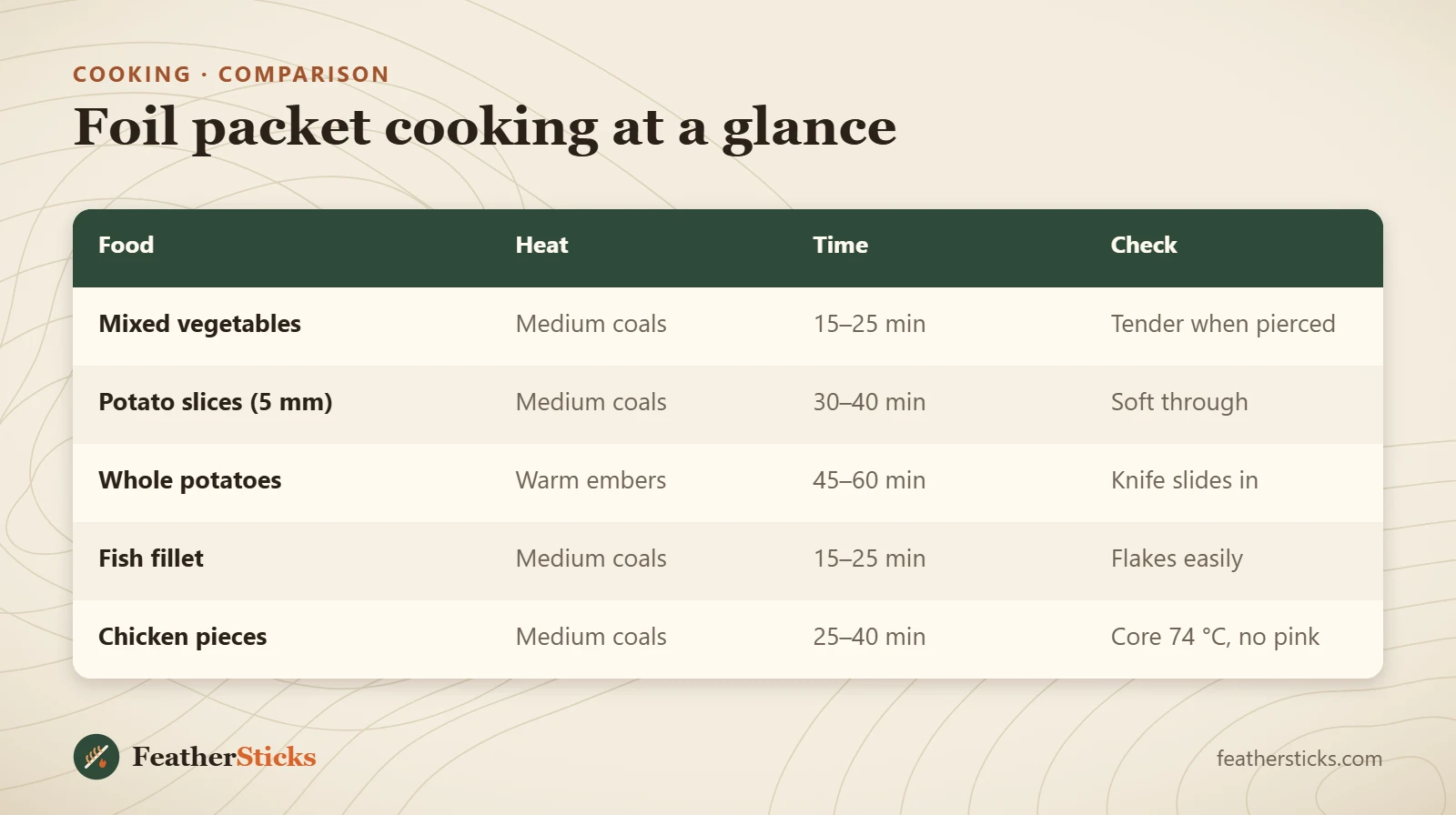
| Food | Heat | Time | Check |
|---|---|---|---|
| Mixed vegetables | Medium coals | 15–25 min | Tender when pierced |
| Potato slices (5 mm) | Medium coals | 30–40 min | Soft through |
| Whole potatoes | Warm embers | 45–60 min | Knife slides in |
| Fish fillet | Medium coals | 15–25 min | Flakes easily |
| Chicken pieces | Medium coals | 25–40 min | Core 74 °C, no pink |
Common mistakes
- Putting packets into open flames instead of onto coals.
- Using a single thin layer that tears, or folding without a tight seam.
- Wrapping food so tightly that there is no air space for steam.
- Cutting food in uneven sizes so that parts are raw and parts are burnt.
- Guessing whether chicken is done instead of using a thermometer.
- Opening a packet with your face over it and getting a steam scald.
- Leaving foil flakes in the fire pit instead of packing it out.
What you need
- Heavy-duty aluminium foil
- Long tongs
- Leather fire gloves
- Probe thermometer for meat
- Long green stick or small shovel for raking coals
- Small cutting board and knife
- Bag for used foil and rubbish
- Cool box for raw meat and fish
FAQ
How do you cook in foil on a campfire?
How long do foil potatoes take on a campfire?
What is a hobo dinner?
Should the shiny side of the foil face in or out?
Can you put foil directly on the coals?
Is it safe to cook in aluminium foil?
How do you stop foil packets from burning on the bottom?
What can I use instead of aluminium foil on a campfire?
What do I do with the foil afterwards?
Check yourself
Completed6 quick questions from this guide. Nothing is sent anywhere.
Related step-by-step guides
-
 1
-
 1
-
 1