Outdoor Games for Kids in the Woods: Bushcraft Activities, Nature Games & Challenges
The best outdoor games for kids in the woods are real bushcraft skills in disguise: Kim's game trains the eyes, a compass treasure hunt teaches bearings, a mini-shelter contest shows why a roof needs to be steep and thick. This guide sorts more than twenty games by skill and by age, from three-year-olds collecting leaves to teenagers running an orienteering course.
Every game comes with the rules that keep it safe: boundaries, buddies, whistle signals, sensible group sizes and a tick check at the end. Knife and fire rules follow our main guide to bushcraft with kids, and the games are a playful way into the other bushcraft skills and our bushcraft basics. No game here needs a knife, and none needs a real fire.
Step by step
-
1

Set boundaries, buddies and signals
Walk the edges together and mark them with ribbons, pair children into buddies and agree the whistle signals before the first game starts.
-
2

Pick games by age and skill
Little ones look and find, school-age children track and sneak, older kids navigate. Choose one main skill per session.
-
3

Warm up with an observation game
Start calm: Kim's game with nine natural objects under a cloth, or a short sit spot. It settles the group and sharpens the eyes.
-
4

Add a skill challenge
Follow with a compass treasure hunt, a mini-shelter contest or a knot relay – a real skill, wrapped in a game with a clear goal.
-
5

Rotate stations, keep games short
Fifteen to twenty minutes per game, then switch. Count heads after every round and stop while everyone still wants more.
-
6

Check for ticks, leave no trace
Take dens apart, scatter the material, pick up every ribbon – and check every child for ticks at home that evening.
Why games are the best way to teach bushcraft to kids
Children learn outdoor skills fastest when they do not notice they are learning. A game gives a clear goal, a reason to try again and an instant result: the teddy stays dry or it does not, the treasure is under the stump or it is not. That feedback loop is exactly how adults learn bushcraft too – only children need it shorter, louder and more often.
Games also solve the biggest practical problem of a day in the woods with kids: attention. A ten-minute talk about bearings loses most eight-year-olds; a hunt for a hidden snack box using the same bearings holds them for half an hour. And games let you practise the important safety habits – staying inside boundaries, answering a whistle, moving quietly, keeping a distance from a fire ring – long before they are needed for real.
Use the same age bands as in our age table for bushcraft with kids. They are guidelines only: whether a child listens, can wait their turn and stops immediately on "stop" matters more than the birthday.
| Age | Good game types | Tools in games | Supervision |
|---|---|---|---|
| 3–5 years | Colour hunts, Kim's game with 5–6 objects, track detectives, teddy dens, pretend-fire game | Hands, magnifying glass, bucket | Constant, within arm's reach |
| 6–8 years | Kim's game with 9 objects, fox and rabbits, mini shelters, first knot relay, nature bingo, short sit spot | No knives in games; peeler or round-tipped knife only at a separate, seated carving station | One adult per one or two children at any tool station |
| 9–11 years | Compass treasure hunt, track traps, hide and seek with signals, knot relay with hitches, night games with red light | Compass, cord; knives only at the supervised carving station | Adult within reach at tool and fire work, in sight during games |
| 12–14 years | Map orienteering, contour challenges, timed shelter builds, leading games for younger kids | Map, compass, tarp and cord | Nearby, regular check-ins |
Matches the age bands in our guide to bushcraft with kids. Knife work and real fire are never part of a race or a timed game.
The safety framework: boundaries, buddies, signals
Every outdoor game with children rests on the same frame, set up before the first game and repeated in the same words each time. Children remember short rules they hear often far better than long explanations they hear once.
Boundaries you can see
Choose a play area you can overview – a clear stretch of wood with a path on one side is ideal. Walk its edges together and tie coloured ribbons to trees at the corners and along the sides. The rule: nobody crosses a ribbon, not even to fetch a ball or follow a hare. Avoid areas with deep water, steep drops, busy roads, thick thorn scrub or lots of dead wood overhead – check the trees for hanging branches before you play, and do not play in the woods in strong wind.
Buddies and head counts
Pair every child with a buddy. Buddies stay within sight of each other in every game, go to the toilet together and tell an adult at once if the other one is missing. The adult counts heads at the start, after every round and before leaving. A head count takes ten seconds and should become as automatic as a whistle.
Whistle signals
Give every child a whistle on a lanyard and agree on few, clear signals. Use one long blast for "game over, everyone back to base". Keep three blasts for help only – they are the widely used distress call (see distress signals), so they must never become part of a game. If a child gets lost they follow the rule from our kids guide: stop, stay by one tree, blow three blasts and wait.
| Situation | Rule of thumb | Why |
|---|---|---|
| Any group outdoors | At least two adults, however small the group | One deals with an injury or a missing child, the other stays with everyone else |
| Games with 3–5-year-olds | Small groups of about 2–4 children per adult, always within sight and reach | Little ones wander off silently and fast |
| Games without tools, 6–10 years | Roughly 6–8 children per adult inside a marked area | Enough eyes to see everyone at a glance |
| Tool or fire station | One adult per one or two children at that station | Same as our kids guide – full attention on the blade or flame |
| Hide and seek, night games | Smaller groups, more adults, shorter rounds | Children are out of sight on purpose |
Schools, clubs and paid providers often set their own ratios, first aid and consent rules – check them first.
Before the first game
- Play area chosen, edges marked with ribbons, hazards checked (water, drops, dead branches)
- Every child paired with a buddy and wearing a bright layer
- Whistle signals agreed: one long blast = back to base, three blasts = help only
- Meeting point ("base") marked, for example a tree with a blue ribbon
- First aid kit with tick remover, plasters and personal medication at base
- Phone charged; emergency number known (112 in Europe)
- Snacks and drinks for a break every 45–60 minutes
Observation games: Kim's game, sit spot and colour hunts
Observation is the root skill of bushcraft: a tracker, a navigator and a forager of firewood all succeed by noticing small things. Observation games are also the calmest way to start a session – they settle a lively group and work for every age.
Kim's game with natural objects
The classic memory game works beautifully outdoors. Lay out natural objects on a cloth, let the children look for about a minute, cover them, remove one and ask what is missing. Use only loose finds from the ground – cones, a fallen leaf, a pebble, a feather, a dead stick, an acorn – never anything torn from a living plant. As a guideline use 5–6 objects for small children, about 9 for school-age children and 12–15 for older kids.
Kim's game with natural objects
 1Lay out nine objects
Collect nine loose natural objects and lay them in a 3 × 3 grid on a cloth or sit mat. Different shapes and colours make it easier; two similar cones make it harder.
 2Look for a minute, then cover
Children look for about one minute without touching, then you cover the cloth with a jacket or second cloth. Let them say the objects aloud – naming helps memory.
 3What is missing?
Remove one object under the cover and reveal the grid. First correct answer chooses the next object to hide. For older kids, swap two objects instead of removing one.
 4Find a twin on the ground
Variation: each child gets one object and must find a "twin" in the play area within two minutes – inside the ribbons, from the ground only, nothing picked from living plants.
The sit spot challenge
A sit spot is the quietest game there is: each child sits alone, within sight of an adult, and listens. Start with 3 minutes for younger children and build up to about 10 minutes, as in our kids guide. Afterwards everyone draws a "sound map" – a cross in the middle for themselves, and a mark for every bird, rustle or plane they heard, in the direction it came from. The full method is in sit spot with children; it is also the best preparation for spotting wildlife without disturbing it.
Colour and texture hunt
For the youngest: find something rough, smooth, red, soft, prickly, older than you. An egg box with a word or a colour patch in each compartment turns it into a collection game. Keep the rule simple: loose things from the ground only, and nothing goes in the mouth.
Tracking games: detectives, track traps and stalking
Tracking turns any muddy path into a crime scene. Children love the detective role, and the games quietly teach the basics of reading animal tracks and signs: shape, number of toes, stride and direction.
| Game | From age | How it works | What it trains |
|---|---|---|---|
| Track detectives | 4 | Find footprints in mud, sand or snow and press your own boot print next to them for comparison | Looking closely, comparing |
| Track trap | 7 | Smooth a patch of mud or sand near a path in the evening, check it in the morning, draw what you find | Patience, recording |
| Stick-arrow trail | 6 | One group lays a trail of stick arrows and stone signs, the other follows it to a hidden snack | Trail signs, attention |
| Fox and rabbits | 6 | The blindfolded "fox" points at any sound; the rabbits try to sneak up and touch him | Stalking, quiet movement |
The stick-arrow trail is a favourite for groups: the "laying" team gets a head start of five minutes and marks every junction with an arrow of sticks; a cross of two sticks means "not this way". The following team must stay together and may not run. Keep trails short (about 10 minutes of walking) and always inside your marked area, and have the laying team wait at the end so nobody is alone.
For fox and rabbits, teach the "fox walk" first: weight on the back foot, place the outer edge of the front foot down slowly, roll in, then shift the weight. It is the same technique as in moving quietly, and children are often better at it than adults. Agree that nobody climbs, runs or crawls through brambles.
Navigation games: compass treasure hunt and map orienteering
From about nine, children can handle a baseplate compass, and a treasure hunt is the perfect first use. The steps are exactly those of real map and compass navigation – set a bearing, turn until the needle sits in the orienting arrow ("red in the shed"), pick a target and walk – only the distances are short and the reward is a snack box.
Prepare a chain of three to five legs in an open wood or park. For each leg, write a bearing and a number of paces on a card: for example 120° and 20 paces to post A, where the next card waits. Measure the course yourself with the children's pace length in mind – small children take short steps, so test it with one child before the game. Older kids can calibrate their own pace count over a measured 100 m and use the pace count calculator.
Compass treasure hunt step by step
 1Set the bearing
Turn the bezel until the bearing on the card – here 120° – sits at the index line. Check the number twice; a mix-up of 120° and 210° sends the team the wrong way.
 2Red in the shed
Hold the compass flat at the belly and turn the whole body until the red end of the needle sits inside the orienting arrow. The direction-of-travel arrow now points along the bearing.
 3Aim and count paces
Pick a tree or rock exactly in line with the arrow, walk to it counting paces – here 20 – and aim again if the leg is longer. Counting in pairs (one counts, one checks the compass) halves the errors.
 4Find the post and the next clue
At the end of the leg a marker or snack box waits with the card for post B. Last post: the treasure. Every team checks in at base after finishing.
Map orienteering for beginners
Map games start earlier than compass games. Six-year-olds can follow a hand-drawn map of a garden or clearing; teenagers can run a small orienteering course on a proper map.
Setting up a mini orienteering course
- Draw or print the map For young children, sketch the play area from above with big features: path, stream, big tree, bench. For older kids use a printed large-scale map of a park or wood edge.
- Place the controls Hang 5–8 markers (orange-white cloth, a letter on each) at clear features – a path junction, a boulder, a bridge – all inside your boundary.
- Mark them on the map Draw a circle around each control on the map, numbered in order. Teams note the letter at each control to prove they found it.
- Orient the map Teach one habit first: turn the map so it matches the ground, path on the map along the real path. A compass helps but is not essential.
Contour games for older children
Contour lines are abstract until children make them. Two easy games: "knuckle mountains" – make a fist, draw rings at equal heights around the knuckles with a washable pen, open the hand flat and look at the lines from above. Or build a mountain from sand or a heap of leaves, push sticks in at equal heights and lay string around them. Then go outside and find the real hill on the map. Our guide to reading contour lines takes it further, and navigation gear explains which compass suits small hands. Children who enjoy this also love finding north without a compass – see natural navigation.
Shelter-building contests with mini shelters
A full-size debris shelter takes adults hours. A mini shelter for a teddy, a toy figure or a pine-cone "person" teaches the same principles – frame, ribs, thick roof, dry floor – in about 20–30 minutes, and the rain test at the end makes the result visible. Teams of two or three work best.
Mini shelter contest: build and test
 1Prop and ridge
A forked stick as a prop, a long straight stick as the ridge from the fork down to the ground. Use only dead, fallen wood – no breaking branches off living trees.
 2Ribs close together
Lean sticks along the ridge on both sides, so close that a finger hardly fits between them. Gaps here become leaks later.
 3Thick leaf roof
Pile on dry leaves, much thicker than seems necessary – for a mini den at least a hand's length. Thin roofs are the most common reason for failing the test.
 4Rain test
Each team pours the same amount of water (half a bottle) over its roof. Then lift the guest out: dry, damp or soaked? Discuss why.
Score the shelters on more than speed: is the guest dry, is the floor insulated with a layer of leaves, does the entrance face away from the wind, is it stable when you blow on it? A timed build for 12–14-year-olds can scale up to a sit-in den or a tarp shelter with a ridgeline. At the end, every team takes its shelter apart and scatters the material, so the forest looks untouched – part of the game, not an afterthought.
Knot relay: a race that teaches real knots
Knots stick when they are tied often, and a relay makes children tie them again and again. Set up a line between two trees about 15–20 m from the start. Each team gets a short cord per child (around 1 m, cut by an adult beforehand). One by one, children run to the line, tie the knot of the round, an adult checks it, they untie it and run back to tag the next child.
Start with an overhand knot and the figure-eight for 6–8-year-olds, add the round turn and two half hitches and the clove hitch from about nine, and the bowline and taut-line hitch for older kids – the same knots that hold a tarp in our essential bushcraft knots guide. The knot finder helps you pick a knot for each job.

| Age | Knots for the relay | Variation |
|---|---|---|
| 6–8 | Overhand knot, figure-eight | Tie it around your own wrist, then around the line |
| 9–11 | Round turn and two half hitches, clove hitch, sheet bend | Join all team cords with sheet bends into one long rope |
| 12–14 | Bowline, taut-line hitch, trucker's hitch | Tie a tarp ridgeline as a team against the clock |
A fire-safety game without real fire
Small children should learn the fire rules long before they light a real fire, and the best place to learn them is a pretend campfire. Build a ring of stones, put "flames" of orange, yellow and red cloth in the middle and lay a ring of sticks about 1.5–2 m around it – the same safety ring as in our kids guide. Then play.

Rounds of the pretend-fire game
- Ring rulesWalk around the ring, never through it. Who steps inside without an invitation sits out one round.
- Three sizesRace to collect match-thin, pencil-thick and thumb-thick dead sticks and sort them into piles.
- Kneel and "light"Approach kneeling, hair tied back, and pretend to light the tinder – never bending over from standing.
- Water readyWho can place the water bucket where the adult can reach it fastest?
- Stop, drop, rollPractise what to do if clothing catches fire: stop, drop to the ground, cover the face, roll.
The game teaches the habits without the risk, and it works anywhere – in a garden, a school yard or a forest where fires are banned. When children later sit at a real fire, the rules already feel normal. The real thing follows our campfire safety rules: the adult owns the fire, it is only lit where fires are allowed, and water is always within reach.
Camouflage and hide and seek with boundaries and whistle signals
Hide and seek in the woods is the classic, and a camouflage version teaches how animals – and hunters – avoid being seen: shape, shine, shadow, silhouette and movement. Because children are deliberately out of sight, it needs the firmest rules of all games here.
Hide and seek: safe rules in three pictures
 1Base and boundaries
The seeker counts to 30 at base with eyes covered. Hiders stay inside the ribbons – no exceptions, and the area is small enough that a call can be heard everywhere.
 2Hide still and low
Crouch behind a bush or log, stay still and quiet. No hiding near water, in holes, under piles of wood or up trees, and no crawling into brambles.
 3One long blast: back to base
One long whistle blast ends the round and everyone comes back. Three blasts mean help only. Count heads after every round.
Camouflage game variations
- Camouflage statues (from 6): the seeker stands at base and may turn but not walk. Hiders must stay where they can see the seeker. Anyone spotted and named comes to base. After each round the hiders creep a few steps closer – the first to touch base wins.
- Hidden objects trail (from 4): the adult hangs ten man-made objects along a short path – a clothes peg, a spoon, a bright button. Children walk it slowly and count how many they see. Brightly coloured ones are easy, brown and green ones teach how camouflage works. Collect every object afterwards.
Rounds should be short – a rule of thumb is no more than about 5–10 minutes before the end signal. If a child does not come back after the signal, everyone stops playing, stays at base with one adult and the other adult calls and searches the area; then follow the advice in distress signals and call 112 early if the child cannot be found quickly.
Night games with lights
For many children the woods after dark are the biggest adventure of a trip. Night games work best close to camp or home, on ground you all know from daylight, and with rules agreed before anyone switches on a lamp. Our night walk with kids gives the frame: short, on a known route, heads counted often.

Every child needs a headlamp, ideally with a red mode – see headlamps and camp lighting for models that suit small heads. The light rules: beam down, never in faces, no running, stop when someone calls "stop". Dark adaptation takes about 20–30 minutes and a white beam undoes it in a second, which is why red light and "lights off" moments are part of the games.
| Game | From age | How it works |
|---|---|---|
| Reflector trail | 5 | Follow a short trail of reflective markers along a known path with headlamps on low; collect every marker on the way back |
| Lighthouse | 8 | The "lighthouse" sits with a lamp and sweeps slowly; the others try to creep closer on a flat, open meadow without being caught in the beam |
| Star spotting | 6 | Lights off, find the Plough and the North Star – see star-gazing for beginners |
Nature bingo and forest scavenger hunts
A forest scavenger hunt or nature bingo card turns any walk into a mission. Draw a 3 × 3 grid with pictures – a cone, a feather, a track, a bird, a flower, a piece of bark – and children tick, draw or photograph each find. Three in a row is bingo; a full card is the jackpot.

The important design decision is what children may take. Following leave no trace, the rule is: look, draw or photograph – collect only small loose things from the ground (a fallen leaf, a cone), and put most of them back at the end. Flowers are spotted, not picked; many wild plants are protected, and in nature reserves you stay on the paths. Birds, insects and frogs are watched, not caught. And the most important rule of all: nothing found goes in the mouth – no berries, leaves or mushrooms, not even as a "test". This guide does not teach which wild plants are edible, and neither should a children's game.
Rainy day games in the woods
Rain does not have to cancel the plan if everyone is dressed for it – good rain gear and a spare set of clothes in a dry bag make all the difference. Pitch a tarp first as a dry base, then turn the weather into the game. Keep the session shorter, change wet gloves early and have a warm drink ready. Thunder, strong wind or heavy rain are reasons to go home.
| Game | Where | What it teaches |
|---|---|---|
| Real rain test | Mini shelters in the open | The sky does the testing – check the guests after 10 minutes |
| Drip detectives | Under the tarp | Find where water runs off and drips; add a drip line to the guyline |
| Puddle boats | Puddles only, not streams | Bark and leaf boats, which design floats longest |
| Dry tinder hunt | Under trees and logs | Where do dead twigs stay driest? Look, don't light |
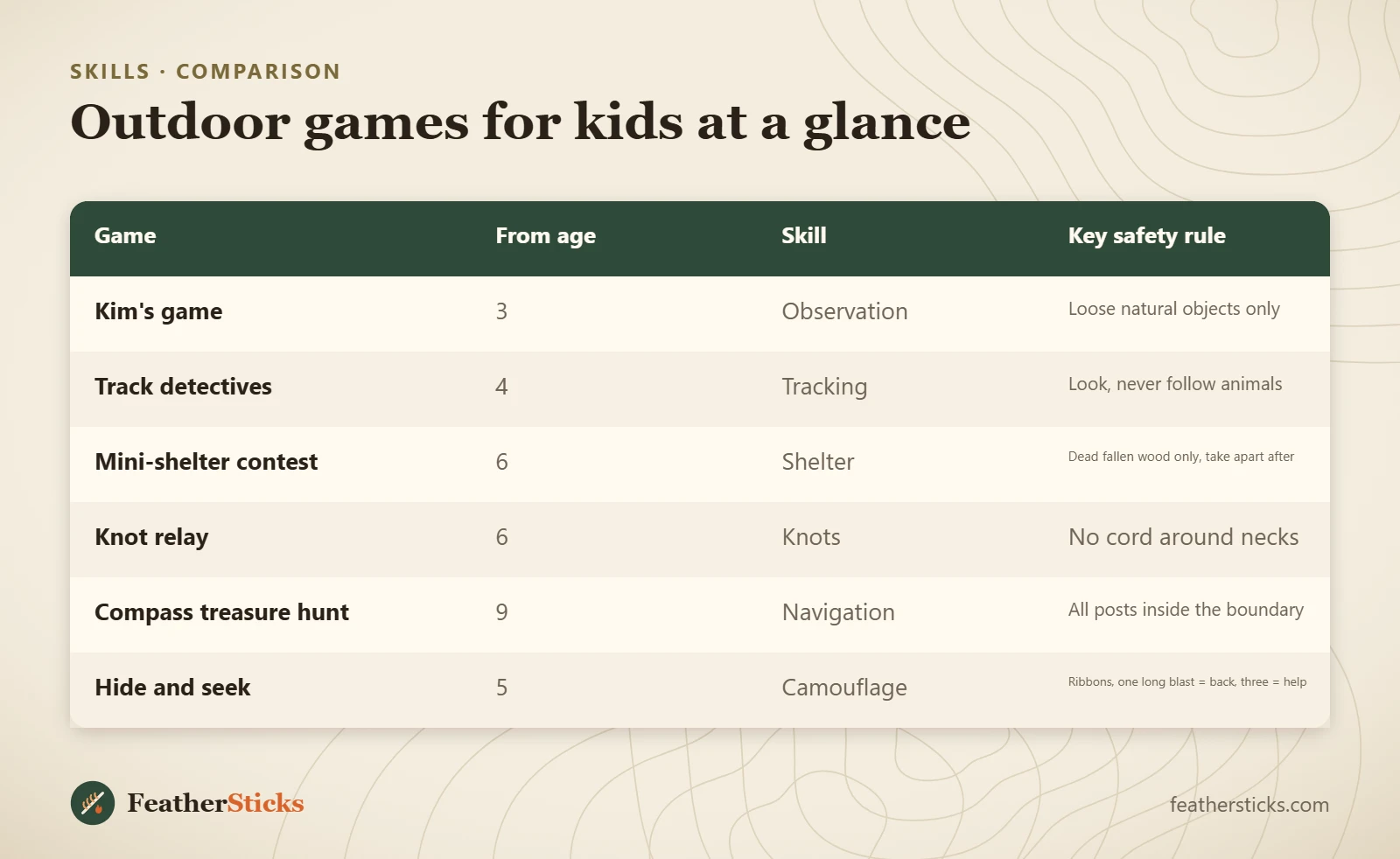
| Game | From age | Skill | Key safety rule |
|---|---|---|---|
| Kim's game | 3 | Observation | Loose natural objects only |
| Track detectives | 4 | Tracking | Look, never follow animals |
| Mini-shelter contest | 6 | Shelter | Dead fallen wood only, take apart after |
| Knot relay | 6 | Knots | No cord around necks |
| Compass treasure hunt | 9 | Navigation | All posts inside the boundary |
| Hide and seek | 5 | Camouflage | Ribbons, one long blast = back, three = help |
Common mistakes
- Starting the first game before the boundaries and whistle signals are agreed.
- Using three whistle blasts as a game signal, so the real help call loses its meaning.
- Making knife work or a real fire part of a race or timed challenge.
- Letting hide and seek spread over an area too big to hear a call.
- Bingo lists that ask children to pick flowers or taste berries.
- Forgetting the head count after a round or before leaving.
- Skipping the tick check because "we were only out for two hours".
What you need
- Whistle on a lanyard for every child
- Coloured ribbons to mark boundaries and base
- A cloth or sit mat for Kim's game
- Baseplate compass and simple cards for bearings
- Short cords (about 1 m) for the knot relay
- Headlamps with red light for night games
- First aid kit with tick remover
- Small tarp as a rain base
FAQ
What are good outdoor games for kids in the woods?
How do you play Kim's game outdoors?
How do you set up a compass treasure hunt for kids?
How do you make hide and seek in the forest safe?
What should be on a forest scavenger hunt list?
How many adults do you need for outdoor games with children?
Which bushcraft games work on a rainy day?
Check yourself
Completed6 quick questions from this guide. Nothing is sent anywhere.
Related step-by-step guides
-
 1
-
 1
-
 1