How to Keep a Fire Going All Night: Long Fires, Banking and Fire Watch
To keep a fire going all night, you need three things: enough dense, dry wood (typically 25–30 kg for a ten-hour night), a lay that burns slowly, such as a long fire or star fire with a reflector wall, and a person who stays awake or wakes on schedule to feed it. An overnight campfire is never left alone. Banking a fire under ash slows it down, but it does not make it safe to walk away from.
This guide covers when an overnight fire makes sense and when it does not, the right wood and quantities, the long log fire and reflector, banking embers for the morning, fire watch shifts, safe sleeping distances and how to put it out properly. It builds on the fire lays guide and the rules in campfire safety; for the bigger picture see bushcraft for beginners.
Step by step
-
1

Check rules, wind and dryness
Only plan a night fire where fires are allowed, the fire danger is low and the wind is light. Otherwise put it out before bed and rely on your sleep system.
-
2

Gather a full night of wood
Before dark, collect about 25–30 kg of dry wood for ten hours, mostly thick hardwood, sorted by size and stacked within reach.
-
3

Build a long fire with a reflector
Lay two thick logs parallel, about 1.5–2 m in front of a canvas lean-to, with a reflector wall 0.5–1 m behind the fire. Tents stay at least 5 m away.
-
4

Bank the coals before sleeping
Rake the coals together, lay thick hardwood close to them and dust the edges with ash. A banked fire burns slower, but it is not out.
-
5

Keep a fire watch
One person stays awake in shifts, checks every 30–60 minutes, rolls logs together, adds one at a time and watches sparks, wind and water.
-
6

Relight, then put it out properly
In the morning, uncover the coals and add fine kindling. Before you leave, drown, stir and feel until everything is cold.
Why keep a fire going overnight?
For most nights outdoors, you do not need a fire after you go to bed. A good sleep system keeps you warm more reliably, and the safe default in our campfire safety guide is clear: unless someone stays awake as a fire watch, the fire is put out before sleeping.
There are situations, though, where an overnight campfire is a real tool rather than a luxury:
- Warmth in an open shelter. In a lean-to with a cotton or poly-cotton roof, a long fire and a reflector wall push radiant heat onto your sleeping spot. This is the traditional northern way to spend a cold night with light gear.
- A group camp with people awake anyway. When a group takes turns staying up, the fire stays alive for drying clothes, warming hands and hot drinks.
- A quick morning start. A bed of live coals turns breakfast and morning coffee into a ten-minute job instead of a fresh fire-lighting session in the cold.
- Emergencies. If someone is cold and wet, a fire through the night can be part of the response described in treating hypothermia, alongside shelter, insulation and food.
The price is high: a lot of wood, broken sleep and a fire that needs attention every hour. Decide before dark whether the night really calls for it.
Overnight fire or sleep system?
Fire through the night
- Radiant warmth in an open canvas shelter
- Clothes and boots dry at a safe distance
- Live coals for breakfast
- Light and comfort in a group camp
Fire out, warm sleep system
- No wood to gather beyond the evening
- Unbroken sleep, no watch needed
- No spark risk to tents or bags
- Works where fires are banned
When you should not keep a fire going all night
An all-night fire multiplies every risk of an evening fire: more hours, tired people, and the darkest, windiest part of the night. Skip it, or put the fire out completely before bed, in any of these cases:
- Fire bans and high fire danger. Many regions restrict or ban open fires in dry periods, and rules differ by country, region and landowner. Check the official fire danger rating and the local rules; this is not legal advice. Our overview of wild camping rules shows the typical situation.
- Dry season and dry ground. Dry needles, peat, humus and roots can carry fire underground. A fire that smoulders in the soil for hours is exactly what an overnight fire risks.
- Wind. A night wind can rise without warning and revive coals that looked harmless at 22:00. If the forecast in reading the weather shows gusts, plan a fire-free night.
- Tents, hammocks and synthetic tarps. Most tents, bivvy bags and sleeping bags are synthetic and melt from a single ember. A fire you sleep beside only works with an open shelter of canvas or poly-cotton, and even then with someone awake.
- Nobody can stay awake. If you are exhausted, alone on a first trip or responsible for children, the safest choice is to drown the fire and prepare a dry kit for a fresh fire in the morning.

Should this fire burn through the night?
Are fires allowed here and is the fire danger low?
Yes → Go to the next question.No → No fire at night. Put it out, or do not light one at all.Is the wind light and forecast to stay light?
Yes → Go to the next question.No → Drown, stir and feel before bed.Do you sleep in an open canvas or natural shelter, with tents at least 5 m away?
Yes → Go to the next question.No → Put the fire out before sleeping. Tents and fires do not mix.Can someone stay awake or wake reliably every 30–60 minutes?
Yes → An overnight fire is possible. Gather the wood before dark.No → Put it out and prepare a dry morning-fire kit instead.
Which wood burns all night? Hardwood, softwood and quantities
The wood decides more than the lay. Softwoods such as spruce and pine light easily and burn hot and fast, but they leave little lasting coal. Dense hardwoods such as beech and oak burn slower and build a deep bed of glowing coals that holds heat for a long time. The tree identification guide helps you recognise them, ideally as dead standing wood.
The classic plan: softwood and fatwood to get going, thick hardwood for the night. Only use dead and fallen wood where collecting is allowed, never cut living trees.

How much wood do you need for a whole night?
Most people badly underestimate it. The firewood calculator uses a base rate of about 2.5 kg per hour for a banked all-night fire of long logs (dry mixed wood), compared with 3 kg per hour for an actively fed evening fire. Hardwood lowers the figure, softwood, damp wood and cold raise it. These are rules of thumb, not measurements.
| Conditions | Wood to gather | Armloads (about 5 kg) |
|---|---|---|
| Dry mixed wood, 5 °C | ≈ 27 kg | 6 |
| Dry hardwood, 5 °C | ≈ 23 kg | 5 |
| Dry softwood, 5 °C | ≈ 33 kg | 7 |
| Dry mixed wood, 0 °C | ≈ 30 kg | 7 |
| Damp mixed wood, 5 °C | ≈ 35 kg | 7 |
Values from the firewood calculator (purpose "All night"): 2.5 kg/h × wood type (softwood 1.25, hardwood 0.85) × moisture (damp 1.3) × cold (+2.5 % per °C below 5 °C), plus tinder and kindling for an evening and a morning start.
About three quarters of that should be main fuel of wrist thickness and up: long, thick logs for the long fire or star fire. Gathering takes time too, often more than an hour in a normal forest, so start in daylight; the daylight calculator shows when the light goes. For splitting and cutting, see preparing firewood, folding saws and axes.
Fire lays for a long burn: long fire, star fire and reflector
A fire that lasts the night burns its fuel slowly and needs as little handling as possible. Three lays from the fire lays guide do this well, and the fire lay picker suggests them when you choose "long night".
Long fire (two-log fire)
Two long logs of 15–25 cm diameter lie parallel, 15–30 cm apart, and a fire of kindling and smaller fuel burns in the channel between them. The inner faces of the logs slowly catch and glow for hours. Make it roughly as long as your body, so the heat covers you from head to feet. As the logs burn, roll them closer together; to slow the fire, open the gap a little. This is the standard lay for warmth in front of a lean-to.
Building a long fire with a reflector wall
 1Two thick logs
Lay two dead logs of 15–25 cm diameter parallel, 15–30 cm apart, on bare mineral soil. Long, thick wood that would need a lot of sawing is ideal here.
 2Fire in the channel
Light kindling in the channel between the logs and feed thumb- to wrist-thick sticks along its length until a bed of coals forms. Start with softwood, then switch to hardwood.
 3Reflector behind
Stack dead logs between two pairs of stakes to about 60–80 cm, 0.5–1 m behind the fire. It throws heat back toward the shelter and blocks wind.
 4Feed the full length
Keep the coal bed going along the whole length, about one body length. Feed one or two pieces at a time; a small, even fire is warmer per kilogram than a big blaze.
Star fire pushed in
Five or six long logs point to the centre like spokes, with only their tips in the coals. As the tips burn away, you push the logs in. Push them together for more heat, pull them apart to let the fire die down. The star fire uses the least wood of all lays and suits a small group sitting around it, but its heat is concentrated in one spot rather than along a sleeping area. Logs of 5–10 cm thickness and 1–1.5 m length work well.
Swedish torch as a reference
A Swedish torch burns for a few hours with no attention, roughly one to five depending on size and wood, and makes a fine cooking stove. It is not an all-night fire, though: once burnt through, it collapses and has to be replaced. Use it for the evening or morning pot, not for overnight warmth.
| Lay | Heat pattern | Attention at night | Best use |
|---|---|---|---|
| Long fire + reflector | Wide, along a sleeping spot | Every 30–60 min | Warmth in an open lean-to |
| Star fire | Small, central | Push logs in every 20–40 min | Group around the fire, saving wood |
| Upside-down fire | Steady, compact | Low for the first hours | Long evening, then banked |
| Swedish torch | Upward, one pot | None, burns out after hours | Cooking, not overnight warmth |
Intervals are rough guides from the fire lays burn-time table; wood type and wind change them.
Why the reflector wall matters
Without a reflector, most of a fire's radiant heat goes into the forest behind it. A wall of stacked logs 0.5–1 m behind the fire sends much of it back toward you, and the sloping roof of a lean-to bounces it down onto the sleeper. The result is the same warmth from a smaller fire, which means less wood and less to watch. Build it from dead wood, keep it below about 80–90 cm so smoke can escape, and never use wet river stones, which can crack or burst in heat. The full build is in the lean-to guide.
Safe sleeping distance and camp layout
An overnight fire is only as safe as the layout around it. The site-wide distances from campfire safety apply in full, and the one exception, a canvas lean-to close to the fire, only works with someone watching.

| What | Distance from the fire | Why |
|---|---|---|
| Tents and hammocks | At least 5 m, more downwind | Synthetic fabric melts from a single ember |
| Synthetic tarps | At least 3 m, never directly downwind | Nylon and polyester melt long before they burn |
| Canvas or poly-cotton lean-to | About 1.5–2 m in front of the opening | Only for natural fabrics, with constant attention |
| Reflector wall | 0.5–1 m behind the fire | Close enough to reflect, far enough not to catch |
| Woodpile | 2–3 m, beside the shelter | In reach for the watch, out of spark range |
| Water | Next to the fire | For flare-ups and the morning |
Place the shelter and any tents upwind of the fire, so sparks and smoke drift away from them. Clear about 3 m around the fire down to bare soil and check for overhanging branches. A tarp shelter made of nylon is not a fire-facing shelter: keep it at 3 m or more. Synthetic sleeping bags and bivvy bags inside a canvas lean-to can still be damaged by embers, so keep the fire small and the watch alert. A raised camp bed of logs and boughs keeps you off the cold ground and defines a clear edge between bed and fire zone.
Wear wool or cotton outer layers around the fire; fleece and synthetic jackets melt from sparks, see bushcraft clothing. Keep your boots and socks at a safe distance from the heat, never on the reflector.
Banking a fire: how to keep embers for the morning
Banking a fire means slowing it down on purpose: you gather the coals into a compact bed, lay thick hardwood close to them and cover the edges with a thin layer of ash. Less air reaches the glowing wood, so it burns slower and keeps coals alive for longer. Banking is how a watch stretches the time between feeds, and how a fire keeps live coals for breakfast.
Banking is not extinguishing. A banked fire still contains glowing embers, a gust can lift sparks out of it, and coals under ash can stay hot for many hours. It must stay under watch exactly like an open fire. Never cover coals with soil: buried embers can smoulder unseen, which is how fires escape long after people think they are out.
Banking the coals step by step
 1One compact bed
Rake scattered coals into one tight bed between or against the long fire logs. A compact heap loses less heat than coals spread across the ring.
 2Thick hardwood
Lay one thick piece of dense hardwood, such as beech or oak, close to the coals. Thick wood takes hours to burn through; thin sticks burn away in minutes.
 3Thin ash at the edges
Dust a thin layer of fine ash over the edges, never soil. Leave the top partly open so some air still reaches the coals, otherwise they choke and die.
 4Morning: uncover and blow
Scrape the ash aside, push the glowing coals together, lay fine kindling on top and blow gently at the base. It usually flames up within a minute.
Banking a long fire and a star fire
With a long fire, roll the two logs closer so they almost touch over the coal bed, then dust the gap with ash. The glowing inner faces keep each other alive. With a star fire, pull the logs back a few centimetres so only the very tips touch the coals, and push them in again when you want heat. Both reduce wood use, and both still need a watch.
Fire watch: waking up to feed the fire
Every overnight fire needs a fire watch: one person who is awake, or wakes on schedule, to check and feed it. In a group, this is a rota. Alone, you are the watch, which is why a solo overnight fire is an advanced technique for cold conditions, not a default. Read solo safety before you try it.
What the fire watch does
 1One person awake
Split the night into shifts so that one person is always awake. Hand over with a quick briefing: wood left, water level, wind, anything odd.
 2Feed little and often
Every 30–60 minutes, roll the logs together and add one piece at a time. Use gloves and a stick, and do not lean over the fire with a loose hood or scarf.
 3Check the surroundings
Look for sparks landing outside the fire area, changes in wind, smoke drifting into the shelter and the water supply. Wake the others if the wind rises.
Planning the shifts
Divide the hours of darkness by the number of people. Short shifts keep people alert; very short ones mean more interruptions for everyone. A red or dim headlamp saves the night vision of the watch and does not wake the sleepers, see moving and working at night.
| Group size | Shift length | Notes |
|---|---|---|
| 2 people | 5 h each, or 2 × 2.5 h | Tiring; consider letting the fire die after midnight |
| 3 people | About 3 h 20 min each | Comfortable for one night |
| 4 people | 2.5 h each | Good balance of sleep and alertness |
| Solo | Alarm every 30–60 min | Advanced only; put it out if you oversleep or the wind rises |
Fire watch rules
- The watch sits up, outside the sleeping bag, not dozing in it
- Water container full and next to the fire for the whole night
- Feed one piece at a time; never pile on wood to "make it last"
- Wake the group if sparks fly, the wind rises or the fire grows
- No alcohol for whoever is on watch
- Hand over with a short briefing, never by simply going to bed
Keeping wood dry and in reach
At 03:00 you do not want to search the forest with a headlamp. Everything the night needs should be stacked before dark, sorted by size, and protected from dew and rain. Dew alone can make fine kindling useless by the morning.
- Stack off the ground on two rails or a few sticks, so moisture cannot creep up from the soil.
- Cover the top with bark, a spare tarp offcut or a pack cover, but leave the sides open for air.
- Keep a morning kit dry: tinder, feather sticks and a bundle of matchstick-thin kindling in a bag inside the shelter, well away from the fire.
- Long logs for the long fire lie beside the shelter, ready to roll in; thick hardwood pieces for banking go on top of the pile.
In wet weather, split wood to reach the dry core and pre-dry the next pieces near, but not beside, the fire. More on that in fire in wet weather and, for winter camps, fire on snow.
Night woodpile at a glance
- Distance from fire
- 2–3 m, upwind side
- Main fuel
- Wrist thick and up, about three quarters of the pile
- Banking wood
- 2–3 thick hardwood pieces on top
- Morning kit
- Tinder + fine kindling in a dry bag
- Cover
- Top only, sides open
Relighting from banked coals in the morning
If the watch kept the coals alive, the morning fire is easy. Scrape off the ash with a stick, push the glowing pieces together, lay matchstick-thin kindling and a few curls directly on them and blow gently at the base. Add pencil-thin, then thumb-thick wood as soon as there is a flame. Within minutes you have heat for a pot hung from a pot hanger or set on the coals for campfire cooking.
If the coals have died, do not waste time blowing into grey ash. Start a fresh fire with the dry kit you prepared: tinder, fine kindling and your usual method from fire starting. A sliver of fatwood helps a lot when everything is damp with dew.
| What you find | What it means | What to do |
|---|---|---|
| Red coals under the ash | Banking worked | Uncover, fine kindling on top, blow at the base |
| Only a few small embers | Fire nearly out | Gather them into a heap, add tinder and blow; fetch the dry kit |
| Warm grey ash, no glow | Coals died recently | Light fresh tinder on top; the warm ash helps it dry |
| Cold, wet ash | Out for hours | Start a new fire from the dry kit |
Putting an overnight fire out properly
A fire that has burned all night on thick logs is the hardest fire to put out. The logs are glowing deep inside, and the ground below has heated up. Stop feeding it about an hour before you leave, then follow the method from campfire safety: drown, stir and feel.
Putting out a long fire
 1Spread it out
Pull the logs apart and spread the coals thinly with a stick, so water can reach every ember.
 2Drown
Pour water slowly over all embers and both big logs, not just the red parts, until the hissing stops. Keep your face out of the steam.
 3Stir and turn
Stir the ash down to the soil. Turn the logs, scrape off charcoal and soak them on all sides; split a log if its core stays warm.
 4Feel
Hold the back of your hand close to the ash, then touch it. Check the ground under the logs too. Leave only when everything is cold.
Plan the water before the night, not in the morning. The campfire safety guide gives about 20 litres or more for a long fire or big logs. A collapsible bucket or two large bottles from your water containers make that realistic. If water is scarce, mix mineral soil into the embers and stir, but never simply bury the fire. Then scatter cold ash, dismantle the reflector and leave the site as you found it, or as tidy as an established fire pit.
Troubleshooting an overnight fire
Most problems at night come from wood, air or layout. The table lists common symptoms and fixes.
| What you notice | Likely cause | Fix |
|---|---|---|
| Fire dies within an hour of banking | Too much ash, too little air, or thin wood | Leave the top open, use thicker hardwood |
| Fire flares up and eats wood fast | Logs too far apart, softwood, wind | Roll logs together, switch to hardwood, add a windbreak |
| Smoke curls into the shelter | Fire too close, reflector too high or wind eddying | Move the fire 30 cm out, lower the reflector |
| Cold back, warm front | No reflector or shelter too open | Build a reflector, insulate the back with your sleep system |
| Wood runs out at 03:00 | Gathered too little | Use the firewood calculator next time; let the fire die and rely on your bag |
| Sparks land on the bags | Crackling softwood or fire too big | Burn hardwood, keep the fire small, wake up and check |
On cold nights, check how much heat you really need: the wind chill calculator and the sleeping bag calculator show whether your gear alone would be enough. Often the honest answer is a warmer bag, not a bigger fire. More fire skills are collected on the fire hub.
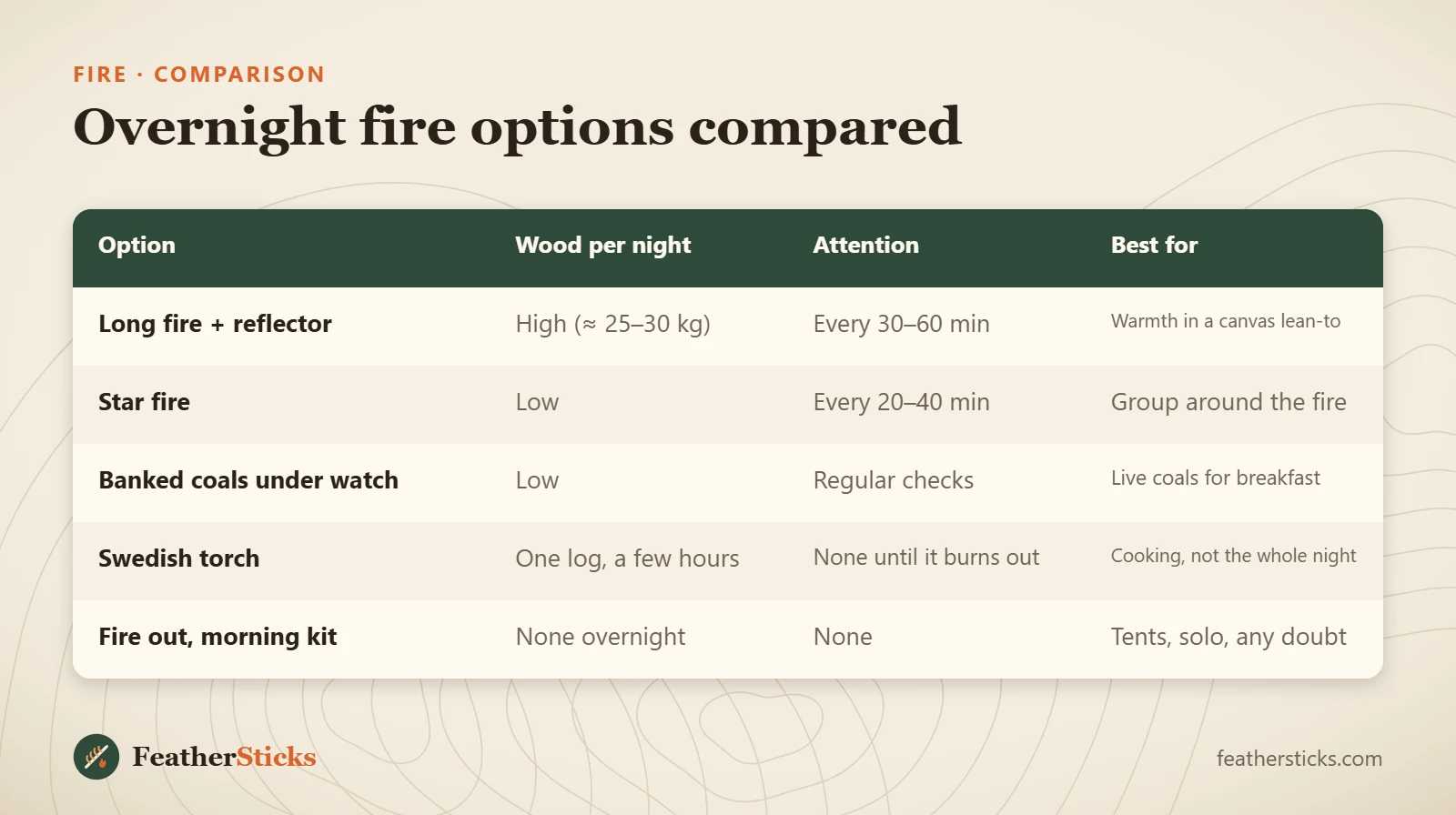
| Option | Wood per night | Attention | Best for |
|---|---|---|---|
| Long fire + reflector | High (≈ 25–30 kg) | Every 30–60 min | Warmth in a canvas lean-to |
| Star fire | Low | Every 20–40 min | Group around the fire |
| Banked coals under watch | Low | Regular checks | Live coals for breakfast |
| Swedish torch | One log, a few hours | None until it burns out | Cooking, not the whole night |
| Fire out, morning kit | None overnight | None | Tents, solo, any doubt |
Common mistakes
- Going to sleep with a banked fire and no one on watch: banked is not out.
- Covering embers with soil, which hides them without putting them out.
- Sleeping in a tent, hammock or under a synthetic tarp close to the fire.
- Taking embers, a stove or a grill into a tent for warmth: carbon monoxide can kill.
- Gathering wood for the evening only and running out in the small hours.
- Burning softwood all night: fast flames, sparks and no lasting coals.
- Piling on a big load of wood at bedtime to "make it last".
What you need
- Folding saw and axe for long, thick logs
- Leather gloves and a poker stick
- Collapsible bucket or bottles for about 20 litres of water
- Canvas or poly-cotton tarp for a fire-facing lean-to
- Headlamp with red light for the watch
- Alarm or watch for shift times
- Dry bag with tinder and fine kindling for the morning
FAQ
How do you keep a fire going all night?
Is it safe to leave a campfire burning overnight?
What does banking a fire mean?
What is the best wood for an all-night fire?
How far from a fire should you sleep?
How much firewood do I need for one night?
Can I keep a fire going overnight alone?
Check yourself
Completed6 quick questions from this guide. Nothing is sent anywhere.
Related step-by-step guides
-
 1
-
 1
-
 1