Your Fire Kit: Lighters, Matches & Backups for Bushcraft
A good fire kit for bushcraft is small, redundant and always on you: a reliable lighter as your first choice, storm or waterproof matches and a ferro rod as two backups that fail in different ways, a pinch of tinder that catches easily, and waterproof packaging. Spread the parts between your pocket, your belt and your pack, check them before every trip, and you will have fire when you need it, not just when the weather is kind.
This guide explains the common "rule of three" ignition idea, which lighter types cope with cold, wind and altitude, the difference between safety, strike-anywhere and storm matches, how to waterproof everything, what to put in a personal and a group kit, and how to keep it working. It builds on starting a fire from scratch and belongs in every bushcraft for beginners setup.
Step by step
-
1

Choose a reliable primary lighter
A simple flint-wheel lighter is the easiest first choice. Make sure it is full and lights first time.
-
2

Add two different backups
Pack storm or waterproof matches and a ferro rod, so no single weakness such as cold, wet or empty gas leaves you without fire.
-
3

Pack tinder that catches easily
Add cotton pads with petroleum jelly, birch bark or fatwood. Prepared tinder turns a brief spark into a flame that lasts.
-
4

Waterproof everything
Seal matches in a screw-top case with a striker strip and keep tinder and spares in a zip bag or small dry bag.
-
5

Spread it: pocket, belt, pack
Lighter in an inside pocket, ferro rod on the belt or neck cord, the kit tin in the pack. Losing one never means losing all.
-
6

Check and rotate before every trip
Test the lighter, look at the matches and striker, refill tinder and replace anything damp, worn or nearly empty.
Why a fire kit needs more than one lighter: the rule of three
A common piece of outdoor advice is to carry three independent ways to make fire. The point is that each method should fail for a different reason, so one bad situation cannot knock out all of them at once.
- A lighter is the fastest and easiest, but butane loses pressure in the cold, a wet spark wheel will not spark until dried, and gas runs out without warning.
- Matches do not care about cold, but ordinary ones hate moisture and wind. Storm matches and waterproofed matches close most of that gap.
- A ferro rod has no fuel and works wet, frozen and at altitude, but it only throws sparks, so it needs fine, dry tinder and a little technique.
Together they cover each other's weak points. Some experienced people reduce this to "two sources in two places", and for a summer day hike that is often enough. The longer, wetter, colder or more remote the trip, the more the third source earns its few grams. A fire kit is also more than ignition: without tinder that catches, even a perfect flame or spark may not become a fire, which is why tinder and packaging are part of the system.
The fire kit as layers of insurance
- Check before every trip, keep it dry, keep the lighter warm, practise with each method.
- Sealed match case, zip bag or small dry bag, tin for tinder.
- Prepared tinder plus natural material you can find on the way.
- No fuel, works wet and cold, needs fine tinder.
- Direct flame, independent of gas and cold.
- Fastest and easiest in normal conditions.

Which is the best lighter for camping? Flint wheel, piezo or jet
For most people the best lighter for camping and bushcraft is a plain, refillable or disposable flint-wheel lighter with a visible fuel level. It is cheap, simple to repair in the field and, even when the gas is gone, the wheel still throws a few sparks from the flint onto very fine tinder. Push-button and jet lighters have their place, but each comes with trade-offs worth knowing.
Flint-wheel lighters
You spin a ridged steel wheel against a small flint, and the sparks ignite the gas. Strengths: few parts, works with gloves once you get used to it, and if the wheel gets wet you can dry it by rolling it on your trousers and blowing on it. Weaknesses: the flint wears out, a rusty or clogged wheel slips, and like all butane lighters it weakens in the cold.
Piezo (push-button) lighters
A piezo crystal produces a small electric spark when you press the button. They are easy to use with numb fingers and have no flint to wear out. However, the spark has to jump a tiny gap, and many users report that piezo ignition becomes unreliable at high altitude, when wet, or as the parts age. When the piezo fails there is no fallback spark.
Jet or torch lighters
Jet lighters push gas through a nozzle to make a hot, narrow, blue flame that resists wind much better than a soft yellow flame. That makes them useful for lighting stoves and stubborn tinder in a breeze. On the other hand they burn fuel fast, usually rely on piezo ignition, often struggle in the cold and at altitude, and are more complex.

| Type | Wind | Cold | Wet | Altitude | Field repair |
|---|---|---|---|---|---|
| Flint wheel | Fair, shield the flame | Weak near and below 0 °C, warm it first | Dry the wheel, then fine | Generally reliable | Easy: dry wheel, new flint |
| Piezo push-button | Fair | Weak near and below 0 °C | Spark may fail until dry | Often reported unreliable high up | Hardly possible |
| Jet / torch | Good | Often weak, warm it well | Spark may fail until dry | Often reported unreliable high up | Hardly possible |
Values are rules of thumb; individual lighters vary. Whatever type you choose, carry a backup that does not depend on gas.
What makes a good kit lighter
- Visible fuel level: a translucent body shows when it is time to replace or refill it.
- Bright colour: orange or red is easy to find in leaf litter and snow.
- Two of them: lighters are light. One in a pocket and one in the kit tin is cheap insurance.
Lighters in cold weather and at altitude
Most lighters run on butane. Butane boils at about −0.5 °C, so near and below freezing it barely turns into gas, and the flame shrinks or does not appear at all. That matches what you see with gas stoves, as explained in our guide to camp stoves. The fix is simple: keep the lighter warm.
- Carry it in an inside pocket, close to your body, not in a hip-belt pocket or the lid of the pack.
- Before use, warm it in your fist for half a minute or so.
- Prepare tinder and kindling before you take the lighter out, so it does not cool down while you work.
- At night in the cold, keep it in your sleeping bag or a warm pocket.
Altitude adds a second effect: less oxygen and lower air pressure make flames smaller and sparks less effective. Many people find flint-wheel lighters, matches and ferro rods more dependable high up than piezo and jet lighters. If you travel in high mountains, test your kit there before you rely on it. For a complete winter routine, from platform to fuel, read making fire in snow and deep cold and the guide to winter camping.
Getting a lighter to work in the cold
 1Inside pocket, close to the body
Keep the lighter and a small bag of tinder in an inside chest pocket. Body heat keeps the gas warm enough to vaporise, while a lighter in an outer pocket cools to air temperature.
 2Warm it in your fist
Plain butane works poorly below about 0 °C. Hold the lighter in your closed hand for a while before you strike, and do it with everything else already prepared.
 3Light at once, low down
Build on a platform of dead sticks, hold the flame under the edge of the tinder and light immediately. If it sputters, warm it again rather than spinning the wheel until your thumb is raw.
Matches for your fire kit: safety, strike-anywhere and storm matches
Matches are the quiet hero of a fire kit. They do not freeze, need no fuel level check and give you a real flame that you can hold exactly where you need it. Their enemies are moisture, wind and a worn striking surface. Choose the type with that in mind.
Safety matches
Ordinary safety matches only light on the striking strip of their box, because part of the chemistry sits in the strip. That makes them safe to carry, but if the strip gets wet or wears smooth, the matches become useless. Always pack a spare strip, cut from a box, in a separate dry place.
Strike-anywhere matches
These light on any rough, dry surface such as a rock or a zip. They are handy, but they can also ignite by accident from friction in a pocket or bag, and they are harder to buy in some countries and banned from many flights. If you carry them, keep them in a hard case with the heads separated from anything abrasive.
Storm matches (stormproof, windproof matches)
Storm matches have a long coated head that burns fiercely for several seconds. Once lit they keep burning in strong wind and even after brief immersion, and they are hard to blow out. Most need their own striker strip. They are the best match for a fire kit: bulky, but the closest thing to a lighter that cannot run out of gas.
Waterproof matches
"Waterproof" usually means a coated head and a sealed box, so they survive damp conditions and light after getting wet. They burn like normal matches, so they still need shelter from wind. Wax-dipped matches, which you can make at home, belong in this group.
| Type | Lights on | Wind | Wet | Best use |
|---|---|---|---|---|
| Safety match | Box strip only | Poor | Poor, strip is the weak point | Cheap backup, kept sealed |
| Strike-anywhere match | Any rough, dry surface | Poor | Poor | Convenient, store in a hard case |
| Waterproof match | Strip, depending on type | Fair | Good | Damp climates, canoe trips |
| Storm match | Own striker strip | Very good | Very good | Main backup in any weather |
| Wax-dipped match (DIY) | Strip, after scraping wax off | Poor to fair | Good | Low-cost home project |
How to light a storm match
Storm matches behave differently from ordinary matches. The striking head lights, then the long coating flares with a hiss and sparks. Do not drop or shake it in surprise; let it burn and bring it to the tinder.
Using a storm match, step by step
 1Strike on the box strip
Hold the match near the end of the stick and draw the head firmly along the striker in one stroke, away from your body. A wet or smooth strip is the usual reason a storm match will not light.
 2Let the coating flare, shield it
The long coating catches within a second and burns hard. Keep your back or a cupped hand to the wind. The flame survives a breeze, but your tinder may not.
 3Hold it under the tinder
Bring the burning head under the finest part of the tinder, at the bottom of your fire lay, and hold it there until the coating is spent. Then let the stick burn into the fire or drop it in.
Waterproofing your fire kit: cases, bags and wax-dipped matches
Water is the most common reason a fire kit fails. Rain soaks a cardboard matchbox, sweat dampens a pocket, a canoe tips. Waterproofing is cheap, so do it thoroughly:
- Screw-top match case with an O-ring: the standard home for matches. Many have a striker strip inside the lid or on the side. Check that the seal is clean and seated each time you close it.
- Small metal tin: good for tinder and cotton pads, and the same kind of tin works for making char cloth. Tape the lid or put the tin in a zip bag, because tins are not watertight.
- Zip bags: light and transparent. Double-bag important items and replace bags when the seal wears.
- Small dry bag: ideal for the group kit or for everything on water trips.
Wax-dipping matches as a home project
Dipping ordinary matches in wax makes them water-resistant and adds a little extra burn time. It is a nice project for a rainy afternoon and works with safety matches as well as strike-anywhere ones. Melting wax is a fire hazard, though: use a water bath, never an open flame or a pan directly on the heat, never leave it unattended, and keep a lid nearby to smother a flare-up. Our guide to melting wax safely explains the setup in detail, and the same session can produce wax pads and cords for your kit.
Wax-dipped matches: the home project
 1Melt wax in a water bath
Put old candle stubs or paraffin wax in a tin can standing in a pot of hot water. Heat gently until the wax is liquid. Never heat wax directly over a flame, and never leave it alone.
 2Dip the head only, briefly
Hold each match at the end and dip the head plus a few millimetres of stick into the wax for a moment. Lift it out, and later test one or two at home before you trust the batch.
 3Let the wax harden
Lay the matches on baking paper with the heads apart so they do not stick together. After a few minutes the wax is firm. A second dip gives a thicker, more water-resistant coat.
 4Into a sealed case
Store them in a screw-top case and pack a striker strip in a separate dry place. Before striking, scrape the wax off the tip with a fingernail so the head can grip the strip.
The ferro rod: the backup that never runs out
A ferro rod is the most robust part of a fire kit. It has no fuel, no moving parts and no seal to fail; you can drop it in a stream, wipe it on your trousers and strike. In return it asks for good technique and fine, dry tinder, because each spark lives for only a fraction of a second.
- Size: an 8–10 mm rod of 10–13 cm with a handle is the usual main rod. A 4–6 mm keychain rod is fine as a pocket backup.
- Striker: a hard edge with a crisp 90° corner, tied to the rod with a lanyard. Never use your knife edge.
- Practice: learn the pull-back strike at home with a cotton pad, then with natural tinder.
Our complete guide shows how to use a ferro rod, including technique, strikers and troubleshooting. For the very traditional route, flint and steel with char cloth is a rewarding skill, but it is slower and is better treated as a hobby than as a backup. If every source fails, improvised fire with a battery and steel wool is the last resort.
Tinder in the fire kit: prepared and natural
A flame from a lighter or match lasts seconds; a spark lasts less. Tinder bridges the gap between that brief heat and your kindling. Carrying a small supply means you are not dependent on finding dry material in the rain.
Prepared tinder
Cotton pads or cotton wool rubbed with petroleum jelly are the classic choice: they catch from a match, lighter or spark when pulled open, and burn for minutes. Wax-soaked pads and cords, egg-carton starters and other homemade options are covered in our guide to DIY fire starters. Five to ten pieces in a small tin or bag are plenty for a personal kit.
Natural tinder
Birch bark burns even when damp because of the oils it contains, and you can carry a few strips taken only from fallen trees and where collecting is allowed; see working with birch bark. Fatwood can be scraped into fine dust or shaved into curls, and it keeps for years. Learn to find dry grass, seed fluff and fine twigs on the way too; our guide to natural tinder shows what works in which season.
| Tinder | Catches from | Burn time | Damp conditions | Keeps |
|---|---|---|---|---|
| Cotton + petroleum jelly | Match, lighter, spark (pulled open) | Minutes | Excellent | Long, if sealed |
| Wax pads / wax cord | Match, lighter; spark only on frayed fibres | Several minutes | Excellent | Long |
| Birch bark strips | Match, lighter, spark when scraped fine | Medium | Good | Long, if dry |
| Fatwood stick | Match, lighter, spark on fine dust | Long | Excellent | Years |
| Char cloth | Spark, then blow into flame | Glows only | Poor, must stay dry | Long, if dry |
Where to carry your fire kit: pocket, belt or pack
The best fire kit is useless if it is in the wrong place at the wrong moment. A pack can be left at camp, dropped down a slope, or float away after a capsize. That is why the parts of the kit should live in different places.
- Pocket: the lighter, ideally in an inside pocket where body heat keeps it warm and it goes everywhere you go, including a short walk away from camp.
- Belt or neck cord: the ferro rod, on the knife sheath, in a belt pouch or on a cord. Our guide to the belt kit shows how to build a small set that stays on your body. Tuck neck cords away when climbing or scrambling.
- Pack: the kit tin with storm matches, spare lighter and tinder, near the top or in a lid pocket, where you can reach it without unpacking.
On water, attach the most important ignition source to your buoyancy aid rather than packing it in the boat. If you ever have to spend an unplanned night out, the kit on your body is what you will actually have. Where fire tools fit in a full, weighed packing list is shown in our bushcraft kit list and the Kit Builder.

| Trip | On the body | In the pack | Tinder |
|---|---|---|---|
| Summer day hike | Lighter | Small match case or keychain ferro rod | 3–4 cotton pads |
| Overnight bushcraft trip | Lighter, ferro rod on the belt | Storm matches, spare lighter | Cotton pads, birch bark or fatwood |
| Autumn and winter | Lighter in an inside pocket, 10 mm ferro rod | Storm matches, spare lighter, extra tinder | Cotton pads, fatwood, wax starters |
| Canoe or kayak | Ferro rod on the buoyancy aid, lighter in a sealed pocket | Everything else in a dry bag | Sealed tin of prepared tinder |
| Group or family trip | Each adult carries a pocket kit | Shared group kit in a dry bag | Generous shared supply |
Personal fire kit vs group fire kit
A personal fire kit is small enough to carry every time, in a pocket or belt pouch: one lighter, a small case of storm or waterproof matches, a ferro rod and a few pieces of tinder. Its job is to give one person a fire, even alone and after things have gone wrong.
A group fire kit supports the camp: spare lighters, a larger supply of matches and tinder, a few homemade fire starters, perhaps a candle stub for lighting fires in very wet conditions, and a long lighter or a ferro rod for the stove. Pack it in a small dry bag and decide who carries it. It does not replace the personal kits; every adult still carries their own.
With children, the group kit stays with an adult. Children can carry a ferro rod and learn to use it under supervision, which is a great first fire tool; our guide to bushcraft with kids gives age-appropriate steps.

Checking and rotating your fire kit
A fire kit that has lived in a pack for two years is not the same as the one you packed. Lighters leak or get used and not refilled, flints wear, matches absorb moisture, strikers wear smooth and tinder dries out or gets squashed. A five-minute check before each trip catches almost all of that.
The five-minute kit check
- Lighter Light it three times in a row. Check the fuel level, the flint and that the wheel spins freely. Replace or refill when it is under a third full.
- Matches Open the case, look for damp, crumbly heads, count the matches and check the striker strip. Replace the strip when it looks smooth.
- Ferro rod Strike once onto a fireproof surface. Scrape off any corrosion, check that the striker edge is still crisp and the lanyard is sound.
- Tinder Refill used pieces. Replace prepared tinder that has dried out, got wet or picked up dirt.
- Packaging Check O-rings, zip seals and the dry bag for holes. Dry everything before it goes back.
Once a season, rotate the stock: use the oldest matches and tinder at home in a fire bowl or barbecue, and put fresh ones into the kit. The Fire Lay Picker and Firewood Calculator help you turn a lit tinder bundle into the right fire with enough wood.
Fire kit tips for cold and wet weather
Bad weather is when a fire kit matters most and when it is most likely to fail. A few habits change that:
- Prepare before you ignite. Tinder, kindling and fuel sorted and within reach, a platform of dead sticks under the fire on wet or snowy ground. Every second of flame counts.
- Shield the flame. Use your body, a jacket or a log as a windbreak, and light low on the side facing the wind so the flame is blown into the fuel.
- Use your strongest flame first. In rain and wind a storm match or a warmed lighter is better than ordinary matches. Keep the ferro rod for when the others fail.
- Double your tinder. Use two cotton pads or a wax starter where one would do in summer.
- Think about gloves. Practise with the gloves you actually wear; a large ferro rod handle and a lighter with a big wheel help.
Our guides to lighting a fire in wet weather and fire in snow go into finding dry wood, platforms and windbreaks. When hands are already numb, the fire becomes a safety matter; read about the early signs of hypothermia and do not wait too long before stopping to make warmth.
Which ignition source should I use right now?
Is the lighter warm and lighting normally?
Yes → Use it: the fastest flame, shield it from the wind.No → Warm it in your fist, or move to matches.Is it windy or raining?
Yes → Use a storm match, held under the tinder.No → A normal or waxed match is fine.Are all matches wet or used up?
Yes → Use the ferro rod with fine, opened tinder.No → Keep the ferro rod for later.Does the tinder flare and die?
Yes → Add more prepared tinder and thinner kindling before the next try.No → You have a fire: feed it gradually.
Travelling and flying with a fire kit
Rules for lighters, matches and fire starters on planes differ between countries, airports and airlines, and they change. Some allow one small lighter or a box of safety matches on your person and ban them from checked bags; many forbid strike-anywhere matches, jet lighters and spare fuel entirely. Storm matches and fire paste may be treated as dangerous goods.
- Check the current guidance of the airport security authority and your airline before you travel.
- Do not try to hide fire tools in luggage; it can lead to fines and confiscation.
- Ferro rods are often allowed, but screeners may decide otherwise. Have a plan to buy lighters, matches and tinder at your destination.
Plan this as part of your trip planning. A fire kit that is confiscated at the gate is as useful as one left at home.
Fire bans: a kit is not a permit
Carrying a fire kit is sensible almost everywhere; using it is not. Open fires are restricted or forbidden in many forests, parks and protected areas, and temporary fire bans are common in dry periods. Rules vary by country, region and landowner, and some areas also restrict stoves during high fire danger. This is not legal advice: check the local rules and the current fire danger rating before you light anything.
When a fire is allowed, choose a safe site, keep it small, keep water ready and put it out completely. Keep fires at least 5 m from tents and hammocks and at least 3 m from synthetic tarps. Our guide to campfire safety and Leave No Trace covers the full routine, and all fire skills lists every related guide. In an emergency, call 112 (EU) or the local emergency number.
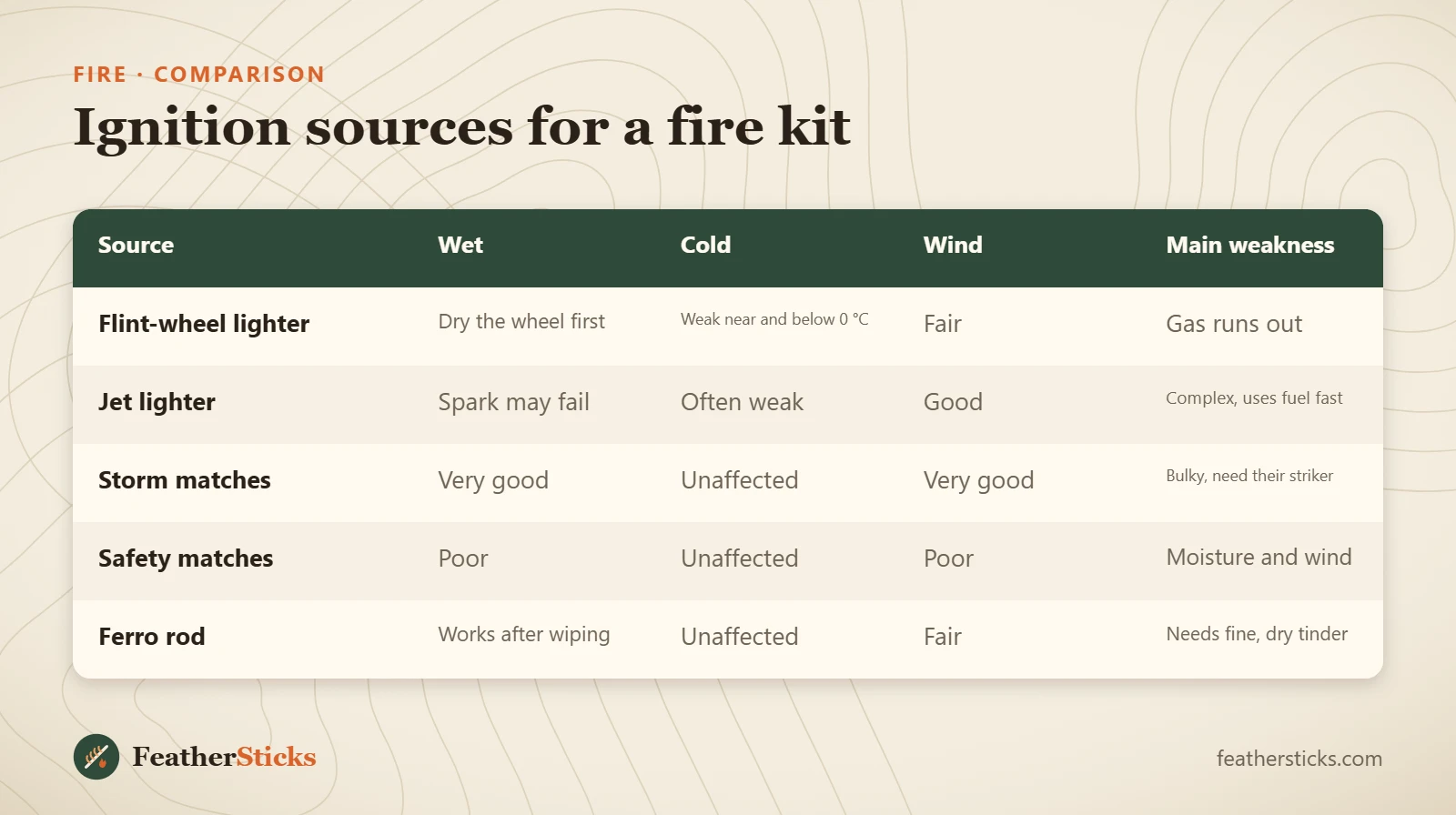
| Source | Wet | Cold | Wind | Main weakness |
|---|---|---|---|---|
| Flint-wheel lighter | Dry the wheel first | Weak near and below 0 °C | Fair | Gas runs out |
| Jet lighter | Spark may fail | Often weak | Good | Complex, uses fuel fast |
| Storm matches | Very good | Unaffected | Very good | Bulky, need their striker |
| Safety matches | Poor | Unaffected | Poor | Moisture and wind |
| Ferro rod | Works after wiping | Unaffected | Fair | Needs fine, dry tinder |
Common mistakes
- Relying on a single lighter with no backup.
- Keeping every fire tool in the same pack, so one lost pack means no fire.
- Carrying a lighter in an outer pocket in winter, where the butane gets too cold to work.
- Packing safety matches without a spare, dry striker strip.
- Leaving the kit unchecked for months until the lighter is empty and the tinder is wet.
- Never practising with the backups, so the ferro rod is useless when it is finally needed.
- Assuming fire tools are allowed on every flight or that carrying a kit means fires are permitted.
What you need
- Flint-wheel lighter with visible fuel level, plus a spare
- Storm or waterproof matches in a screw-top case with O-ring
- Spare striker strip, packed separately
- Ferro rod, 8–10 mm, with striker and lanyard
- Cotton pads with petroleum jelly or wax starters in a small tin
- Birch bark or a fatwood stick
- Zip bags or a small dry bag
FAQ
What should be in a bushcraft fire kit?
What is the best lighter for camping?
Do lighters work in freezing weather?
What is the difference between storm matches and waterproof matches?
How do I make waterproof matches at home?
What is the rule of three for fire?
Can I take a lighter or matches on a plane?
Where should I carry my fire kit?
Check yourself
Completed6 quick questions from this guide. Nothing is sent anywhere.
Related step-by-step guides
-
 1
-
 1
-
 1