Improvised Fire: How to Start a Fire Without a Lighter (Battery, Steel Wool & More)
If you need to start a fire without a lighter, the most dependable improvised method is a small battery and fine steel wool: touch both terminals of a 9 V battery, or two AA cells taped end to end, to loose grade 0000 steel wool and the strands glow at once and ignite dry tinder. A lens in strong sun, the sparks from an empty lighter's flint wheel and, as a last resort, friction can also work.
The honest message of this guide: a proper kit is faster and surer, and improvising is an emergency skill, not a plan. It explains when it is justified, how each method works, which risks come with batteries (burns, fires in the pack and overheating lithium cells), what you should never try, and how to treat a burn. Read it together with building a reliable fire kit and bushcraft for beginners.
Step by step
-
1

Stop and decide: is fire needed?
Shelter, insulation and calling for help come first. Light a fire only if it is safe, needed and, wherever possible, allowed.
-
2

Prepare tinder and wood first
Collect dry tinder, pencil-thin kindling and thicker fuel before you try any ignition. Improvised sparks and glows last seconds.
-
3

Battery and fine steel wool
Fluff 0000 steel wool on a tinder nest and touch it briefly with both terminals of a small alkaline battery. The strands glow at once.
-
4

Other sources: sun or dead lighter
Focus strong sun with a lens onto dark tinder, or spin an empty lighter's flint wheel right above very fine, fluffed tinder.
-
5

Blow the glow into a flame
Fold the tinder nest around the glow, lift it and blow gently and steadily until it flames, then set it under the kindling.
-
6

Keep it small, put it out cold
Keep the fire small, away from shelter and dry vegetation, with water ready. Before you leave, drown, stir and feel until it is cold.
Can you start a fire without a lighter? The honest answer
Yes, you can start a fire without a lighter or matches, and knowing how is worth it. But every improvised method is slower, less reliable and more dependent on luck than the contents of a small, well-packed kit. A lighter in your pocket, storm matches in a sealed case and a ferro rod on your belt solve the problem in seconds, in rain and in the dark. A battery trick or a lens is what you fall back on when that system has failed.
So the first lesson of emergency fire starting is a packing lesson: carry the kit. Spread at least two different ignition sources between your body and your pack, as described in our guide to the fire kit and the rule of three, and keep them dry in a dry bag or zip bag. Improvisation is the layer underneath that, for the day the pack floats away or the lighter is empty.
The second lesson: ignition is rarely the real problem. People who fail to get a fire going in an emergency usually fail because their tinder is damp, their kindling too thick or the wood not collected yet. Improvised ignition sources give you a glow or a spark for a few seconds, so preparation decides almost everything.
Fire kit vs improvisation
A real fire kit
- Flame or sparks in seconds
- Works in rain, wind and the dark
- Lighter, storm matches and ferro rod back each other up
- Light, cheap and easy to check before a trip
Improvised methods
- Depend on what you happen to carry
- Lens needs strong sun, friction needs skill and dry wood
- Batteries bring burn and fire risks
- Fail far more often under stress and cold
When is improvising a fire justified?
Improvised fire is a tool for genuine need, not a party trick in the woods. Typical situations where it is justified:
- An unplanned night out after getting lost, injured or caught by darkness, when your fire kit is missing, wet or empty. Our guide to the unplanned night outdoors puts fire in its place among the other priorities.
- Cold and wet conditions where someone shows early signs of hypothermia: shivering, clumsy hands, slurred speech. Warmth then becomes a safety matter.
- Signalling and morale during a long wait for rescue, where smoke and light help others find you; see distress signals.
Even then, fire is rarely the first thing to do. In most cold-weather emergencies the order is: call for help if anyone is hurt or you cannot get out (112 in the EU), get out of the wind, insulate yourself from the ground, put on every layer you have, and only then think about fire. The wind chill calculator shows how quickly wind changes the picture.
Should I try to make an improvised fire now?
Is anyone injured, very cold or are you unable to get out?
Yes → Call 112 (EU) or the local emergency number first, then continue.No → Consider walking out or making yourself comfortable without fire.Are you out of the wind and insulated from the ground?
Yes → Good. Now fire can add warmth, light and morale.No → Do that first: shelter and insulation save more heat than a small fire.Is the fire danger high, the ground dry or the site in a protected area?
Yes → A fire may be the bigger danger. Rely on clothing, shelter and rescue.No → Choose a safe spot and prepare tinder and wood.Do you have a lighter, matches or a ferro rod that works?
Yes → Use it. Improvisation is only for when the kit fails.No → Pick the improvised method that fits what you carry and the weather.
Prepare tinder, kindling and fuel before you try to ignite
Every improvised method gives you something small and short-lived: a glowing tuft of steel wool, a spot of focused light, a shower of tiny sparks or a pinch of smouldering dust. That only becomes a fire if the next stage is ready and within arm's reach. Collect everything first, then ignite.
- Tinder: a double handful of the finest, driest material you can find. Dry grass, seed fluff, fine inner bark fibres, the papery outer layer of birch bark, scrapings of fatwood, or cotton and paper from your pockets. Our guide to natural tinder shows what works in each season.
- Kindling: dead, dry twigs from matchstick to pencil thickness, ideally snapped from standing dead branches rather than picked off wet ground. If everything is damp, split sticks and carve feather sticks to reach the dry core, as our guide to fire in wet weather shows.
- Fuel: wrist-thick dead wood, enough for the first hour. The firewood calculator gives a feel for how much a night really needs.
Shape the tinder into a loose bird's nest with the finest fibres in the centre, and build a small platform of dry sticks underneath if the ground is wet or snowy. Lay the kindling ready beside it, or build a small teepee with a door facing you. The fire lay picker and our guide to fire lays help you choose a structure that catches easily.
What must be ready before ignition (top = last)
- Wrist-thick dead wood, sorted, for at least the first hour.
- Matchstick to pencil thickness, dry, two big handfuls.
- Fist-sized, finest fibres in the centre, kept dry in a pocket until use.
- A layer of dry sticks or bark on wet or frozen ground.
- Mineral soil or rock, away from shelter, roots and dry grass, water ready.
How to start a fire with a battery and steel wool
The battery and steel wool fire is the best-known improvised method, and for good reason: it works within a second, needs no skill and copes with wind and drizzle better than a lens. It works because fine steel wool is a tangle of extremely thin iron strands. When you connect both terminals of a battery through those strands, a current flows through the thinnest fibres, heats them until they glow, and the hot iron then burns in the air. The glow spreads through the loose wool for several seconds, long enough to light good tinder.
Which steel wool works?
Steel wool is sold in grades from coarse to very fine; the finest commonly sold grade is labelled 0000. That is the one you want, because the strands are thin enough to heat with a small battery. Coarser grades such as 0 or 1 are much harder to ignite. Steel wool still works when slightly damp, though dry is better, while rusty, compressed or oily wool from the kitchen drawer is unreliable. Pull a piece about the size of a fist loose and airy, so air can reach every strand.
Which battery works?
A 9 V block battery is easiest, because both terminals sit side by side on top and you can simply press them onto the wool. Two AA or AAA alkaline cells taped end to end, plus to minus, also work: you then press one end of a thin strand of wool to the bottom terminal and touch the other end to the top. A single 1.5 V cell is usually too weak. Use only small alkaline (or zinc-carbon) cells. The next section explains why lithium cells, phone batteries and power banks do not belong anywhere near this method.
Battery and steel wool fire with a 9 V battery
 1Tease the wool loose
Pull a fist-sized piece of 0000 steel wool apart until it is airy and see-through. A compact pad hardly glows, because the strands touch each other and air cannot reach them.
 2Lay it on the tinder nest
Put the fluffed wool into the hollow of a dry tinder nest, with fine grass, bark fibres or cotton directly under and around it. The glow has to touch fuel within seconds.
 3Touch both terminals briefly
Press both terminals of the 9 V battery onto the wool for a moment. The strands glow at once; take the battery away as soon as they do. The battery gets hot if you keep it there, and glowing wool can burn your fingers.
 4Fold, lift and blow gently
Close the nest loosely over the glow, lift it to face height and blow slowly and steadily. When smoke thickens and the first flame appears, set it under your kindling.
The AA or AAA version
With round cells you need a little more care, because the terminals are at opposite ends. Tape two cells together in a line so that the plus of one presses on the minus of the other; electrical tape, plaster tape or a strip of duct tape all work. Then twist a thin strand of steel wool, about as long as the pair of cells, and hold it so it bridges the bottom and the top terminal. The strand glows along its length within a second or two. Drop or lay it straight into the tinder.
The same trick with two AA cells
 1Plus to minus, taped
Line up two alkaline AA or AAA cells so the plus end of one touches the minus end of the other, and tape them firmly. Together they give about 3 volts.
 2Bridge the ends with a thin strand
Twist a thin strand of 0000 steel wool and hold it against the bottom terminal, then touch the other end to the top terminal. Hold the cells by the tape, not near the ends.
 3Glow into the tinder
The strand glows at once. Hold the cells directly over the tinder nest so the glowing wool falls or can be laid straight into it, then blow it into flame.
| Combination | Works? | Notes |
|---|---|---|
| 9 V alkaline + 0000 steel wool | Yes, very easily | Easiest version; touch briefly, battery warms quickly |
| 2 × AA or AAA alkaline in series + 0000 strand | Yes | Needs a thin strand bridging both ends |
| Single 1.5 V cell | Usually not | Too little voltage for most wool |
| Rusty or compressed kitchen wool | Unreliable | Fluff it well; replace if rusty |
| Lithium cells, phone batteries, power banks | Never try | Risk of overheating, fire and explosion |
Battery and steel wool risks: burns, fire in the pack, lithium cells
The method is simple, which makes it easy to underestimate. These are the risks to take seriously.
Burns
Glowing steel wool is far hotter than a match head and drops sparks. Hold the battery at the far end, keep fingers out of the wool, and never do this over your lap or a sleeping bag. A short-circuited battery heats up within seconds; drop it on the ground rather than holding on.
Fire in the pack
Steel wool and batteries carried loose together are a genuine fire risk. A 9 V battery rolling against steel wool, keys or coins in a pocket or pack can short-circuit and start a fire or a burn without anyone noticing. If you carry both as an emergency option:
- Keep the steel wool sealed in its own zip bag or tin, ideally in a different pocket from the batteries.
- Keep the terminals covered: the plastic cap a 9 V battery is sold with, a strip of tape over the terminals or the original blister pack.
- Never store loose batteries with coins, keys or other metal.

Never lithium, never phone batteries
Lithium-ion and lithium cells, including phone batteries, power banks, camera batteries, headlamp cells and the cylindrical cells used in torches and e-cigarettes, can deliver very high currents. Short-circuiting them can make them overheat, swell, vent hot gas, catch fire or burst. Use only small alkaline cells such as 9 V, AA or AAA for this method. Never take a phone apart to get at its battery, and never puncture, crush or cut any battery: damaged lithium cells can burn violently and leaking alkaline cells contain corrosive material.
Your phone and power bank are emergency equipment in their own right; our guide to power banks and batteries outdoors shows how to keep them charged and warm instead.

Fire with a lens and the sun
A lens concentrates sunlight into a small, hot spot. In strong, direct sun it can make dark tinder smoulder within a minute or less; under thin cloud it may take much longer; on an overcast day or in the evening it does nothing at all. Our full guide to fire with a magnifying glass covers focal points, seasons and tinder in detail. In an emergency, the short version is:
- Best lenses: a magnifying glass or a Fresnel card from a first aid or survival kit. Some compasses have a small magnifier that can work in bright summer sun.
- Tinder: dark materials heat fastest: char cloth, charred punk wood, dark bark fibres, the black edge of a previous fire's charcoal. Light-coloured grass reflects most of the light.
Hold the lens at right angles to the sun, move it until the spot is as small and bright as you can make it, and hold it still. When the tinder smokes and glows, keep the spot on it a few seconds longer, then move the glow into your tinder nest and blow it into flame. Never look at the sun through the lens. Don’t stare at the bright spot either: glance at it only briefly to aim, ideally with sunglasses. And never leave a lens lying in the sun: it can start a fire by itself.
| Lens | How well | Notes |
|---|---|---|
| Magnifying glass | Good | The most reliable option; needs direct sun |
| Fresnel card | Good | Weighs a few grams; keep it clean and unscratched |
| Reading glasses (plus dioptres) | Weak | Minus lenses for short sight do not work |
| Clear water bottle, full | Poor | Gives a line, not a dot; rarely lights natural tinder |
Sparks from a dead lighter's flint wheel
An empty disposable lighter is not useless. As long as the flint has not worn away, the wheel still throws a small shower of sparks every time you spin it. Those sparks are far weaker than a ferro rod's, but they can light very fine, fluffy tinder: pulled-apart cotton wool, char cloth, the finest seed fluff, cotton with a little petroleum jelly, or the fine dust scraped from fatwood.
If the lighter has gas but will not light because the wheel is wet, dry it first: roll the wheel firmly on your trousers, blow on it and warm the lighter in your fist. In the cold, a lighter that only sputters may simply be too cold, a problem our fire kit guide explains. Do not take apart lighters that still contain gas, and never hold a lighter close to a fire to warm it.
Using an empty lighter as a spark source
 1Prepare the finest tinder
Pull a cotton pad or a pinch of seed fluff apart into a loose, airy tuft about the size of a walnut. The sparks are tiny and only catch on the finest fibres.
 2Spin the wheel right above it
Hold the lighter tilted, with the wheel a finger's width above the tuft, and spin it hard and fast with your thumb so the sparks fall straight into the fibres. Repeat several times.
 3Glow into the nest, then blow
When a fibre catches or a char cloth edge glows, lay it in the centre of the tinder nest at once, fold the nest and blow gently into flame.
Friction fire as a last resort: bow drill, hand drill, fire plough
Friction methods need nothing manufactured, which makes them famous in survival stories. In reality they are the hardest way to make fire. They need the right dry, soft wood, careful preparation, good technique and a lot of energy, and they are much harder when you are cold, tired, wet or injured, which is exactly when an emergency happens. Treat friction as a skill you learn in good conditions, not as a plan.
- Bow drill: the most achievable friction method. A cord turns a spindle in a notched hearth board until hot dust forms an ember. It needs a cord (a bootlace or paracord works) and suitable dry wood.
- Hand drill: a long, straight stalk spun between the palms.
- Fire plough: a stick rubbed in a groove.
All three produce a small ember in a pile of dark dust, which you transfer to a tinder nest and blow into flame, just as with the other methods. If you have never made a friction fire in your garden on a dry day, the chance of managing it for the first time on a wet, cold night is small. Use your energy for shelter and insulation instead.
| Method | Needs | Weather | Skill | Typical result |
|---|---|---|---|---|
| Battery + steel wool | 9 V or 2 × AA alkaline, 0000 steel wool | Copes with wind and light drizzle | Low | Glow within seconds |
| Lens + sun | Magnifier or Fresnel card, dark tinder | Strong direct sun only | Low to medium | Smoulder in about a minute |
| Empty lighter wheel | Working flint, very fine tinder | Dry tinder needed | Medium | Weak sparks, several tries |
| Bow drill | Cord, suitable dry wood, knife | Dry wood needed | High | Ember after preparation and effort |
| Hand drill / fire plough | Suitable dry stalks or wood | Dry conditions | Very high | Often fails, even for the practised |
Char cloth and tinder: catching a weak spark or glow
Improvised sources produce weak heat: a small spot of light, a few faint sparks, a brief glow. What catches that heat decides whether you get a fire. Three kinds of material help most.
- Char cloth: cotton fabric charred without air. It catches even feeble sparks and lens light and glows for a long time. A few squares in a small tin are a light, cheap addition to any kit.
- Natural glowing tinder: dry, soft punk wood and tinder fungus can hold a glow in the same way; charred material from an old fire pit works too.
- Flame tinder: once something glows, you need fine, dry fibres that burst into flame when blown: dry grass, shredded inner bark, birch bark curls, fluffed cotton.
From weak heat to a fire
- CatchSpark, glowing wool or lens spot lands on char cloth, steel wool or the finest fluff.
- GlowThe catcher glows; lay it in the centre of the tinder nest at once.
- FlameFold the nest, lift it and blow gently until it flames.
- KindlingSet the burning nest under thin, dry twigs, then add thicker wood gradually.
What not to do: no chemicals, no fuel, no aerosols
The internet is full of "survival hacks" that mix household chemicals, pour fuel or turn spray cans into torches. This guide deliberately does not describe any of them.
- Do not mix chemicals to make fire, even if you have read that it works. Reactions can be violent, unpredictable and toxic.
- Do not pour fuel such as stove fuel, petrol or alcohol onto tinder or a fire. Vapour can flash back to the bottle and the person holding it. Stove fuel belongs in a stove.
- Do not misuse aerosols such as insect repellent, deodorant or gas canisters near flame. They can burst and spray burning liquid.
- Do not use signal flares to light fires. Flares are for signalling rescue and can start uncontrollable fires; see distress signals for how to use them correctly.
- Do not short-circuit lithium batteries or open any battery, as described above.
If none of the safe methods works, stop trying to make fire and put your energy into insulation, shelter and staying dry. A cold night in a well-insulated shelter is survivable far more often than a burn far from help.

Fire safety and fire bans, even in an emergency
An emergency changes your priorities, but it does not change how fire behaves. Wildfires started by people in trouble are still wildfires, and they can endanger you first. Fire rules differ by country, region and landowner, and in dry periods many areas ban all open fires. This is not legal advice: in a genuine emergency, protecting life comes first, but in high fire danger the fire itself may be the greater risk. Call for help, and rely on clothing, shelter and insulation where a fire could escape.
If you do light one:
- Choose bare mineral soil, sand, gravel or rock, away from roots, peat, dry grass and overhanging branches. Clear a circle of about a metre around it.
- Keep the fire at least 5 m from tents and hammocks and at least 3 m from synthetic tarps, bivvy bags and foil blankets, which melt and burn.
- Have water ready, never leave the fire unattended, and watch the wind.
- Put it out completely before you leave or sleep away from it: drown, stir, drown again and feel with the back of your hand until it is cold.
Our guide to campfire safety covers site choice and extinguishing in detail, and Leave No Trace shows how to leave no scar afterwards. All fire guides are collected in fire skills.
Before you strike, glow or focus
- Help called if anyone is injured, very cold or stuck
- Shelter and insulation sorted first
- Safe site on mineral soil, cleared of litter, no overhanging branches
- At least 5 m from tents and hammocks, 3 m from synthetic tarps
- Tinder, kindling and fuel collected and within reach
- Water or soil ready to put the fire out
First aid for burns
Burns are the most likely injury when improvising fire: from glowing steel wool, a hot battery, sparks or a flaring tinder nest. Treat them at once, as described in our first aid guide:
- Stop the burning and move away from the heat.
- Cool with cool or lukewarm clean water for about 20 minutes. No ice, butter, oils or creams. In the cold, cool only the burn and keep the rest of the body warm to avoid hypothermia.
- Remove rings and watches near the burn before it swells, unless they are stuck to the skin.
- Cover loosely with a sterile non-adhesive dressing or clean cling film. Do not burst blisters.
Get medical help for burns larger than the casualty's palm, deep burns, burns on the face, hands, feet, genitals or across joints, electrical or chemical burns, and any burn on a child. If in doubt, call 112 (EU) or the local emergency number.

Practise safely at home, then build a real kit
The time to learn any of these methods is on a calm, dry afternoon, not on a cold night. Practise in a fire bowl, on a barbecue or on bare ground where fires are allowed, with water ready and an adult in charge if children are watching.
- Try the 9 V battery and steel wool once, so you know how fast it glows and how hot the battery gets. Then cover the terminals and store the battery and the wool separately.
- Find the focal point of your magnifier or Fresnel card on a sunny day and see which tinder catches.
Then do the most effective thing of all: build a proper kit and carry it. Our fire kit guide and the Kit Builder show what to pack. An emergency fire method is a good thing to know. A lighter in your pocket is a better thing to have.
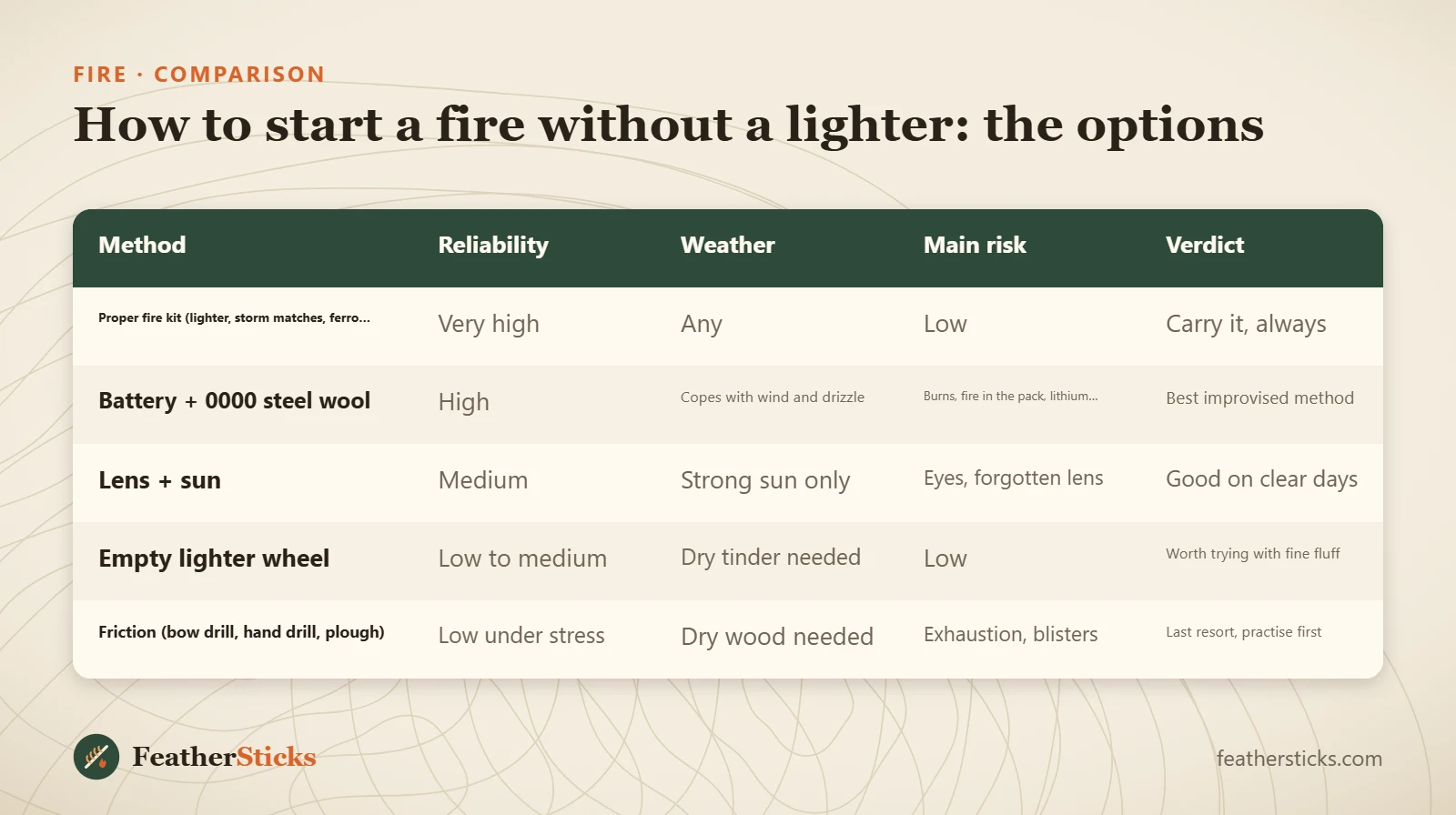
| Method | Reliability | Weather | Main risk | Verdict |
|---|---|---|---|---|
| Proper fire kit (lighter, storm matches, ferro rod) | Very high | Any | Low | Carry it, always |
| Battery + 0000 steel wool | High | Copes with wind and drizzle | Burns, fire in the pack, lithium cells | Best improvised method |
| Lens + sun | Medium | Strong sun only | Eyes, forgotten lens | Good on clear days |
| Empty lighter wheel | Low to medium | Dry tinder needed | Low | Worth trying with fine fluff |
| Friction (bow drill, hand drill, plough) | Low under stress | Dry wood needed | Exhaustion, blisters | Last resort, practise first |
Common mistakes
- Trying to ignite before tinder, kindling and fuel are collected and ready.
- Keeping steel wool and batteries loose together in a pocket or pack.
- Using lithium cells, a phone battery or a power bank instead of a small alkaline battery.
- Holding the battery on the wool after it glows, until fingers or battery are burnt.
- Spending your last energy on friction fire instead of shelter and insulation.
- Trying chemical mixtures, pouring fuel or using aerosols and flares to light a fire.
What you need
- A real fire kit: lighter, storm matches in a sealed case, ferro rod
- 9 V alkaline battery with terminal cap, or two AA cells and tape
- A pad of 0000 steel wool in its own sealed zip bag
- Fresnel card or small magnifying glass
- Char cloth or cotton pads with petroleum jelly in a small tin
- First aid kit with a burn dressing
FAQ
How do you start a fire without a lighter?
How does the battery and steel wool fire work?
Which battery is best for steel wool fire?
Is it dangerous to carry steel wool and batteries together?
Can you start a fire with a phone battery?
Is it allowed to make a fire in an emergency?
Check yourself
Completed6 quick questions from this guide. Nothing is sent anywhere.
Related step-by-step guides
-
 1
Fire · 6 steps
Your Fire Kit: Lighters, Matches & Backups
Starts with: Choose a reliable primary lighter
-
 1
-
 1