How to Make Char Cloth: Tin, Fabric and Step-by-Step Method
To make char cloth, you heat pieces of pure cotton in a closed tin with one small vent hole until the smoke stops, then let the tin cool before you open it. What comes out is black, feather-light fabric that will not burn with a flame but starts to glow from a single weak spark. That glow is the ember you need for flint and steel, and it also makes a ferro rod or a magnifying lens far more forgiving.
This guide explains what happens inside the tin, which fabrics work, how to prepare a char cloth tin, how to read the smoke, and how to fix a batch that came out brown, crumbly or dead. If you are still building your fire skills, read the fire starting basics and our introduction to bushcraft for beginners alongside it.
Step by step
-
1

Cut cotton into squares
Cut clean, dry 100 % cotton into squares of about 5 × 5 cm. Old T-shirts, denim and flannel all work; anything with synthetic fibre does not.
-
2

Fill the tin loosely
Lay the squares loosely in a steel tin whose lid has one vent hole of 2–3 mm. Do not pack them tight, or the middle stays brown. Close the lid firmly.
-
3

Set it on the coals
Push the tin onto a bed of hot coals with a stick, not into tall flames. After a minute or two, smoke jets from the hole and may burn as a small flame.
-
4

Wait until the smoke stops
Keep your face away and watch the hole. When no more smoke comes out, usually after 5–15 minutes, the cloth is fully charred.
-
5

Plug the hole, cool it closed
Lift the tin off with a stick, plug the hole with a twig and let it cool completely. Opened hot, the fresh char starts to glow and turns to ash.
-
6

Test it and store it dry
Good char cloth is evenly black and flexible, and one spark makes it glow. Keep it in a closed tin inside a waterproof bag.
What is char cloth, and why does it catch a weak spark?
Char cloth is plant-fibre fabric, usually cotton, that has been baked in a container with almost no air. Nothing is added to it. The heat alone changes the material: instead of burning away, the fabric is reduced to a thin, black sheet that is mostly carbon. It is the same process that turns wood into charcoal, only with cloth and on a much smaller scale.
Pyrolysis in simple words
Cotton consists almost entirely of cellulose. When cellulose gets hot, it breaks down and gives off water vapour, tar and flammable gases; that is the smoke you see. In an open fire those gases burn as flames and the remaining fibres burn up as well. In a closed tin there is no oxygen to burn anything. The gases are simply pushed out through the vent hole, and what stays behind is the carbon skeleton of the fibres. This heating without air is called pyrolysis. The same process turns sticks into charcoal.

Why a tiny spark is enough
Ordinary tinder has to do a lot of work before it burns. A spark first has to dry the fibre, then heat it until it gives off gas, and only then can that gas ignite. The cool, short-lived sparks from a steel striker run out of energy long before that. Char cloth has already been through those stages. There is no moisture and no gas left to drive off, only dry carbon with an enormous surface, and carbon begins to glow at a comparatively low temperature. A single speck of glowing steel is enough to start it.
Because there are no gases left, char cloth never bursts into flame by itself. It smoulders, slowly and stubbornly, and wind makes it hotter rather than blowing it out. That is exactly the behaviour you want from a spark catcher: a steady ember you can carry to a bundle of natural tinder.
From T-shirt to flame
- CottonClean, dry plant fibre cut into squares.
- CharringHeated in a tin until the smoke stops.
- Char clothBlack carbon fabric, stored dry.
- EmberOne spark makes it glow.
- FlameThe ember is blown up inside a tinder bundle.
Which fabric makes the best char cloth?
The rule is short: plant fibre only. Cotton, linen and jute are all cellulose and char cleanly. Anything made from oil, such as polyester, nylon, acrylic or elastane, melts into a hard lump and gives off acrid fumes. Wool and silk are animal fibres; they shrivel, smell of burnt hair and do not produce a usable char.
Check the label. "100 % cotton" is what you are looking for. A T-shirt with 5 % elastane will still char after a fashion, but the result is patchy and stiff, and the batch is less reliable. Stretch jeans are the classic trap: they look like cotton denim but contain synthetic stretch fibre. If there is no label, pull out a thread and hold it in a flame outdoors: cotton burns with a steady flame and leaves soft grey ash, while a synthetic thread shrinks away from the heat and forms a hard bead.

| Fabric | Catches a spark | Durability in the tin | Notes |
|---|---|---|---|
| T-shirt jersey (100 % cotton) | Very easily | Fragile | Thin and fluffy; the best choice for learning |
| Flannel, terry towel | Very easily | Fragile | Raised fibres give sparks plenty to land on |
| Denim, canvas | Easily | Robust | Thick; needs a little longer in the tin, survives a pocket |
| Linen | Easily | Medium | The traditional material; old tea towels work well |
| Jute sacking or twine | Easily | Crumbly | Coarse weave; coil twine loosely in the tin |
| Cotton pads, cotton wool | Very easily | Very fragile | Check the pack: some pads contain synthetic fibre |
| Polyester, nylon, blends | No | – | Melts, fumes, ruins the batch |
Wash out fabric softener and let the cloth dry completely before charring.
Thin or thick?
Thin, loosely woven or fluffy cloth has more free fibre ends, so sparks find something to bite into. Thick, tightly woven cloth such as denim is slower to take a spark but holds together when it is carried around. Many people char both in the same batch: jersey for catching the spark, a few pieces of denim as a tougher reserve.
Size and shape
Squares of about 5 × 5 cm are a practical size. They fit a pocket tin without folding, they char evenly, and one square can be torn into four pieces of roughly 2 × 2 cm, each enough for one fire. Larger pieces can be rolled loosely, but tightly rolled or folded cloth often stays brown in the middle.
Old clothing is the obvious source, and worn-out cotton outdoor clothing gets a useful second life this way. Do not use fabric that is oily, painted, waxed or treated with a flame retardant; you do not want those substances in the smoke.
The char cloth tin: size, lid and vent hole
The char cloth tin has two jobs: it keeps air away from the cloth, and it lets the gas out. Any small steel container with a snug lid will do. Hinged mint tins of about 6 × 9 cm are the usual choice; shoe polish tins, small tea caddies and screw-top spice tins work as well. For bigger batches, a clean food can with a second can pushed over it as a lid is a common improvised charring vessel.
Avoid aluminium: thin aluminium tins and drinks cans soften and burn through in a hot fire. Remove any rubber seal or plastic insert before the first use.
Why the vent hole matters
Without a hole, pressure builds up until the lid pops open, air rushes in and the cloth burns. With a hole that is too large, air finds its way in as soon as the gas stream weakens. A single hole of 2–3 mm in the middle of the lid is the proven compromise: large enough for the smoke, small enough that the outward flow keeps oxygen out. Hinged tins that do not close perfectly leak a little at the hinge anyway; some people use such a tin without any hole and it works, but a deliberate hole is easier to watch and easier to plug.
Preparing a tin for charring
 1Choose a steel tin
Pick a small steel tin with a lid that closes snugly, for example a hinged mint tin of about 6 × 9 cm. A magnet sticks to steel but not to aluminium, which is too soft for the fire.
 2Punch one hole
Lay the lid on a block of wood and tap a nail through the middle to make a hole of 2–3 mm. Hold the nail with pliers rather than your fingers, then flatten the sharp burr on the inside.
 3Burn it off empty
Heat the empty, closed tin once in the fire until the paint and lacquer have burnt away. Do this outdoors and stay out of the smoke; then let it cool and wipe out the soot.
Char cloth tin at a glance
- Material
- Steel (tinplate); no aluminium, no plastic or rubber parts
- Size
- About 6 × 9 cm for a pocket kit; larger cans for big batches
- Lid
- Snug fit, hinged or slip-on
- Vent hole
- One hole, 2–3 mm, in the middle of the lid
- First use
- Burn off paint and coatings empty, outdoors
- Plug
- A green twig or a pointed stick that fits the hole
How to make char cloth on a campfire or stove
The method is the same whatever the heat source: closed tin, steady heat from below, wait for the smoke to stop, cool it closed. What changes is how evenly the heat arrives and how easy the tin is to watch.
On a campfire
A bed of glowing coals is the ideal heat source. It is hot enough, it heats the whole base of the tin evenly, and you can see the vent hole clearly. Rake some coals to the edge of the fire, flatten them and set the tin on top with the hole facing up. Tall flames are less suitable: they hide the smoke signal, heat the tin unevenly and make it awkward to retrieve. A long-burning fire such as a Swedish torch or the coal bed left after campfire cooking is a good moment to char a batch, because the heat is there anyway.
Use a stick or a pair of tongs to place and move the tin. If the heat comes mostly from one side, turn the tin over once halfway through so that both faces get their share; the hole then points sideways or down for a while, which does no harm as long as the gas can escape.

On a camp stove
Where open fires are not allowed, or when you want to make char cloth at home in the garden, a gas, spirit or wood-burning camp stove does the job. Set the stove on level, non-flammable ground, put the tin on the pot supports and use a low to medium flame. A small tin can slip through wide supports; a flat stone, an old pot lid or a piece of steel mesh makes a stable platform. Our guide to hobo stoves and camp stoves explains stable set-ups.
A stove heats from one small point, so the smoke often starts sooner than on coals and the batch may be done in a few minutes. Turning the tin once helps to char the top layers. Never do this on a kitchen hob or anywhere indoors: the smoke is thick and smelly, and the gas that leaves the hole burns.
The full procedure in detail
- Prepare everything first Have the filled tin, a long stick or tongs, a twig that fits the vent hole, gloves and a safe place to put the hot tin down, such as a flat stone or bare soil.
- Close the lid properly Press the lid shut all the way round. A lid that springs open in the fire lets air in and the batch burns.
- Place the tin Set it flat on the coals with the hole up. Step back and stay upwind.
- Watch the hole Smoke starts after a minute or two, thickens, may ignite into a small flame, then thins out. Do not open the tin to look.
- Take it off when the smoke stops Once no smoke or flame comes from the hole, give it another half minute, then lift the tin off.
- Plug and cool Push the twig into the hole and set the tin on stone or soil. Leave it alone until you can hold it comfortably in your bare hand.
How do you know when char cloth is done?
You cannot look inside, so the vent hole is your gauge. The smoke tells you exactly where the process stands, and learning to read it is the whole skill of making char cloth.
Reading the smoke at the vent hole
 1Thick smoke
After a minute or two on the coals, dense white to yellowish smoke streams from the hole. The cloth is giving off water vapour and gas: charring has begun.
 2A flame at the hole
The gas often ignites and burns as a small flame on the lid. That is normal and does no harm to the cloth inside. Keep your face away and leave the tin where it is.
 3A thin wisp
The jet weakens to a thin thread and the flame, if there was one, goes out. Most of the gas has been driven off. Do not take the tin off yet.
 4No more smoke
When nothing more comes out, usually after 5–15 minutes in total, the cloth is charred through. Wait about half a minute longer, then take the tin off the heat.
How long does it take?
Between 5 and 15 minutes is typical for a pocket tin, but the clock is only a rough guide. A small tin of thin jersey on a fierce coal bed can be finished in three or four minutes; a larger can packed with denim on a modest fire may need 20 minutes or more. Go by the smoke, not by the time.
| Factor | Faster | Slower |
|---|---|---|
| Heat source | Deep bed of glowing coals, stove flame | Dying embers, edge of a small fire |
| Tin size | Pocket tin, few pieces | Large can, big batch |
| Fabric | Thin jersey, cotton pads | Denim, canvas, rolled pieces |
| Packing | Loose layers | Tightly stuffed |
| Weather | Calm and dry | Wind cooling the tin, rain, cold ground |
Too early or too late?
Taking the tin off while it still smokes leaves brown, half-charred cloth. That is easy to fix: close it and put it back. Leaving a well-sealed tin on the heat for a few minutes too long does little damage, because without air the char cannot burn. Leaving it for a very long time, or in a leaky tin, slowly turns the outer pieces thin, grey and brittle. If in doubt, a little too long is better than too short.
Testing and storing char cloth
Open the cooled tin and look at the batch in good light. A finished piece should be black all the way through, matt, and still clearly recognisable as fabric, with the weave visible. It should bend without snapping, although it tears easily. Rub a piece between your fingers: it leaves soot on your skin but does not fall apart into dust.

The spark test
Tear off a corner and test it before you rely on the batch. Throw one or two sparks onto it with a steel striker or a ferro rod. A small orange dot should appear and slowly spread without any help. Blow on it gently: the glow should grow, not die. If it does, the batch is good. Put the test piece out by pressing it between two stones or dropping it in water; a smouldering scrap in your pocket or in dry grass is a real fire risk.
A lighter flame is not a fair test, because almost anything will glow when held in a flame. The point of char cloth is that it takes a weak spark.
Storing it
Char is hygroscopic: it soaks up moisture from the air, and damp char cloth will not catch a spark. It is also fragile. Both problems are solved by the same container: a tin with a tight lid, kept inside a small zip bag or dry bag. If you carry the cloth in the tin you made it in, put a strip of tape over the vent hole or keep the twig plug in place.
Storage checklist
- Tin completely cool before you pack it away
- Lid closed, vent hole taped or plugged
- Tin inside a zip bag or dry bag
- Pieces lying flat, not crushed under heavy gear
- Carried in an inside pocket or the lid pocket of the pack, not at the bottom
- A few squares kept in a second container as a reserve
Stored like this, char cloth keeps for years. If it has become damp, dry it in the closed tin on a warm stone beside the fire or in an inside pocket for a few hours, and it will work again. Add the tin to your bushcraft kit list as part of the fire kit, or account for it in the Kit Builder; it weighs next to nothing.
Troubleshooting: too brown, crumbly or will not catch
Almost every failed batch falls into one of three groups, and each has a clear cause. The table sorts them by what you see when you open the tin.
| What you see | Likely cause | Fix |
|---|---|---|
| Brown or patchy brown-black cloth | Taken off too early, or heat too low | Close the tin and heat again until the smoke stops completely |
| Black outside, brown in the middle of the stack | Tin packed too tight, cloth folded or rolled | Fill loosely, lay pieces flat, turn the tin once during heating |
| Grey, thin, crumbles to dust | Air got in: hole too large, lid leaking, or opened while hot | Use a 2–3 mm hole, press the lid shut, plug the hole and cool it closed |
| Only a pinch of ash left | Lid popped open or was not closed | Close firmly; weigh the lid down with a small stone if it springs open |
| Stiff, shiny, melted spots | Synthetic fibre in the fabric | Discard the batch and use 100 % cotton |
| Looks perfect but will not take a spark | Damp char, or the sparks are missing it | Dry the cloth; use a torn, fuzzy edge and bring the sparks closer |
| Glows, then goes out | Under-charred, slightly damp, or the piece is too small | Recharge the batch; use a piece of about 2 × 2 cm and blow gently |
| Sticky tar on the cloth | Smoke could not escape and condensed inside | Clear the vent hole; do not let ash or soil block it |
The cloth will not catch — find the cause
Is the cloth evenly black?
Yes → Go to the next question.No → It is under-charred. Put it back in the tin and heat it until the smoke stops.Is it completely dry?
Yes → Go to the next question.No → Dry it in the closed tin near the fire or in an inside pocket.Do sparks actually land on it?
Yes → Go to the next question.No → Move the cloth closer to where the sparks fly and offer them a torn, fuzzy edge.Does a glowing dot appear and then die?
Yes → Blow gently and steadily straight away; use a larger piece.No → Check your spark source: a dull flint edge or a coated ferro rod gives too little spark.
A brown batch is never wasted. It simply goes back on the heat. A grey, crumbly batch can still be useful: the crumbs take a spark, they are just awkward to handle. Tip them into the hollow of a tinder bundle instead of trying to hold them.
How to use char cloth: flint and steel, ferro rod and lens
Char cloth does one thing: it turns a spark or a point of heat into an ember. Everything after that is the same whichever tool you used. Prepare the tinder bundle and the fire lay before you make the ember, because a piece of 2 × 2 cm smoulders for only a minute or so.
From spark to flame with char cloth
 1Flint and steel
Pin the cloth on top of the stone with your thumb, its edge 2–3 mm behind the sharp edge of the stone, and strike the steel downwards. The technique is described in full in our flint and steel guide.
 2Ferro rod
Lay the cloth on a piece of bark, plant the tip of the rod just beside it and pull the rod back under the striker. One light scrape is plenty; a hard strike blows the cloth away.
 3Lens
In bright sun, hold a magnifying lens so that the light shrinks to the smallest possible dot on the cloth. Black char absorbs the light and begins to glow within seconds.
 4Into the nest
Let the glow spread to the size of a coin, then lay the cloth in the hollow of a dry tinder bundle and fold the fibres loosely around it.
 5Blow it into flame
Hold the bundle at chest height with the wind at your back and blow long, steady breaths. The smoke thickens, then the bundle flames. Put it straight under your kindling.
Why bother with char cloth if you have a ferro rod?
A ferro rod throws sparks hot enough to light fine, dry tinder directly, so char cloth is not strictly necessary. It becomes valuable when conditions are poor: when the only tinder you can find is slightly damp or coarse, a guaranteed ember gives you far more time and heat than a shower of sparks. Our guide to fire in wet weather shows where to find dry material; char cloth bridges the gap between the spark and that material.
Char cloth and a lens
Lighting pale tinder with a lens is slow, because light-coloured material reflects most of the sunlight. Char cloth is black and starts glowing almost at once. A small magnifier, the lens of a compass baseplate or a pair of reading glasses can be enough on a clear day. Never look at the sun through a lens, and do not leave a lens lying in the sun on dry ground.
| Source | How easily it lights char cloth | Works when |
|---|---|---|
| Flint and steel | Easily, with practice | Any weather, as long as the char is dry |
| Ferro rod | Instantly | Any weather; the rod works wet |
| Magnifying lens | Within seconds | Direct, strong sunlight only |
| Empty lighter (spark wheel only) | Easily | Any weather, if the flint wheel still sparks |
| Bow drill ember | Not needed, but extends the ember | When the dust ember is small or the tinder is poor |
Building the fire around the ember
An ember is only the first step. The tinder bundle should be about two fists of fine, dry fibre: dry grass, shredded inner bark or fibres left over from making natural cordage. Behind it comes kindling in rising thickness. Feather sticks and slivers of fatwood take the flame from the bundle quickly, and a simple teepee or lean-to from our overview of fire lays gives it somewhere to go. The fire lay picker suggests a lay for your weather, and the firewood calculator tells you how much wood to gather before you strike.
Natural alternatives: charred punk wood and tinder fungus
Cloth is convenient, but it is not the only material that can be charred, and people made fire with sparks long before worn-out cotton was common. The same tin and the same method work for several things you can find outdoors.
Charred punk wood
Punk wood is dead wood that fungi have broken down until it is soft, light and spongy; dry, you can crush it between your fingers. Break it into pieces the size of a thumbnail, dry them thoroughly and char them exactly like cloth. Charred punk wood takes a spark readily and smoulders for much longer than cloth, which makes it excellent for carrying an ember. It is crumbly, so keep it in its own tin.
Other plant material
Dry cattail heads, the pith of some plant stems, strips of rotten bark and coarse natural string can all be charred. As a rule, anything that is plant-based, dry and fairly light is worth trying in a small test batch.
Tinder fungus
The tinder fungus (Fomes fomentarius), a grey, hoof-shaped bracket on beech and birch, contains a felt-like layer that has been used as a spark catcher for thousands of years. It needs preparation: the layer is cut out, dried and worked soft, and traditionally boiled and pounded to make "amadou". Raw, it rarely catches a flint-and-steel spark; properly prepared it catches well with practice, and charred it takes a spark as easily as char cloth. Our guide to tinder fungus and amadou shows the whole process, and natural tinder covers other natural materials. This is about fire lighting only; do not treat any fungus as edible on the basis of a description.

| Material | Catches a spark | Smoulders for | Handling |
|---|---|---|---|
| Char cloth (cotton) | Very easily | About a minute per small piece | Flat, light, fragile |
| Charred denim | Easily | A little longer | Tougher, good reserve |
| Charred punk wood | Easily | Several minutes per chunk | Crumbly; own tin |
| Charred cattail head | Very easily | Short | Very fragile |
| Tinder fungus, prepared as amadou | Well with practice (charred: easily) | Long | Durable, can be put out and reused |
Safety and fire rules
Making char cloth is a small job, but it combines three things that deserve respect: a very hot piece of metal, flammable gas and an ember that does not go out by itself.
- Outdoors only. The smoke is dense and irritating, and the gas burns. Never make char cloth indoors, in a tent, under a low tarp or in a closed shelter.
- Hands off the tin. Use a stick, tongs or leather gloves. A tin that has stopped glowing can still cause a deep burn several minutes later.
- Face away from the hole. The gas jet can ignite suddenly. Stand upwind and to the side, and keep children at a distance.
- Put the tin down safely. Stone, sand or bare mineral soil, never dry grass, leaf litter, a plastic groundsheet or a wooden table.
- Kill every test ember. Glowing char cloth looks harmless and keeps smouldering in wind. Crush it between stones or drown it.
- Clean fabric only. No oily rags, no coated or printed synthetic fabric, no unknown materials.
A charring tin on a fire is still an open fire in the eyes of the law. Fire rules vary by country, region and season; many places ban open fires in or near forests for all or part of the year, and stoves can be restricted in periods of high fire danger. Check the local rules and the current fire danger level, use established fireplaces, and read our guide to campfire safety and Leave No Trace before you light anything. The German situation is summarised in wild camping in Germany.
Char cloth is a fine project to do with older children, because the result is so visible, but an adult handles the tin and the fire. Ideas for age-appropriate tasks are in bushcraft with kids.
How much char cloth do you need?
One piece of about 2 × 2 cm is enough for one fire if the tinder bundle is ready. A 5 × 5 cm square therefore gives up to four fires. While you are learning, count on using two or three pieces per fire, because embers get dropped, blown away or smothered in the bundle.
| Situation | Carry | Notes |
|---|---|---|
| Practice session at home | One pocket tin, 10–12 squares | Enough for an afternoon of spark practice |
| Day trip, one fire | 2–3 squares | Plus a lighter as backup |
| Weekend with several fires | One full tin | Recharge a new batch in the evening coals |
| Longer trip | Two tins, one sealed as reserve | Add charred punk wood found on the way |
Making more on the trail
Because the tin is both the workshop and the container, char cloth is one of the few fire aids you can renew in camp. Any evening coal bed will do: fill the tin while you boil water for the night (see boiling water), set it on the coals when you have finished cooking, and it is cool and ready by the time you go to bed. A strip cut from a cotton bandana or a worn sock top is enough raw material for several days.
A simple practice plan
- Batch one: thin T-shirt cotton, pocket tin, good coals. The aim is only to recognise the smoke stages.
- Batch two: mix jersey and denim and compare how each takes a spark.
- Batch three: take the tin off deliberately early, look at the brown result, then put it back and finish it. You will never misread the smoke again.
- Then: ten embers in a row with your chosen spark tool, each one carried into a tinder bundle and blown into flame.
More fire skills, from tinder to fire lays, are collected in the fire hub.
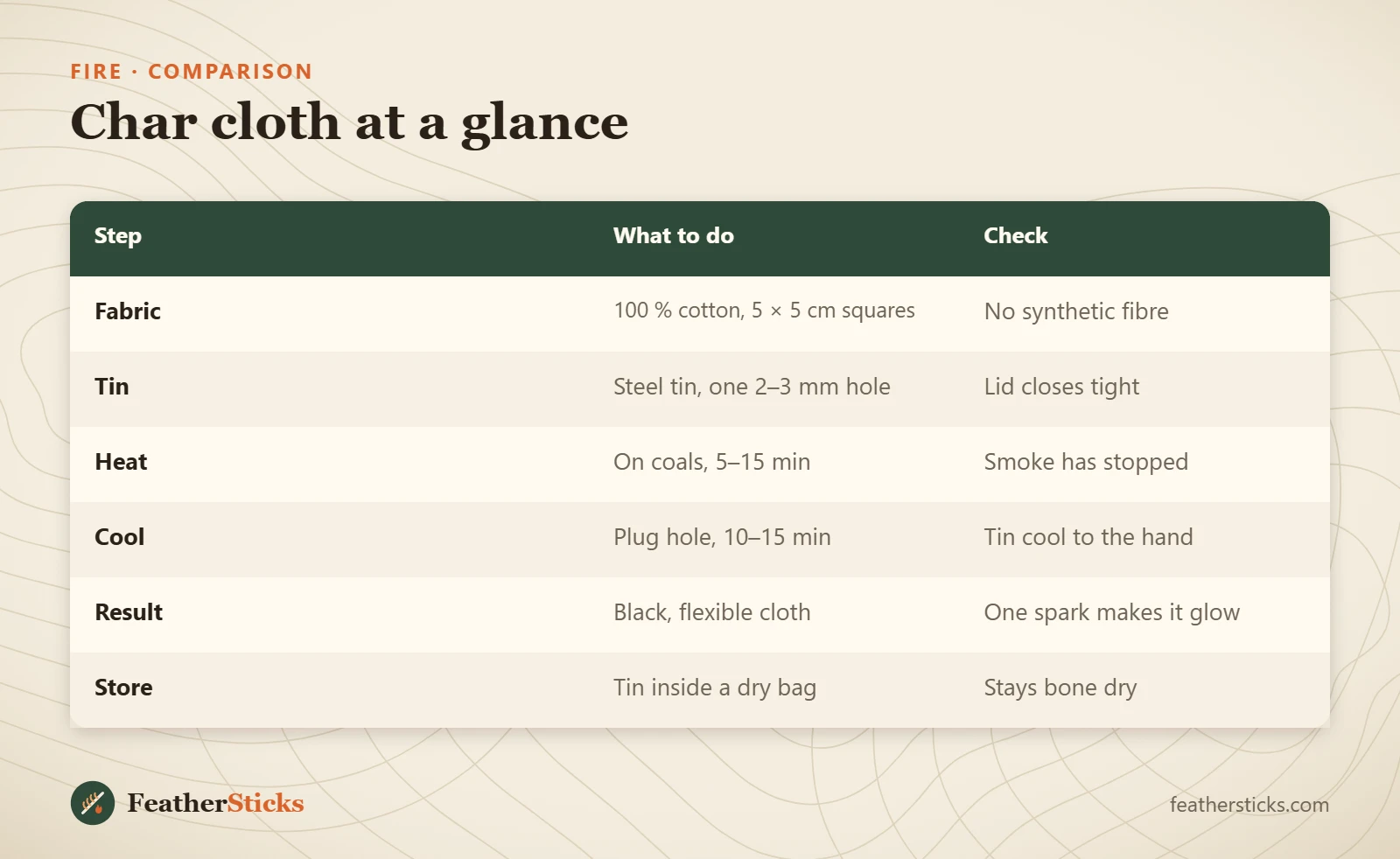
| Step | What to do | Check |
|---|---|---|
| Fabric | 100 % cotton, 5 × 5 cm squares | No synthetic fibre |
| Tin | Steel tin, one 2–3 mm hole | Lid closes tight |
| Heat | On coals, 5–15 min | Smoke has stopped |
| Cool | Plug hole, 10–15 min | Tin cool to the hand |
| Result | Black, flexible cloth | One spark makes it glow |
| Store | Tin inside a dry bag | Stays bone dry |
Common mistakes
- Using a cotton blend or stretch denim that melts instead of charring.
- Stuffing the tin so full that the middle pieces stay brown.
- Putting the tin into tall flames, where the smoke cannot be read.
- Taking the tin off while smoke is still coming from the hole.
- Opening the tin while it is hot, so the fresh char glows away to ash.
- Making the vent hole too large, so air gets in and the cloth turns grey and brittle.
- Storing the char cloth in a leaky container, where it draws moisture.
What you need
- Small steel tin with a tight lid and a 2–3 mm vent hole
- 100 % cotton fabric (old T-shirt, denim, flannel)
- Scissors or a knife for cutting squares
- Nail and pliers for punching the hole
- Stick, tongs or leather gloves for the hot tin
- Green twig to plug the hole
- Zip bag or dry bag for storage
- Spark tool for testing: steel striker and flint, or a ferro rod
FAQ
What is the best material for char cloth?
How long does it take to make char cloth?
Why did my char cloth turn to ash?
Do I need a hole in the char cloth tin?
Can I make char cloth without a campfire?
Does char cloth work with a ferro rod?
How long does char cloth last in storage?
Can I reuse a piece of char cloth?
Check yourself
Completed6 quick questions from this guide. Nothing is sent anywhere.
Related step-by-step guides
-
 1
-
 1
-
 1