Canoe Camping: How to Plan a Canoe Trip, Pack the Boat and Camp by the Water
Canoe camping means travelling by open canoe and sleeping by the water: you paddle a river or lake for a day or a week, and the boat carries the tent, the kitchen and the food that would break your back on foot. It works when four things are right: a route that matches your skill and the water level, a canoe packed low, centred and waterproof, a buoyancy aid worn every minute on the water, and a camp chosen high enough above a river that can rise overnight.
This guide walks you through a canoe trip in that order, from planning and packing a canoe to landing, portaging and pitching camp, with the cold-water and capsize basics in between. It builds on planning a bushcraft trip and the general bushcraft basics, and it does not replace a paddling course: practise strokes, rescues and capsizes with an instructor before you load the boat for a night.
Step by step
-
1

Plan river, level and rules
Choose water that matches your skills, check the gauge and forecast, and find out where landing and camping are allowed.
-
2

Pack in dry bags and a barrel
Split the kit into closed dry bags and a barrel. Keep a small day bag with phone, warm layer and snacks within reach.
-
3

Load low, centred and level
Put heavy items low in the middle and light ones at the ends, so the canoe floats level with enough freeboard.
-
4

Wear the buoyancy aid, always
Wear a fitted, zipped buoyancy aid on the water at all times. Stay close to shore and turn back when wind or water get worse.
-
5

Land and portage safely
Land slowly with the bow into the current, step out in shallow water, unload first, then carry the empty boat around weirs.
-
6

Camp high, boat up and tied
Camp well above the flood line, keep washing and toilet 60 m from water, and pull the canoe up, upside down and tied.
What is canoe camping – and is it for you?
Canoe camping is a multi-day trip in an open canoe (in German usage Kanadier), usually two people per boat, with all camping gear carried in the hull. The boat takes the weight, so food for several days, a bigger tent and a comfortable sleep system are no problem. In exchange, you depend on water, weather and wind, and mistakes end in cold water.
The best first trips are on slow, wide rivers without weirs or rapids, or on sheltered lake chains with short crossings. Fast water, open coast and big lakes in wind are for paddlers with training and experience. If you have never capsized a canoe on purpose and got back to shore, do that on a warm day with an instructor before your first overnight trip.
A canoe trip in six moves
- PlanWater, level, grade, rules, landing places.
- PackDry bags, barrel, day bag.
- LoadHeavy low and centred, check the trim.
- PaddleBuoyancy aid on, stay near shore.
- Land and portageUnload, carry around obstacles.
- CampHigh, dry, boat up and tied.
Planning a canoe trip: water, level and rules
Planning a canoe trip starts with the same questions as any trip in trip planning – goal, group, time, weather – plus three that only paddlers ask: how difficult is the water, what is the water level, and where may you land and camp?
River grade: match the water to the weakest paddler
Rivers are graded on the international whitewater scale from I (easy, moving water with small waves) to VI (extreme). For loaded touring canoes, beginners belong on flat water and grade I at most. Grade II needs solid steering strokes and a crew that has practised; a fully loaded open canoe is heavier, slower to turn and fills faster than an empty one. River guides and paddling clubs describe each stretch, including weirs, locks, strainers and portages – read the description for your exact stretch and date.
| Water | Suits beginners? | What to watch |
|---|---|---|
| Slow lowland river, grade I or flat | Yes, ideal | Weirs, fallen trees, other boats, low bridges |
| Lake chain with short crossings | Yes, in calm weather | Wind and waves on open water, distance from shore |
| Faster river, grade II | Only after training | Rocks, waves, eddies, strainers, quick decisions |
| Large lake or reservoir | Only along the shore | Waves build fast in wind, long swims after a capsize |
| Coast, estuary, tidal water | No | Tide, current, offshore wind – see camping at the coast |
Water level: check the gauge before you go
The same stretch can be a gentle float at normal level, a scrape over gravel at low water and a dangerous, fast flood after heavy rain. Most rivers have official gauges whose current readings are published online by the water authorities. Paddling guides often give a lower and upper level for each stretch. Above the upper level, do not paddle: the current is stronger, landing places disappear, and trees and debris drift down. Below the lower level, you damage the riverbed and the boat. Check again on the morning of departure, and keep an eye on rain upstream during the trip.
Rules for paddling, landing and camping
Rules differ by country, region and river, and this page is not legal advice. Many rivers in Germany and elsewhere run through nature reserves with seasonal closures for breeding birds, minimum water levels, daily boat limits or banks where landing is forbidden. Camping is usually limited to campsites and designated canoe rest areas; many German regions, especially in the north-east, have simple riverside sites for paddlers, often for one night. Wild camping on the bank is generally not allowed without the landowner's consent, and the details are explained in wild camping rules. Ask the local authority, river warden or canoe rental, and plan each night at a site you know you may use.
Choosing a camp by the water in three checks
 1Read the bank
Look for twigs, grass and litter caught in bushes and for washed-out banks: they show how high the water has been. Pitch well above that line, never on a gravel bar or low island.
 2Boat up high and tied
Carry the empty canoe well above the water, turn it upside down and tie the bow line to a tree or a heavy object. A gust or a rising river can take an untied boat at night.
 3Keep the 60 m zone clean
Washing, dishwater and the toilet stay at least 60 m from the water. Where you choose the spot yourself, pitch the tent there too; on a designated site, use the pitches provided.
How far can you paddle in a day?
Distance on water depends on current, wind, load and experience far more than on a map line. On flat water a loaded touring canoe often makes a few kilometres per hour, and a gentle current helps; a headwind can halve that. As a rough planning figure, many touring groups keep the first days to about 15–20 km and only go further once they know their pace. Leave daylight for landing and setting up camp – the daylight calculator shows sunset for your dates – and treat any portages as extra time, because unloading, carrying and loading again takes longer than the paddling between them.
Packing a canoe: dry bags, barrels and the day bag
On a canoe trip, everything in the boat must survive a capsize. That means waterproof containers, not just rain covers. The basics of roll-top bags are in dry bags and waterproof packing; on the water, use tougher bags and close them properly every time, not just when rain is forecast.
Three kinds of container
- Roll-top dry bags (see the glossary) for sleeping bag, clothes and soft kit. Roll the top at least three times and clip it. Several medium bags are easier to load and trim than one huge one.
- A waterproof barrel with a screw lid for food and anything that must not be crushed. Barrels are rigid, keep animals and water out and make a seat or table in camp. A harness lets you carry it on portages.
- A small day bag clipped next to your seat: phone in a waterproof case, warm layer, snack, water, sun cream, map, first aid basics and a lighter. This is what you need without unpacking the boat.
Packing and loading the canoe in four moves
 1Roll three times, clip
Squeeze out air, flatten the top, roll it tightly three times and clip the buckle. A bag closed with only one roll leaks when it lies in water.
 2Heavy low and near the middle
Barrel and food go on the floor close to the centre yoke, light bags towards the ends. Nothing should stick up above the gunwale.
 3Check the trim
Sit in, push off and look along the boat. It should float level with clear freeboard – as a rule of thumb at least about 15 cm. Shift bags until it does.
 4Secure without loose lines
Clip bags to the thwarts with short straps so they stay with the boat. Never leave loose rope lying in the hull: in a capsize it can wrap around a leg.
What must stay dry – and what can get wet
Sleeping bag, a full set of camp clothes, phone and power, first aid kit and fire-lighting kit must stay dry, so they go in the best bags. Cookware, tarp, stove and fuel bottles can get wet. Keep a spare ignition source on your body, as the fire kit guide recommends, and keep electronics in a separate small bag; the power bank calculator helps you size the battery for several days without a socket.
| Container | Contents | Where in the boat |
|---|---|---|
| Barrel | Food, cooking spices, matches as back-up | Centre, on the floor |
| Large dry bag | Sleeping bag, mat, camp clothes | Behind or in front of the yoke, low |
| Medium dry bag | Tent or tarp, ridgeline, pegs | Ends of the load, low |
| Small dry bag | Phone, power bank, papers, first aid | Clipped at a seat, within reach |
| Loose but tied | Spare paddle, bailer, sponge, throw bag | Clipped or wedged under the seats |
Loading and trim: heavy low and centred
How you load a canoe changes how it paddles. A boat with the weight high rolls easily; a boat that is heavy at one end steers badly and digs its bow into waves. The rule is short: heavy low and centred, light at the ends, level overall.

Trim: level, then fine-tune for wind
Trim is how level the boat floats from bow to stern. Load the boat, sit in and let someone look from the side, or check where the waterline runs along the hull. Level is the default. In a strong headwind a boat that is very slightly heavier at the bow holds its line better; with the wind from behind, slightly heavier at the stern. Correct trim by moving bags, not by asking the lighter paddler to lean.

Freeboard and maximum load
Freeboard is the height of the hull side above the water. With little freeboard, waves and wake come over the gunwale. Stay well below the maximum load given by the canoe's maker, and keep enough freeboard for the water you are on – more on open lakes, less on a calm, narrow river. If the loaded boat sits low, leave kit at home rather than trusting calm weather.
Tie in or not?
On lakes and slow rivers, clipping bags to the thwarts keeps the load with the boat after a capsize. In moving water, a swamped boat full of tied-in gear is heavy and every line can entangle a swimmer, so use only short, tight straps, keep bow and stern lines coiled, and know how to release the load quickly.
On the water: buoyancy aid, cold water and wind
Wear the buoyancy aid – always
A buoyancy aid (PFD) only works if you are wearing it when you go in, because a capsize happens in a second and nobody manages to put a vest on in the water. Wear it zipped and buckled, adjusted so it does not ride up over your ears when someone pulls it at the shoulders, every minute you are on the water – also on hot days and on calm lakes. Paddling buoyancy aids for adults are commonly rated around 50 N; children need a model for their weight, ideally with a crotch strap. Attach a whistle; a knife on the vest is a personal choice and subject to the rules in knife law.
Cold water is the real danger
Most canoe accidents are not dramatic rapids but a simple capsize in cold water. The first minute brings cold shock: gasping and fast breathing, which is why the buoyancy aid matters more than swimming skill. After that you have roughly ten minutes of useful movement before your hands and arms stop working well, and hypothermia follows later. This is the 1–10–1 principle explained in falling into cold water. Water stays cold long after the air is warm, so a sunny day in spring is often the most dangerous time to paddle.
- Dress for the water temperature, not the air: quick-drying synthetic or wool layers instead of cotton, and a dry set in a bag. More in clothing.
- Stay close to the shore on lakes, so a swim is short.
- Paddle with at least one other boat, so someone can help.
- Anyone who swam in cold water needs dry clothes, shelter and a warm drink at once, even if they feel fine; watch them for the next hour.
Wind and waves on open water
Wind is the main limit on lakes. Waves grow with wind strength and with the distance the wind blows over open water, so the far side of a lake can be rough while your bay is calm. Plan crossings in the morning, when wind is often lighter, cross at the narrowest point and follow the shore that the wind comes from, where the water stays calmer. Check the forecast for gusts each evening and morning; how to read the sky is in reading the weather.

| Situation | Decision | Why |
|---|---|---|
| Calm, light wind, level normal | Go as planned | Normal conditions |
| Fresh wind, white caps on open water | Stay near shore or wait | Waves come over the gunwale of a loaded boat |
| Thunderstorm forecast or heard | Get off the water at once | Open water is exposed; see lightning safety |
| River rising and brown after rain | Do not start; land if on the water | Faster current, debris, fewer safe landings |
| Group cold, tired or someone swam | Land, warm up, shorten the day | Tired paddlers capsize more often |
For thunderstorms, the storm distance calculator turns flash-to-thunder seconds into distance; do not wait for it to get close. Land, move away from the water and from lone trees, and wait until the storm has passed.
Capsize basics: what to do if you go in
Every canoeist capsizes sooner or later. What decides the outcome is calm, the buoyancy aid and a plan you practised in warm water.
After a capsize
- Breathe first Let the buoyancy aid hold you up and get your breathing under control for the first minute. Do not try to swim hard yet.
- Check your partner Call out, count heads, make sure nobody is under or tangled in the boat.
- Stay upstream of the boat In moving water, never get between a swamped canoe and a rock or tree: a boat full of water is heavy enough to pin you.
- Float feet first if you swim On your back, feet up at the surface and pointing downstream, so your feet, not your head, meet rocks. Do not stand up in fast water.
- Get to shore, then the gear People first, then the boat, then bags. Swim the boat to the nearest bank or let other boats help; on lakes, stay with the boat if the shore is far.
- Warm up at once Dry clothes, shelter, warm sweet drink. Treat the swimmer as cold even if they feel fine.

Practise rescues before the trip: emptying a swamped canoe beside another boat, climbing back in from deep water and throwing a throw bag. These skills are taught in canoe club courses and are worth one afternoon of cold fingers.
Landing, unloading and portaging
Landing is where many small accidents happen: a foot between boat and stone, a wet sleeping bag, a canoe that drifts away while everyone is unloading. A fixed routine avoids them.
Landing and portaging in four moves
 1Approach slowly, bow into the current
Look for a calm landing, ideally an eddy behind a bend. Turn the bow upstream before you reach it, so the current holds the boat against the bank instead of pushing it past.
 2Step out, hold the boat
The front paddler steps out into shallow water, never onto a slippery stone, and holds the boat parallel to the bank. Keep the weight low and use the paddle for support.
 3Unload first, lift empty
Hand the bags out and put them well above the water. Never lift or drag a loaded canoe: it strains the hull and your back.
 4Carry, then the gear
Walk the portage path once without load, then carry the empty boat with two people and bring the bags in a second trip. Barrels with a harness carry like a rucksack.
Portages around weirs and locks
Many rivers have weirs, some with boat chutes or trolleys, some with locks for paddlers and many with a marked portage path. Read the river guide, land at the marked exit well above the obstacle, and do not let the current carry you close to the edge. A small boat trolley saves a lot of carrying on longer portages. Carry with bent knees, a straight back and enough people; with three people, one carries bags while two carry the boat. Good shoes that can get wet matter here – wet feet all day blister easily, so read foot care before a long trip.
Securing the boat at every stop
Even for a five-minute break, pull the canoe fully out of the water or tie it. Wake or a gust can float it away. A round turn and two half hitches around a tree is quick and easy to untie; see bushcraft knots.

Choosing a campsite by the water
The general rules of choosing a camp site apply – flat ground, no dead branches overhead, shelter from wind – but by the water three things come first: height above the river, the boat and the 60 m zone.
Height: a river can rise while you sleep
Rain far upstream can raise a river overnight, even under a clear sky at camp. Never camp on gravel bars, low islands, in side channels or on the inside of a bend at water level. Look for signs of past floods – debris in bushes, sand on grass, bare roots – and pitch clearly above them.
The boat: up, over and tied
Carry the empty canoe well above the water, turn it upside down so rain and leaves stay out, and tie the bow line to a tree. Paddles and buoyancy aids go under the boat or into the tent porch.
Designated canoe site vs. a spot you choose
Designated canoe site
- Legal for the night it is meant for
- Landing, pitches and often a toilet
- Pitch where the site intends, even close to the water
- Shared with other groups – keep it quiet and clean
Spot with the owner's consent
- Only with permission or where rules clearly allow it
- You check flood risk and dead trees yourself
- Tent, kitchen and washing at least 60 m from the water
- Leave it so nobody can see you were there
Washing, dishes and the toilet: 60 m from the water
Soap, food scraps and human waste do not belong in the river. Carry water away from the bank to wash yourself and the dishes, at least 60 m from the water, and scatter strained greywater there. Bury human waste in a small cathole at least 60 m from water, camp and paths, or use the site's toilet; the details are in hygiene outdoors. Drinking water from a river must be treated – see water purification and the boiling time calculator.
Fire, kitchen and food
Many canoe sites forbid open fires or allow them only in fixed rings, and dry summers bring fire bans. Plan to cook on a stove from camp stoves, and follow fire safety if a fire is allowed: at least 5 m from tents and 3 m from synthetic tarps. Keep food in the closed barrel at night – it is also the best answer to mice, foxes and birds; more in food storage at camp. The food planner and water calculator help you plan amounts for several days.
Is this a good camp by the water?
Is camping allowed here tonight (campsite, canoe site or owner's consent)?
Yes → Continue.No → Paddle on to the planned site or the back-up.Is the spot clearly above flood marks and off gravel bars and islands?
Yes → Continue.No → Move higher, even if the view is worse.Are there dead branches or leaning trees over the pitch?
Yes → Choose another pitch.No → Continue.Can you wash and use the toilet at least 60 m from the water?
Yes → Pitch, then pull up and tie the boat.No → Use the site toilet or pack waste out.
Shelter and kit for nights by the water
Air near water is damp, dew is heavy and mosquitoes like riverbanks. A tent with a mesh inner is the comfortable standard; a tarp over a ridgeline gives a dry kitchen and a place to sit in rain. Sandy or soft banks hold pegs badly, so take a few longer pegs and read tent pegs. In wind, pitch low and use the boat or bushes as a break; camping in wind and the wind camping planner show how.
Canoe camping kit beyond the usual camping list
- Buoyancy aid for every person, sized and adjusted
- Spare paddle per boat, bailer and sponge
- Throw bag for the group, whistle on each vest
- Phone in a waterproof case on the body, map in a waterproof sleeve
- Shoes that can get wet, plus dry camp shoes
- Sun hat, sun cream and sunglasses – reflection on water is strong
- Insect repellent and a head net for riverbanks
Sun and wind on water dry you out faster than you notice, so drink regularly and refill at taps or treated sources. Ticks wait in riverside grass; check yourself every evening, as described in ticks and mosquitoes. Birds nest on banks and islands in spring and early summer – keep your distance, land only where allowed and look but do not approach; bird watching has tips on observing without disturbing.
Leave no trace on rivers and lakes
Riverbanks are narrow strips of habitat that many people use, so every trace adds up. The Leave No Trace principles apply on water as on land, with a few paddling details:
- Land where landing is allowed and use existing landings instead of breaking down reed beds or soft banks.
- Keep your distance from wildlife. Paddle quietly past birds and keep to the middle of the river in reserves.
- Pack out all rubbish, including food scraps, and pick up what others left at the landing if you can.
- No soap in the river, even biodegradable soap: wash 60 m away.
- Clean the boat between waters where invasive species are an issue: let it dry, and remove plant bits and mud.
- Be quiet in the evening at shared canoe sites, and leave the pitch tidy for the next boat.
Canoe camping with groups and children
Canoe trips are excellent for groups, because the boats carry everything and the pace is set by the slowest boat anyway. Mix experienced and new paddlers in each boat, agree simple signals, and keep the boats together: a lead boat that nobody passes and a sweep boat that stays last. The roles and briefing from leading group trips apply directly.
Children should be confident in water, wear a buoyancy aid made for their weight at all times near the water, and sit in the middle of the boat between two adults on their first trips. Keep days short and make camp early; the bushcraft with kids guide has more ideas.
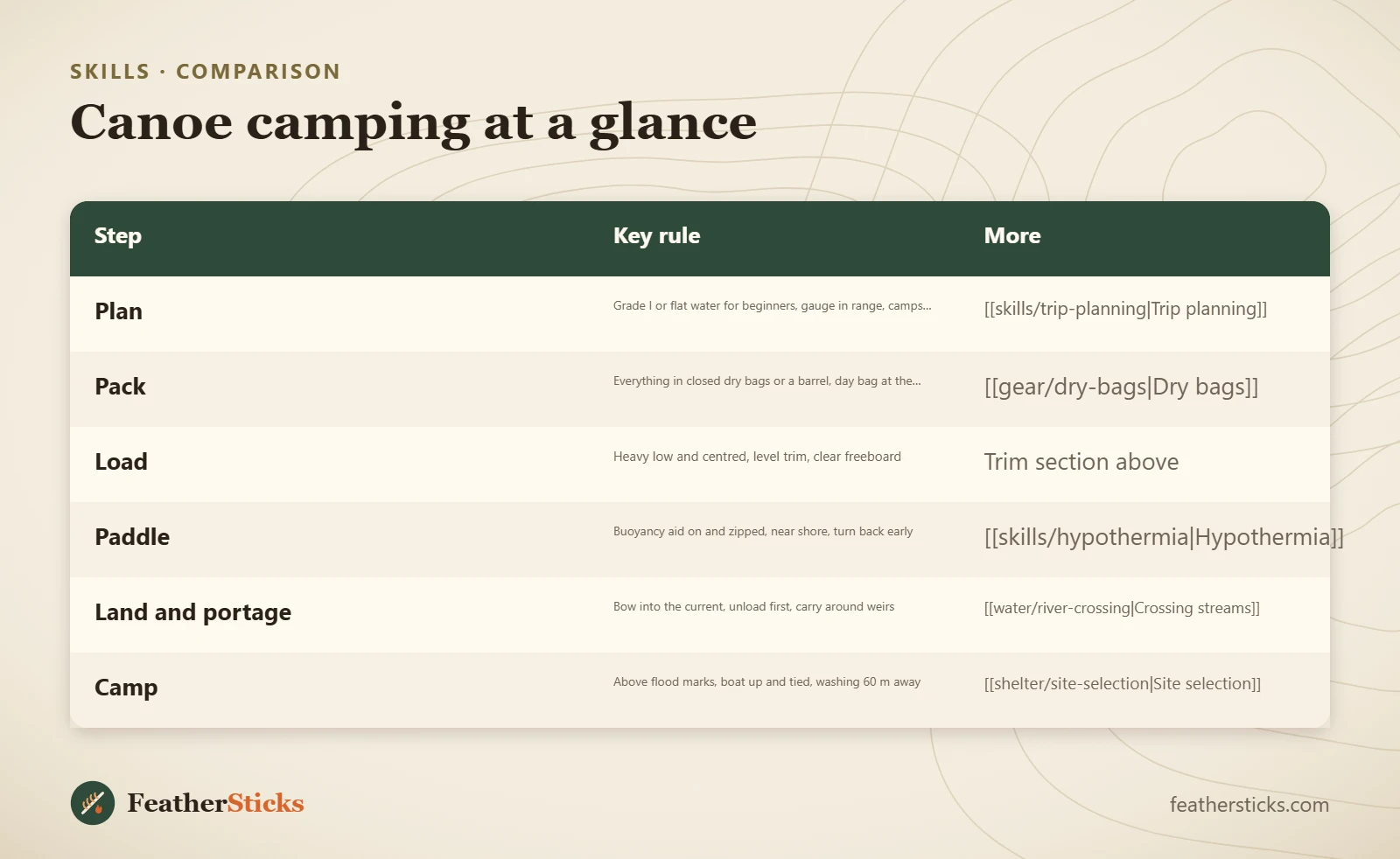
| Step | Key rule | More |
|---|---|---|
| Plan | Grade I or flat water for beginners, gauge in range, camps allowed | [[skills/trip-planning|Trip planning]] |
| Pack | Everything in closed dry bags or a barrel, day bag at the seat | [[gear/dry-bags|Dry bags]] |
| Load | Heavy low and centred, level trim, clear freeboard | Trim section above |
| Paddle | Buoyancy aid on and zipped, near shore, turn back early | [[skills/hypothermia|Hypothermia]] |
| Land and portage | Bow into the current, unload first, carry around weirs | [[water/river-crossing|Crossing streams]] |
| Camp | Above flood marks, boat up and tied, washing 60 m away | [[shelter/site-selection|Site selection]] |
Common mistakes
- Taking the buoyancy aid off on a hot, calm day – capsizes happen without warning.
- Starting on a river above its normal level, or after heavy rain upstream.
- Loading the boat high or at one end, so it rolls easily and steers badly.
- Closing dry bags with one roll, or packing the sleeping bag in a rucksack with a rain cover.
- Crossing the middle of a lake in rising wind instead of following the shore.
- Paddling close to a weir or a fallen tree to have a look.
- Camping on a gravel bar or low island and leaving the canoe untied at the waterline.
What you need
- Open canoe suited to the water and load, with spare paddle
- Buoyancy aid for every person, whistle attached
- Roll-top dry bags in several sizes and a waterproof barrel
- Bailer, sponge, throw bag, bow and stern lines
- Phone in a waterproof case, map in a waterproof sleeve
- Quick-drying clothing plus a dry set for camp
- Tent or tarp with longer pegs for soft banks
- Stove, water treatment and a first aid kit
FAQ
How do you pack a canoe for camping?
Do you have to wear a life jacket in a canoe?
Where can you camp on a canoe trip in Germany?
How far can you paddle in a day on a canoe trip?
What should you do if your canoe capsizes?
How far from the river should you camp?
Should you tie gear into a canoe?
Check yourself
Completed6 quick questions from this guide. Nothing is sent anywhere.
Related step-by-step guides
-
 1
-
 1
-
 1