Bird Alarm Calls & Bird Language: Read the Forest's Warning System
Bird alarm calls are the forest's warning system: when a hawk passes, a fox slinks through the undergrowth or a person walks down the path, the birds react first – and their reaction travels faster than the cause. Learning this bird language does not mean knowing every species. It means knowing what a calm wood sounds like, noticing when that changes and asking where the birds are looking.
This guide covers baseline and disturbance, the difference between song, companion calls and alarms, the "bird plow" that moves ahead of a walker, six common Central European woodland birds as examples, dawn chorus timing, binocular basics, a sit-spot routine, respectful observation and journaling. It builds directly on the sit spot practice and feeds tracking and safer wildlife encounters – a quiet core skill of bushcraft.
Step by step
-
1

Sit and learn the baseline
Sit still for 10–15 minutes until song and calls return. That calm pattern is the baseline you compare everything else with.
-
2

Tell song, calls and alarms apart
Song is long and relaxed, companion calls are short and soft, alarms are sharp, repeated and often directed at one spot.
-
3

Watch for the bird plow
A walking person pushes a wave of alarm ahead: birds lift off, call and land again behind. The wave shows where someone moves.
-
4

Read where the alarm points
Sudden silence and birds diving into cover suggest a raptor. Scolding from above one spot suggests a cat, fox or owl.
-
5

Raise binoculars, eyes on the bird
Keep looking at the bird and bring the binoculars up into your line of sight, instead of searching through them.
-
6

Note it down, keep your distance
Write time, direction and likely cause. Stay away from nests and never use playback in the breeding season.
What is bird language and why does it work?
Birds live in a world of predators. Sparrowhawks, goshawks, owls, martens, foxes and cats all hunt them, so small birds spend much of their day checking for danger and listening to each other. Many species react to the warnings of other species, and mammals such as squirrels and deer often respond to bird alarms too. The result is a shared information network covering the whole wood.
For you, that network works like an early-warning system and a map. A burst of alarm 80 metres away tells you something is moving there before you could ever see it. A quiet stretch of path tells you somebody passed recently. Hunters, wildlife photographers and trackers have used this for generations; in bushcraft it is the natural next step after the sit spot and goes hand in hand with reading tracks.
What you need to know – and what you do not
- You do not need to identify every bird. The pattern matters more than the name: relaxed or tense, spread out or focused on one spot.
- You need a baseline. Without knowing what is normal for a place and a time of day, you cannot recognise a change.
- You need patience. Bird language only shows itself when the birds have stopped reacting to you.
- Every alarm is a clue, not proof. Birds also call about each other, about squabbles over food and about things you will never find out.
Baseline vs. disturbance: what a calm wood sounds like
The baseline is the normal, relaxed state of a place: birds singing from their usual perches, feeding on the ground, calling softly to each other, flying in short, unhurried hops. A disturbance is any break in that pattern – song stops, calls get sharper, birds freeze or fly up into cover. You learn the baseline by sitting still long enough that your own arrival is no longer the disturbance.
Learning the baseline in four stages
 1You arrive: the wood goes quiet
Your arrival is itself a disturbance. Nearby birds stop singing, some fly off, a few give short alarm calls. This is normal and tells you how far your own "alarm bubble" reaches.
 2Sit still for 10–15 minutes
Settle with your back to a tree, breathe slowly and keep movements small. As a rule of thumb it takes 10–15 minutes before birds close to you behave normally again – longer if you arrived noisily.
 3Song and calls return
The first sign is usually a bird singing again nearby, then soft calls from birds feeding on the ground or in the bushes. From now on you are watching the real baseline, not the reaction to you.
 4Write the baseline in one line
Note what is normal right now, for example "light wind, blackbird singing to the east, tits calling in the hazel, distant road". Every later change is compared with this line.
Signs of baseline and disturbance
Baseline or disturbance?
Baseline (relaxed)
- Song from exposed perches, repeated for minutes
- Soft, regular companion calls while feeding
- Birds on the ground, heads down, feeding
- Short, unhurried flights between bushes
- Squirrels and other animals going about their business
Disturbance (tense)
- Song stops suddenly, often over a wide area
- Short, sharp, repeated calls, several species joining in
- Birds upright, frozen or flicking wings and tail
- Fast, direct flights into dense cover or high up
- Calls concentrated on one spot or moving in one direction
The baseline is not the same everywhere or all day. A wood at dawn in May is loud; the same wood at noon in August can be nearly silent because many birds are moulting and no longer defending territories. Wind and rain also change the baseline: in strong wind birds stay low and sing less, which is not a disturbance but weather – see reading weather signs. Compare like with like: same place, similar time of day, similar weather.
Song, companion calls and alarm calls: the voices of birds
Bird-language teachers often sort what birds say into a handful of "voices". The categories are a tool for listening, not a scientific system, but they make the first months much easier. Four of them belong to the baseline; only the last signals danger.
| Voice | What it sounds like | What it usually means |
|---|---|---|
| Song | Long, varied, repeated phrases, often from a high or exposed perch | Territory and courtship; the bird feels safe enough to be loud – baseline |
| Companion calls | Short, soft, regular notes between birds that feed or move together | "I am here, all is well" – baseline |
| Begging of young | Insistent, repeated thin calls, often with wing-shivering; mainly late spring and summer | Fledglings asking for food; parents nearby – baseline, but a sign to keep your distance |
| Territorial aggression | Harsh chases between two birds of the same species, often around a boundary | A dispute between neighbours – usually not a predator |
| Alarm | Sharp, hard, repeated notes or very thin high calls; often several species at once | Danger: a predator, a person, a dog – disturbance |

Two kinds of alarm
Many small birds use two quite different alarm types. Against a threat on the ground or a perched predator, they give loud, harsh, easy-to-locate calls – a scold that says "I see you, everybody look here". Against a hunting bird of prey in the air, many give a very thin, high, drawn-out call that is hard to pinpoint, and then fall silent and hide. A loud scold invites you to look at one spot; a sudden, thin call followed by silence says: look up, and do not move.
Common woodland birds and their alarm calls
You do not need dozens of species. Six common birds of Central European woods, parks and gardens cover most situations. The descriptions below are in words, because written syllables never match real sounds well; listen to recordings in a field guide or a public sound archive, then go and find the bird. Calls vary between individuals and regions, and many birds have more calls than listed here.
| Bird | Song | Alarm and other calls | Why it is useful |
|---|---|---|---|
| Blackbird | Slow, mellow, flute-like phrases from a rooftop or treetop, especially at dawn and dusk | Loud, hard, repeated "chink" or rattling chatter when flushed or mobbing; a thin high call for raptors | Very common and loud; its rattling alarm when flushed is one of the clearest signals in the wood |
| Robin | Thin, wistful, rippling phrases; also sings in autumn and winter | Sharp, repeated "tic" notes; a very thin high call when a raptor passes | Stays close to people and ground level; often the first to react to a cat or a walker |
| Wren | Astonishingly loud, fast song for its size, with trills and rattles | Hard, ticking rattles and churring from low cover | Lives in the undergrowth; its scolding often marks something on the ground |
| Great tit | Ringing two-note phrase, repeated ("teacher, teacher" is a common memory aid) | Harsh churring chatter when mobbing; thin high call for raptors | Common in mixed flocks; other small birds react to its alarm |
| Jay | Rarely sings in a way you notice; quiet chatter and mimicry | Loud, harsh, screeching call that carries far; often imitates other sounds, including a buzzard's mewing | Often the first to announce people, foxes and owls; called the "guardian of the forest" in German folklore |
| Great spotted woodpecker | No song: in late winter and spring it drums – short, very fast rolls on dead wood | A short, sharp single "kik", repeated faster when agitated | Its drumming and calls are easy to recognise and tell you a lot about the season |
Later, add the larger black woodpecker of old beech woods, with its far-carrying calls and drumming. To know the trees the birds sit in, see tree identification.
The bird plow: how a walking person moves through the forest
A person walking at normal speed through a wood pushes a wave of disturbance ahead of them, a bit like a snow plough pushes snow. Birds in front lift off, call and fly to the sides or ahead; behind the walker they settle again within minutes. Trackers call this the bird plow. Seen from a sit spot, it is one of the clearest patterns in bird language – and it explains why walkers see so little wildlife.
How a bird plow unfolds (seen from above)
 1Calm before the walker
Birds feed along the path and in the bushes. Song and companion calls are the baseline.
 2Birds ahead lift off and call
As the walker approaches, the nearest birds give short alarm calls and fly up – often 20–50 m ahead in open woodland, more if the person is loud or has a dog off the lead.
 3A wave ahead, calm behind
The disturbance moves with the walker like a bow wave. Behind them the first birds land and resume feeding, so the silent zone travels along the path.
 4From your seat: the wave shows movement
At your sit spot you hear the wave approach from one direction long before you see anyone. Note the time and direction – and stay still, so you do not start a wave of your own.
Why it matters to you
- You are the plow. Fast walking, talking and bright colours widen your alarm bubble. Slow down with the fox walk and you see more.
- You can read others. A plow moving along a ridge at dawn may be another walker, a dog, a deer moving through or a fox. Combine it with tracks and sounds to narrow it down.
- Group trips are loud. A group of six talking people creates a plow so wide that hardly any bird is seen. If you lead group trips, plan silent stretches and short sits.

Reading who causes the alarm: raptor, fox, cat, owl or person
The shape of an alarm – how sudden, how loud, how long, and where the birds look – often hints at the cause. Treat these as typical patterns, not rules. Birds are individuals, and the same species can react differently in different places.
| What you notice | Possible cause | What to do |
|---|---|---|
| Sudden silence over a wide area, a thin high call, birds diving into dense cover and freezing | A hunting bird of prey (e.g. sparrowhawk) in the air | Look up and along the woodland edge; stay still |
| Loud, harsh scolding from several species, birds perched above one spot on the ground, moving slowly with it | Ground predator: cat, fox, marten, sometimes a snake | Watch the ground below the birds with wide-angle vision |
| Persistent group scolding around one tree or dense conifer, staying there for many minutes | A roosting owl or another perched predator | Look into the canopy from a distance; do not approach the tree |
| A wave of alarm moving steadily along a path, birds landing again behind it | A person, often with a dog | Note direction and time; it may reach you |
| Fast, erratic bursts of alarm and flushed birds, sometimes deer running | A dog off the lead or a running person | Expect it to come close quickly; stay calm |
| A jay screeching loudly and repeatedly, moving through the canopy | Many possibilities: person, fox, owl, another jay | Follow its direction with your eyes; check other birds |
Quick decision: what is the alarm about?
Did the wood go silent suddenly, with birds diving into cover?
Yes → Think of a bird of prey: look up and along the edge, keep still.No → Go to the next question.Are birds scolding from above one spot on the ground?
Yes → Think of a cat, fox or marten: scan the ground below them.No → Go to the next question.Is the scolding fixed on one tree and lasting many minutes?
Yes → Possibly a roosting owl: look from a distance, do not approach.No → Go to the next question.Is the disturbance moving steadily along a path?
Yes → Probably a person or dog: note the time and direction.No → Note it as unknown – that is a valid result.
Mobbing – small birds gathering around a predator and scolding it loudly – is common with owls, cats and foxes. It can last a long time and is one of the best chances to see an owl by day. Watch it from a distance; walking up to the tree to look only adds another disturbance and may flush the owl into danger. A few mammals, like deer, also react to bird alarms, so the same rules from wildlife encounters apply: keep distance and give animals an escape route.
Dawn chorus: when birds sing and when to listen
The dawn chorus is the wave of birdsong at first light. In Central Europe it is strongest in spring, roughly from March to June, when territories are set up and defended. As a rule of thumb, the first songs start in the half-light about 30–60 minutes before sunrise, and the chorus is loudest around sunrise before it fades during the morning. Blackbirds and robins are typically among the early singers; many other species join later.

Sunrise times change through the year and with your latitude – the daylight calculator tells you when sunrise and twilight are where you live, so you can be seated before the first song. Dress for sitting still in the cold early hours; a dawn sit in April can be colder than you expect, so check the wind chill and wear warm layers. Bring a headlamp for the walk in, and switch it off once you sit – see night skills.
| Season | What you hear | Good focus |
|---|---|---|
| Late winter | Great tits singing, woodpeckers drumming, first blackbirds | Learn the great tit and woodpecker drumming |
| Spring | Full dawn chorus, territorial disputes, returning migrants | Dawn sits, baseline notes; extra distance from nests |
| Early summer | Begging young, alarm near nests, chorus thinning | Watch from paths; leave areas where adults alarm constantly |
| Late summer | Quiet woods, moulting birds, mixed feeding flocks forming | Companion calls and flock movement |
| Autumn | Robins singing again, jays busy caching acorns, migrants passing | Jay alarms, mixed flocks, migration days |
| Winter | Mixed flocks of tits and others, sharp alarms in a quiet wood | Alarms are easier to hear; combine with tracks in snow |
For a broader picture of how the forest changes through the year, see bushcraft through the seasons. Evening is the second good window: blackbirds in particular give a loud chatter around dusk as they go to roost, which is easy to mistake for an alarm. Note it, and compare with your baseline from the same time of day.
Binocular basics for birdwatching
You can learn bird language entirely by ear, but binoculars let you see what the birds are looking at, where they sit and whether they are relaxed. Two numbers describe them: 8×42 means 8 times magnification and 42 mm front lens diameter. Dividing the second by the first gives the exit pupil in millimetres – 42 ÷ 8 ≈ 5 mm – a rough measure of how bright the image looks in dim light.
| Type | Exit pupil | Strengths | Weak points |
|---|---|---|---|
| 8×42 | ≈ 5 mm | Wide view, steady image, bright at dawn and dusk; the classic all-rounder in woods | Larger and heavier than compact models |
| 10×42 | ≈ 4 mm | More detail at distance, good for open land and water | Narrower view, shake shows more, finding birds in branches is harder |
| 8×32 | ≈ 4 mm | Lighter and smaller, easy to carry on every walk | Less bright in deep shade and twilight |
| Compact 8×25 / 10×25 | ≈ 3 mm or less | Fits a pocket | Dim in woods, small eyepieces, tiring for long sits |
Set up and use binoculars in four steps
 1Set the width
Look at something distant and fold the two barrels in or out until you see one round image, not two overlapping circles. If you wear glasses, twist the eyecups down; without glasses, twist them up.
 2Focus with the centre wheel
Pick a sharp target such as a sign or a branch about 20 m away. Close the eye on the side of the dioptre ring (often the right) and turn the centre wheel until the image is sharp for the other eye.
 3Fine-tune the dioptre ring
Now close the other eye, open the first one and turn only the dioptre ring until that side is sharp too. Note the setting – a small mark helps – so you only need the centre wheel afterwards.
 4Eyes on the bird, binoculars up
Do not search for a bird through the binoculars. Keep your eyes on it and slowly bring the binoculars up into your line of sight. Sitting, rest your elbows on your knees for a steady image.
Wear the binoculars on a short strap or a harness so they do not swing and knock against branches. Lift them slowly – a fast arm movement is exactly the kind of motion that makes birds nervous. In rain, keep them under your jacket and the lens caps on until you need them; a dry bag helps on wet trips and on canoe trips.
A bird-language sit: a 30-minute routine
The sit spot is where bird language is learned. Visit the same place two or three times a week, ideally at a similar time, and follow a simple routine. Choose your seat with the wind blowing from the area you watch towards you or from the side, a tree at your back and an open view.
The 30-minute routine
- Approach slowly (last 50 m) Walk the last stretch slowly and quietly. Stop at the edge, look and listen, then go to your usual seat.
- Settle (10–15 minutes) Sit, relax and do nothing. Count how long it takes until the first bird sings close to you again – write that number down later.
- Baseline (2 minutes) Note the normal state in one line: weather, which birds, where, how relaxed.
- Sound map (5 minutes) Close your eyes, listen all around and then draw where each bird is singing or calling, as described in the sit-spot guide.
- Watch for changes (10 minutes) Use wide-angle vision. When the pattern changes, freeze, note the time and look where the birds look.
- Leave quietly Stand up slowly and leave on the same route. Notice the wave you create yourself.
Dress for sitting still, not for walking: you cool down quickly on the ground, so bring a seat pad and an extra layer. If you start shivering, stand up, walk home and warm up – see hypothermia and cold injuries. In summer, sitting in grass means ticks: check yourself afterwards as explained in ticks and insects. With children, keep the sit short and playful; the nature games work well alongside it.
Respectful observation: breeding season, distance and playback
Bird language is about understanding birds, not about making them react. Your presence costs them time and energy they need for feeding and raising young. A few rules keep that cost low.
Breeding season
In Central Europe most woodland birds breed roughly between March and July, with large differences between species and years. During this time, disturbance near a nest can keep parents away from eggs or chicks and attract predators. Many regions apply stricter rules in spring and early summer, such as staying on paths or keeping dogs on a lead; in Germany this period is known as the breeding and rearing season, and dates differ by federal state. This guide is no legal advice – check the rules for the area you visit. An overview of the German framework is in wildlife law in Germany.
- A bird alarming constantly at you, often with food or nesting material in its beak, means you are near a nest. Leave the way you came, calmly, and do not look for the nest.
- Never touch nests, eggs or chicks. Fledglings sitting on the ground are usually not abandoned; their parents still feed them.
- Keep to paths and edges in spring, and choose sit spots away from dense hedges and thickets where many birds nest.
- Dogs on a short lead – a loose dog flushes ground-nesting birds and creates a much wider plow. See bushcraft with dogs.

No playback during the breeding season
Playback means playing recorded songs or calls to make a bird come closer or answer. A territorial bird hears a rival and spends time and energy chasing an intruder that is not there, instead of feeding its young or guarding its nest. Repeated playback can disturb birds noticeably. Do not use playback in the breeding season, never near nests, and never for rare or protected species; in nature reserves and for protected species it may also be prohibited by local rules. Use recordings at home to learn, and listen outdoors.
Distance and behaviour
The simple test from the Leave No Trace principles applies: if a bird changes its behaviour because of you – stops feeding, calls at you, flies off – you are too close. Back off. Photograph only from a distance, without flash, and never cut branches to get a clear view of a nest. Do not feed birds in the wild to attract them for watching.
Keeping a bird-language journal
A journal turns single sits into knowledge. Over weeks you see which birds sit where, at what times alarms happen and which causes repeat. Keep it short so you watch more than you write.
What to note on every sit
- Date, start and end time, weather and wind direction
- How long until the first bird sang near you again
- Baseline in one line: which birds, where, how relaxed
- Every change: time, direction (compass or clock face), which birds, what kind of call
- Likely cause, if seen – or "unknown"
- A small sound map and one question for next time
An example line could read: "07:42 – blackbird and wren alarm to the NE, scolding stays low near the hedge for 6 min, then a cat crosses the meadow." Directions are easier with a compass or with simple landmarks; our guide to natural navigation shows how to estimate directions from the sun. After a month, read through your notes and mark patterns in colour – that is where real bird language begins.
| Week | Focus | Journal task |
|---|---|---|
| 1 | Sit and settle, learn one common song | Time until birds sing again |
| 2 | Song vs. companion calls | Mark song and calls separately on the sound map |
| 3 | First alarms | Log every alarm with time and direction |
| 4 | Dawn sit | Compare with a midday sit at the same place |
| 5 | Binoculars: eyes first, then glass | Note where alarmed birds were looking |
| 6 | Bird plow | Record how far ahead of walkers the wave runs |
Bird language is a lifelong skill and fits every outdoor trip: a few quiet minutes on a first night out, at the edge of a camp or by the water make the trip richer. Explore more bushcraft skills for the next step.
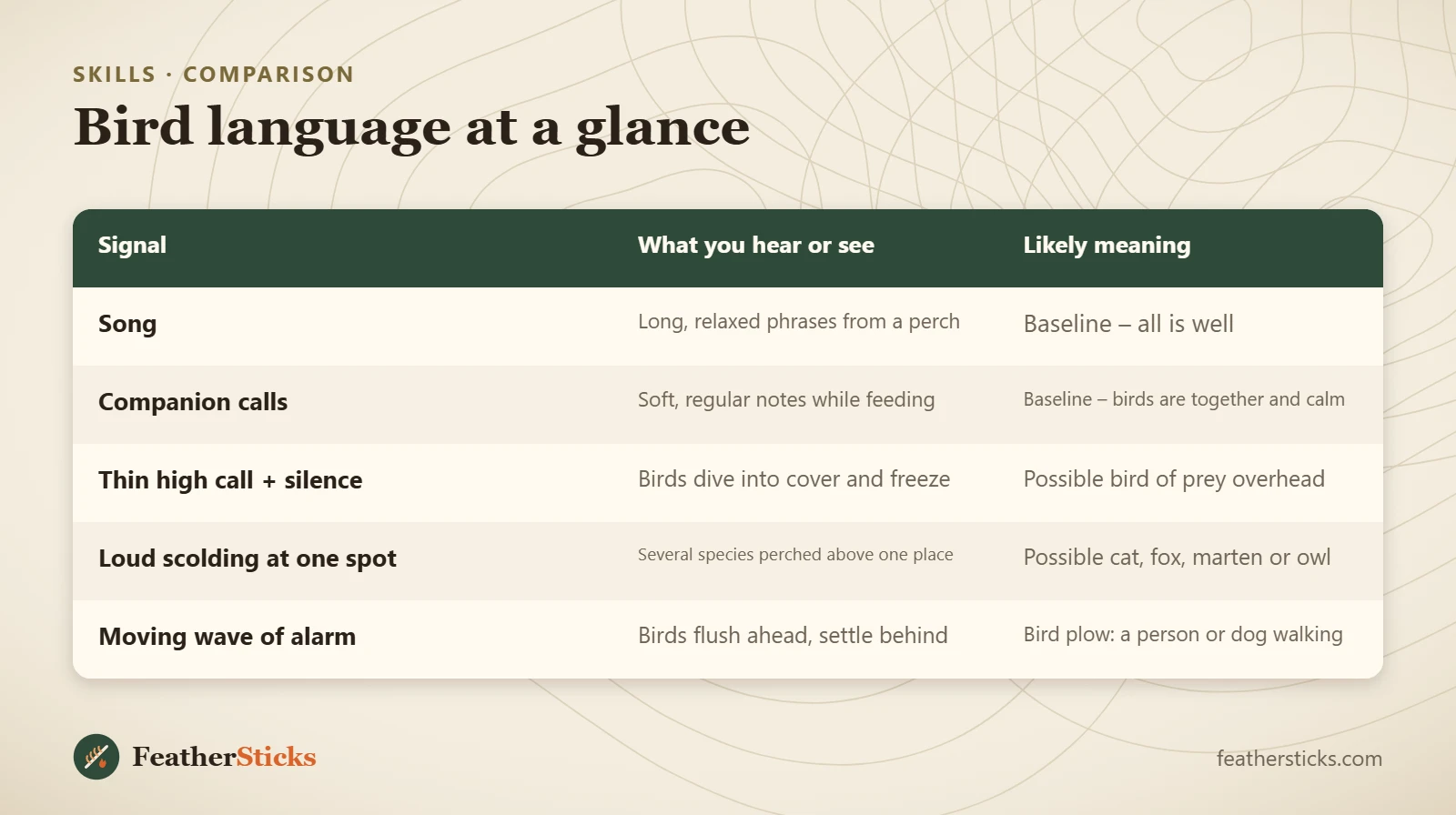
| Signal | What you hear or see | Likely meaning |
|---|---|---|
| Song | Long, relaxed phrases from a perch | Baseline – all is well |
| Companion calls | Soft, regular notes while feeding | Baseline – birds are together and calm |
| Thin high call + silence | Birds dive into cover and freeze | Possible bird of prey overhead |
| Loud scolding at one spot | Several species perched above one place | Possible cat, fox, marten or owl |
| Moving wave of alarm | Birds flush ahead, settle behind | Bird plow: a person or dog walking |
Common mistakes
- Walking and talking while expecting to hear bird language – sit still first.
- Treating every alarm as proof of a predator instead of a clue.
- Mistaking the blackbird's evening roosting chatter or territorial disputes for alarms.
- Searching for birds through the binoculars instead of raising them into your line of sight.
- Approaching a mobbed tree to see the owl, flushing it.
- Using playback in the breeding season or near nests.
- Skipping the journal, so patterns between visits are lost.
What you need
- Notebook and pencil in a zip bag
- Binoculars, 8×42 or 8×32 (optional)
- Foam seat pad
- Warm, quiet clothing in earth tones
- Regional field guide with bird sounds
- Headlamp for dawn and dusk sits
- Small compass for noting directions
FAQ
What are bird alarm calls?
What is the bird plow?
How can I tell a hawk alarm from a fox alarm?
When is the best time to hear birds?
Which binoculars are best for birdwatching in the woods?
Is it okay to use bird song apps to call birds?
Do I need to know bird species to learn bird language?
Check yourself
Completed6 quick questions from this guide. Nothing is sent anywhere.
Related step-by-step guides
-
 1
-
 1
-
 1