Smoking Fish & Meat at Camp: Hot Smoking over a Campfire
Smoking fish over a campfire works best as hot smoking: you salt the fish, dry its skin, then cook it in thin, fragrant smoke at roughly 80–120 °C until the thickest part reaches 63 °C. A lidded steel pot on embers with a handful of beech or alder chips is all the smoker you need. The result is cooked, smoky fish to eat the same day.
This guide explains why only hot smoking belongs at camp, how to brine or dry-salt, three DIY smoker builds, which woods to burn and which never, how to control temperature, safe core temperatures, how long smoked food keeps, fishing law in brief, fire safety and wildlife. It builds on grilling over a campfire, campfire cooking basics and the wider cooking hub.
Step by step
-
1

Salt the fish
Brine gutted fish in cold salt water (typically 50–100 g per litre) for 1–4 hours in the cool box, or dry-salt it.
-
2

Rinse and dry the skin
Rinse briefly, pat dry and air-dry in the shade for 30–60 minutes until the skin feels matt and tacky.
-
3

Build the smoker
Put wood chips in a lidded steel pot, add a foil drip tray and a rack, and set it stable on dry stones over embers.
-
4

Embers and smoking wood
Burn hardwood down to embers. Use dry beech, alder or fruit-wood chips, never resinous, painted or unknown wood.
-
5

Smoke hot
Close the lid and keep the inside at roughly 80–120 °C with thin, bluish smoke. Typical trout: 45–90 minutes.
-
6

Probe and eat soon
Probe the thickest part: fish 63 °C, poultry 74 °C. Eat it the same day or chill it to 4 °C or below within 2 hours.
Hot smoking vs cold smoking: which one is safe at camp?
There are two very different crafts behind the word smoking. Hot smoking cooks food in smoke. The air in the smoker is hot – most guides work with roughly 80–120 °C – and the food ends up fully cooked, just like grilled or baked fish, with a smoky flavour and a golden skin. Cold smoking keeps the smoke below about 30 °C for many hours or days, so the food stays raw. Cold-smoked salmon, ham and bacon depend on precise curing, controlled salt levels, steady low temperatures and a clean environment. Without that control, bacteria and parasites survive and can multiply.
At camp you cannot control humidity, temperature or hygiene over days, and you rarely have a fridge to finish a cure. That is why this guide only covers hot smoking and gives no camp method for cold smoking. If cold smoking interests you, learn it at home from food-safety guidance or a course, with proper equipment and tested recipes.

Hot smoking and cold smoking compared
Hot smoking (camp-friendly)
- Smoke chamber roughly 80–120 °C
- Food is cooked through: fish 63 °C in the core
- Takes about 30 minutes to a few hours
- Simple gear: pot, box or tent over embers
- Eat soon – it is cooked food, not preserved food
Cold smoking (not at camp)
- Smoke below about 30 °C
- Food stays raw; safety depends on curing
- Takes many hours to days
- Needs controlled temperature, salt and hygiene
- Real risk of food poisoning if done wrong
Where does the fish come from? Licences and shop-bought fish
Most people who smoke fish at camp either bring it from a fishmonger or catch it themselves. Fishing needs a licence or permit in Germany and in many other countries, often both a general fishing licence and a permit for the specific water, plus rules on species, sizes, closed seasons and how fish must be handled. Rules differ by country, state and water body, and this is no legal advice: check the official rules or ask the local fishing authority or club before you cast a line. This guide does not explain how to fish.
The easiest and most predictable option is fresh trout, char or mackerel from a shop, packed cold and carried in a cool box at 4 °C or below. Plan it for the first or second evening, as described in storing food at camp. Gutting, cleaning and washing up belong at least 60 m from lakes and streams; fish guts go into a sealed bag and leave with you unless local rules say otherwise.
Brining and dry salting fish for smoking
Salting seasons the fish, firms the flesh and helps form a dry skin that takes smoke evenly. It does not make raw fish safe on its own, so salt for taste and texture, then cook properly. Two methods are common.
Wet brine
Dissolve salt in cold water. Typical brines for hot-smoked fish use about 50–100 g of salt per litre; many people start in the middle, around 60–80 g. Whole small trout of a typical portion size often brine for 1–4 hours, thin fillets for less. Keep the brine and fish in the cool box at 4 °C or below the whole time – brining on a warm table is exactly the danger zone that the food storage guide warns about. Some add a little sugar, pepper, bay leaf or juniper; shop-bought spices only.
Dry salting
Sprinkle an even, thin layer of salt over the flesh side and into the belly cavity, wrap the fish and put it back into the cool box. Typical recipes leave fillets around 30–60 minutes and whole small fish a few hours. Dry salting needs no water and less space, which makes it practical in a small cool box. Rinse off surface salt before drying, or the fish will taste harsh.
| Method | Typical amount | Typical time | Keep at |
|---|---|---|---|
| Wet brine, whole small trout | About 50–100 g salt per litre water | 1–4 h | 4 °C or below (cool box) |
| Wet brine, thin fillets | About 50–80 g salt per litre | 30–60 min | 4 °C or below |
| Dry salt, fillets | Thin, even layer on the flesh side | 30–60 min | 4 °C or below |
| Dry salt, whole small fish | Thin layer inside and out | A few hours | 4 °C or below |
Typical ranges from common home-smoking practice, not tested recipes. Thicker fish and stronger brines need longer or shorter times; start mild, then adjust to taste. Salting never replaces cooking.
Salting and drying the fish
 1Mix the brine
Stir salt into cold water until it dissolves, typically 50–100 g per litre. Use drinking-quality water; see boiling water if you have to treat it first.
 2Into the brine, into the cool box
Put the gutted fish into a lidded tub and keep it at 4 °C or below for typically 1–4 hours. Do not brine in the sun or on a warm table.
 3Rinse and pat dry
Rinse off surface salt briefly and pat the fish dry inside and out with a clean cloth or paper towel. Keep raw-fish cloths and boards away from cooked food.
 4Air-dry until tacky
Lay or hang the fish in shade and a light breeze for about 30–60 minutes until the skin feels matt and slightly tacky. Protect it from flies and keep this short in warm weather.
The tacky surface that forms while drying is what smokers call a pellicle. It helps smoke settle evenly and stops the skin from turning wet and grey. In hot weather, dry for the shorter time and keep the fish covered with a fine cloth; never leave raw fish out for more than two hours, or one hour above about 32 °C.
Which DIY smoker works at camp?
A camp smoker needs three things: a closed space that holds smoke and heat around the food, a source of gentle heat below, and wood that smoulders rather than flames. Three builds cover almost every situation.
| Smoker | Strengths | Weaknesses | Best for |
|---|---|---|---|
| Lidded steel pot or box on embers | Reaches hot-smoking temperatures easily, compact, controllable | Limited space, needs a pot you do not mind sooting | One to three trout, fillets, chicken pieces |
| Grill with a lid or a covered grate | Uses gear you may already carry, more space | Lids leak, heat uneven; needs foil tent or pot cover | Fillets, sausages, small portions |
| Tripod smoke tent with cotton cover | Large capacity, traditional, made on site | Rarely gets hot enough; wind and cold steal heat; fire risk to the cover | Flavouring before finishing over coals |
Use plain steel, stainless steel or cast iron. Avoid galvanised, painted or plastic-coated containers and anything with rubber seals: coatings can give off harmful fumes when heated strongly.
The lidded pot or box smoker
The easiest camp smoker is a large lidded steel pot, a cast-iron pot or a plain steel box. Chips go on the bottom, a small tray of foil above them catches dripping fat, a rack sits above that, and the fish lies on the rack. On embers, the chips smoulder in the low-oxygen space and the closed lid holds the heat. It is the same idea as a commercial table-top smoker, built from camp cookware. Choose a pot you are happy to blacken inside; smoke residue is hard to scrub off. A Dutch oven works well and holds heat evenly; read cast iron care first, as smoke and salt are harsh on seasoning.
Ammunition-box style steel containers are sometimes used, but most are painted inside and out and have rubber seals – burn nothing like that. Plain, uncoated steel only, burned off once empty and away from camp before the first use.
Building a lidded pot smoker
 1Chips on the bottom
Scatter one or two handfuls of dry hardwood chips or coarse sawdust evenly over the bottom of the pot. Too many chips give thick, bitter smoke.
 2Drip tray and rack
Shape a shallow tray of foil a little above the chips so fat cannot drip onto them and flare. Set a rack or small grate about halfway up the pot.
 3Fish on, lid on
Lay the dried fish skin side down on the rack with space between pieces so smoke can reach every side. Close the lid; it should sit well, but it need not be airtight.
 4Onto the embers
Set the pot level on two dry, flat stones or a stable grate over embers, not flames. Check that it cannot tip, exactly as for a grill grate on stones.
The tripod smoke tent
The traditional camp smoker is a tripod of green poles with a rack for fish and a cover. It holds a lot of fish, but it is a slow, cool smoker. In wind or cold weather the air inside often stays well below hot-smoking temperatures, so treat it as a flavouring stage and always finish the fish over coals or on a grill until the core reaches 63 °C. The cover must be natural fibre – cotton canvas or poly-cotton – and must never touch the embers; synthetic tarps and paracord melt and burn near heat. Keep the ember bed small, stay beside it the whole time and keep the tent 5 m from your sleeping tents and hammocks.
Tripod smoke tent with a finish over coals
 1Lash three green poles
Cut three straight green poles of a wood you can identify, about 2 m long, only where you are allowed to. Lash them near the top with natural cord – see lashings and cooking tripods.
 2Hang the fish
Lash a cross pole between two legs at about half height and hang the fish from it with cotton string or green wooden hooks, well above where the embers will be.
 3Small embers and a cotton cover
Rake a small bed of embers under the fish, add damp chips so they smoulder, and wrap the tripod loosely in cotton canvas with a gap at the top. No flames, no synthetics, never leave it.
 4Finish over coals
After an hour or two of smoke, move the fish onto a grate over medium coals and cook it until a thermometer reads 63 °C in the thickest part.
Grill with a lid
If you carry a grate, you can smoke on it: push the coals to one side, put a small foil packet of chips with a few holes directly on the coals, place the fish on the cool side and cover it with a large upturned pot or a dome of foil. It is less precise than a pot smoker but needs no extra kit. The heat zones are the same as in campfire grilling.
Best wood for smoking fish and meat
Smoking wood is about flavour and about what you breathe and eat. In Germany and Central Europe the classic smoking woods are beech (the standard for smoking flour and chips), alder (traditional for fish), and fruit woods such as apple and cherry. Oak gives a strong, tannic smoke; maple and hornbeam are mild. In North America hickory and maple are common. Whatever you use must be dry, untreated, free of mould and identified with certainty.
| Wood | Flavour | Use | Note |
|---|---|---|---|
| Beech | Mild, balanced | Fish, meat, sausages | The everyday choice; also the best ember wood |
| Alder | Mild, slightly sweet | Fish, especially trout | Traditional for fish in Germany and Scandinavia |
| Apple, cherry (fruit woods) | Mild, fruity | Fish, poultry, pork | True cherry – not cherry laurel, which is toxic |
| Oak | Strong, tannic | Meat, small amounts with fish | Easy to overdo; mix with beech |
| Hornbeam, maple | Mild | All-round | Dense, good embers |
| Pine, spruce, fir, larch | Resinous, sooty, bitter | Never for smoking | Fine as kindling only |
Flavours are general descriptions, not test results. Species identification and the list of woods that must never touch food are in the tree identification guide.

Never in the smoker
- Resinous softwoods – pine, spruce, fir and larch – give sooty, bitter smoke and deposit resin on the food. Keep them for kindling.
- Treated, painted, varnished or glued wood: pallets, fence posts, plywood, chipboard, old furniture and building timber can release toxic substances.
- Toxic species: the tree identification guide lists yew, laburnum, elder, spindle, cherry laurel, rhododendron, privet and black locust as woods that never touch food. Smoke counts as food contact.
- Mouldy, rotten or unknown wood: if you cannot name it, do not smoke with it.
Chips, chunks and embers
Make chips by shaving dry wood with a bushcraft knife or sawing thin discs with a folding saw and splitting them. In a closed pot smoker, use dry chips: they smoulder because there is little oxygen. On open embers under a smoke tent, slightly damp chips smoulder longer instead of catching fire. The embers themselves should come from dense, dry hardwood, as explained under which firewood to choose; the firewood calculator helps you plan enough for a long smoke.
Temperature control: how hot and how long?
Hot smoking is gentle cooking. Too cool, and the fish dries out for hours without reaching a safe core temperature. Too hot, and the skin tears, the fat drips and the chips flare into flames. Aim for roughly 80–120 °C inside the smoker and judge the food by its core temperature, never by the clock alone.
Measure two temperatures
- Smoker temperature: a dial thermometer pushed through a small hole in the lid, or an oven thermometer on the rack, shows the air temperature. If you have neither, lift the lid only briefly – every look loses heat and smoke.
- Core temperature: a probe thermometer in the thickest part of the fish or meat. This is the number that decides when food is safe.
Steering the heat
You control heat with the ember bed, not with the wood chips. Fewer embers or a higher stand means less heat; raking fresh embers underneath means more. Keep a small feeder fire to one side, as in building a coal bed, so you always have embers ready. Wind steals heat from one side; a windbreak of stones or logs helps.
| Food | Smoker heat | Typical time | Done when |
|---|---|---|---|
| Whole trout, portion size | About 80–120 °C | 45–90 min | Core 63 °C, flesh opaque, fins pull out easily |
| Thick fillets (salmon, char) | About 80–110 °C | 30–60 min | Core 63 °C, flakes easily |
| Whole mackerel | About 80–120 °C | 45–90 min | Core 63 °C |
| Chicken thighs, bone-in | About 100–120 °C | 60–120 min | Core 74 °C, away from the bone |
| Pork tenderloin | About 100–120 °C | 60–120 min | Core 63 °C plus 3 min rest |
| Pre-cooked sausages | About 80–120 °C | 20–40 min | Hot throughout, 74 °C |
Typical ranges only. Size, starting temperature, wind and how well the lid closes change times a lot. A thermometer decides, not the clock.
Is the smoke right?
Is the smoke thin, bluish or almost invisible?
Yes → Good – this is clean smoke. Keep the heat steady and wait.No → Thick white or grey smoke means too many or wet chips, or too little air. Remove some chips or open the lid a crack.Do you see flames inside or around the smoker?
Yes → Too hot: lift the smoker off the embers, let the flames die and reduce the ember bed.No → Fine – smouldering chips are what you want.Is the core temperature rising?
Yes → Carry on until the target in the core-temperature table.No → Too cool: rake fresh embers under the smoker or lower it closer to the heat.
Thick, white, billowing smoke makes food bitter and acrid. It usually means too many chips, damp chips in a closed pot, or chips that are burning instead of smouldering. A small, steady wisp from the lid edge is enough.
Core temperatures and how long smoked food keeps
Smoked food must reach the same minimum core temperatures as grilled food. The values below are the ones used across this site, in campfire grilling, foil packet cooking and the food storage guide. They follow commonly published guidance such as that of the USDA; other countries publish slightly different numbers, so check your own national food-safety authority.
| Food | Core temperature | Note |
|---|---|---|
| Fish | 63 °C / 145 °F | Opaque, flakes easily |
| Whole cuts of beef, pork, lamb | 63 °C / 145 °F | Then rest 3 minutes |
| Minced meat, raw sausages | 71 °C / 160 °F | Bacteria are mixed through |
| Poultry | 74 °C / 165 °F | Thickest part, away from bone |
| Leftovers, pre-cooked sausages | 74 °C / 165 °F | Reheat until hot throughout |

How long does hot-smoked fish keep at camp?
Not long. Hot-smoked fish is cooked fish, not preserved fish. Treat it like any perishable: eat it while it is warm, or within two hours (one hour above about 32 °C). To keep some for later, let it cool briefly, wrap it and put it into the cool box at 4 °C or below; eat it the next day at the latest and reheat leftovers until hot throughout. If the cool box has been warm for hours, throw it out. The food storage guide explains the danger zone of roughly 5–60 °C and how to keep a cool box cold. Smoked meat on a trip is not the same as commercially made, dried and cured salami or jerky; for food that keeps for days, see dehydrating trail meals.
Smoking meat, poultry and other food at camp
Everything in this guide works with meat as well as fish, with two differences: meat takes longer, and the core temperatures differ. Smaller pieces fit a pot smoker and cook through in a reasonable time; large joints belong on a spit or in a Dutch oven.
- Chicken thighs and drumsticks: dry-salt them lightly, smoke skin up at the hotter end of the range and finish to 74 °C. Skin often stays soft in a smoker; crisp it over coals for a few minutes at the end.
- Pork tenderloin or chops: a light dry salt, then smoke to 63 °C in the core and rest 3 minutes.
- Raw sausages contain minced meat and need 71 °C. Pre-cooked sausages only need reheating until hot throughout.
- Vegetables, tofu and cheese: peppers, onions, mushrooms from the shop and firm tofu take smoke well in 20–40 minutes. Soft cheese melts in a hot smoker; grilling cheese works on foil.
Raw meat needs the same hygiene as on the grill: separate boards, tongs and plates for raw and cooked food, and hands washed with soap after handling raw meat or fish. More in outdoor hygiene. For side dishes, see campfire recipes and foil packet cooking.
Fire safety when smoking food
A smoker runs for an hour or more with embers under it, so fire safety matters more than with a quick meal. The rules are the same as for any campfire in campfire safety:
Before you start smoking
- Open fires allowed here and now – no fire ban or high danger level; check fire bans and danger levels
- Existing fire ring or a proper fire pit on bare mineral soil, about 3 m cleared around it
- At least 5 m from tents and hammocks, at least 3 m from synthetic tarps
- No synthetic covers, cords or tarps on or near a smoke tent
- Water and a small shovel ready; heat-resistant gloves for the hot pot and lid
- Someone stays with the smoker the whole time
- Never put a smoker, embers or smouldering chips inside a tent or closed shelter
Lift the hot pot with gloves and a stick through the handle, and open the lid away from your face – a rush of hot smoke and steam can scald. When you finish, put the fire out completely with water, including the spent chips, stirring until no heat is felt. If a fire escapes, leave the area and call 112. Fire lays for a steady ember bed are in fire lays; in a fire ban, use a camp stove and skip smoking altogether, because a stove cannot replace an ember bed safely.
Smell, smoke and wildlife
Smoked fish is one of the strongest food smells you can make at camp. It carries far, and foxes, martens, wild boar, birds and, in parts of North America and Scandinavia, bears follow it. The routine from a clean camp applies doubly:
- Smoke and cook a good distance from where you sleep, ideally downwind of the sleeping area.
- Do not leave the smoker unattended – an animal can knock it over, and a hot pot on the ground is a burn and fire risk.
- Seal leftovers, fish waste and greasy foil in odour-tight bags and store them with your food, away from the tent, as described in food storage.
- Pack out fish guts and skins unless local rules say otherwise; never leave them "for the animals" or throw them into water.
- Wash the pot, rack and boards at least 60 m from water, strain the water and scatter it widely.
Smoke also travels to neighbours on a campsite. Keep it small, avoid thick smoke and be considerate. Leave the site as you found it, following the principles of Leave No Trace.
Troubleshooting smoked fish
| Problem | Likely cause | Fix |
|---|---|---|
| Bitter, acrid taste | Thick white smoke, too many or wet chips, resinous wood | Fewer dry hardwood chips, thin smoke only, never conifers |
| Fish too salty | Brine too strong or too long, no rinse | Shorter brine, weaker salt, always rinse |
| Skin grey, wet and patchy | Fish not dried before smoking | Air-dry 30–60 min until tacky |
| Core temperature will not rise | Too few embers, wind, smoke tent too cool | Rake fresh embers, windbreak, finish over coals or on a grill |
| Skin torn, fish falls apart | Too hot, fish turned too often | Lower the heat, lay skin side down, turn rarely or not at all |
| Chips flare into flames | Too hot, too much air, fat dripping on chips | Lift off the embers, add a foil drip tray, close the lid |
| Black, sooty coating | Flames, softwood or burning fat | Embers not flames, hardwood only, drip tray |
A short practice session at home in the garden or on a balcony grill, where allowed, makes the first camp smoke far more predictable. Once the routine works, smoked trout fits into a normal trip plan; calorie and portion planning are covered in the calorie planner, and the wider set of camp skills in bushcraft basics.
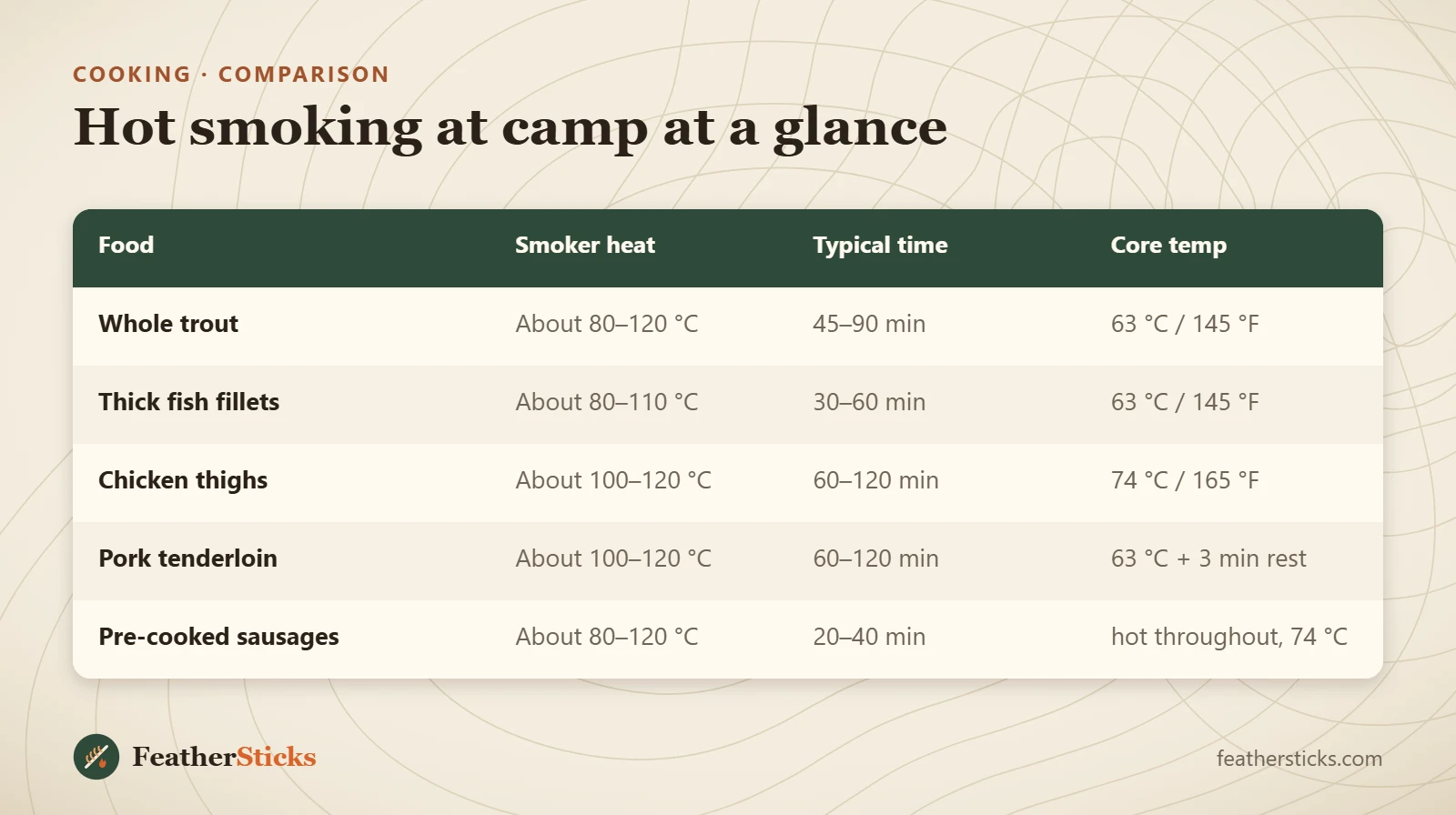
| Food | Smoker heat | Typical time | Core temp |
|---|---|---|---|
| Whole trout | About 80–120 °C | 45–90 min | 63 °C / 145 °F |
| Thick fish fillets | About 80–110 °C | 30–60 min | 63 °C / 145 °F |
| Chicken thighs | About 100–120 °C | 60–120 min | 74 °C / 165 °F |
| Pork tenderloin | About 100–120 °C | 60–120 min | 63 °C + 3 min rest |
| Pre-cooked sausages | About 80–120 °C | 20–40 min | hot throughout, 74 °C |
Common mistakes
- Trying to cold-smoke at camp instead of hot smoking to a safe core temperature.
- Brining fish on a warm table instead of in the cool box.
- Smoking with pine, spruce, pallets or painted and treated wood.
- Piling in chips until the smoke turns thick and white.
- Relying on the clock instead of a probe thermometer.
- Using a galvanised, painted or plastic-sealed box as a smoker.
- Keeping smoked fish for days as if it were preserved.
What you need
- Large lidded steel pot, cast-iron pot or plain steel box
- Small rack or grate that fits inside
- Dry beech, alder or fruit-wood chips
- Probe thermometer and a dial or oven thermometer
- Salt and a lidded tub for brine
- Cool box with ice packs
- Heat-resistant gloves and long tongs
- Foil, water container and a small shovel
FAQ
How do you smoke fish over a campfire?
Can you cold smoke at camp?
What is the best wood for smoking fish?
How long does it take to smoke a trout?
How do you build a DIY smoker for bushcraft?
How long does smoked fish keep when camping?
What temperature should smoked fish reach?
Check yourself
Completed6 quick questions from this guide. Nothing is sent anywhere.
Related step-by-step guides
-
 1
-
 1
-
 1