Hot Tent Camping: How to Use a Tent Stove Safely in Winter
Hot tent camping means sleeping in a tent that was designed for a wood stove: it has a stove jack (a fire-resistant ring where the pipe leaves the tent), fabric suited to sparks and heat, vents and room to keep a safe distance. With the right stove, careful set-up and strict habits, a hot tent turns a long winter evening into a warm, dry base camp. Without them, it is one of the fastest ways to start a fire or poison yourself with carbon monoxide.
This guide explains what a hot tent is, why you must never put any stove, grill or embers into a normal tent, how to set up the stove jack, pipe and spark arrestor, how to feed a tent stove with dry wood, what to do at bedtime, and how to recognise carbon monoxide poisoning. It builds on our winter camping guide, the wider shelter guides and bushcraft basics.
Step by step
-
1

Use a tent built for a stove
Only a tent with a stove jack, made by its maker for stove use, may hold a stove. Never put a stove, grill or embers into a normal tent.
-
2

Fit pipe, jack and spark arrestor
Slide the pipe sections together, pass the pipe centred through the stove jack, fit the spark arrestor and guy the pipe against wind.
-
3

Set the stove on a safe base
Stand the stove level on a non-flammable base and keep fabric, sleeping bags and gear well away from stove and pipe.
-
4

Open the vents, switch on a CO alarm
Keep high and low vents open the whole time the stove is in use and run a tested battery CO alarm near where you sleep.
-
5

Feed small loads of dry wood
Burn short, dry, split wood two or three pieces at a time. Never let the stove or pipe glow red.
-
6

Never sleep with it burning
Either someone stays awake as a fire watch, or you let the stove burn out with the vents open before anyone sleeps.
What is a hot tent?
A hot tent is a tent that its maker designed to be used with a small wood-burning stove inside. The defining feature is the stove jack: a ring or panel of fire-resistant material sewn into the roof or wall, through which the stove pipe leaves the tent. Around it, the tent is built for the job — enough height and floor space to keep fabric away from the stove, high and low vents for air exchange, and often a floorless design or a floor section that can be opened where the stove stands.
Typical hot tents are bell tents, pyramid or tipi shapes and wall tents (a ridge tent with vertical side walls), made of cotton, polycotton or synthetic fabrics with a heat-resistant treatment. They are heavier than ordinary trekking tents and are mostly used for winter base camps, car-supported trips, hunting and trapping camps and groups, as described in tent types compared. For a fixed camp with a kitchen and woodpile, see also setting up a base camp.

One point matters more than any detail of gear: cotton and polycotton are spark-resistant, not fireproof. Treated synthetic fabrics resist heat for a while, but they melt and burn when they touch a hot pipe or catch a larger ember. A hot tent reduces the risk; it does not remove it. That is why the rest of this guide is mostly about distances, ventilation and routine.
Why you must never put a stove into a normal tent
Every year people are injured or killed because they tried to warm an ordinary tent with a stove, a barbecue, a bucket of embers or a disposable grill. There are two separate dangers, and either is enough.
- Carbon monoxide (CO). Anything that burns — wood, charcoal, gas, alcohol — produces carbon monoxide, an invisible gas with no smell. Smouldering charcoal and embers are especially dangerous because they burn with little air and look harmless. In a closed tent, CO can build up to dangerous levels without any warning you would notice.
- Fire. Normal tents are made of thin nylon or polyester that melts and burns in seconds. They have no stove jack, so a pipe would touch the fabric, and no space to keep the stove away from walls, sleeping bags and people.
Our campfire safety guide states the rule plainly, and it applies here without exception: never bring a burning stove, a charcoal grill, a bucket of embers or a lit disposable grill into a tent, a snow shelter or a vehicle, not even when it seems to have gone out. The same applies to snow shelters and to cooking: run camp stoves outside or in an open vestibule only, as explained in camp stoves and carbon monoxide.

Carbon monoxide in a hot tent: alarm, vents and warning signs
A hot tent stove sends its smoke out through the pipe, but that does not make carbon monoxide impossible. Smoke can blow back down the pipe in gusty wind, leak at loose pipe joints or a warped door, or escape when you open the door to add wood. A stove that is throttled down to a smoulder burns with too little air — exactly the condition in which more CO forms. And a tent full of sleeping people cannot notice the danger.
A CO alarm is strongly recommended
A battery-powered carbon monoxide alarm is cheap insurance and should be part of every hot tent kit. Use one made as a CO alarm (not a smoke alarm), test it before each trip, carry spare batteries and keep it warm enough to work — many alarms have a minimum operating temperature in their manual. Place it as its manual describes, usually near where people sleep and at a distance from the stove itself. An alarm is a back-up, not a licence to skip ventilation or sleep with a burning stove.
Ventilation is always open
Air needs to come in low and leave high. Keep at least one low vent (or a gap at the base of the door) and one high vent near the ridge open whenever the stove is lit and until it is completely out. Check after snowfall that drifting snow has not buried the low vent or the tent wall. The heat loss is small compared with the safety you gain, and the airflow also reduces condensation.
Before you light the stove
- CO alarm tested, switched on, placed near the sleeping area
- High vent and low vent open and free of snow
- Pipe joints tight, spark arrestor fitted, pipe guyed
- Stove level on a fire-safe base, door closes properly
- Fabric, sleeping bags and clothes outside the clearance zone
- Exit path clear; water, gloves and a knife within reach
Signs of carbon monoxide poisoning
Early symptoms are easy to mistake for tiredness, altitude or a cold: headache, dizziness, nausea, unusual tiredness or drowsiness, weakness, confusion and shortness of breath. Warning signs are several people (or a dog) feeling unwell at the same time, and symptoms that improve in fresh air. Severe poisoning can cause collapse and unconsciousness. Do not wait to be sure.
Suspected CO poisoning: what to do
- Everyone out into fresh air Leave the tent at once and bring others out with you. Open the doors fully on the way, but do not spend time on the stove.
- Call 112 Call the emergency services (112 in Europe) and say that carbon monoxide poisoning is suspected — even if people start to feel better outside.
- Keep them warm and watched Wrap the affected people in jackets and sleeping bags, because cold is the next danger. An unconscious person who breathes goes into the recovery position; follow the first aid you have learned and the dispatcher's instructions.
- Do not go back in Nobody sleeps in the tent again that night. Let the stove go out and air the tent thoroughly; find the cause before you use the stove again.
Tent stove types: titanium, steel and cylinder stoves
Tent stoves are small wood burners with a closed firebox, a door, an air control and a collar for the pipe. They differ mainly in material and shape. No stove is best for everything; choose by how you travel and how long you stay. Whatever you choose, use a stove designed for tent use and follow the manuals of both the stove and the tent — especially their minimum clearances.
| Type | Strengths | Weaknesses | Typical use |
|---|---|---|---|
| Titanium box stove | Very light, packs flat or rolls up, heats up fast | Thin walls warp, cools quickly, little heat storage, burns through wood fast | Pulk, canoe or backpacking hot tent trips |
| Steel box stove | Sturdy, holds heat longer, often with a window and a cooking top | Heavy and bulky | Car camping, base camps, groups |
| Cylinder stove | Even burn, compact, sometimes with water tank or oven | Heavier, smaller door | Long base camps, cold regions |
General patterns only; the manufacturer's data and clearances for your stove and tent always apply.
Features that matter for safety
- Spark arrestor: a fine mesh cap on top of the pipe that keeps glowing particles from landing on the tent roof or in dry vegetation.
- Air control and damper: let you regulate the burn. They are for steady heat, not for choking the fire down to a smoulder overnight.
- A door that closes properly: a warped or loose door lets out sparks and smoke.
- Stable legs: wide feet or leg plates help on soft ground and snow.
- Pipe that fits the jack: the pipe diameter must match the stove jack the tent maker provides.
Setting up the stove jack, pipe and spark arrestor
Pitch the tent fully and tension it before you think about the stove: a sagging roof brings fabric towards the pipe. Then assemble the pipe outside or near the open door, fit it through the stove jack and connect it to the stove's collar. Practise the whole set-up at home or in a garden in daylight before a real trip.
Pipe, stove jack and spark arrestor step by step
 1Slide the sections together
Follow the stove maker's instructions. With crimped sections, the narrower crimped end usually points down towards the stove, so condensate and tar run back inside instead of dripping out of the joints. Each joint should sit firmly without gaps.
 2Through the stove jack, centred
Pass the pipe through the middle of the jack ring so it touches only the fire-resistant patch, never the tent fabric. If the jack has a flap or cover for use without a stove, roll it fully away from the pipe.
 3Fit the spark arrestor
Put the mesh cap on top before the first fire. Check it each day: a clogged mesh reduces draught, a missing one lets sparks land on the roof.
 4Guy the pipe
Wind and snow load can tilt a tall pipe and pull the jack out of line. Guy the upper pipe in two or three directions with the clamp or guy points the maker provides, independent of the tent's own tension.
How long should the pipe be?
A taller pipe usually draws better and carries sparks higher above the roof, but it catches more wind. Use the number of sections the stove and tent makers recommend; as a rule, the top of the pipe with its arrestor should rise clearly above the highest point of the roof nearby, so that sparks and smoke do not fall onto the fabric. In strong wind, a shorter, well-guyed pipe is safer than a tall, wobbling one — and in a storm the safest stove is an unlit one. More on choosing sheltered spots is in camping in wind and choosing a camp site.
Distance between fabric and pipe
The stove jack is the only place where the pipe may come near the tent. Everywhere else, keep the pipe well away from walls, roof seams, guylines inside the tent and anything hanging from the ridge. The first section above the stove gets hottest. Never hang clothes, socks or gloves on or directly over the pipe.
Stove placement, clearances and floorless vs floored tents
Where the stove stands decides how safely you can move, sleep and get out. Plan the layout before you unpack the sleeping bags: stove position first, then a clear zone around it, then the exit path, and only then the beds.

How much clearance around a tent stove?
The minimum distances in your stove and tent manuals come first. If you have no figures, a conservative rule of thumb is to keep at least about 50 cm between the stove body or pipe and any tent fabric, and more between the stove and sleeping bags, down jackets and anything synthetic. Remember that people move in their sleep and that bags slide on a sloping floor. Keep fuel, lighters and spare wood outside the zone too, and never put the stove where it would block the only way out if something catches fire.
Lighting and running a tent stove
 1Tinder, kindling, then light
Lay a small fire of dry tinder and thin kindling in the firebox, open the air control fully and light it. Use a reliable fire kit, not fuel paste or liquids poured in.
 2Stay with it until it draws
Leave the door slightly ajar for a few minutes until the fire draws well and the pipe warms. Stay right beside it while the door is open, then close it.
 3Little and often
Add two or three short pieces at a time once the kindling has caught. Small loads burn cleaner and give steadier heat than a stuffed firebox.
 4Steady, never red-hot
If the stove body or pipe starts to glow red, or the stove roars, it is overloaded: stop adding wood and reduce the air. A glowing stove can damage itself and the jack and radiates heat far beyond the normal clearance.
Floorless or floored hot tent?
Many hot tents are floorless, or have a removable floor or a panel at the stove spot. Then the stove stands on the ground — but still on a non-flammable base: a stove mat made for the purpose, flat stones under the legs or a cleared patch of mineral soil. Dry grass, needles and leaves under a stove can smoulder unnoticed.
In a tent with a sewn-in floor, the stove must never stand on the groundsheet. Use only the stove panel or cut-out the maker provides, and a fire-resistant mat large enough to catch embers that fall out when you open the door.

Firewood for a tent stove: dry, short and split
A tent stove is only as good as its wood. Damp wood smokes, cools the fire, coats the pipe with tar and creosote and tempts you to open the door and fiddle more often. Dry wood burns cleaner, with fewer sparks and less smoke blowing back.
- Dry: standing dead wood that snaps cleanly is usually much drier than wood lying on wet ground. Split it to reach the dry core. The details are in finding dry dead wood.
- Short: cut pieces clearly shorter than the firebox, so the door closes without forcing and nothing sticks out against the glass or door.
- Split and sized: mostly thumb- to wrist-thick pieces, plus kindling for lighting. See firewood sizes and use a folding saw, an axe or batoning to process it.
Process the whole night's wood in daylight and stack it under cover near the door, outside the stove's clearance zone. Bring a small bag of dry kindling inside each evening. Collect only where it is allowed and only dead wood.
| Size | Thickness (rule of thumb) | Use |
|---|---|---|
| Tinder | Fine fibres, shavings, birch bark | Lighting |
| Kindling | Match to pencil | Getting the fire going |
| Small fuel | Thumb to two fingers | Quick heat, warming up the tent |
| Main fuel | About wrist-thick, split | Steady heat in small loads |
Lengths always shorter than your firebox. Very thick rounds smoulder in small stoves and produce more smoke.
How much wood does a tent stove need?
That depends on the stove, the wood, the cold and how long you heat. The firewood calculator is built for open campfires; a small, closed stove fed in small loads typically burns less wood per hour than a blazing evening campfire, so the calculator's "evening warmth" result is a generous upper estimate for planning a stove night. In deep cold, plan extra, and keep a reserve for the morning. Never plan on heating through the night — see the next section.
Can you sleep with a tent stove burning?
The cautious answer is: not with nobody awake. A burning stove in a tent full of sleeping people combines all the risks at once — a log can roll against the door, wind can push smoke back down the pipe, an ember can land on a bag, a choked-down fire produces more carbon monoxide, and nobody notices. This guide does not present sleeping beside a burning stove as safe. There are two careful ways to handle the night:
- Fire watch: in a group, one person stays awake while the stove burns, in turns, and keeps it small. The watch also checks the vents and the CO alarm.
- Let it die down: stop adding wood well before bed — an hour or two is a reasonable rule of thumb — let it burn down while you are awake, and only sleep when the fire is out and the vents are still open.
Then sleep warm the way you would without a stove: a winter sleeping bag and stacked pads as described in sleeping gear and the sleeping bag and R-value calculator. The tent will cool down within an hour or so; your sleep system has to carry the night. Do not throttle the stove to a smoulder and hope it lasts until morning.
Shutting down: from last log to cold ash
 1Last wood early
Plan your evening so the last pieces go in well before bed. Use the remaining heat to dry small items and fill a hot water bottle for the sleeping bag.
 2Awake until it is out
Keep the vents open and stay awake until the flames are gone and the stove is clearly dying. Do not pour water into a hot stove inside the tent: steam can scald and the metal can warp.
 3Cold ash into a metal bucket, outside
Ash can hide live embers for many hours. Remove it only when the stove is cold, into a metal container with a lid, and keep it outside, away from the tent and dry vegetation. Before disposal, drown, stir and feel as in putting out a fire.
 4Brush the pipe, check the jack
When everything is cold, brush soot and tar from the pipe, look for holes or scorch marks around the stove jack and on the roof, and check the spark arrestor mesh.
Condensation and drying gear in a hot tent
A warm hot tent is a great place to dry damp gloves, socks and liners — one of its main advantages on long winter trips. But warm air holds a lot of moisture, and when the stove goes out the inside of the roof turns cold, so condensation or frost forms. Cotton and polycotton handle this better than thin synthetics because the fabric absorbs and breathes, but no tent avoids it completely.
- Vent: the same high and low vents that protect you from CO also move moist air out.
- Dry high, but away from the stove: hang small items on a line along the ridge or wall, outside the stove's clearance zone and never above the stove or on the pipe. Turn them regularly instead of moving them closer.
- Not your sleeping bag: do not dry a sleeping bag or down jacket near the stove; synthetics melt and down scorches. Air it in the evening warmth from a safe distance, or in the sun. See sleeping bag care.
- Frost in the morning: shake off frost before packing, and dry the tent fully at home, because cotton left damp gets mildew. The routine is in tent care.
A safe hot tent routine from pitch to pack-up
Accidents come from small lapses at the end of a cold day. A fixed routine protects against them.
Hot tent evening in five phases
- PitchSafe site, tent tensioned, pipe guyed, vents open.
- PrepareStove level on base, wood processed, clearance zone marked.
- BurnSmall loads, CO alarm on, someone always present.
- Wind downLast wood early, dry small items, hot bottle for the bag.
- SleepFire out or fire watch; vents open, alarm on.
Children, dogs and groups
A hot stove at knee height is a burn hazard for children and dogs. Agree clear rules — nobody touches the stove or the pipe, only one person feeds it — and keep children's sleeping places furthest from it. In groups, give one person the job of "stove keeper" for the evening. More family tips are in bushcraft with kids. Have a fire blanket or water within reach and know how to treat a burn: cool it with clean, cool water for about 20 minutes, as in our first aid guide.
Plan for the worst case
Know before dark how you would get everyone out if the tent caught fire: which door, whether a knife could cut a second exit, where shoes and jackets are. Keep a head torch on your body at night. If your stove fails or the wood is too wet, a warm sleep system without heating must still work — the kind of night described in an unplanned night out.
Fire bans, local rules and where hot tent camping is allowed
A wood stove in a tent throws sparks from its pipe and is usually treated like an open fire, not like a gas stove with a valve — see what counts as open fire. That means fire bans, forest fire danger levels and local rules about fires apply to it. Rules differ by country, region and landowner, and this is not legal advice; check them for every trip.
- Germany: open fire in the forest and near the forest edge is generally prohibited without permission, and wild camping is restricted by the forest and nature laws of each federal state. A hot tent with a wood stove is therefore realistic mainly on campsites or private land where the owner allows it, or at sites that explicitly permit fires. Our guide to wild camping rules in Germany explains the background.
- Elsewhere: Scandinavia, the UK and North America each have their own access and fire rules, including seasonal bans even where camping is otherwise free. Ask the landowner or managing authority.
- Snow does not cancel a fire ban: the spark arrestor reduces risk, but sparks can still land on dry ground, grass or roofs of nearby tents. Pitch with distance to other tents and dry vegetation.
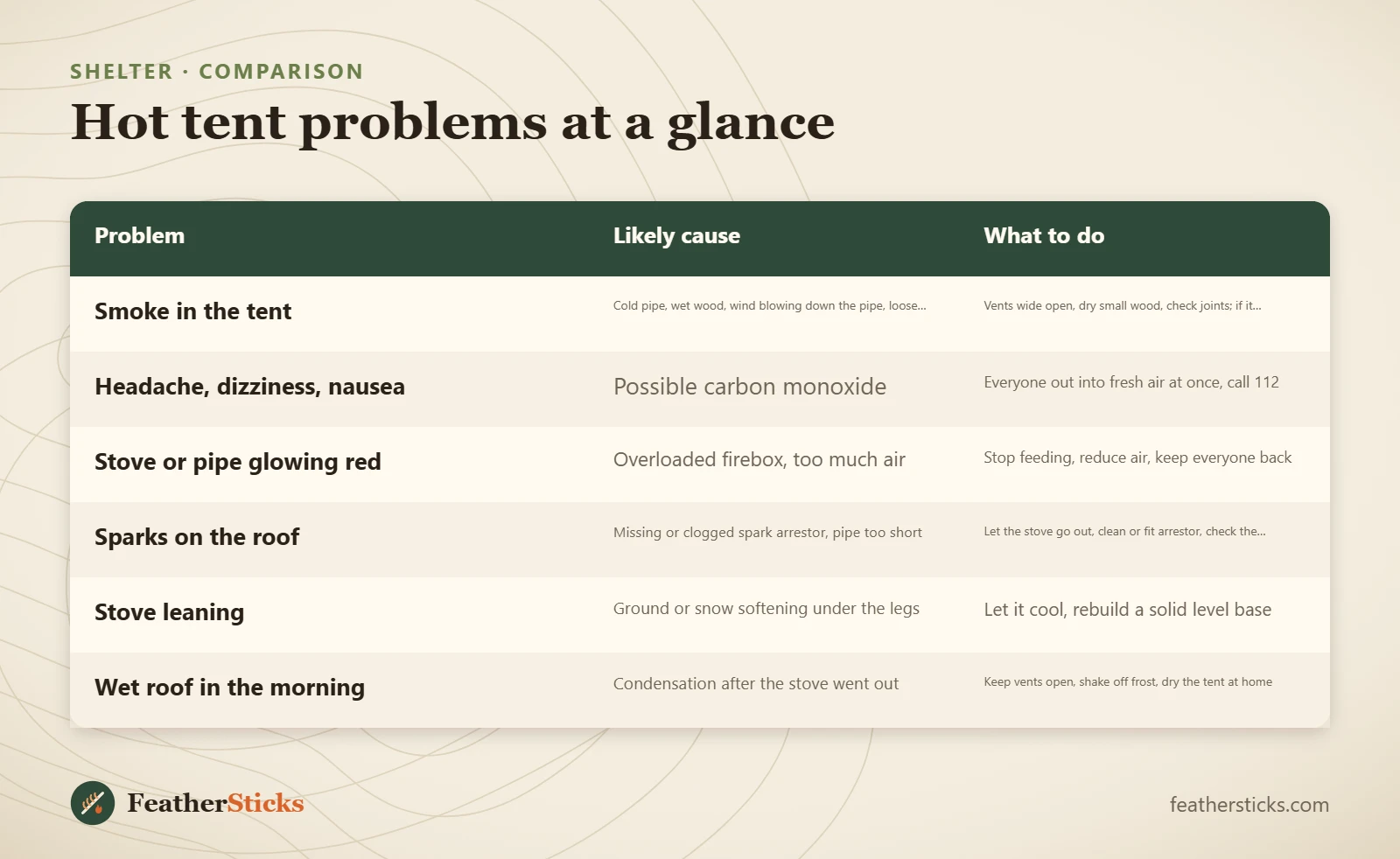
| Problem | Likely cause | What to do |
|---|---|---|
| Smoke in the tent | Cold pipe, wet wood, wind blowing down the pipe, loose joints | Vents wide open, dry small wood, check joints; if it persists, let the stove go out |
| Headache, dizziness, nausea | Possible carbon monoxide | Everyone out into fresh air at once, call 112 |
| Stove or pipe glowing red | Overloaded firebox, too much air | Stop feeding, reduce air, keep everyone back |
| Sparks on the roof | Missing or clogged spark arrestor, pipe too short | Let the stove go out, clean or fit arrestor, check the roof |
| Stove leaning | Ground or snow softening under the legs | Let it cool, rebuild a solid level base |
| Wet roof in the morning | Condensation after the stove went out | Keep vents open, shake off frost, dry the tent at home |
Common mistakes
- Putting any stove, grill, charcoal or embers into a normal tent.
- Closing all vents to keep the heat in.
- Going to sleep with the stove burning and nobody awake, or choking it down to smoulder overnight.
- Camping without a CO alarm, or with an untested one.
- Stove standing directly on a tent floor, dry grass or soft snow.
- Sleeping bags, clothes or gear inside the clearance zone, or clothes hung over the pipe.
- Ignoring a fire ban because "it is only a small stove".
What you need
- Hot tent with a stove jack, designed by its maker for stove use
- Tent stove with spark arrestor, air control and enough pipe sections
- Battery CO alarm with spare batteries
- Fire-resistant stove mat or solid, non-flammable base
- Pipe guylines and clamp, heat-resistant gloves
- Metal ash bucket with lid, small shovel, pipe brush
- Saw, axe or knife for processing dry firewood
- Fire blanket or water, first aid kit with burn dressings, head torch
FAQ
Can you put a wood stove in any tent?
Is it safe to sleep in a hot tent with the stove on?
Do I need a carbon monoxide alarm in a hot tent?
What are the signs of carbon monoxide poisoning in a tent?
How far should a tent stove be from the tent wall?
What is a stove jack?
What wood is best for a tent stove?
Is a hot tent allowed when there is a fire ban?
Check yourself
Completed6 quick questions from this guide. Nothing is sent anywhere.
Related step-by-step guides
-
 1
-
 1
-
 1